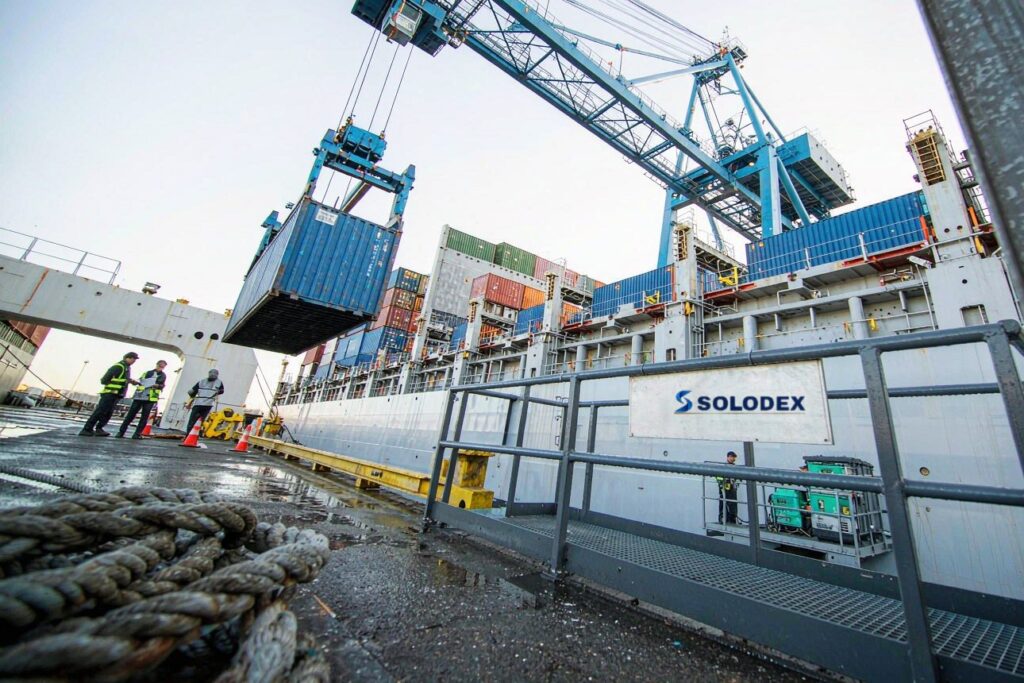
At call 04 of voyage 041W, the terminal’s discharge list carried a line for SXDU 204871-0. Six hours and ten minutes later, the load list for the very same call carried another line for SXDU 204871-0. Both rows named the same vessel, the same voyage number and the same call number. Neither row had been entered twice by mistake, and nobody raised a duplicate-number exception, because the two lines are the normal signature of one particular kind of move.
The box had come off the ship and gone back onto it. It was lifted from cell 12 04 82, set down in a temporary ground slot beside the crane rail, and loaded again into cell 14 06 84 on the same vessel before she sailed. The cartons inside did not leave the box, the seal was not cut, and the booking, the bill of lading, the port of discharge and the consignee were all exactly what they had been at the previous call. A container moved twice. A consignment moved not at all.
This page is about that difference and about the small set of records that can prove it. The numbers below are illustrative, chosen so the shape of the two lists is visible; the shape is what carries across vessels, trades and seasons. Only the movement of the goods is in scope here, not rates, claims or anything that happens after delivery.
One number, two lines
A port call produces two working lists. The discharge list is the crane’s order of work for boxes coming off; the load list is the order for boxes going on. Each row normally carries a vessel code, a voyage number, a call number, a container number, a move type, a time and a position. The position is a ground slot on the discharge side and a cell on the load side.
Both lists belong to one vessel call, not to a port in the abstract. A service rotation is a table of calls, each with its own voyage and call number, and the working lists hang off a single row of that table. That is why the two rows for SXDU 204871-0 can be compared at all: they share three identifying fields before the container number is even considered.
The move type is what separates a restow from an ordinary discharge. Terminals use different codes, but the shape is consistent: one code marks a box landed temporarily for the ship’s own convenience, another marks that same box returning to the same ship. On a public tracking page such codes are rarely surfaced. They are internal working instructions, in the same family as the crane split and the bay plan, and they appear in no commercial document a shipper is given at booking.
Nothing about the pair is confidential or unusual. A planner looking at call 04 sees 186 imports to land and 41 boxes above them that belong to later ports. Some of those 41 will be set ashore for a few hours and put back. The lists record both halves because the crane did two lifts and the ship’s plan changed twice. What the lists do not record is a second transport leg, because there was none.
What was moved, and what was not
Six identifiers stayed fixed across the pair of rows: the container number, the seal number, the booking reference, the bill of lading number, the port of discharge and the consignee. A seventh, the shipper’s declared description of the cartons, was not restated at all. There was no new booking, no new transport document and no new line on the manifest. Release arrangements concern who may take delivery under a document that already exists; here no such question arose, because the document had not changed.
Three identifiers did change. The cell in the stowage plan changed from 12 04 82 to 14 06 84. The box acquired a temporary ground slot and then lost it. And the plan itself acquired a new revision number, because the arrangement of boxes on board had been redrawn between the two lifts. Those three belong to the ship and the terminal, not to the cargo.
That is the whole asymmetry. A position on board is a property of the vessel for this voyage, assigned when the plan is drawn and reassigned when a call changes what has to be reachable. It is not a property of the goods. The stowage plan has columns calculated from the ship’s own geometry, including a vertical arm used in stability work; it also has a cell column, and that column is rewritten at a call without any reference to the shipper. Planning a load in the ordinary sense is work done against a description of goods, not against a slot on a particular hull.
It helps to be precise about what a repeated container number is not. Two packing lists under one container number is a question about paper describing goods. A delivery order or a release instruction is a question about who may collect them. A restow is neither: the same number appears twice because the same steel box was handled twice, and the second appearance adds no information about the contents.
Four ways a number can appear
If a container number turns up on two lists, four explanations are possible. They can be told apart with four columns, and only one of them produces the pair described above.
| Case | Discharge / load lists | Voyage and call | Manifest line |
|---|---|---|---|
| Import at this call | Discharge only | One | One, closed here |
| Export at this call | Load only | One | One, opened here |
| Transhipment | Discharge and load | Two different voyages | One per leg |
| Restow | Discharge and load | Same voyage, same call | One, unchanged |
The second and third columns do most of the work. A transhipment box really is discharged and really is loaded again, but the two rows sit on different voyages: the mainline vessel’s call and the onward vessel’s call. There is a connection to be made, a second booking leg and a second set of documents. A hub connection is a second chance for a box to miss a ship precisely because it introduces that second allocation. A rolled box, by contrast, is on the load list in principle and comes off it before sailing.
A restow has no second leg to miss. Its two rows share a voyage and a call, and the manifest line is neither opened nor closed: it simply continues. That is the signature. If you can read the vessel, voyage and call on both rows and find only one manifest line behind them, the number has been handled twice for the ship’s own convenience and the goods have kept the same transport identity throughout.
The fourth column is the one people reach for first and trust least. A manifest is a declaration of what is being carried and where it is to be delivered. It has no column for a temporary ground slot, and no reason to acquire one when a box comes back on board. Some cargo travels without a box number at all; a restow travels with exactly one box number, counted once, no matter how many lifts it takes.
Why a middle call does it
Call 04 was a middle call. The ship had loaded at two earlier ports and would call at three more. Her plan had been drawn to put the call 04 boxes where the crane could reach them, but a plan drawn at the first port is a compromise across six ports, and the boxes for later calls had to go somewhere. Some of them went on top.
When a box for this port sits under boxes for a later port, the upper ones have to be lifted before the lower one can come out. Most are simply set down elsewhere on deck and left there. Others are landed ashore for the duration of the call because there is no clear deck space within the crane’s reach, or because the hatch cover has to come off and the whole stack above it must be cleared. A restow like that uses crane time without producing a discharge, and that is exactly why it appears in the berth window as a job with no delivery attached to it.
The box in the example was an ordinary forty-foot dry container of cartoned spare parts. It was not a reefer, not dangerous goods and not out of gauge. That matters, because the reason for the move had nothing to do with what was inside. A temperature-controlled box carries its own instructions and its own readings, and it also needs a numbered outlet assigned to the cell it occupies; those are reasons for a planner to treat a box specially. Classification, dimensions and how the load is secured inside the box are further reasons. A restow is not one of them. It happens to a perfectly unremarkable dry box because of where that box was standing.
Nineteen of the 41 over-stowed boxes at call 04 were landed and reloaded; eight were shifted on board without going ashore; the rest were reached by working the crane in a different order. The split changes with the tide, the crane split and how full the yard is. What does not change is the paperwork: every box that came off and went back on produced a pair of rows tied to the same voyage and call.
The three files that know
Four records, held by three different offices, are enough to establish what happened. Each alone is ambiguous. Paired, they are conclusive.
| Record | Fields to read | What it establishes |
|---|---|---|
| Discharge list, call 04 | Vessel, voyage, call, container number, DISC-RESTOW code, time, temporary ground slot | The box came off this ship |
| Load list, same call | The same identifiers, LOAD-RESTOW code, time, new cell | It went back on the same ship |
| Stowage plan, before and after | Container number, old cell, new cell, revision and timestamp | Its position changed |
| Manifest, before and after | Container number, port of discharge, one line | The goods gained no second leg |
Read the first two together and the voyage and call match. Read the third and you can see which cell the box lost and which one it gained. Read the fourth and you can see that the cargo’s destination is the same line it always was. There is no fifth record to hunt for: an interval such as port dwell days is assembled later from event rows in a report, whereas these four records are the primary entries written by the people doing the work.
The stowage plan deserves a note, because it is not one document but a versioned one. Weight and measurement can be recorded in more than one way depending on which basis is used, but a plan revision is simpler: it is the same table with a later timestamp and a different cell against one container number. If the box were powered, the socket assignment sheet would need the same kind of revision, since a new cell can belong to a different circuit. For a dry box there is no second sheet to update.
None of this is visible from a booking confirmation. A booking window describes when a booking can be made against a sailing, and choosing between a small consignment and a full container decides what occupies a cell. Neither document has a column for a mid-voyage change of cell, because from the cargo’s point of view there is nothing to report.
The four articles next door
Four earlier pages touch this move from four different directions, and it is worth saying exactly where they stop.
One ETA, Twelve Discharge Times mentions a restow as a job that consumes crane time without producing a discharge, in order to explain why twelve boxes on one bill come off across a whole shift. Its subject is the sequence of discharge at a berth window. One Yard, Two Stack Positions describes a rehandle as a real move logged with an operator, a machine, a time and a pair of coordinates, in order to explain why a released box is not always a reachable one. Its subject is the yard’s bay, row and tier, not the ship’s cell. One Service, Eleven Port Calls establishes that the call number, the load list and the discharge list belong to operational systems rather than to the contract of carriage. This page takes that call number as a given and uses it as a discriminating field. Rolled Cargo explains a box that never made the load list and a connection that introduces a second voyage. A restow is the case that is neither: it is on both lists, on one voyage.
The three earlier pages in this batch take other objects. The first is about the moment column, where a weight is multiplied by a vertical arm. The second is about three different things that can be called a temperature. The third is about two inventories that a powered box must occupy at once. This one is about a single container number appearing twice in one call. It does not restate the idea that a plan is not a record, and it does not treat an interval as something assembled in a report; the four fields above are written down as the work happens.
That boundary also keeps the subject where it belongs. How the goods are packed, how many shippers share a box and who controls capacity on an aircraft are all questions about what a consignment is and who may move it. A restow answers a narrower question: which row of which list records a lift that changed nothing about the consignment.
A discharge with no delivery
Most tracking pages show nothing at all for a restow, and that is reasonable: the shipment’s status has not changed. A few systems do push a discharge event, because the terminal sent one, and a consignee who sees the word discharged may reasonably assume the box is at his port. It is not. It is back on the same ship in a different cell, several calls away.
The same asymmetry shows up in statistics. A port counts crane moves, and a restow produces two of them for a box that never entered or left its trade. A carrier counts transported containers, and that box is still one unit on one manifest line. The steps that follow a genuine discharge – grounding, release, appointment, collection – simply do not start here. Transit time estimates move for reasons outside the cargo, but a restow is not one of those reasons; it is already inside the berth window that was planned for the call.
There is a practical way to read such a page. Terminal charges are attached to services performed on a box, and a temporary landing for the ship’s convenience is not a service the cargo owner ordered. A diversion changes the route; a restow changes only a cell. So the useful question is not “was my container discharged” but “on which voyage and which call was it loaded again”. If the answer is the same voyage and the same call, the goods never left the ship in any sense that the transport documents recognise.
This is also why the equipment history of a container and the transport history of a consignment are different records. The box acquires two crane moves and a new cell. The consignment acquires neither. Both statements are complete, and neither needs the other to be corrected.
The four-column check
When a tracking event or a terminal report suggests that a box came off a ship at an intermediate port, four short checks settle what actually happened.
- Ask for the discharge list row and the load list row for the container number, and read the vessel, voyage and call on both. Matching identifiers on both rows mean one ship, one call.
- Read the move type codes. A temporary landing and a return to the same ship are labelled as such in the terminal’s own working lists, even when the codes differ from one port to another.
- Ask for the before and after stowage plan revisions, then check the manifest. One unchanged manifest line behind two plan revisions is the whole of a restow.
With those four columns in hand, the opening pair of rows reads differently. SXDU 204871-0 was not entered twice, was not delivered at call 04 and was not put on a second vessel. It was lifted twice so that other boxes could be reached, and it went back onto the same ship in a different cell. The goods kept one line; the box kept one number; the working lists kept two rows. That is what a move looks like when nothing about the consignment has moved at all.
When only part of a consignment has left, the remaining cartons may be moved within the station; that decision follows restow with two lists and one call.


