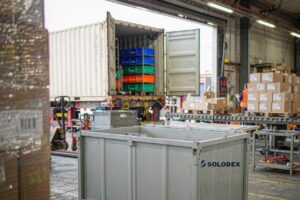
The container was opened at the destination with sixty-two cartons inside. The officer had two packing lists in his hand. One described thirty-eight cartons of LED luminaires from a factory in one province; the other described twenty-four cartons of vehicle spare parts from a different supplier. Both lists were signed, both matched their invoices, and both matched their declarations. Neither had a line that was wrong.
He asked for the list for the container. There was not one. The two shippers had never met, and neither of them had any reason to describe the other’s goods. For the whole voyage those sixty-two cartons had travelled inside one sealed steel box, while the only documents that said what was in it sat on two different desks, each one complete and each one covering only half.
Sixty-two cartons, two desks
Shipper A booked thirty-eight cartons. Shipper B booked twenty-four. A freight forwarder put them on the same sailing because the volumes fitted, and gave both parties the same container number. That number went into two booking confirmations. It did not go into either packing list.
Each shipment acquired its own set of papers: an invoice, a declaration, a house bill of lading, a packing list. The boundary of every one of those documents is the consignment, not the box. That is not a convention anyone chose for this shipment. It is how the documents are defined.
There is an earlier piece about five factories delivering to one doorstep, and it describes the opposite situation. There, one buyer deliberately turns five purchases into one shipment: one exporter of record, one declaration, one invoice that reconciles five purchase orders, and a packing list whose rows carry PO numbers so that one arrival can be received as five. That is an act of merging, and it produces a sheet whose boundary really does cover the whole load. Its closing line is that one doorstep is not a distance, it is a document.
In this container there is no common buyer, no common declarant and no one with the authority to merge the two lists. The door exists. The document does not.
The unit that has no sheet
Here is the distinction that decides most of what follows. A container is a physical unit: it is what is lifted, weighed, stowed, sealed and opened. A packing list is a legal unit: it is what is declared, classified, valued, examined and released. The two boundaries almost never coincide, and nothing in the system requires them to.
So the field to check is not a value on any one form. It is a count: how many packing lists belong to one container number. If the answer is two, the next question is which of the two describes the whole container. The honest answer is neither, and there is no third one.
Two pieces in this series ask earlier questions about the same sheet. One asks how many rows exist, because a row is the smallest legal unit. Another asks when the sheet became true, because a plan printed before loading is not a record of loading. This one asks where the sheet stops. A document can have forty honest rows, be issued at exactly the right moment, and still stop one boundary short of the box that carried it.
Where the container number lives
The container number does appear in plenty of places: the booking confirmation, the equipment interchange receipt, the seal record, the verified gross mass declaration, the manifest, the carriage document. All of those are documents about the state of a unit of equipment. They say that a particular sealed box weighing so many tonnes was received, loaded and carried.
The packing list carries different facts: marks, carton numbers, descriptions, quantities, net and gross weights per line. Those are facts about a consignment. The two sets of facts are rarely printed on the same page, and when a number is copied from one to the other it is copied as a reference, not as an assertion that the page describes the box.
Read the two kinds of sentence side by side. One says there is a sealed steel box of a certain weight. The other says shipper A has thirty-eight cartons of luminaires. No sentence anywhere says what is in the box.
Four documents, four boundaries
| Document | What it describes | What it cannot describe | Who is asked about it |
|---|---|---|---|
| Shipper A’s packing list | 38 cartons, one consignment | The other 24 cartons, or the container as a whole | Shipper A |
| Shipper B’s packing list | 24 cartons, one consignment | The other 38 cartons, or the container as a whole | Shipper B |
| Bill of lading and manifest | Two consignments carried in one unit of equipment | What is inside any individual carton | The carrier and the forwarder |
| Seal record and equipment receipt | A container, its number, its seal, its gross mass | Anything about the goods beyond their mass | The terminal and the carrier |
Read down the third column. Every document is silent about the same thing. None of them is incomplete by its own definition; each is a finished answer to a different question.
A tree in the air, a box on the water
Air freight offers a useful comparison. Under a master air waybill there are house waybills, one per consignment, and the master document does have the whole consignment as its boundary. Those two documents are two different contracts with two different parties, which is its own complication, but at least a document exists at the level of the whole uplift.
A shared sea container has no equivalent. There is no “container packing list” with a recognised name, a standard form and a signatory. A house bill of lading is issued per consignment; a master bill, if the forwarder issues one, is a document about carriage, not an inventory of cartons. The physical collection simply has no paper layer.
That difference is structural, not a gap somebody forgot to close. Air cargo is built up into a unit that a carrier issues a document for. A sea container is a piece of equipment that several independent consignments happen to occupy.
The gap nobody owns
It would be convenient if this were a clerical omission. It is not. Customs requires a declaration per consignment. The carrier is responsible for the safe carriage of the container. The forwarder’s contract is with each shipper separately. The terminal receives and releases equipment by container number. Every party is doing exactly what its own documents ask of it.
That is why the missing sheet has no owner. Nobody is paid to produce it, no authority asks to see it, and no system has a field for it. The more correctly each party performs its own role, the less likely it is that anyone will improvise an extra list at the door.
There is a piece on how to plan a container load – axle weight, stacking limits, securing the last rows against the door – and it does produce a load plan. But that plan exists to decide how the cartons will be arranged before loading. It is an operating tool, not a document that travels with the goods and is read by an authority at the other end. A plan of the load is not a description of the load.
What an examination counts
An examination opens a container. The seal is checked, the door is opened, cartons are pulled out. The physical act is performed on the equipment. The paperwork that follows is performed per consignment: a query, a request for documents, a release, a hold.
This is the mechanism behind an inconvenience that is usually listed as a single line in a pricing comparison. Choosing consolidated shipping carries a risk of another shipper’s inspection affecting your cargo, and that risk is not a matter of bad luck. Because no document can split the container back into consignments at the door, a problem found in one shipment stops the equipment that holds both; and because no document can add the consignments back up into the container, the other shipper cannot produce a sheet that would get its own cartons released independently.
Consider one unmarked carton. A’s list accounts for thirty-eight cartons and B’s for twenty-four. Both lists are correct, and there are sixty-three cartons in the box. A can show that every carton on A’s list is present. B can do the same. Neither can show that the extra carton is not theirs, because neither list was ever a statement about the box. The question “whose is this” has no document to be answered from.
Four ways a container and its lists can line up
| Situation | Container numbers | Packing lists | Does any list cover the container? | Where the gap lands |
|---|---|---|---|---|
| One shipper, full container | 1 | 1 | Yes, by coincidence of boundaries | Nowhere; this is the case everyone assumes |
| One buyer, five factories merged | 1 | 1 merged list with PO rows | Yes, because somebody merged them | The merging work, and the exporter of record |
| Two unrelated shippers, one container | 1 | 2 | No | Examination, holds, and anything unmarked |
| One shipment split across two containers | 2 | 1 | No; the list covers both and describes neither box | Which cartons went in which box |
The first row is the only one in which the two units coincide, and it is the row that templates, checklists and most training material are written for. The fourth row is the same problem turned around: the consignment is now larger than the equipment, and a single list cannot say which half travelled in which box.
So the useful question is never “are the documents complete”. Each one is. It is whether any document has the same boundary as the thing that was actually sealed.
The door with two sheets
For three weeks sixty-two cartons occupied one steel box. They were weighed together, stowed together, sealed together and opened together. No sheet of paper ever described them together.
The rest of this series argues that paper does not record cargo but stands in for it: the rulebook never sees the warehouse, only the lines on the form. A shared container is the harder version of that. Here the physical unit has no stand-in at all. The cargo has one body and two documents, and the body is the part nobody wrote down.
Two complete packing lists arrived with that container. The container itself arrived with none.
A shared container has no sheet at its own level; each of the sheets it does have is spoken by a named party, not by the box.
A shared container has no sheet at its own level; even a sheet that does exist has no single reader.
One container number can appear on two packing lists on the same sailing; one tank number can appear on four bills of lading across fourteen months.
The container number appears on the booking confirmation, the equipment interchange receipt, the seal record and the manifest; the earliest of those records is an empty release that names equipment and no goods at all.
Two packing lists under one container number are two descriptions of what is inside a box; a single container number appearing twice in one call is two records of where the box itself was lifted, on the same voyage and against one unchanged manifest line.