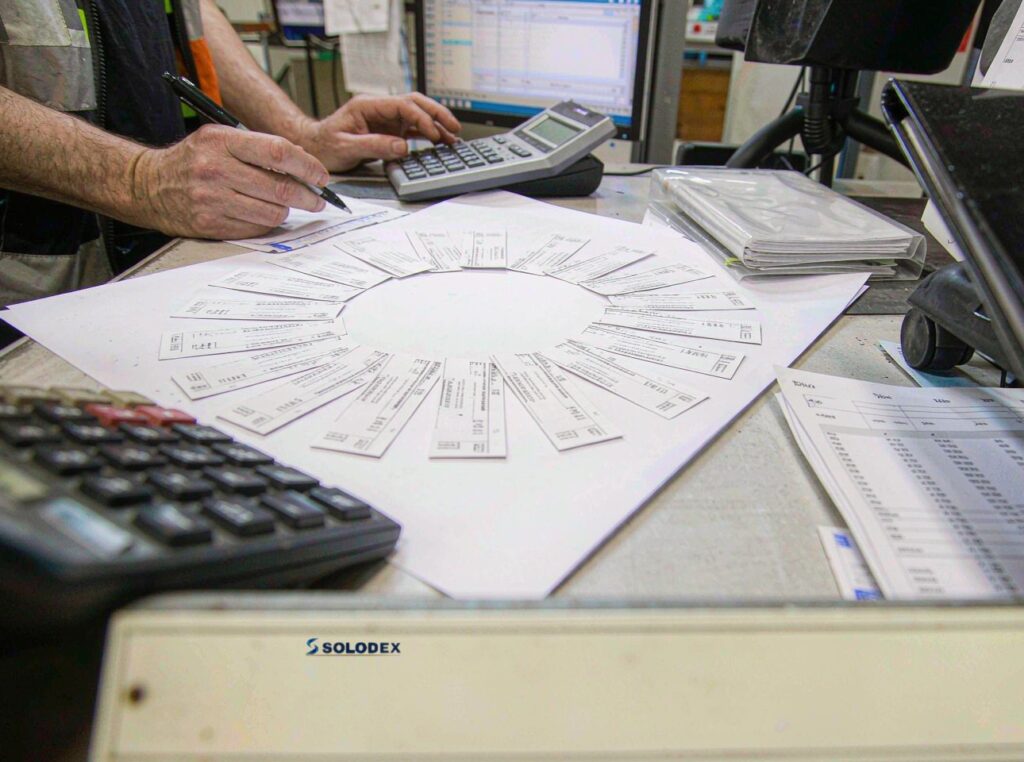
The invoice arrived as one number: a single stripping charge for the container. Then it was divided into twelve, and the arguments began. The consignee with three pallets of dense machinery parts said the split should follow weight. The consignee with twenty cartons of light textiles said it should follow cartons. The station, which had actually done the work, had already chosen a unit and posted the shares. Nobody had asked any of them, because the choice had been made in the rate card months before the ship sailed.
Devanning is one physical operation on one box. It is paid for by many consignees through many house bills. The fee is incurred on the container and recovered from the consignments, and the unit used for that recovery silently moves money between them. Split by piece, by cubic metre, by house bill or by a minimum charge, and the same box produces four different bills for the same twelve people.
Why One Service Has Many Payers
The asymmetry starts with what the station actually does. It opens one door, unloads one container, sorts the contents into blocks and reconciles them against one manifest. The crew does not work twelve times; it works once on a mixed pile that happens to belong to twelve parties.
But the station cannot invoice the container. In a consolidation there is no single consignee for that box — the carrier’s customer is the consolidator, and the twelve receivers hold house bills, not relationships with the warehouse. So the station recovers the cost per consignment: one line on each delivery-order statement, twelve lines that add back up to the stripping invoice. The seven kinds of money on one page shows where the CFS line sits; this article opens that line and asks how it is divided.
The same structure appears upstream. A freight quote is built from a handful of charges that later appear in many invoices; the way they grow is covered in six ways a quote grows legs. Downstream, the split is where an agreed total turns into twelve disputed shares.
Four Units, Four Different Bills
There is no natural unit for dividing a stripping charge. Each candidate unit is defensible and each produces a different answer, which is why the choice must be made in the rate card rather than at the counter.
| Unit | How the share is set | Who tends to pay more | Where it is fair |
|---|---|---|---|
| Per piece | One rate × cartons handled | Consignments with many small cartons | Mixed cartons of similar size |
| Per cubic metre | Rate × volume on the manifest | Light, bulky goods | Volume-driven stowage |
| Per house bill | Flat share, one per consignee | Small consignments | Similar-sized shipments |
| Minimum charge | Floor per house bill or per job | Tiny consignments | Covering fixed desk work |
Note what is missing: weight. A stripping crew handles cartons and volume, not tonnes. A pallet of dense machinery takes the same forklift movement as a pallet of foam, so a weight-based split is almost never used for devanning — even though customers, trained on freight by weight, keep asking for it. The volumetric weight article explains why carriers charge on space; the same logic applies to the handling of the box, one step later.
The per-piece and per-cubic-metre columns are mirror images. A consignee shipping twenty small cartons pays most under a piece split; a consignee shipping three oversized crates pays most under a volume split. Neither is being overcharged in an accounting sense — the rate card simply picked which physical property to count.
The Minimum Charge Eats the Small Consignment
The harshest unit is not the rate but the floor. Most freight-station tariffs carry a minimum charge per house bill or per handling job, because issuing a delivery order, checking a carton and opening a file cost money regardless of how much cargo moved.
For a consignee with two cartons, that minimum can exceed the entire per-piece share several times over. The customer sees a handling line that looks unrelated to the size of the goods and assumes an error. It is not an error; it is the fixed cost of the counter being charged to the smallest user, the same mechanism behind the first kilogram costing the most in parcel tariffs.
A minimum also changes behaviour. Some consolidators merge tiny house bills at the destination to avoid paying five floors for five cartons, which then creates a new paperwork problem at the collection desk. Others quote an all-in LCL price precisely so the customer never sees the floor — the practice dissected in the hidden-fee checklist.
Who Chose the Unit, and When
The split is not decided at the freight station on the day of the strip. It was decided when the consolidator built the destination tariff, usually months before the vessel sailed, and printed in a rate card that most consignees never see. The station simply applies it.
This matters for disputes. A customer who complains to the counter is complaining to a party that did not set the rule and cannot change it. The negotiating point is the original quote, where the charge should have appeared as a defined line with a stated unit — the discipline recommended in reading a freight quote. Once the box is open, the only question left is whether the unit was applied correctly to the manifest figures, not whether it was the right unit.
There is one exception. Where the consignee ordered a dedicated strip rather than the standard consolidated one (the right is described in who opens the box decides the clock), the billing can be negotiated as a single job with the requesting party. In that case there are not twelve payers, and the asymmetry this article describes disappears — at the price of a separate strip.
Why the Station Cannot Invoice the Box
It looks simple to charge once for the stripping work and be done with it. The station cannot, and the reason is not administrative laziness — it is who owes the money. The carrier’s contract for the box runs to the consolidator, and in most destination arrangements the consolidator has already collected the freight and the destination charges from its twelve customers. The station’s invoice goes to the consolidator’s agent, who then recovers it from the house bills. One payer becomes twelve debtors at the point of recovery, not at the point of work.
This is why a consignee’s complaint about the split is answered by the consolidator, not the warehouse. The warehouse charged one line to one account; the division into twelve happened in the consolidator’s tariff. The customer arguing at the counter is therefore two steps away from the party that chose the unit — a structure the two paperwork layers in one bill in, many bills out make easier to understand.
The same separation explains why a “pay the stripping charge yourself” arrangement rarely helps. A consignee can settle its own share early to speed collection, but it cannot replace the station’s single invoice with twelve direct ones. The station would have to run twelve credit accounts for a job it performed once, and no tariff is built for that.
A Worked Split of One Invoice
Take the twelve-consignments box from the earlier articles. The station’s stripping invoice is a single figure. The table below shows how four different units distribute it; the numbers are illustrative but the direction is the real point.
| Consignment | Cartons | CBM | Per-piece share | Per-CBM share |
|---|---|---|---|---|
| Machinery parts | 3 | 1.2 | Low | Mid |
| Textiles | 20 | 2.0 | High | High |
| Samples | 4 | 0.4 | Low | Low |
| Six mixed small bills | 2 each | 0.3 each | Mid + minimum | Mid + minimum |
| Two oversized crates | 2 | 6.0 | Low | Very high |
The textiles move from “expensive” to “most expensive” in both systems because they are many and large. The crates flip from the cheapest share under a piece split to the most expensive under a volume split. The same work, the same invoice, and two consignees exchange places in the pecking order without a single rate changing.
Under a flat per-house-bill split, all twelve pay the same and the small bills silently subsidise the big ones — or are rescued by the minimum, depending on which way the tariff leans. This is the mirror of the way a shared box gives every consignment a position but not an equal one, described in a shared container is not a shared shipment.
What to Put in the Rate Card
The only durable fix is to define the split before the cargo exists. A destination handling line that says only “CFS charge” invites the argument above; the same line with a unit and a floor does not. Four fields are enough, and all four belong in the booking confirmation rather than in a later invoice.
The unit — per piece, per cubic metre or per house bill — stated in words, not inferred from the rate. A rate without a unit is a promise that can be reinterpreted at the counter.
The source of the figures — the deconsolidation manifest, not an estimate made at the delivery desk. This ties the share to a document both sides can inspect and keeps a disputed carton count from becoming a disputed invoice.
The minimum — the floor per house bill, with the threshold that triggers it. Small consignments then know they are paying fixed counter costs, not a penalty.
The exception — what happens when a consignee orders a separate strip. If that customer pays for a dedicated job, the shared-box split should not apply to its goods at all. Without this line, a customer who paid for priority still receives a share of the standard job.
These four fields turn a silent transfer between consignments into a visible term. They are the destination-side counterpart of the quote discipline in reading a freight quote, and they matter more in a consolidation than in a full container because the number of payers multiplies the chance that somebody will check.
What the Consignee Can Verify
The customer cannot choose the unit after the fact, but it can check that the chosen unit was applied honestly. Three fields are enough.
The unit stated in the original quote. If the destination handling line says “per CBM” or “per house bill”, the split should follow that and nothing else. A station applying a per-piece rate to a per-CBM quote is an error worth raising.
The figures on the deconsolidation manifest. Piece counts and volumes for each consignment come from the manifest, not from the delivery-order clerk’s estimate. A miscounted carton changes the share; the correction path is the one used for manifest key fields.
Whether a minimum was applied to each small bill. This should be on the rate card. Where it is not, the smallest consignments are paying an invisible surcharge that the larger ones never see.
These are the same three questions that settle any freight invoice — what unit, what figures, what floor — asked of a line that happens to be split twelve ways. The fuller invoice method is in reading a freight quote.
When the Bill Is Wrong in a Way That Costs Goods
An unpaid share can stop a consignment at the delivery-order desk, which turns an accounting dispute into a physical delay. The station is not being difficult: it has one invoice to recover and twelve debtors, and it releases cartons only as the shares settle.
The common pattern is a small consignee refusing a handling line it considers absurd, holding up three cartons while the other eleven are collected. The cartons accrue storage at the station on that consignment’s own clock, while the dispute over the unit continues. The wait charges that then attach are set out in who pays for the wait, and they follow the consignment, not the box.
Where the disagreement is about damage during the strip rather than the price of it, the remedy belongs to a different process — claiming for damaged cargo. Mixing the two arguments is the fastest way to lose both. A bill dispute is about the unit; a damage claim is about the condition of the carton when it came out.
The Sentence That Ends the Argument
Everything above compresses into one line: one box is stripped once, but the bill is rebuilt from the consignments, and the unit chosen for that rebuild decides who pays for whose cartons. The work is shared; the invoice is not. It is divided by a rule written before the cargo existed.
M1 showed the box and the consignments on different lists. M2 showed the strip is an ordered service. M3 showed the two paperwork layers with two release points. This piece shows the money at the hinge: a single handling charge recovered twelve times, with a silent transfer between consignments every time the unit changes. The last piece in the chain asks what happens when one of those consignments is collected in several goes rather than one.
Related reading: the charge catalogue is in port and terminal charges; the box-versus-consignment economics are in small batches or container loads; who ordered the strip is in who opens the box decides the clock; the two paperwork layers are in one bill in, many bills out; the box-level release is in the box clears, the consignments do not; the shared-box position is in a shared container is not a shared shipment; space-based charging is in volumetric weight and the box as the freight unit; the first-kilogram floor is in why the first kilogram costs the most; the hidden destination lines are in the hidden-fee checklist; quote growth is in why a shipping quote doubles; wait charges are in who pays for the wait; and damage disputes are in claiming for damaged cargo.
A later sailing shifts the whole handling schedule, which is why the stripping charge is quoted against a window rather than a single date; see the stripping bill split by piece.


