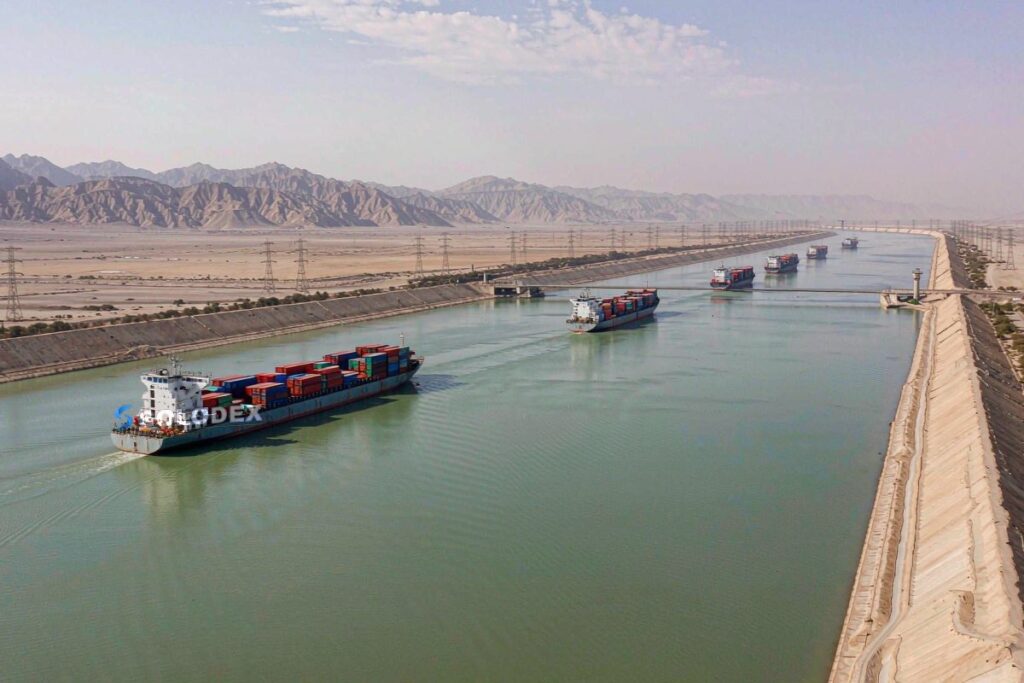
A saving of forty-three dollars per box
Here is a number that makes no sense until you understand what shipping lines actually sell. Routing a 24,000 TEU vessel through Suez instead of around the Cape of Good Hope saves its operator roughly one million dollars on a round voyage. Divide that by the slots on board and the saving is about 43 dollars per container.
Forty-three dollars is not a reason to reorganise a network. It is less than the documentation fee on the same box. And yet between May and October 2026 more than 140 containerships with over two million TEU of capacity moved from the Cape route back to Suez, and by early October the share of global capacity still going around Africa had fallen to about 4.6 per cent.
The explanation is not the freight saving. It is the calendar — and the calendar is precisely why a transit time quoted to you in June can be wrong in October without a single word of the routing having changed on paper.
What the canal actually gives back
The arithmetic of the two routings, for Asia to North Europe — the lane described in the EU import rules — is unusually well documented. A round voyage via Suez covers about 21,878 nautical miles; via the Cape, 29,711. That is 7,833 miles and about 27 days of round-voyage time — 97 days instead of 124.
Operating cost falls from roughly 18 million dollars to 17 million, a saving of about 6 per cent. That is the whole of the direct benefit, and it is exactly the kind of margin that disappears the moment insurance moves.
Because insurance is where this decision is really made. A war-risk premium of 0.3 per cent of hull value on a 225-million-dollar ship adds about 1.35 million dollars for two transits through the designated area. At 1 per cent it adds 4.5 million — several times the voyage saving. Canal discounts partly offset it: a 15 per cent reduction in canal fees is worth about 365,000 dollars across two transits, 25 per cent about 600,000. Which means the choice between routes is not an arithmetic question about fuel and distance. It is a bet on a security assessment, repriced every few weeks.
So why come back at all
Because a ship is a fixed cost that must keep earning, and 27 days is a quarter of a round voyage.
A carrier does not sell tonnage, it sells sailings: a weekly service on a given lane requires a fixed number of vessels, and that number is set by the round-voyage time divided by seven. Cut 27 days from the loop and the same fleet can maintain the same frequency with fewer ships, or increase frequency with the same ships. Either way, effective capacity is released without anyone ordering a new vessel.
That is the real return. The Premier Alliance’s FE1 loop, for instance, drops from a 13-week round voyage to 11 weeks; its IOX service goes from 13 to 10. Read as capacity, a 13-week loop becoming an 11-week loop is roughly a 15 per cent increase in what that service can carry per year — from the same hulls, with no ships added.
For a shipper, this cuts both ways. Released capacity presses on rates, which is good. But it also means the schedule you booked against is a moving target: the same named service can change routing, port rotation and transit time inside a single quarter, and the change is announced by the carrier, not negotiated with you.
The 44 per cent that sailed dark first
One detail from September explains why a forwarder’s answer changes before any public announcement does. Lloyd’s List Intelligence counted 314 containership crossings of the Bab el-Mandeb that month — up 14.6 per cent on August and 64.4 per cent on September 2025, the highest monthly total since the diversions began. Of those, 139 crossings, or 44.3 per cent, were made with AIS transponders switched off, and 108 of those dark crossings involved ships of 7,000 TEU or more.
Carriers were testing the corridor quietly before putting their names on a customer advisory. By the time a routing change reaches a rate sheet, the operational decision is already weeks old. That is the practical lesson for anyone planning around transit times: public announcements are a lagging indicator, and the market’s real position is visible first in vessel movements, insurance pricing and canal transit counts.
The bottleneck that never moved
There is a second reason a “Suez is back” headline misleads. Not every route that appears to pass through the Red Sea issue is fixed by the canal, because the canal is not the only chokepoint on the way.
The Strait of Hormuz has been effectively closed to commercial container traffic since February 2026. In late September, commercial containership transits through the strait were running at a handful per week — one widely cited count logged a single commercial transit on 20 September, against a pre-crisis norm of roughly 85 vessels a day.
So a shipper sending goods to Jebel Ali, Dammam, Doha or Kuwait is quoted a rate and a transit time that reflect a closure, not a diversion. Their cargo may pass the same water the Asia–Europe ships now use and still sit for weeks, because the delay is downstream of the canal. Any general statement about “Red Sea recovery” is therefore route-specific, and the specific route is the only one that matters to your shipment.
The congestion that was never about the canal
The third variable has nothing to do with either chokepoint, and it is currently the largest single source of schedule noise in Asia.
Roughly 8.5 per cent of the global container fleet is tied up in delays — about three million TEU of capacity effectively removed from the market, more than the entire fleet of all but four of the world’s largest carriers. Much of it accumulated from weather: backlogs that began with a typhoon in August and compounded with another in September cascaded through transhipment hubs, and transhipment congestion is the kind that does not clear quickly, because every delayed connection delays the next one. Colombo became a hotspot as India–US volumes piled into it.
This is why a sailing can be on time and the cargo still late. Port-to-port transit may be exactly as scheduled while the container waits eleven days at a transhipment hub for a connection, which is one of the costs that consolidation trades away for its cheaper rate — a delay that appears nowhere in the carrier’s schedule and everywhere in the receiver’s inbox. The mechanics of that kind of wait, and who pays for it, belong to a later piece in this series.
Four kinds of late, and how to tell them apart
Everything above resolves into a small number of failure modes, and each one looks different from the shipper’s side. Naming the mode is most of the diagnosis, because the fix and the responsible party differ for each.
| What slows it | What you see | Days added | Who decides |
|---|---|---|---|
| Routing change (Cape instead of Suez) | Same service name, whole schedule shifts; no incident to point at | 20–27 on a round voyage | Carrier, on security and insurance advice |
| Chokepoint closure downstream | Vessel loads normally, then waits; cargo sits short of destination | 2–4 weeks | Geopolitics, not the carrier |
| Transhipment hub congestion | Port-to-port leg on time, but the connection is missed | 5–14 | Terminal and hub operator |
| Weather backlog at origin | Queue at the load port before you have shipped anything | 3–10 | Nobody; it clears or it does not |
| Incomplete documentation | Arrives, discharges, does not move | 1–5, plus storage | Shipper |
The table is also a diagnostic sequence. If the delay appears before departure, it is weather or booking. If it appears mid-voyage with the vessel moving, it is routing. If the vessel is stationary short of destination, it is a chokepoint. If the vessel arrived on schedule and the container did not move, it is the hub or the paperwork — and only the last of those is yours to fix.
Reading a quote in this market
Given all of the above, a transit time on a quotation is not a specification. It is a statement about a route, taken at a moment, under an assumption about congestion. Three questions turn it into something usable.
- Which routing, this month? Cape or Suez, and on which named service. The answer changes the number by three to four weeks on Asia–Europe.
- Which bottleneck applies to my destination? A Gulf consignment and a Rotterdam consignment leaving the same terminal on the same day are exposed to different closures.
- What is the current wait at the intermediate hub? If the service tranships, the connection time matters more than the ocean leg. A forwarder who cannot answer this is quoting a schedule, not a shipment.
Then subtract the parts that are not transit at all. The door-to-door figure is transit plus clearance plus delivery, and in the fourth quarter it also includes the queue at the destination, as set out in why a November order misses Christmas. A quote that says “32 days port to port” is answering a narrower question than the one a seller is asking.
Four rules that survive a moving market
None of this is forecastable, which is exactly why the discipline has to be procedural rather than predictive.
Quote a range, and put the assumption in writing. “28–38 days via Suez, assuming no diversion and normal congestion at the hub” is a professional statement. “30 days” is a guess wearing a number.
Ask for the sailing date, not the transit time. Transit is measured from departure. A booking made today on a vessel that loads in twelve days has already lost twelve days, and nobody will mention it.
Watch the inputs, not the announcements. Canal transit counts, war-risk premium movements and hub dwell times move before the advisory does. Between the dark crossings of September and the service changes of October there was a month of visible evidence, and it was all in operational data.
Keep one route assumption per shipment. The most expensive planning error in a market like this is a document that says “via Suez” and an invoice that says otherwise — because the difference is not a line item, it is three weeks of inventory that nobody budgeted for. The cost layers that go with that are set out in how shipping cost is calculated.
Transit times are not a property of a lane. They are a property of the month. Treating them as fixed is not optimism — it is a planning assumption that the world has spent three years disproving.
A named service can change routing, port rotation and transit time; even with the rotation unchanged, one port name on that rotation can stand for two different visits with opposite working directions.
Schedules move for reasons outside the cargo itself; a change of vessel or of sailing leaves the container number intact but sends the planner back to the socket assignment sheet for a fresh pairing.


