Six forty-foot reefers were confirmed for a Tuesday sailing. On Thursday the terminal returned four socket numbers and a note that the other two boxes would travel on the next vessel. The stowage plan for the same sailing still showed thirty-four cells with no container number against them. Nobody had moved a box, no cargo had changed, and no booking had been cancelled. What had run out was not space in the ordinary sense of the word.
The two answers came from two different lists. One list belongs to the geometry of the ship: bays, rows and tiers, each of them a place where a steel box can be landed, stacked and secured. The other belongs to the electrical system: numbered outlets, grouped into circuits, fed from a distribution board, with a rated load that was settled when the vessel was built. A reefer needs an entry in both. A dry box needs only the first. That second entry is the subject of this page.
It is easy to overlook, because both lists carry container numbers and both are printed before sailing. What follows is an account of how a box acquires the second entry, why that entry can never be worked out from the first, and which documents hold the evidence. The numbers below are illustrative, chosen to make the shape of the two lists visible; the shape itself is what carries across vessels, trades and seasons. No rates, claims or after-sales arrangements are involved here, only how the cargo is received by the ship.
Two inventories
The stowage plan is an inventory of places. Every line is keyed to a cell, written as a bay, a row and a tier, and the stock it counts is cells. A forty-foot box occupies a forty-foot cell, an empty one is a cell with no container number, and the remainder at the bottom of the sheet is a count of such cells. The plan belongs to the ship rather than to any shipment: it is redrawn at every call as boxes come off and others go on. Planning a load in the ordinary sense is work done against this inventory, and the yard keeps its own version of the same coordinates while the box is ashore.
The second inventory is keyed to a socket ID. The stock it counts is outlets, not cells. Each outlet has an identifier, a circuit, a board, a rated load and, when it is in use, a container number written against it. It exists with or without a box plugged into it. It is part of the vessel’s equipment, in the same family as a lashing bridge or a hatch cover, and it stays on board after the cargo has gone.
Because the units differ, the two inventories cannot be subtracted from one another or converted into one another. Thirty-four empty cells and five unassigned socket IDs are not two estimates of a single remainder. They are the remainders of two different stocks, held in two different sheets, maintained by two different pieces of work. A planner who reads them as one column will promise a place on board that the ship cannot supply.
There is a useful comparison here. The stowage plan has a column that is calculated rather than observed, because a cell also carries a vertical arm used in the ship’s stability arithmetic. That column is a property of a place on this particular vessel. It is still a column about a place. Neither it nor any other column on the plan says where the electricity comes from.
The number on the outlet
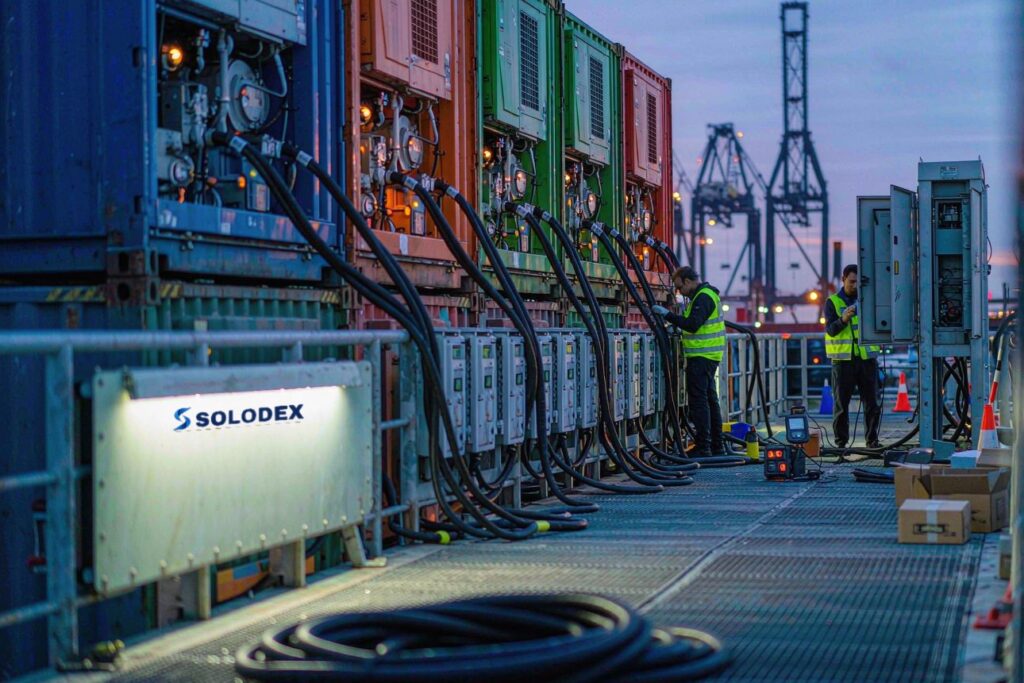
Walk a reefer row on board and the outlets are fixed boxes mounted on columns or lashing bridges, each stencilled with an identifier such as R-14-07. The identifier normally encodes a group and a position. Behind it runs a cable to a circuit, behind the circuit a distribution board, and behind the board the generating plant of the ship. A cable from the machinery end of the container is what joins a box to that chain.
How many outlets there are, how they are grouped and what load they may draw were decided at design and build. Not every cell has one. Some bays carry a dense bank of them, others none at all, and some positions can only be reached from an adjacent walkway. This distribution is a fact about the vessel, printed in her reefer capacity table, and it is not altered by a booking, a rate, or a request from the shore. It changes only if the ship is refitted.
That is why an outlet cannot be improvised for a sailing. A cell without one can still receive a reefer physically: the box can be landed, stacked and twistlocked like any other. It just cannot be supplied. A cell whose outlet belongs to a circuit already carrying several running units presents a different question again, one about load rather than about geometry. The planner works with what is installed and with where it is wired.
The container number written against an outlet is temporary; the identifier is not. At discharge the number is cleared, the cable is coiled, and the outlet returns to the free list with the same ID, the same circuit and the same rated load. The cargo leaves and the asset stays. This is the simplest way to see that the socket table is an inventory of the ship, not a description of the goods.
A second acceptance
A booking request for a temperature-controlled box carries the box type, a requirement for power, and the carriage conditions that go with it. It does not carry the identifier of an outlet. Somebody on the planning side has to pair a specific container number with a specific socket ID, using the capacity table for that vessel. That pairing is a separate act, performed after the request and before the box is loaded.
What it produces is a third document: a socket assignment sheet. It is not a copy of the booking confirmation, and it is not a copy of the manifest. It exists because the ship has to know which circuit will feed which box, and because neither of the first two documents was built to say so. Its columns are the socket ID, the circuit and board, the associated cell, the container number, and the rated load of the unit assigned to it. The booking window fixes the carriage terms, the transport document carries them onward, and a call number identifies the visit of the vessel. None of these three carries a socket ID.
The distinction has a practical edge. If the pairing is never made, a box can appear on the stowage plan and still have no supply. If a cell is changed late, an outlet can remain reserved for a box that now sits somewhere else. The two lists move independently until somebody writes the pair, and the pair is the only place where they meet. A quote can describe the service being bought; it cannot name the outlet that will feed a particular box on a particular sailing.
What an empty cell proves
An empty cell proves one thing: there is a place where a box could be secured. It says nothing about whether an outlet is installed at that place, whether that outlet has already been written against another container number, or whether the circuit behind it has spare load. All three are questions for the other sheet.
A free socket proves one thing: there is an outlet with no container number against it, on a circuit where the planner is willing to add load. It says nothing about whether the cell beside it is free, or whether the cell it is associated with happens to be reachable from the same walkway as the rest of the shipment. The two remainders are independent facts.
No column in either sheet converts one of those facts into the other. That is the whole operational explanation for six confirmed bookings producing four socket numbers while thirty-four cells stood empty. It was not a shortage of space and not a shortage of boxes. It was a mismatch between two independently counted stocks, resolved by the sheet that had the smaller usable remainder.
This is a different question from the ones asked about air freight. Capacity on a flight is held in layers of ownership, and a schedule can move for reasons that have nothing to do with the ship’s equipment. On this sailing the question is narrower: which numbered outlets are still unassigned, and on which circuits do they sit.
Where the neighbouring articles answer
Electricity in one form or another already appears in several places on this site. Each of those pages answers a different question, and it is worth saying which, so that this one is not read as a repeat of any of them.
Reefer plug-in and monitoring appear on a terminal bill as a charge per day, running from plug-in to plug-out; there the clock is the cost. A rail wagon has no power at all, so a temperature-controlled box on that leg needs a genset or a clip-on unit; there the question is whether a supply exists. Both are about the provision of power, not about which numbered outlet on a ship has been written against a box.
A plug-in, a plug-out and a transfer to a genset mark boundaries in the machine’s own record, changing which intervals that machine was able to log. They are events in a temperature story. The ceilings a loading officer works to are the load line and the vertical moment, and a ship can be described as full while slots are still visible; that is a weight margin, not an outlet count.
Air capacity is held in layers of commercial control, which decides who gets rolled when a flight is tight. This page stays with how the cargo moves. It does not price the plug, settle a claim, or discuss who is entitled to sell the space. Its object is a numbered outlet on a circuit, written against one container number before sailing, and the sheet on which that writing appears.
Simultaneous demand
A count of socket IDs is not the whole of the electrical limit. Each refrigeration unit draws power while its compressor runs, draws more at the moment of starting, and may be called on harder by a warm load, a defrost cycle or a high ambient temperature. Several units on the same circuit can therefore demand power at the same instant. The generating plant and each circuit are sized for a load that can occur together, not for a queue of units that take turns.
For that reason the capacity table carries two kinds of numbers side by side. One is the installed count of outlets, usually broken down by circuit or by board. The other is the rated load in kW available to each circuit, with an allowance for the fact that not every unit runs at full load at once. The same two kinds of numbers reappear on the assignment sheet, because every occupied ID has to be added into the load of the circuit it belongs to.
The allowance is finite. A circuit with eight installed outlets may be planned for six units running under design conditions. A free socket on a circuit that is already carrying five units is then a different object from a free socket on an idle circuit, even though both are unassigned and both have an ID. The first can only be used if load is moved elsewhere; the second can be written against a box directly. This is precisely why the assignment sheet records the circuit and not only the identifier.
Vessel documents of this kind are used as evidence elsewhere too. A draft survey reads the ship’s own tables and a weight basis is chosen against the vessel’s particulars. The reefer capacity table is another such document: it describes the ship, and it is consulted before any cargo is accepted against it.
A worked example
Three of the four assigned boxes from the sailing at the start of this page are enough to show how the pairing works. All three were confirmed, all three sat in adjacent cells on the same tier of the stowage plan, and all three were temperature-controlled. The figures are illustrative.
First. The capacity table listed circuit C-14 with six installed outlets, R-14-05 through R-14-10, serving the forward reefer group, and circuit C-16 with six outlets, R-16-01 through R-16-06, serving the after group. Each circuit was rated for 36 kW with an allowance for four units running at once. C-14 already carried three assignments from earlier bookings; C-16 carried one.
Second. The assignment sheet gave the first box, SXDU 410027-3, the ID R-14-05. It gave the second, SXDU 410028-8, the ID R-16-01, and the third, SXDU 410029-2, the ID R-16-02. Two of the three boxes therefore depended on one circuit and the third on another, while all three stood beside one another in the plan.
Third. The planner did not group the boxes by where they stood. The grouping followed the circuits that had room. Had the three IDs been taken from C-14 alone, that circuit would have been carrying six units against an allowance for four, even though six installed outlets were present and three of them looked free on a simple count.
Fourth. Nothing on the stowage plan reveals this. Its three adjacent cells look like one supply arrangement; the socket table shows two circuits and two boards. Conversely, nothing on the socket table reveals how the boxes are stacked. Each sheet can be read on its own, and neither can be reconstructed from the other. That is why the pairing has to be written down rather than assumed.
Two tables, two remainders
Placed side by side, the two working sheets for this sailing look like this. The first is the socket assignment sheet; the second is a comparison of what each sheet can tell a planner.
| Socket ID | Circuit / board | Associated cell | Container number | Rated load (kW) |
|---|---|---|---|---|
| R-14-05 | C-14 / DB-1 | 14 08 82 | SXDU 410027-3 | 6 |
| R-14-06 | C-14 / DB-1 | 14 08 84 | Earlier booking | 6 |
| R-16-01 | C-16 / DB-2 | 18 06 82 | SXDU 410028-8 | 6 |
| R-16-02 | C-16 / DB-2 | 18 06 84 | SXDU 410029-2 | 6 |
| R-16-03 | C-16 / DB-2 | 18 06 86 | Unassigned | 6 |
The last column is a property of the unit and the circuit, not a reading taken during the voyage. It is on the sheet so the load on each circuit can be added up before sailing and checked again after any change. The associated cell is on the sheet so the two inventories can be cross-read, but it is a reference to the other table, not a substitute for it.
| From the stowage plan | From the socket table |
|---|---|
| 34 cells with no container number | 5 IDs with no container number |
| 3 adjacent cells on tier 82 | 2 circuits and 2 boards for those 3 boxes |
| Counted in bays, rows and tiers | Counted in outlets per circuit |
| A place to secure a box | A place to feed a box |
Neither column is a conversion of the other. Both are needed before anybody can say that a particular reefer has a place on this sailing. A plan with empty cells and a socket table with free IDs can still leave the shipment ashore if the free IDs sit on circuits with no spare load, or if the cells those IDs serve are already taken.
What changes during the voyage
At an intermediate call, boxes are discharged and others loaded. A reefer may be shifted to a different cell to clear a hatch, to bring a discharge port forward, or to rebalance the ship. The container number stays the same. The associated cell may change, and the socket ID may change with it, because the outlet that served the old position is not the outlet that serves the new one.
When that happens the assignment sheet is rewritten: an ID is cleared, another is written against the same container number, possibly on a different circuit and board. This is a change in a pairing. It is not a gap in a temperature record, not a new booking, and not a fresh acceptance of the cargo. The box continues on the same voyage with one identity and, on the ship’s second inventory, two different addresses.
Several neighbouring pages describe movements of this kind from other angles. A box can be held for a later sailing, a call has its own number in the rotation, a berth window sets an order of discharge, and the equipment itself keeps a history of its first move. None of those accounts names an outlet. The sheet that does is the one being revised at the call.
From the shore side the shipment looks continuous: one container number, one booking, one set of documents. From the ship side the electrical arrangement is a working list that has to be kept current. Reports assembled after the fact can describe the interval differently, but they do not maintain the pairing. That job belongs to the people planning the load, at each call where the arrangement changes.
Where the dry box stops
A dry container never appears on the socket table. It takes a cell, is secured, travels, and is discharged. There is no second acceptance, no identifier, no circuit, no rated load, and nothing to rewrite at an intermediate call. Its paperwork ends where the reefer’s begins, and the two inventories have only one line in common: the container number in the plan.
The difference is not really in the goods. A steel box can be built with or without a machinery end, and cargo that needs no temperature control can still travel in a reefer if that is what is available. What makes a shipment powered on board is a line in the ship’s second inventory, written before sailing against a numbered outlet. The cargo does not bring that line with it.
Several pages here answer questions about what the cargo is. Moisture inside a box is managed by packing and ventilation, not by a plug. Dry ice is a regulated substance that cools its own surroundings and needs no outlet. Dangerous goods are judged by composition, and shelf-life conditions are written into a product specification. All of those describe the shipment. The socket table describes the ship.
So the everyday question, is there room for one more reefer, is not one question. One part of it is answered from the stowage plan, in cells. The other is answered from the socket assignment sheet, in identifiers and circuits. A box that has a cell but no number on the second sheet is a box the vessel can carry but cannot feed, which is another way of saying it is not going on that sailing.
The three lines worth asking for
None of this requires access to a carrier’s planning system. Three short requests, made while the booking is still open, are usually enough to establish whether the second entry exists.
Which numbered outlets on this vessel serve the cells where the box could sit? The answer should be a list of IDs from the ship’s capacity table, not an assurance that reefer space is available. It fixes the second inventory as a real set of installed assets rather than a notional quantity.
Which circuit and board does each of those IDs belong to, and what is already assigned to that circuit? An unassigned ID on a loaded circuit is not the same object as an unassigned ID on an idle one. This request is the one that brings the rated load and the simultaneity allowance into view before sailing rather than after a box has been left behind.
If the box is moved at an intermediate call, who rewrites the pairing? A voyage with several calls can give one container number two different socket IDs. Asking how the sheet is maintained is asking whether the ship will still know which circuit feeds the box when the arrangement changes.
With those three answers, the opening of this page reads differently. Six bookings, four socket numbers and thirty-four empty cells are not a contradiction and not a counting error. They are the normal result of two inventories that were never convertible into each other: a list of places to secure a box, and a list of places to feed one. A reefer needs an entry in both, and the second entry is assigned, not discovered.
Where the remaining cartons need a powered space until the next trip, slot allocation follows the logic of the second reefer socket slot.


