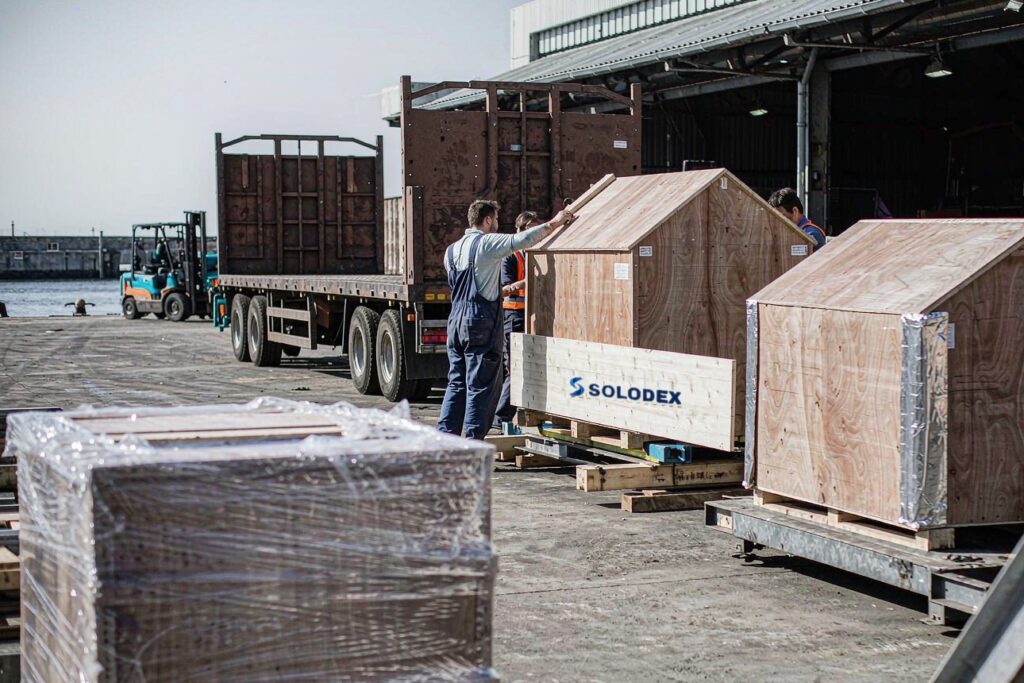
Three quotations arrived for the same machine, a 4.2 tonne vertical machining centre, and the packaging line was the only one that did not agree. The first said “stretch wrap, VCI bag, timber skid”. The second said “fully enclosed plywood case, internal cradle, marked lifting points”. The third said “seaworthy case, foil barrier, sloped weathertight lid, stainless fixings, drained base, preservative coat on all machined faces”. Nothing about the machine had changed. Its weight, its footprint, its finish and its tolerance were identical in all three.
What changed was where it was going to sit. The first price assumed a sealed container. The second assumed a hold. The third assumed the weather deck of a break bulk vessel. Three different walls, and therefore three different packing specifications for one object.
Most shippers read that as a question of how careful the packer is. It is not. It is a question of which parts of the transport system have been removed, and who is now expected to supply them. A container is a piece of the ship’s equipment that happens to surround the goods. Take it away and a surprising amount of engineering returns to the crate.
Three specifications for one machine
The cheapest of the three is not a bad specification. Inside a general purpose container, the machine needs protection from condensation and from the vibration of the road and the vessel; it needs to be held down; and it needs a barrier between bare steel and humid air. Stretch wrap, a volatile corrosion inhibitor bag, a timber skid and a handful of desiccant do all of that. The roof, the sides and the doors are provided by somebody else.
The hold version adds a case because a hold is a shared space. Other consignments are stowed above and beside it, slings come down from overhead, and the piece will be lifted more than once before it reaches its final position. A bag and a skid cannot carry a second tier of cargo on top of them and cannot give a stevedore a place to hook on. The case is not primarily weather protection here. It is a structural member.
The deck version is the expensive one because the deck is outdoors for the whole voyage. Rain, spray, salt, direct sun, and a daily temperature swing that condenses water inside anything sealed imperfectly. A flat lid holds water; ordinary zinc-plated screws stain and seize; a bare machined face rusts in a fortnight of sea air. The case has to be a small building, and the machine inside it has to be preserved as though it were going into storage rather than onto a truck.
None of this is a quality ladder. A deck-specification case shipped inside a container is not “better packed”; it is larger, heavier and more expensive, and it consumes cubic metres that the shipper is paying for. The right specification is the one that replaces exactly the wall that is absent.
The wall was never part of the product
Retail packaging and transport packaging are decided by different people for different reasons, and the confusion between them is where most of these mistakes begin. Retail packaging is designed for a shelf, a customer and an unboxing. It is removed by the person who bought the goods. Transport packaging is designed for a hook, a stack of other cargo and a fortnight of weather. It is removed by a warehouse hand at the far end, often with a crowbar, and its performance is finished before anybody evaluates its appearance.
Which means the transport pack is not a property of the product. It is a property of the journey. A machine does not “come in a case” in the way that a phone comes in a box; it comes in whatever case the route requires. The same serial number can be shipped three times in three different enclosures, and all three can be correct.
That is an uncomfortable idea for a purchasing department, because a packing specification is usually treated as a line item to be negotiated once with the factory and then reused. Reusing it across a change of mode is precisely the failure mode: the drawing still says “export standard”, the goods still arrive in the same crate, and nobody notices that the crate was priced for a roof it no longer has.
Five jobs a container does for free
It helps to be literal about what disappears. A steel box is not just a roof. It is a set of five services, each of which has to be bought back when the box goes away.
| What the container supplies | What it protects against | Who supplies it without the box | Line to check in the packing spec |
|---|---|---|---|
| Corrugated roof and doors | Rain, spray, direct sun | Weathertight lid, foil or bitumen barrier, sloped top | Weathertight / deck-rated enclosure |
| Steel side walls | Contact with other cargo, slings, fork tines, quay equipment | Full plywood or timber sheathing, corner battens | Fully enclosed case, panel thickness |
| Corner posts and roof structure | Stacking loads from units above | Case framing rated for a stated tier count | Permissible superimposed load, in kg or tiers |
| Corner castings and base frame | Lifting and restraint forces, applied at known points | Marked lifting points, internal cradle, sling angles | Lifting diagram and centre of gravity mark |
| Painted outer surface and seal | A legible place for identity, plus a record of tampering | Durable stencilled face, weather-resistant ink | Marking surface and stencil specification |
The fourth row is the one that is most often missed, because it is about forces rather than weather. A container is lifted by castings designed for the load path; the goods inside never see the force. A loose case is lifted by slings around its own body, and the force runs through the case, through the cradle, and into the machine feet. If the case was drawn as a weather cover and not as a lifting structure, the first lift is the test.
The fifth row connects directly to the earlier argument in this series. Without a container number, identity lives on a painted surface of the goods. A stencil applied to a paper wrap or to a surface that absorbs rain is not an identity system; it is a temporary note. The specification has to say what the marking surface is and what it is expected to survive.
Under deck is not the same as in a box
“Under deck” is often heard as “equivalent to a container”, and it is not. A hold is dry in the sense that rain does not fall into it. It is not private, not temperature-controlled, and not divided into cells. Cargo is built up in tiers against a bulkhead, separated by dunnage, secured with lashing, and covered by whatever else is loaded afterwards.
Three consequences follow. The case must carry the weight of the tier above it, which is a compression requirement and not a weather requirement. It must present faces that a sling can bear on without crushing a machined surface. And it must tolerate being adjacent to cargo that is not clean: steel coils, bagged minerals, timber, drums. A hold is a shared room with a roof, not a sealed box with your name on it.
This is also why the internal cradle is a separate item from the outer case. The case takes the stack and the weather; the cradle takes the machine. Bolting the machine to a skid and then sheathing the skid is not the same thing, because the sheathing will be asked to carry loads it was not designed for. Specifications that list only “plywood case, 18 mm” have described a material without describing a structure.
What weather deck actually asks of a crate
Deck stowage adds a set of requirements that have nothing to do with strength. The list is short and each item exists for a specific failure:
- A sloped or pitched lid. A flat top ponds. Water that sits finds the screw holes, and screw holes are always the first leak.
- A continuous vapour barrier under the sheathing. Foil or bitumen-laminated paper, lapped rather than butted, so that water driven by wind does not track through a joint.
- Non-corroding fixings. Salt spray attacks plated screws at the panel edges, and a case that cannot be opened without drilling is a case that will be opened with a grinder.
- A drained, raised base. Water on deck runs along the deck. A case sitting flush in it wicks moisture up the end grain of the skid.
- A preservative on the machine, not just around it. Bare ways, spindles and tooling interfaces need a coating that can be removed at destination, and the removal instructions have to travel with the goods.
- Ventilation that does not let rain in. A perfectly sealed case sweat internally as the air temperature cycles; the usual answer is a baffled vent, not an open gap.
The last item is worth dwelling on, because it is the point where the two water problems are most often confused. Container rain is water that was already inside, cycling between the cargo and a cold steel roof. Deck cargo has that problem too, but it also has water arriving from outside. A desiccant bag addresses the first and does nothing about the second; a tarpaulin addresses the second imperfectly and often makes the first worse. Treating the two as one problem produces a case that is sealed against the weather and quietly wet inside.
Tarps deserve their own caveat. A cover over a deck load keeps most rain off for a while, and that article’s point about open top containers applies with more force on a weather deck: a fortnight of wind-driven spray is a different test from a shower at the loading bay. The case is the primary protection. Anything draped over it is a courtesy.
The first line of the specification is a position
If packing is a property of the journey, then a specification that does not state the journey is incomplete regardless of how detailed the rest of it is. The first line should not be a material. It should be a stowage position.
In practice that means the specification carries one of three phrases: suitable for FCL, suitable for under-deck break bulk stowage, or suitable for weather deck stowage. Everything below that line follows from the choice. It also means the phrase is checkable. The booking confirmation, the mate’s receipt and the bill of lading all say something about where the goods went, and deck stowage in particular is normally endorsed on the bill. Those two documents are readable by the same person on the same day.
The field to reconcile is the stated stowage position on the packing specification against the stowage clause or “shipped on deck” endorsement on the transport document. If the specification says FCL and the bill says on deck, the goods travelled with a wall they did not have. If the specification says weather deck and the goods went in a container, somebody paid for a wall twice over. Either way the mismatch is visible on paper before anyone has to discuss rust.
A packing specification also happens to be the document a claim file will ask for, but that is a consequence of writing it properly, not the reason to write it. The reason is that the packer cannot choose a lid, a barrier or a cradle without knowing which of the five jobs the ship will not be doing.
When the ship keeps the option
There is an obvious objection: at the time the case is built, nobody knows whether the consignment will be stowed in a hold or on deck. Booking confirmations for break bulk commonly reserve stowage to the ship’s option, and the final plan is settled at the quay with the other cargo already alongside.
That is exactly why the position belongs in the specification rather than in an email. Three workable answers exist:
- Write the stricter position into the booking and pay for under-deck stowage if the goods cannot be made deck-worthy. This turns an operational preference into a contractual one.
- Specify to the highest exposure allowed by the booking when the option genuinely remains open. Deck-worthy packing is the only version that is safe in both places.
- Ask what the surcharge is for a position guarantee and compare it with the difference between the two packing specifications. On a heavy machine that difference is usually larger than the surcharge, which makes the decision arithmetic rather than a gamble.
The third answer is the useful one, because it exposes a cost that is normally invisible. Packing is quoted by the factory as a fixed line, and stowage is quoted by the carrier as an option. Nobody puts the two numbers next to each other, so the cheaper packing gets chosen and the risk is left with whoever opens the case.
There is a timing problem too. The case is built weeks before the ship is loaded, and the decision that determines whether it is adequate is made hours before loading. Any process that leaves the position undecided until the quay has already decided the packing by default. The only way to make the decision early is to put it in a document that the factory reads.
The box hides what it protects you from
Container cargo teaches a bad habit. Because the roof, the walls and the lifting points are all supplied without appearing on an invoice, shippers come to believe the goods are simply robust. A machine that has made twenty trips in containers has never been rained on, never been stacked under a coil, never been lifted by a sling around its own body. Its record proves nothing about the machine and a great deal about the equipment it travelled in.
The first break bulk shipment is where that assumption is tested. The goods are the same, the route is the same, and the packaging line is the only thing that looks different on the quotation. It is tempting to treat the increase as the packer padding the invoice. In reality it is the bill for five services that used to be bundled into the freight rate.
This is a specific version of a broader pattern in this series. A container makes a set of decisions on behalf of the cargo, and because the decisions are made silently, nobody notices them until the container is not there. The number of pieces was decided by the box before anybody counted. The two capacities were answered by a box number instead of two manifest columns. Protection is the same kind of hidden decision, except that it has a physical price tag and a drawing.
The packing is on the manifest too
Once the case is treated as transport equipment rather than product wrapping, it starts appearing in places the product description never reaches.
It appears in the piece count, because a strapped bundle, a palletised unit and a sheathed case are three different answers to what one lift is. It appears in the measurement column, because the case and its dunnage occupy cubic metres that the machine does not; the gross weight barely moves while the measurement grows by a visible margin. It appears in the marks, because the stencil has to be on a face that survives the voyage. And it appears in the stowage plan, because a case rated for two tiers cannot be put at the bottom of four.
None of those entries are about the goods. All of them are about the enclosure. That is the cleanest test of the whole argument: if removing the case would change four fields on the manifest, then the case was never packaging in the retail sense. It was a small, shipper-owned container.
It also explains why “packing included” on a commercial invoice is such an unhelpful phrase. It collapses a structural decision into a price, and the price says nothing about which position the case was built for. Two suppliers can quote the same line and deliver two entirely different levels of protection, and the buyer will not find out until a wet deck and a sling between them do the inspection.
A wall you can point at
The useful question to ask a packer is not “is this export standard”. There is no single export standard, and the phrase survives because it lets everybody avoid the position. The useful question is: which of the five jobs is this case doing, and which ones is somebody else still doing?
Ask it in that order and the answers become concrete. Is there a rated stack load? Where do the slings go, and is the centre of gravity marked? What happens to water that lands on the lid? What is the marking surface and will the stencil still read after spray? Is the preservative removable, and does the removal instruction travel with the machine? Each answer corresponds to a wall that the container used to supply.
Three quotations for one machine is not a sign that somebody is guessing. It is the correct response to three different absences. FCL removes almost nothing, a hold removes privacy and a known lifting point, and a weather deck removes the roof entirely. The packing line changes because the wall changes, and the specification is the only place where that decision is written down before the crane arrives.
A container is a wall the cargo never has to buy. Cargo that does not go into one has to bring its own, and the specification has to say which wall it is replacing.
A packing specification names a stowage position before the case is built; a crushed corner on that case is exactly the sentence a tally clerk can write at the rail.
A container supplies a roof, walls and corners that loose cargo has to buy back; a flexitank does the opposite and asks those same walls to hold internal liquid pressure they were never designed for.
Weather deck stowage asks the packaging to survive what the box would otherwise shield; the same deck tier also carries a much larger vertical arm, which is why heavy deck slots are the first to be trimmed when GM runs short.


