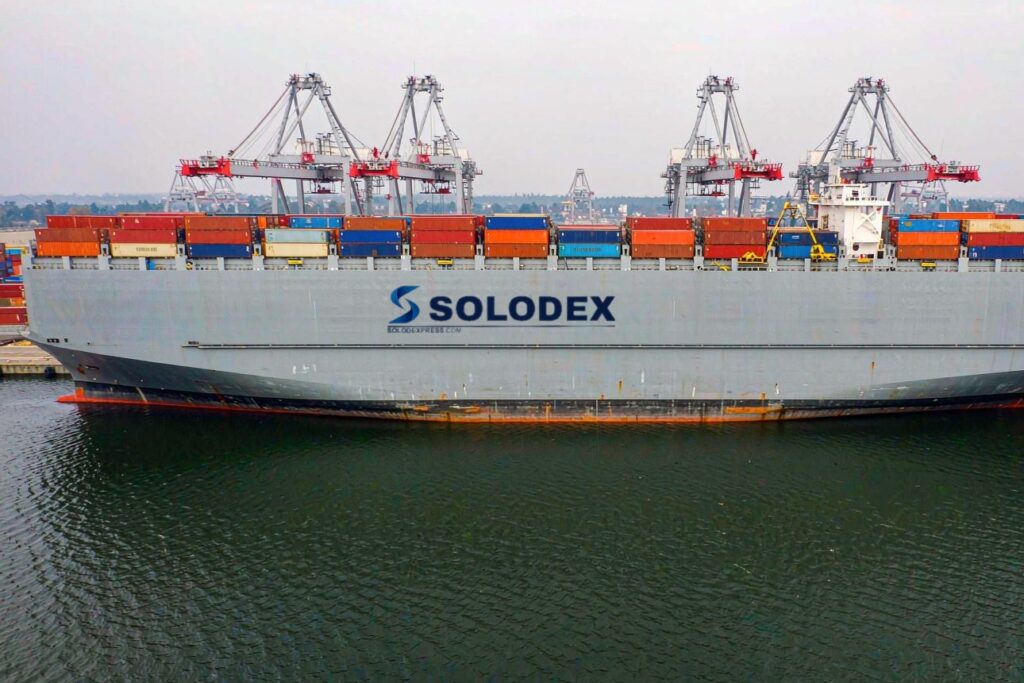
Here is an arithmetic problem that decides more delivery dates than any port schedule. A bill of lading is produced in Shanghai two days after the vessel sails. The original goes into a courier envelope and reaches Tokyo in four working days, so it exists in the consignee’s hands on day six. The vessel arrived on day three. For three days the cargo was physically present, legally available, and impossible to collect.
That gap is not a service failure and no amount of chasing closes it. It is a property of the document itself, and it explains why the same shipper uses three different paper instruments on three different routes without ever changing forwarder. The question is never “which document is best”. It is which of the three can physically arrive before the cargo does, while still doing the one job you need it to do.
The paper runs slower than the ship
Ocean transit is now shorter than the paperwork chain on a large share of the world’s trade lanes. On intra-Asia services this is not close: Shanghai to Tokyo is two to three days, Shanghai to Busan is one to two, and a sailing to Ho Chi Minh City can berth before the carrier has finished issuing the bill. Add a day for issuance, four to six days for courier, and one day for the consignee to endorse and present it, and the original is a week behind the box on a voyage that took three days.
| Lane | Ocean transit | Original in hand | Paper arrives |
|---|---|---|---|
| Shanghai to Busan | 1–2 days | 5–8 days | 4–6 days late |
| Shanghai to Tokyo or Osaka | 2–4 days | 5–8 days | 2–5 days late |
| South China to Singapore | 5–7 days | 6–9 days | Roughly level |
| Shanghai to Los Angeles | 13–18 days | 7–10 days | 5–9 days early |
| Shanghai to Rotterdam | 30–38 days | 7–10 days | 3 weeks early |
Read the last two rows against the first two and the pattern is obvious. The original bill is a comfortable instrument on a long voyage and a guaranteed delay on a short one. Shippers who run both lanes and use originals on both are paying for a delay on one of them every single shipment, and the invoice for that delay arrives from the terminal, not from the forwarder. It shows up as demurrage, and then as detention once the box finally leaves the gate.
The other half of the decision is payment. If money has not changed hands and will not change hands until documents are presented, you need an instrument a bank will accept, and that narrows the field to one. Freight collect terms, letters of credit and documentary collections all pull in the same direction: the cargo must not be releasable without the paper. The paperwork a bank will actually read is set out in the invoice and packing list, and a bill that disagrees with either of them is a discrepancy before it is anything else.
Three instruments, one question
Every bill in this family answers exactly one question: who can walk up to the carrier and demand the box. The difference between the three is not formatting or terminology. It is whether the document represents the goods, or merely describes them.
| Original bill of lading | Telex release | Sea waybill | |
|---|---|---|---|
| Document of title | Yes | Yes, until surrendered | No |
| Transferable | Yes, by endorsement | No, frozen to one consignee | No |
| Released against | One original, the rest void | Carrier’s electronic instruction | Proof of identity |
| Issued as | Usually three originals | Originals recalled, then instruction sent | Single non-negotiable copy |
| Typical fee | Courier $50–100 | Telex fee $30–60 | Usually included in freight |
| Fits | Letter of credit, unpaid balance, cargo resale in transit | Trusted buyer, balance paid, short lane | Prepaid, group companies, no title needed |
| Fails when | The voyage is shorter than the courier | The buyer stops paying after the instruction | You still needed to control the cargo |
Two of these can be converted into each other after sailing and one cannot. That asymmetry is where most of the expensive mistakes live, because the conversion deadline falls on the day the vessel departs, and nobody is thinking about paperwork on that day.
The original bill is the only one that holds the cargo
A negotiable bill of lading is a document of title, which is a legal category most goods never enter. Whoever lawfully holds it can claim the cargo, sell the cargo, or pledge it to a bank, and the carrier’s obligation is to deliver against it and to nobody else. Three originals are typically issued, any one of which is sufficient; the other two become void the moment one is used, which is why a set that has been split across two countries is a genuine problem rather than an inconvenience.
It is worth being concrete about what this buys you. With an original in your drawer you can still redirect a shipment to a different buyer while it is at sea, which happens routinely when a buyer’s credit fails mid-transit. You can pledge the goods as security. And you can refuse to hand over the paper, which is the only lever that works on a buyer who has stopped answering emails. On a long lane, none of that costs you any time at all.
What it costs is a courier chain you cannot audit. Originals go missing, get signed for by a receptionist, sit in a customs broker’s office over a weekend, or arrive with a spelling error that forces a reissue. Each of those is a day, and each of those days is terminal storage if the vessel has already berthed.
A telex release is not “no bill”
The phrase gets used as if the document disappears. It does the opposite: the originals are collected back by the carrier at origin, cancelled, and then the destination agent is instructed by message to release the cargo to the named consignee without presentation. The bill existed, the bill was surrendered, and the release is now an instruction rather than an instrument.
Three consequences follow, and all three are routinely missed. First, every original must come back. If one copy is already in the buyer’s hands — because it was couriered to them before the payment method changed — then a telex release has not actually happened, and that copy remains a document of title that someone can present. Ask for written confirmation that the full set has been returned and cancelled, not for a promise that “it’s been released”.
Second, the instruction is one-way. Once the destination agent releases, there is no recall. If the buyer’s balance payment fails on the same afternoon, you have handed over the cargo and retained nothing. Telex release is therefore appropriate exactly when the commercial risk is already gone: full payment received, or a buyer whose credit you would extend anyway.
Third, it must be requested before sailing, or at least before the originals are issued. Forwarders field this request every day and the answer changes once the set has been printed, because collecting three originals from three places is a different task from never printing them. A request made on the day of departure is the single most common reason a shipper ends up air-couriering paper they did not want.
A sea waybill gives away the cargo, not the title
A sea waybill is not a document of title and this is not a technicality. It names a consignee, it is not transferable, it cannot be endorsed, and the carrier will deliver to that consignee against identification. It is a receipt and a contract of carriage with the title function surgically removed. Nothing is surrendered because nothing was ever held.
That makes it the fastest instrument in the set and the only one that can never be late, since no paper needs to travel. It also means the seller has no mechanism to stop delivery if the payment fails, beyond whatever the carrier voluntarily agrees to and whatever local law provides in the way of a right to stop goods in transit. Those remedies exist, they are slow, and they require a lawyer in the destination jurisdiction. They are not a plan.
Where a sea waybill is unambiguously correct: shipments inside one corporate group, samples and replacements where the value is small, prepaid orders to a long-standing account, and any lane short enough that an original would lose more money in storage than the cargo is worth. What it is not correct for is a new buyer, an unpaid balance, or any arrangement where the cargo is collateral.
The fourth trap is a bill that is not a title document
Consign the cargo to a named company instead of “to order”, and a strange thing happens: the document may stop behaving like a title document at all. This is the “straight” bill, and its legal character depends on where the dispute is heard rather than on what the paper says.
| Jurisdiction | Straight bill, named consignee | Practical effect |
|---|---|---|
| United States | Generally treated as non-negotiable; carrier may deliver to the named consignee | The original protects nothing |
| China | Courts have generally required presentation even when the consignee is named | The original still controls |
| United Kingdom | Turns on the wording and the contract, not the label | Ambiguous until tested |
The lesson is not to memorise three rows. It is that the words “to order” in the consignee box are doing real work, and deleting them in exchange for typing a company name quietly converts a title document into something closer to a sea waybill. If you are relying on the original to hold cargo, the consignee field must say to order, or to the order of the shipper, or to the order of a named bank. A named company in that box is a decision, not a formatting choice.
Two layers of paper, only one of them is the carrier’s
When a forwarder books the space, two bills exist. The carrier issues a master bill to the forwarder as shipper. The forwarder issues a house bill to you, and the house bill is the one you have been reading about in every guide, including this one. The distinction matters at exactly one moment: when the forwarder stops functioning.
The carrier’s obligation runs to the holder of the master bill. Your house bill is a contract with the forwarder, not with the ship. If the forwarder fails, the cargo is still on the water, the carrier will release it to whoever holds the master bill, and your house bill is a claim in an insolvency rather than a right to the goods. This is not a hypothetical; it is the mechanism behind most of the cargo stranded in forwarder collapses over the last decade.
The check is cheap and almost nobody runs it. A legitimate non-vessel-operating common carrier is registered, holds a bond, and has a number you can look up — an FMC licence number if it issues bills for US trade, a filing with the transport ministry if it operates from China. Ask for the number, look it up, and confirm that the entity named on your house bill is the same entity. A trading company that issues its own bill without being a registered carrier is issuing a document with no carrier behind it. The same verification habit applies to every certificate a supplier sends you — the method is in checking supplier documents, and a registration number that cannot be looked up is the cheapest red flag there is.
Releasing to the wrong party costs more than losing the box
Carriers are famously rigid about originals, and the reason is arithmetic. If cargo is damaged at sea, the carrier’s liability is capped by the package limitation: 666.67 special drawing rights per package or two per kilogram, whichever is higher. If the cargo is delivered to the wrong party, that cap may not apply at all, and in China the rule is explicit — compensation for delivery without a bill is assessed on the value of the goods at shipment plus freight and insurance, with no package limitation.
| Same cargo, two failures | Cap applied | Recoverable |
|---|---|---|
| 20 kg of samples, $12,000 value, crushed in transit | 2 SDR/kg, roughly $53 | Under 1% of value |
| Same 20 kg samples, released to a stranger | None | Full CIF value |
| 18,000 kg of machinery, $48,000, damaged | 2 SDR/kg, roughly $47,500 | Effectively the whole value |
For a shipper the practical reading is the opposite of what most people assume. The package limitation is not a general ceiling on what you can recover; it is a ceiling that bites hardest on high-value, low-weight cargo, which is exactly the cargo people describe as “small”. A carton of samples may be worth more than a pallet of hardware and recover almost nothing if the loss happens at sea. If the value is concentrated in a light shipment, marine cargo insurance is not optional and the carrier’s liability is not a substitute for it. The mechanics of claiming are in claiming for damaged cargo, and the same four-second rule at delivery applies whether the loss was damage or misdelivery.
Electronic bills are now paper, in the places that matter
The one development that changes the arithmetic above is the electronic bill of lading. Under the UK Electronic Trade Documents Act, in force since September 2023, an electronic bill that meets the statutory tests has the same legal effect as a paper one — meaning it can be endorsed, transferred and used as title, which was precisely what earlier electronic documents could not do. Singapore, the UAE and several other jurisdictions have adopted equivalent rules, and the pattern is spreading.
This removes the courier from the critical path without removing the title function, which is the first time a shipper has been able to have both. Adoption is uneven and depends on the parties rather than the platform: the carrier, the bank and the buyer all have to accept the same system, and the bank is usually the slowest participant because letters of credit are drafted around paper. It is worth asking whether your forwarder can issue one, and worth not building a process around the answer yet.
Three questions before you book
The whole decision collapses into three, and they can all be answered before the container is loaded.
- Is anyone going to pay against documents? If yes, you need the original, and the courier is a cost of the deal rather than a problem to be solved. If the money is already in, this question is closed and the other two decide it.
- Is the voyage longer than the courier? Compare the transit in the table above against five working days. If the paper cannot win, an original is a storage bill with extra steps — and the storage clock described in what happens after discharge starts on the day the vessel berths, not the day you notice.
- Does the consignee box say “to order”? If you are relying on a title document, it must. If it names a company, you have written something closer to a waybill and should stop pretending otherwise.
Three supporting items are worth fixing in the same conversation. Ask for the set to be issued as an electronic bill if the parties can accept it. Confirm in writing, before sailing, which of the three instruments will be used and who is couriering what. And if a forwarder is issuing the bill, verify their registration number rather than taking the letterhead as evidence.
None of this is exotic. Every one of the failures above is a document that behaved exactly as designed against a shipper who assumed it would behave like the last one. The bill does not care about the vessel’s schedule, the terminal’s free time, or the buyer’s promises. It only records who, in law, is allowed to ask for the box — and on a route where the ship arrives in three days, that record needs to be in the right hands before it sails.
Three documents decide who may take delivery, and paper can be slower than the ship; the bill of lading itself prints no arrival date at all, only a port of loading and a port of discharge.
Release arrangements decide who may take delivery of the goods named in a transport document; before the vessel sails, a temperature-controlled box also needs a numbered outlet on a circuit assigned to its container number, which no transport document carries.


