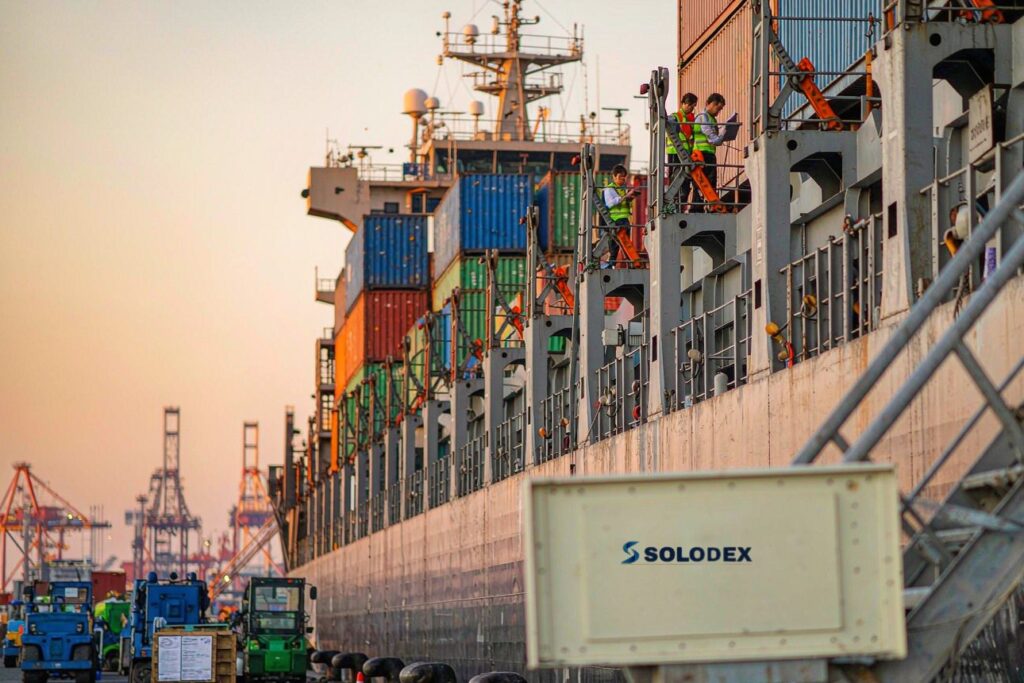
A booking confirmation for four 40-foot high-cube containers of glazed sanitary ware and marble tiles printed four numbers: 28.4, 27.9, 26.6 and 28.1 tonnes. The shipper checked them twice, because the tiles were dense and the factory had weighed every pallet. The carrier accepted them. The terminal weighed the boxes again at the gate. Nobody disputed any of the four figures at any point in the chain, and all four boxes were loaded on the vessel they were booked on.
On the chief officer’s screen those same four weights appeared in a table with two more columns beside them. One was a cell number, a bay, a row and a tier on this particular ship. The other was a vertical arm, in metres above the keel. A fifth column multiplied them. The two heaviest boxes went into the hold, low down. One of the lighter ones went three tiers up on deck. A fourth was moved from a deck tier to a lower one after the first pass of the calculation, without anybody touching the cargo, changing a document or reweighing anything.
That is the part of a sea voyage that shore paperwork almost never shows. A ship does not load weight. It loads weight at a height. The same 28.4 tonnes sitting four metres above the keel and sitting eighteen metres above the keel are the same consignment, the same box, the same verified gross mass and the same bill of lading line, but to the vessel they are two entirely different inputs. What decides whether the ship sails is not how many tonnes are aboard. It is where the combined centre of gravity ends up once every weight has been multiplied by the height at which it was placed.
Two columns on the chief officer’s screen
Open a container stowage plan and the first surprise is that the weight column is not the interesting one. Each line carries a container number, a cell, a port of discharge, a verified gross mass, and a vertical arm taken from the ship’s own tables for that cell. Multiply the last two and you get a weight moment, in tonne-metres. Add up the moments and divide by the total displacement and you have a height: the vertical centre of gravity of the whole floating object, usually written as KG. Compare that height with the ship’s metacentric height for her current draught and you have GM, the number that describes how strongly she returns to upright after being leaned over.
None of those quantities describes the cargo on its own. A tonne-metre is a joint statement about a box and a place on a ship. Change the cell and the moment changes while the box, its seal and its paperwork stay exactly as they were. This is why the stowage plan is not a list of where things were put, even though it looks like one. It is a calculation sheet whose rows happen to be containers. The cell is an input to a sum, not an address written down for the benefit of the consignee.
The arithmetic also explains something that otherwise looks like fussiness. A vessel can be well inside her load line, with empty slots still available, and still be refused another heavy box on deck. Nothing about capacity has been used up. What has been used up is the margin between the centre of gravity the ship has and the centre of gravity she is allowed to sail with. Another twenty-eight tonnes low in the hold might be fine. The same twenty-eight tonnes four tiers higher might not be, and the difference is entirely in the second column.
The same box, two different forces
Take the first of those four tile boxes. Its verified gross mass is 28.4 tonnes. Placed in the hold at a vertical arm of about 4 metres, it contributes roughly 114 tonne-metres to the ship’s vertical moment. Placed three tiers up on the weather deck at about 18 metres, it contributes roughly 511 tonne-metres. The box has not changed. The cargo has not been restacked. Only the height has changed, and the contribution to the calculation is four and a half times larger.
Move enough boxes upward and the combined KG rises. A higher KG leaves a smaller GM. A smaller GM means less righting force early in a roll, a slower and lazier motion back to upright, and larger angles held for longer when the ship is beam-on to a swell. It also changes the forces that lashing gear on deck has to absorb. The crew does not experience this as a number going down. They experience it as a ship that behaves differently for the rest of the crossing, including after the weather has improved and the deck cargo is no longer being thought about at all.
There is a mirror image of the same problem. A very light box high up is usually harmless to GM, but it still occupies a cell that a heavier box might have needed, and it is still exposed to wind, spray and the stack loads from anything placed above it. So the plan is not simply a rule that says heavy things go down. It is a set of sums with several constraints, run against a hull whose own weight, fuel, water and stores are already in the calculation before the first container arrives.
Full is a stability word, not a capacity word
People describe a ship as full when no more slots are visible. The people planning the load use at least four different ceilings, and the lowest one wins. The load line limits total immersion, so it caps total displacement. The allowable GM limits how high the combined centre of gravity may sit, so it caps the sum of the moments. Stack loads and the rated strength of container corners cap what can be placed on top of what in a given stack. And the physical arrangement of hatch covers, cell guides, lashing bridges and reefer sockets decides which cells exist at all on this particular vessel.
These ceilings do not run out together. A ship on a short coastal leg with a light cargo may run out of deck height or lashing positions long before she approaches her load line. A ship carrying dense stone, tiles or metal may reach a draught or a stack-load limit with a third of her slots still empty. A winter departure with heavy fuel and full fresh water tanks starts from a different baseline than the same ship at the end of a long leg. “Full” is therefore not a count of boxes. It is the point at which one of several independent calculations says stop.
This is the practical answer to a question shippers ask surprisingly often: why was a booking accepted and then loaded on a later sailing when the ship visibly had space. Rolled cargo has commercial causes and has been covered elsewhere. But a load can also be trimmed for stability, and the boxes most likely to be moved in that trim are heavy ones planned high. The cargo was never rejected. Its moment was. That distinction is invisible from the quay, where an empty cell looks like an unused slot rather than a used-up margin.
The one line that can still be changed
Once the boxes are on board, almost every input to the calculation is fixed. The cargo cannot be repacked. The cells are occupied. The hull, the machinery and the constant are what they are. The single large line the ship can still move is ballast water. Pumping water into low tanks adds weight near the keel, which pulls the combined KG down and restores GM. Pumping it out does the reverse and frees displacement for more cargo. Ballast is the adjustment that makes the last version of the plan work.
It is not a free adjustment. Water added low still counts against the load line. It changes draught and trim, which changes the metacentric height used in the comparison, so the two numbers being optimised move at the same time. It takes time alongside, and discharge or uptake has its own paperwork. A planner choosing between ballasting and moving two heavy boxes lower is choosing between a change to the ship and a change to the plan, and most often the cheaper change is the plan.
There is a second reason the calculation is not a single snapshot. Fuel, fresh water and stores are consumed during the voyage, and their tanks are at different heights. A departure condition and an arrival condition can therefore produce different GM values for exactly the same cargo, on a ship where not one container has been touched. Loading plans are checked against the weakest condition in the crossing, not against the moment the gangway is lifted. The box that was acceptable on departure has to remain acceptable several days later with lighter bunkers.
What the shore paperwork cannot hold
Follow the same four tile boxes backwards through the documents and every one of them carries a weight. The verified gross mass is a statement by the shipper about a container’s mass, with a method and a signature behind it. The booking holds a weight and a container type. The bill of lading holds packages, gross weight and measurement. The terminal interchange holds the gate weight and a condition code. Not one of those documents has a column for vertical arm, because none of them knows which ship, which cell or which tier the box will end up in.
The mapping from a container number to a cell is made by the vessel, for the vessel, after the shore documents have done their job. A consignee sees “loaded on board” and a vessel name. What the carrier’s planning system holds is a row in a calculation: box, VGM, cell, vertical arm, moment, discharge port, and the constraints that kept it out of other cells. The two views are not inconsistent. They are about different objects. One is a statement about goods; the other is a statement about a floating body with those goods somewhere inside it.
This is worth stating plainly because it sets a limit on what a shipper can verify. You can check a VGM, a seal number and a booking reference from shore. You cannot check the moment from shore, because the height is a property of the ship’s geometry and of a decision made on board. That is also why a discrepancy in declared weight matters so much: the calculation was built on that number, in a cell the shipper never chose, and the error propagates into a quantity nobody on the quay can see.
Four boxes, four positions
Here is the shape of the calculation for the four tile boxes, simplified to the columns that matter. The arms are illustrative heights above the keel for a mid-size container ship, not a specification for any particular vessel. The last column describes the direction of the effect on departure GM, not a measured value.
| Box and declared cargo | VGM | Planned cell | Vertical arm | Weight moment | Effect on departure GM |
|---|---|---|---|---|---|
| MSCU 411203-0, marble tiles | 28.4 t | Hold, low tier | 4 m | 114 t m | Small reduction; weight sits near the keel |
| MSCU 411204-5, sanitary ware | 27.9 t | Hold, low tier | 4 m | 112 t m | Small reduction |
| MSCU 411205-1, sanitary ware | 26.6 t | Deck, third tier | 18 m | 479 t m | Marked reduction; high arm dominates the row |
| MSCU 411206-8, marble tiles | 28.1 t | Hold, mid tier after replanning | 7 m | 197 t m | Moderate reduction; moved down from 18 m before sailing |
| Ballast water in low tanks | Varies | Double-bottom tanks | 1-2 m | Large total, small arm | Increases GM, but consumes displacement and changes draught |
| Hull, fuel, stores and constant | Fixed for the condition | Ship’s own tables | Ship’s own tables | Baseline of the sum | Shifts between departure and arrival as tanks empty |
Read the third and fourth rows together. The box moved before sailing was not the heaviest, and its declared weight never changed. It was moved because the sum of moments was too high, and lowering that one arm from eighteen metres to seven removed far more from the total than shaving a tonne off any single declaration would have done. The consignee received the same four weights, the same four seal numbers and the same loaded-on-board date. Only the ship’s calculation changed.
Why heavy boxes are not always at the bottom
If height were the only constraint, every heavy box would go into the hold and every light one would go on deck. Real plans are messier, and the reasons are mostly operational rather than physical. A box discharging at the first port cannot be buried under a week of other people’s cargo. Certain dangerous goods have to be kept apart from other classes and away from accommodation. Reefer boxes need sockets and monitoring access. Deck height is limited by lashing bridges, visibility from the bridge and the ship’s own approved stacking profiles. A hatch cover may be rated for a stack that a particular combination of weights would exceed even when GM is comfortable.
Those constraints belong to other parts of the operation and are not the subject here. They matter for one reason only: they reduce the number of cells available to the stability calculation. By the time the planner is choosing where a heavy box goes, the choice is usually between two or three imperfect cells, and the moment column is what breaks the tie. Stability is rarely the only reason a container ends up where it does. It is almost always the reason some otherwise reasonable position is not allowed.
Where the other articles stop
Several articles on this site come close to this calculation and then stop at its edge. The piece on weight or measurement explains that a vessel has both a finite number of tonnes and a finite amount of space, and that those two columns are sold separately; it notes that the weight column feeds stability, but its subject is the two different quantities measured on the quay, not the height at which the weight is placed. The piece on draft survey shows that bulk cargo weight is inferred from the ship’s own draught readings, with ballast, fuel and fresh water as corrections to that inference; there the water in the tanks is a correction to a measurement, while here it is an input to a decision.
The article on securing a container load deals with centre of gravity inside the box, where a tall stack becomes a lever under acceleration and the fix is bracing, dunnage and a low centre of gravity within the steel walls. That is cargo physics at the scale of one container. The planning guide for a container load deals with the same scale, distributing weight across the floor and keeping heavy items low inside the box. The article on weather deck stowage asks what packaging must survive when the crate itself is the boundary. All three are about what happens within or immediately around one unit, not about the vessel as a whole.
The recent articles on the port side stop at a different boundary. Berth windows and discharge sequences explain why one vessel arrival produces many discharge timestamps. Yard stacks explain why available is a paperwork state and reachable is a position. Port calls explain why cargo is bound to a call number rather than to a port name. Reports on dwell days explain that a duration is a choice made by a reader of event rows. None of them follows the box up the gangway into the ship’s own calculation, and none of them needs to: by then the terminal’s part of the story is over.
What to ask for before sailing
Most of this is invisible to a shipper, but it is not unverifiable. Four questions separate a real stability check from a reassuring sentence in an email, and all four can be asked without access to any carrier system.
- Ask which cell each of your boxes was planned into, including the tier, and on which vessel and voyage. A vessel name alone is not a position.
- Ask for the vertical arm used for that cell and the weight moment recorded against each container number. These two numbers, multiplied, are the row the ship actually used.
- Ask which condition the GM was checked against: departure, arrival, or the weakest intermediate condition with partly consumed fuel and water.
- Ask whether ballast was adjusted after the first plan, and if so whether any container was moved to a different tier in the same pass. That single answer explains most last-minute changes to heavy boxes.
What can be checked on paper, then, is a short chain: the verified gross mass on the shore document, the cell and vertical arm on the stowage plan, the resulting weight moment, the GM for the stated loading condition, and the ballast movement that closed the gap between the first plan and the final one. If a heavy booking is moved to a later sailing while slots remain visible, this is the chain that tells you whether the ship ran out of space or ran out of righting margin. The two look identical from the quay.
The four tile boxes sailed together, all four weights exactly as declared, all four seals intact. Two sat low in the hold, one went three tiers up on deck, and one was brought down before the gangway was lifted. Nothing about the goods changed between the booking confirmation and departure. What changed was a height, a product of a weight and that height, and the margin left to a ship that has to stay upright for the next two weeks. A vessel does not carry a list of weights from one port to another. It carries a sum of moments, and every container on board is one line in it.
Related reading: why one cargo is measured twice, how bulk cargo weight comes from the ship’s draught, securing a load inside the container, how to plan a container load, when the cargo is bigger than the box, what weather deck stowage asks of packing, why a box number is not the cargo’s identity, one ETA and twelve discharge times, why the yard is a stack rather than a shelf, one service with eleven port calls, the empty box that travels before the cargo, four systems and one container number, why a box misses the ship, the three cut-offs in a booking window, how to read a freight quote, why transit times change, what is inside port charges, bill of lading release types.
The cell a box sits in decides the height used in the ship calculation; that same position changes what the box is exposed to, but the vessel produces no temperature figure for the cargo and never merges the three records a reefer leaves behind.


