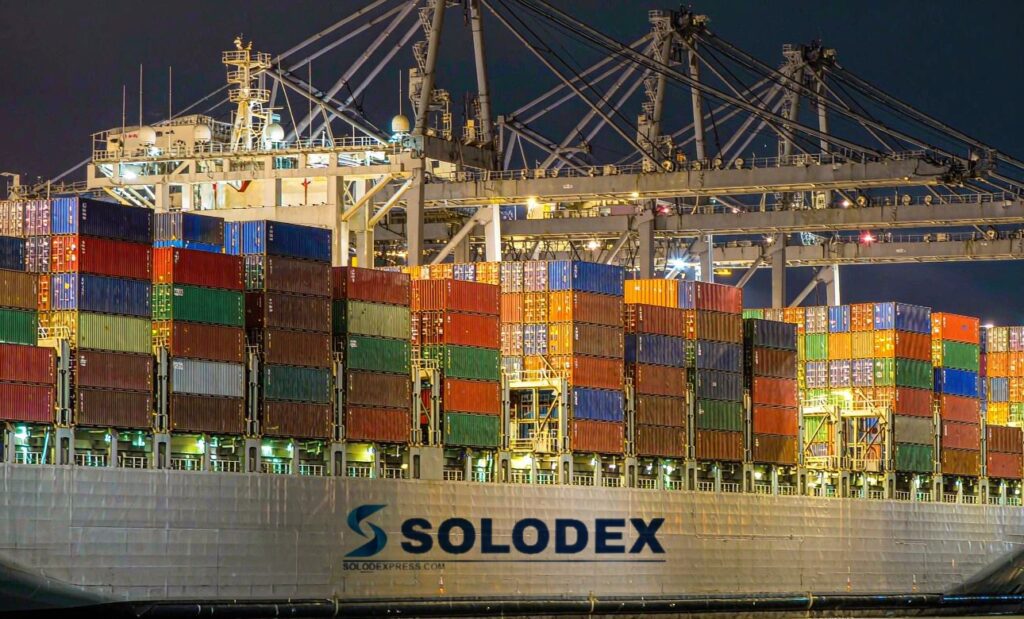
The gate receipt is stamped 14:20. Cut-off was 18:00, so there were almost four hours of margin. The VGM went across at 16:05 and the shipping instruction the day before. At 03:00 the vessel sailed. On the carrier’s tracking page the container’s last event still reads Gate in — no Loaded, no Vessel departure. The box is standing in the same terminal it entered, and it will leave on the same service next week.
Nothing broke. It was not late, it was not rejected, and no document was wrong. It was rolled: accepted for carriage, gated in on time, and left behind because the vessel had more cargo than slots. The distinction matters, because every other delay in this series has a cause you can fix — a port that slowed down, a route that got longer, a promise set at the wrong percentile. This one is a decision somebody made about your booking, and the first step to surviving it is to stop treating it as an accident.
Overbooking is a policy, and it exists because no-shows are real
Between ten and twenty per cent of booked containers never arrive. The cargo is not ready, the factory ran late, the buyer cancelled, the truck broke down, the letter of credit did not clear. A carrier that planned to exactly its capacity would sail with a fifth of the vessel empty, which on a 20,000 TEU ship is not a rounding error — it is the difference between a profitable voyage and a loss-making one.
So every service is overbooked by some margin, typically in the high single digits. In an ordinary week that works: the extra bookings absorb the no-shows and the vessel leaves full. In a week when the no-show rate comes in lower than forecast — which is exactly what happens in a strong market, when everyone’s cargo is ready and everyone wants to ship — more cargo turns up than there are slots, and somebody has to be left on the quay.
There is no legal obstacle to that. A bill of lading carries a liberty to substitute the vessel and to tranship, so “carried on the next available sailing” is not a breach of the contract; it is a term of it. This is also why a roll does not trigger compensation the way a cancelled flight does — there is no defined priority list, no published rule about who gets bumped, and no obligation to tell you it happened.
What actually happens in the last seventy-two hours
A roll is not decided when the vessel sails. It is decided over three days, in stages that belong to different parties, and by the time the last one closes there is nothing left to influence. This is the timeline, and the right-hand column is the one that matters.
| Stage | Clock | Controlled by | What gets decided | Still changeable |
|---|---|---|---|---|
| Booking accepted | T−14 days | Carrier’s revenue desk | Which bookings hold provisional space | Yes — routing, carrier, rate |
| Documentation cut-off | T−48 hours | You | Whether the box can be manifested | Yes — the whole routing |
| VGM and gate-in | T−24 hours | You, then the terminal | Whether the box is physically available | No — only the vessel |
| Stowage planning | T−18 hours | Carrier’s planner | Which boxes occupy which bays | No |
| Load list frozen | T−6 hours | Terminal and carrier | Which boxes are on the list | No |
| Sailing | T−0 | — | Everything after this is a rebooking | No |
Read the top two rows together and the practical consequence appears: the two stages you control are the two earliest ones, and both of them are about being boringly ready. A container whose documents and VGM are complete a day early is not merely compliant — it is available to the planner at the moment the bay plan is being drawn, rather than arriving as an exception to be slotted in later.
You are rolled because you are the least valuable cargo on the ship
Once the load list is over capacity, the planner needs an order. That order is not first-come-first-served and it is not the booking date. It is revenue per slot, adjusted by everything the carrier knows about you.
A slot on a large vessel might carry $1,400 of freight on one booking and $2,600 on another. When one has to come off, the choice is not close. The inputs a planner can see are the all-in rate, whether the booking sits inside a contract with a committed volume, whether the account is a named one with a service history, the equipment type, and how much work the box needs. A cheap spot booking, made late, on a service that is suddenly full, is at the bottom of that list by construction.
Two consequences follow, and both are uncomfortable. The first is that the same container on the same service in a different week is not rolled — this is a price effect, not a service failure, and no amount of complaining will change the ranking it was judged by. The second is that rate and guarantee are not independent levers: a higher all-in rate operates inside the ranking, while a space guarantee, bought as an add-on, operates outside it. That is why a $150 increase in the freight rate can outperform a $250 guarantee on a service where you sit mid-table — and why the guarantee is worth its money only when the ranking is hopeless, which is the case the booking arithmetic sets out.
Every transhipment is a second chance to be rolled
Roughly a quarter of the world’s container moves pass through a hub rather than going direct: a mainline vessel discharges at Singapore, Tanjung Pelepas, Colombo or Tanger Med, and a feeder carries the box the last few hundred miles. The schedule looks like one journey to the buyer. Operationally it is two, and each handover is a fresh load decision with a fresh set of cargo competing for the same space.
Which means reliability does not add, it multiplies. Take a direct service where 92 per cent of bookings get loaded, 96 per cent of those arrive inside the window, and 97 per cent are available at the destination when the truck calls. Two thirds of a per cent of losses here and there compound into a service that is right about six times in seven. Add one transhipment at 88 per cent and the same cargo becomes right three times in four.
| Routing | Load decisions | Origin | Main carriage | Connection | On time |
|---|---|---|---|---|---|
| Direct call | 1 | 92% | 96% | — | 86% |
| One hub | 2 | 92% | 96% | 88% | 75% |
| Two hubs | 3 | 92% | 96% | 88% × 88% | 66% |
| One hub, tight quarter | 2 | 88% | 93% | 80% | 64% |
Destination availability is 97 per cent on every row. The point of the table is the gap between the first line and the last: the same goods, from the same factory, with the same paperwork, land on time 86 per cent of the time on a direct call and 64 per cent of the time through a congested hub in a congested quarter. That is not a difference in service quality. It is a difference in the number of times somebody decides whether your box goes on the ship.
The hub does not only delay you, it handles you again
A transhipment is not a wait. Every box that changes vessel is lifted twice more than it would have been — off the mainline, onto a yard stack, then onto the feeder — and each of those lifts is an opportunity for damage that did not exist on a direct routing. The evidence problem arrives with it, because the damage is now discovered at a third port by an agent who did not load it, which is why the claim depends on photographs taken at the moment of handover rather than on a letter written afterwards.
The physical risk concentrates at the bottom of a stack. A box that was loaded at the top of a bay at origin may be re-stowed under three others at the hub, and the carton compression arithmetic from the container loading side does not care that the voyage was interrupted. Two tiers of cartons specified for a six-high stack survive it; a single-wall carton specified for three does not.
Then there is the timing, which is worse than a roll at origin for a reason that has nothing to do with distance. A missed connection at a hub with a weekly feeder costs seven days, not the three or four that the extra mileage would suggest. At a hub served twice a week it costs three. Port pairs matter more than port names, and a routing that looks shorter on a map can be a week slower in practice because the connection only runs on Thursdays.
How to see it before the vessel sails
Carriers publish container events, and the events tell you what the status field will not. The sequence is gate in, loaded, vessel departure, discharged, gate out. A booking that says “confirmed” is a promise about space; a container that shows loaded is a fact about cargo. If the vessel has sailed and your box is still sitting on gate in twenty-four hours later, you have been rolled, and you will usually find out before the forwarder tells you.
Four things move a booking up the ranking, in descending order of effect: being inside a contract with a committed volume rather than buying spot; a higher all-in rate on the specific service; complete documentation and an early gate-in, so the box is available when the bay plan is drawn; and a named space guarantee, which does not change the ranking but removes you from it. In a tight quarter the order of those four does not change, it just gets more expensive to ignore.
The question worth asking a forwarder is not “will my cargo be rolled” — nobody can answer that — but “what was this service’s roll rate last quarter, and which vessel is my box planned on”. The second half is answerable and rarely asked. A forwarder who can name the vessel three days out is working from a load plan; one who can only name the week is working from a booking system.
The first four hours after you find out
Most of the damage from a roll is done in the week that follows, by decisions taken in the first afternoon. Five things are worth doing in order, and the first is not to argue.
- Get it in writing that the box was rolled, and get the next vessel’s name and ETA. The distinction between “rolled” and “mis-scanned” matters enormously: a mis-scan means the box is on board and the system is wrong, and rebooking it would be catastrophic.
- Establish who pays storage and detention while it waits. Free time at the terminal runs from gate-in, not from sailing, so a roll can consume the entire allowance before the box has moved. This is the same clock that the demurrage and detention accounting runs on, and roughly half of all roll disputes are really about it.
- Split the shipment rather than moving all of it. If a quarter of the order is what keeps a promise, the cheapest recovery is usually to air that quarter and leave the rest on the water — the arithmetic in the promise article applies directly, because a roll is precisely the event the promise was supposed to survive.
- Compare waiting against rebooking. A roll costs one sailing interval. A roll plus a missed connection costs two, and a roll onto a service that is itself overbooked costs three. If the quoted next vessel is more than a week out, a competitor’s sailing on a different service is often closer than your own carrier’s next call.
- Keep the timestamps. Gate-in receipt, VGM submission, documentation cut-off confirmation. If the box was rolled because the carrier oversold a service, those three documents are the whole case, and they exist only on the day.
None of this makes a roll unlikely. It is a policy the carrier applies to protect revenue, in a market where a quarter of the boxes change ships at a hub and nobody is obliged to write to you about it. What it does is turn an unexplained week into a decision with a price — and a box that is cheap, late, and on a routing with two handovers is a box that will be rolled again.
A rolled box was accepted but not loaded, and its problem is a place on the next sailing; at a hub the boundary can instead be the onward vessel receiving window, long after the mother vessel finished discharging.
A rolled box was on the load list and came off it because the ship was overbooked; a box booked against a later call was never on the earlier list at all, and no exception gets raised for it.
A rolled box usually has a commercial cause; it can also be trimmed for stability, where a heavy box planned high is moved or left behind while empty slots remain visible on deck.


