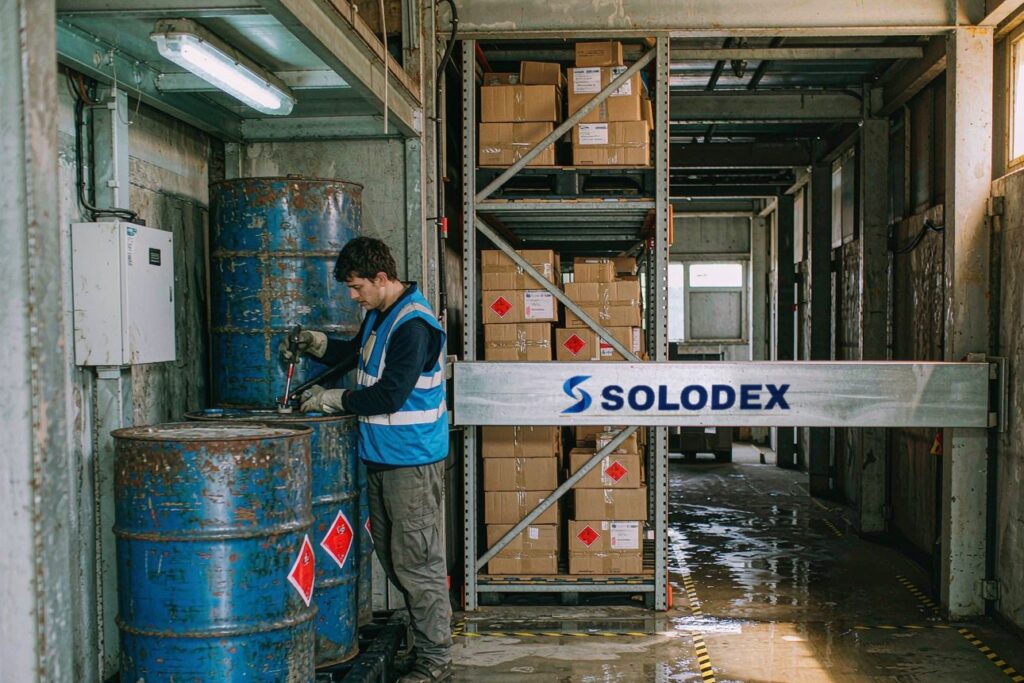
The product was a cleaning agent. The factory had exported it for ten years, always under the same description, always as general cargo, and never once had a problem. Then a forwarder asked a question nobody had asked before: what is the flash point?
Nobody knew. The safety data sheet was three revisions old and section 9 said “not available”. The factory’s technical manager thought it was water-based. The buyer’s specification said solvent-based. Two days later a sample went to a lab and came back at 21 degrees Celsius, closed cup.
That number moved the shipment from general cargo to Class 3, packing group II, and the freight went up by a multiple that had nothing to do with weight. Ten years of uneventful shipping is not evidence of anything. It is evidence that nobody had asked.
Three numbers, not a product name
Whether a liquid is dangerous goods is decided by three measurements, and none of them is the name on the carton.
The flash point, closed cup. The lowest temperature at which the liquid gives off enough vapour to form an ignitable mixture just above its surface. It is not the temperature at which the liquid catches fire — that is the fire point, and it is higher. The flash point is the temperature at which the vapour is already there.
The initial boiling point. The temperature at which the liquid begins to boil, which is what separates the most dangerous packing group from the middle one. A liquid with a flash point of 20 and a boiling point of 40 is a different problem from one with a flash point of 20 and a boiling point of 120, even though the flash point is identical.
The closed or open cup question. The same liquid measured in an open cup reads higher — often by five to fifteen degrees, because vapour escapes instead of accumulating. Which means a report that says “flash point 26” without saying which method produced a number that might be 14 on the other apparatus. The method is part of the measurement, not a footnote.
Where the line falls
Class 3 is divided into three packing groups, and the boundaries are arithmetic.
| Packing group | The numbers | What it means in practice |
|---|---|---|
| I | Initial boiling point 35 °C or below | The most dangerous; small quantities, strict packaging, and many carriers will simply decline |
| II | Flash point below 23 °C, boiling point above 35 °C | The common middle case for solvent-based products; UN packaging, dangerous goods declaration, surcharge |
| III | Flash point from 23 °C up to 60 °C | Still regulated, but with larger limited-quantity allowances and wider carrier acceptance |
Above 60 °C closed cup, a liquid leaves Class 3 — although several jurisdictions still treat it as a combustible liquid with their own storage and handling rules, so “not Class 3” is not the same as unregulated.
Two degrees is the whole difference between group II and group III, and between a booking that is accepted and one that is refused. This is why the number matters more than the description, and why a specification that says “solvent-based” without a flash point is not a specification.
Why the name on the carton is the least useful thing on it
Product names are commercial. Classification is physical. The gap between them is where most dangerous goods problems begin.
A water-based cleaner with five per cent solvent added for degreasing can cross the line. A “lubricant” can be a Class 3 liquid or an unregulated oil depending on the base. A “sample” of perfume is a Class 3 liquid in a glass bottle, and the fact that it is a sample changes the quantity, not the class. And a product sold in two concentrations under one name — concentrate and ready-to-use — is two different classifications with one part number.
The usual mistake is asking the factory whether the goods are dangerous. The factory answers a different question: whether they have ever had a problem. Those are not the same question, and the second one has a survivorship bias built into it, because the shipments that did have a problem are the ones that stopped.
The safety data sheet is a clue, not a verdict
Every exporter has an SDS, and almost nobody reads section 9. That is the section with the flash point, the boiling point, the pH, the density and the vapour pressure, and it is the only part of the document that answers the transport question.
But an SDS is a chemical information document. It is written by the manufacturer, it is not testing, and it is frequently inherited — a formulator copies the section from a supplier’s sheet, the supplier copied it from the raw material producer, and the numbers drift with each transcription. Section 9 entries of “not available” and “not applicable” are extremely common and mean exactly what they say.
What a carrier wants is a transport classification: a report from a laboratory, produced against the UN test methods, stating the class, the packing group and the proper shipping name. Who actually tests what is a separate confusion, and the two are often assumed to be the same visit. That document is a verdict. The SDS is the evidence that led to it, and the two are not interchangeable. A safety data sheet also does not register a product, which is a separate problem that appears at the destination rather than at the port.
The report also has a shelf life. Two years is the usual convention, which means a product that has not changed since 2021 still needs a fresh one, and a product that has changed formulation needs one immediately — even if the change was a supplier substitution nobody documented.
Water-based is a marketing word
Almost every refusal starts with a sentence like “but it is water-based”. That phrase describes the carrier liquid. It says nothing about the flash point, because a water-based product can still carry enough solvent to ignite, and a solvent-free product can still be regulated for other reasons — pH, reactivity, or a biocide that has its own entry in the dangerous goods list.
The reverse is also true. A product described as “solvent-based” is not automatically Class 3; the question is which solvent, at what concentration, and what the mixture’s flash point turns out to be once the other ingredients are in it. Mixtures do not average their components in any intuitive way.
Which is why the sentence to remove from the conversation is “it is only water-based”, and the sentence to add is “the flash point is X, closed cup, measured on this formulation on this date”. One is an opinion about a product. The other is a measurement of it, and only one of them survives contact with a terminal.
The same liquid, four ways to move it
Classification is one axis. Mode is another. The same packing group travels very differently depending on how it is booked.
Full container. The most straightforward route: a dangerous goods declaration, UN-certified packaging, the correct marks and labels, and a carrier that accepts the class. Segregation from other cargo in the same box still applies.
Less than container load. Here the constraint is not the regulation but the consolidation. A groupage operator has to co-load your Class 3 with thirty other shippers’ cargo, and many will decline rather than manage the segregation. Those that accept charge for it.
Air. Stricter on every dimension: smaller quantity allowances, more paperwork, and a state-of-charge or pressure test that sea freight never asks for. Some classes are effectively barred from passenger aircraft and only move on freighters.
Express and parcel. The networks that move e-commerce volumes screen by commodity code and will reject a Class 3 liquid above a small threshold, regardless of the paperwork. This is the mode where a mis-declared shipment is most likely to be discovered, because the screening happens on every piece rather than on a sample.
Which is why liquids in small parcels appear to travel freely while the same liquid in drums needs a week of preparation: the rule did not change, the quantity did. Limited quantities allow a shipment to move under reduced requirements below a stated net quantity per inner packaging — one litre for packing group II, five for group III, under the UN model regulations — and that is a real exemption, not a loophole. It stops being available the moment the packaging gets bigger.
Segregation is a second question
“Can it be shipped” and “can it be shipped with this other cargo” are different questions, and the second one is asked later, usually by somebody who has already booked.
Class 3 liquids have to be kept apart from oxidising agents, and the required distance depends on the mode and on the quantities. In a full container the stow is planned around it. In a groupage box somebody else’s cargo arrives after yours is loaded, and the plan has to accommodate a shipment you have never seen.
This is the practical reason a forwarder asks what else is in the container even when you have booked the whole box: the answer changes what can be loaded next to you, and the answer is not something the shipper can control once the container leaves.
What the classification actually costs
The lab report, the UN packaging, the marking and labelling, the declaration, and the surcharge are all visible. The invisible cost is the schedule.
A dangerous goods booking needs a carrier that accepts the class on that route, a vessel that accepts it on that sailing, and a port that accepts it in that terminal. Any one of those can remove a week. A product that was booked on Thursday for a Tuesday sailing becomes a product booked for the following month, and the buyer’s production line does not care why.
There is also the option nobody prices: reformulating. A solvent-based product that moves to a water-based formulation with a flash point above 60 °C stops being Class 3 entirely. That is a decision for the product, not the shipment — and it is usually cheaper than a decade of surcharges, which is why the question belongs in development rather than in logistics.
Five questions to answer before asking anybody
Most of the delay in a dangerous goods shipment is spent in a loop: the forwarder asks the factory, the factory asks the trading company, the trading company asks the buyer, and the answer comes back as “it is not dangerous”. Breaking the loop costs one email.
What is the flash point, and by which method? Closed cup, with the apparatus named.
What is the initial boiling point? Because it decides between group I and group II at a flash point under 23.
How much is in each inner packaging? Not the total. The inner. That number is what the limited quantity allowance is measured against.
What is the packaging, exactly? A UN-certified drum or jerrican has a code that states the type and the packing group it is tested for. A code that does not cover the group is not packaging, it is a container.
When was the transport classification issued, and against which formulation? Two years is the convention, and a formulation change resets the clock whether or not anybody noticed.
None of these needs a consultant. All five are on documents the factory already has, or should. The only thing that has to change is who is expected to look.
The decision was made on the formulation sheet
By the time a booking is refused, the classification has been fixed for months. It was fixed when the formulation was signed off, when the solvent percentage was chosen, when a supplier was swapped for a cheaper one with a slightly different base.
Which is why the useful time to ask about flash point is not before shipping. It is before the product exists — and the second most useful time is now, on every product already in the catalogue that has never been asked about. The banned list is short and easy to check; the class 3 list is long, quiet, and decided by two numbers on a sheet nobody reads.
The same logic runs through the rest of this series: batteries are five documents with five signatories, aerosols and alcohol have their own allowances, and the cargo that is merely too big has an entirely different set of limits. In every case the answer was determined upstream of the booking, by somebody who was not thinking about shipping at all.
Magnets sit at the other end of the same logic: no fire, no packing group, and still a measurement with a threshold — a field of 0.418 A/m at 2.1 metres decides whether the box flies.
The same liquid changes class when it changes container: aerosols are a gas, not a liquid, and the allowance that lets a small pack travel is measured in litres per inner packaging.
Coolant is the clearest case of goods that are not dangerous travelling as goods that are: the shipment becomes Class 9 because of what is packed around the product, not because of the product.
One item can reclassify the whole load here as well: a single unsecured carton sets the security status of the entire pallet, and the aircraft does not average.
There is a second pattern worth knowing: sometimes the substance is harmless and the shipment is not, because the classification is carried by an accessory.
And one case sits outside the usual question of whether the goods are dangerous: when the packaging is the container itself, the requirements attach to the unit rather than to a package.
The same question can be decided by a component rather than a substance: a machine is classified by the gas sealed inside it, and the nameplate is the document that says which.
One category is unusual because the packaging and the cargo are the same object: a cylinder is both, so the rules attach to the thing you can see.
And one family of products is dangerous goods in almost every configuration: a battery is a container of acid that happens to have a job.
And one category is not regulated by what it contains at all: it is regulated by what will happen to it next.
The smallest unit of the problem is a product you would not think to ask about: the threshold is applied to the package, not to the cartridge.
One family of products fails a different test than “is it dangerous”: is it admitted at all – and the second question is asked by a different agency.
One family of products is regulated by a constituent rather than by the article: the dangerous goods question starts from the substance, and everybody in the transaction starts from the part.
Class 7 is the one class where the paperwork can be entirely absent and the goods are still regulated: the excepted package.
Division 2.2 is the quietest class in the book, and it still has an entry for articles that hold gas rather than receptacles that do.
The most common classification error is not a wrong flash point but a wrong object: a cloth soaked in alcohol is a solid containing a flammable liquid, and the data sheet describes the solution, not the article.
Dangerous goods classification follows flash point and properties, not the size of the vessel; an entirely ordinary food oil becomes a structurally unusual shipment when its boundary is borrowed.
Dangerous goods are judged by composition rather than by a product name; temperature-controlled cargo has a similar need to name the object, since a set point, a supply air reading and a probe inside a pallet are three different subjects.


