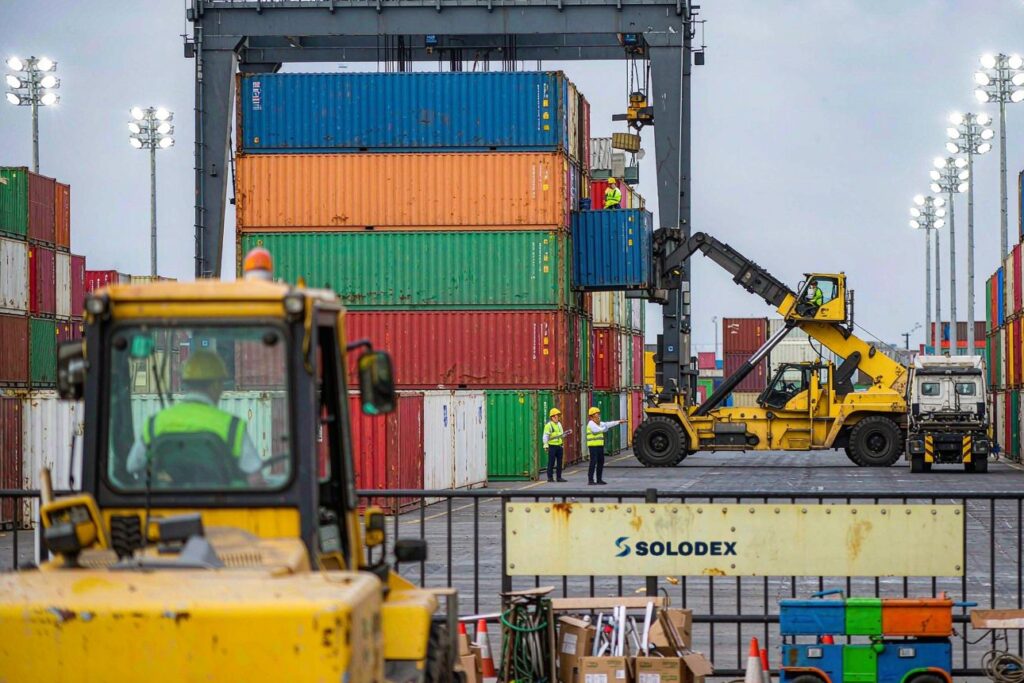
The yard inventory gave the position as bay 14, row 03, tier 2. The release said the box had been available since Tuesday at 09:10. A truck holding a confirmed 14:30 appointment on the Thursday left the gate at 16:05 without it.
Nothing in those three records contradicted anything else. The container existed, it had been grounded, the carrier had released it, and the terminal had sold a slot to collect it. What stood between the records and the truck was physics. Two 40-foot boxes discharged from a different vessel eighteen hours later had been placed on top of it on the Wednesday. A straddle carrier had to move both before the Tuesday box could be lifted, and then set one of them back. Three moves were logged against three container numbers. The available time did not move by a second.
The box was therefore available for three days and reachable for about forty minutes. That gap is ordinary terminal work, and it has almost no presence on the paperwork a shipper sees. A yard is not a shelf where a container is filed under a reference and fetched on request. It is a stack that is rebuilt all day, in which the position of one box decides how much work every other box needs. The vessel, the box and the truck each have a timetable. The yard has a fourth one, and it is written in coordinates rather than dates.
What a yard slot actually names
Ask where a container is and most people expect an address: a terminal name, perhaps a row of boxes visible in a photograph. The terminal’s own answer is three numbers. Bay identifies a position along the length of a block, row gives the width across it, and tier counts height from the ground. A grounded import box at bay 14, row 03, tier 2 is the second box up in the third row of the fourteenth slot along that block.
That triple is not printed on a bill of lading, a delivery order or an arrival notice. It lives in the terminal operating system, where it is written when the box is put down and rewritten every time the box is moved. It is an instruction to a machine, not a statement to a customer. When a tracking page says a container is at the port, it is compressing a coordinate, a release status, an appointment state and a piece of equipment availability into one friendly phrase.
Blocks are segregated before any of that happens. Import full boxes, export full boxes, transhipment boxes, empties, reefers, hazardous cargo and units waiting for inspection are normally kept in separate areas, because each group needs different equipment, different access and different paperwork. A consignee who asks why their box cannot simply be moved nearer the gate is asking the yard to break a segregation rule that exists for safety and for the next vessel’s load plan.
The coordinate also carries an unstated cost. A box on tier 1 can be picked up by one lift. A box on tier 2 needs the box above it moved first. That is why a yard planner cares about the order in which boxes will leave, and why a shipper who only knows the container number is missing the one fact that determines how long the pickup will take. The twelve boxes on one bill of lading already arrived at twelve different times, because stow positions in the ship decided the order of the lifts. Grounding simply continues that sequence in three dimensions instead of one.
Why your three boxes are not neighbours
A consignment of garden tools, hose reels and flat-pack outdoor furniture filled three containers: one 20-foot box of dense metal hardware and two 40-foot high cubes of light bulky goods. On paper they are one shipment, one bill, one consignee, one delivery plan. In the yard they were three unrelated problems.
The heavy 20-foot box was grounded in a low tier, because a yard does not put dense units on top of light ones and does not waste a ground slot on a box that will leave in a fortnight. The two high cubes landed in different blocks, one because it was discharged on the evening shift when the import block nearest the gate was full, the other because a customs examination hold had been raised against it before the truck appointment was even discussed.
Three forces pull boxes apart. The first is time: discharge order spreads one bill across a shift, and each grounding goes to whatever slot is open when the carrier arrives at the stack. The second is weight and height: stacking rules, container lengths and the reach of the handling equipment decide which tier a box can occupy. The third is the next event: a box held for inspection, a box booked for a rail departure and a box waiting for a consignee’s own truck are placed with different access in mind.
None of those three forces reads the bill of lading. The terminal system reads a container number and a set of attributes attached to it. A shipper who assumes the three boxes are standing together will plan one appointment, one truck and one unloading crew, and will discover the arrangement at the gate. Once a box is on the quay, a series of gates takes over, each with a release, a document and a clock of its own. The decision that separated the three boxes happened before the first of those gates, at the moment each was put down.
Available is a word, reachable is a position
Availability is a status in a carrier and terminal system. It normally means the box has been discharged, grounded, released and notified. It is a legal and commercial fact, and the start of free time is a question about that event, not about the vessel’s arrival. Reaching the box is a different kind of fact entirely: nothing is stacked above it, equipment is free to work that block, a truck has a valid appointment, and the gate can process the move.
Put the common mismatches side by side and the pattern is obvious. In every row the paperwork is correct and the box still cannot leave.
| What the record says | Where the box actually is | What has to happen first |
|---|---|---|
| Available since Tuesday 09:10 | Tier 2 with two boxes above it | Two rehandles, then the pickup lift |
| Released and customs cleared | In an examination block off the truck lanes | A shift move into a pickup-eligible block |
| Grounded, import full | Behind a working gantry during a vessel call | Wait for the block to be released to road traffic |
| Appointment confirmed for 14:30 | Anywhere in the yard; the slot is for the truck | Match the appointment to a reachable box, not just a released one |
| Empty return accepted | In a stack of empties waiting for a carrier allocation | Rehandle to the top before it can be loaded out |
| Transhipment box, connection booked | Under export boxes for a different sailing | Reshuffle into the onward vessel’s load sequence |
| Part of a three-box consignment | Three coordinates in two blocks | Three separate pickup events, not one |
Read the fourth row carefully, because it is the one that generates the most wasted truck visits. An appointment system allocates a time window for a vehicle at a gate. It does not, in most terminals, reserve a specific box in a specific stack, and it does not promise that the stack has been dug out. A booking can be valid in every respect while the cargo is still underneath two containers belonging to somebody else.
The move that has no timestamp
Moving a box out of the way so that another box can be lifted is called a rehandle, a shift or a reshuffle depending on the terminal. It is a real move, performed by real equipment, logged with an operator, a machine number, a time and a pair of coordinates. It is also invisible to the consignee, because it creates no new status on the container. The box remains discharged, grounded, released and available. Nothing about its paperwork changes.
The Thursday pickup ran as a short sequence, and the order of it explains why a confirmed slot can still fail.
- The truck books the 14:30 appointment against the container number on Tuesday evening.
- On Wednesday the yard grounds two later boxes in the only open slots in that block, placing them on tier 3 and tier 4 above the Tuesday box.
- At 14:20 on Thursday the carrier’s job is created. The system now needs a box at bay 14, row 03, tier 2.
- A straddle carrier lifts the tier 4 box and sets it down in bay 16, row 02, tier 3.
- The same machine lifts the tier 3 box and places it in an adjacent slot.
- The Tuesday box is finally lifted onto the truck chassis at 15:10; the driver reaches the gate at 16:05 and the appointment window has expired.
- The tier 3 box is moved back on top of the now-empty tier 1 slot to keep the block dense.
Seven steps, three of which are moves of containers nobody ordered. Only step six shows up on a consignee’s tracking page, and it shows up as a gate event rather than as a yard operation. The rehandle log is where the rest of the story lives: container number, from-position, to-position, machine and time. It is the field that explains a two-hour delay that no status message ever mentions.
There is a useful boundary here. Congestion is a weeks-long loop in which berth waiting, yard density and truck appointments reinforce one another. That explains why a port has a bad month. It does not explain why one box on one afternoon needed three moves. The first is a market cycle; the second is a single coordinate.
The export side is stacked backwards
Import boxes are positioned by what has already happened to them. Export boxes are positioned by what is expected to happen next. A yard planner building a stack for a sailing works from the load plan: boxes loaded early go where they can be reached early, boxes loaded late can sit lower and further in, and a heavy unit goes where the vessel’s stability plan and the terminal’s weight rules allow it.
That is why delivering a box early does not buy it a good position. The first export box to arrive for a sailing may be placed deep in a block because the planner expects a dozen more and needs to keep the working face clear. A box delivered on the last day of the receiving period may be put near the top precisely because it will be among the first lifts. The gate-in time and the stack position answer different questions.
The receiving period, with its gate, mass and documentation cut-offs, belongs to the booking window and is owned by several parties. The point here is narrower: those deadlines exist partly so the yard has enough time to arrange the stack, not merely so the box exists before the ship. A container accepted at the last permitted minute is a container the planner has had no opportunity to place well.
The same logic produces the familiar distinction between a box that missed the cut-off and a box that was accepted but not loaded. A rolled container has a position in a yard and a problem belonging to the next sailing. A container that never reached the gate has no position at all. Tracking feeds tend to report both as not on the ship, and only one of them occupies a slot somebody else now has to work around.
What the appointment system cannot see
Book a truck and the terminal asks for a container number, a booking or release reference, a time window and a haulier. It generally does not ask whether the box is on top of its stack, because that condition changes hour by hour and is not something a consignee can control. The slot is therefore a reservation of gate and equipment capacity, not a reservation of a specific reachable box.
This is the mechanism behind a particular kind of wasted day. The driver arrives with the right reference, the release is valid, the appointment is confirmed, and the job is still refused or delayed because the stack has to be dug out and the machine working that block is committed to a vessel call. A missing chassis or a scarce appointment is a separate constraint again, attached to equipment rather than to a position in a stack. Both produce the same outcome at the gate, and they need different questions to diagnose.
Ask the terminal or the forwarder one plain question when a pickup fails: was the container available, and was it reachable? Those are two different records. The first comes from the release and availability events. The second comes from the yard inventory and the rehandle log. Collection and empty return are two separate moves with their own paperwork and their own clocks, and a rehandle belongs to neither of them. It is work done to the stack, not work done to the shipment.
The cost of the confusion is rarely a fee line. It is a second truck visit, an expired appointment, a driver waiting beyond free time at the gate, and a warehouse crew booked for an afternoon when the cargo arrives in the evening. A delivery promise is an interval with a stated start event, and quoting an average transit time as a date is what makes such promises fail. A promise built on availability alone has a start event that says nothing about whether a machine can reach the box.
At a hub, the position is borrowed from the next ship
At a transhipment port the yard is not a waiting room for trucks. It is a buffer between two vessels. A box discharged from a mother vessel is grounded, matched to a feeder or onward service, and placed so it can be pulled into that vessel’s load plan before the onward receiving period closes. Its position is chosen for a ship that has not arrived yet.
That produces a subtle kind of lateness. The inbound leg can finish perfectly, with a discharge event well inside the berth window, and the box can still be buried under export units because the onward connection was scheduled for a later date. Every day it waits is real time in the yard, but no new document marks the beginning of that wait. The availability event belongs to the inbound leg; the position belongs to the outbound one.
Rail repeats the pattern with a different vehicle. An inland ramp is a yard with a timetable, where being cleared and grounded in a retrievable position still does not put a box on a train. At a sea terminal the equivalent is a box that is cleared, released and appointed, but sitting under three containers whose connection leaves tomorrow. The four timetables are aligned by nobody in particular, and the consignee sees only the gap they leave behind.
Four fields before you promise a pickup
The check is short, and it uses records that already exist. First, find the grounding position: bay, row and tier as recorded when the box was put down, plus any later position changes. If the box is not on the top of its stack, the pickup needs at least one rehandle, and the number of boxes above it is a rough measure of how long that will take.
Second, read the availability event against the container number rather than against the vessel. That is the field that opens free time and makes the release usable. The documents that decide who is entitled to take delivery are a separate matter, and paper can be slower than the physical box. A valid release with a buried container is a valid release with a queue in front of it.
Third, ask for the shift or rehandle history of the stack. It will show whether the box has already been dug out once, whether the block is being worked for a vessel call, and how many moves stand between a truck booking and a lift. This is the record that turns “the terminal is slow” into a specific number of machine moves.
Fourth, match the appointment window to the gate-out event, not to the availability time. A confirmed slot is a promise about a truck at a gate. Only the gate-out record confirms that the box, the equipment and the position all came together at the same hour.
None of this requires a new form, and none of it changes how a yard is worked. It changes which of the four timetables gets quoted when somebody asks when the goods can be collected. On the receiving end, a dock that cannot accept a delivery is a schedule problem rather than a distance problem, which is one more reason not to build a plan around a single confident date.
The yard is a stack, not a shelf: the vessel has a berth window, the container has an availability clock, the truck has an appointment, and somewhere underneath all three a machine has to move two other boxes before yours can be lifted.
A grounded box gets a coordinate and a rehandle log; an export box also has to be on the load list of a call worked for loading, which a discharge call at the same berth never provides.
A grounded box gets a bay, row and tier, and a rehandle log when it has to be dug out; that coordinate is one line in a longer equipment history that began with an empty release and a condition code.
A grounded box collects a bay, row and tier and a line in the move log every time it is rehandled; those rows are events, and the days between two of them are written only in the report that joins the yard table to the gate table.
Yard positions are ordered by what must move next; on board, the tier in a cell is also a height above the keel, and that height is what turns a gross mass into a weight moment.


