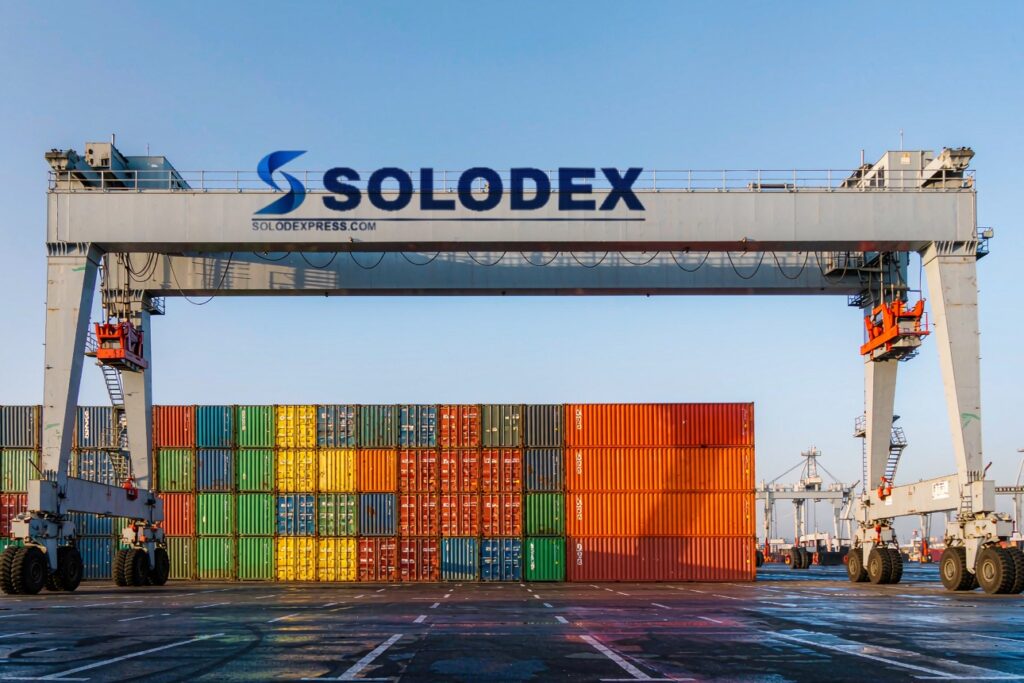
In most industries a booking is a reservation. In liner shipping it is a claim, and the claim is only settled at the moment the container goes over the rail and the vessel sails. Everything before that — the confirmation email, the booking number, the space confirmed in the system — is an intention held by two parties who both know it can still fail.
This matters because the language used in the trade makes no distinction. “I’ve booked it” can mean three different things depending on who is saying it, and the price being compared across three forwarders is often not the same product. One is selling a rate. Another is selling a rate plus a booked slot. A third is selling a rate, a slot and an undertaking to compensate you if the slot disappears. They cost different amounts because they are different things, and the difference only becomes visible in the week it matters.
A booking is a claim, not a reservation
There are three states a shipment passes through, and only the last one is real.
Requested. A booking number exists in a carrier system. Space has been asked for and not yet allocated. This is where most “confirmations” sent on a Friday afternoon actually sit, because the allocation happens when the carrier runs its planning, not when the email is written.
Confirmed. Space has been allocated to that booking on that vessel. This is a real commitment from the carrier to the forwarder, and it is also the level at which overbooking lives: more space is confirmed than the vessel can take, on the reasonable assumption that some cargo will not arrive.
Loaded. The container is on board, the vessel has sailed, and the bill of lading has been issued. This is the only state that a shipper can plan against.
The practical consequence is that a booking confirmation tells you about a probability, not a fact. In a normal month that probability is 95 per cent and the distinction is academic. In a peak month it can be 65 per cent, and every decision that assumed certainty turns out to have been made on a number nobody quoted.
Three cut-offs, three owners
The other reason bookings fail is that three deadlines govern a single shipment, each enforced by a different party, and each with a different failure mode.
| Deadline | Who enforces it | Typical timing | If you miss it |
|---|---|---|---|
| Documentation cut-off (SI) | Carrier or co-loader | 24–48 hours before departure | Container sails but cannot be released at destination |
| Customs cut-off | Broker and terminal system | 24–36 hours before departure | Container is not cleared to load; held at gate |
| Gate-in cut-off (VGM and CY) | Terminal | 12–72 hours before departure | Container is refused and rolls to the next vessel |
The order is counter-intuitive. The deadline that stops the physical container is usually the earliest, and the one that stops the paperwork is usually the latest — so a shipper who is organised about documents and late about trucking loses the sailing, while a shipper who is early with the container and late with the SI watches their cargo leave without a bill of lading. Both failures cost roughly the same, and both are usually discovered by the forwarder at 5pm.
The useful discipline is to write all three times into one line per shipment, with the time zone of the port of loading rather than the shipper’s, and to treat the earliest of the three as the real deadline. Most booking sheets show only the departure date, which is the one number that cannot be acted on.
What a guarantee actually buys
Carriers and forwarders sell three different things under the word guaranteed, and only one of them is worth paying for in a given week.
Space guarantee. The carrier commits that the container will be on the named vessel or pays a penalty — usually a fixed amount per container, occasionally the difference in freight. This is the strongest form and the most expensive, and it is usually available only on contract volume.
Equipment guarantee. The box is reserved, not the slot. This is the clause that keeps its value longest after a route diversion, because empty containers end up in the wrong hemisphere for months after the ships do. This matters more than people expect in the weeks after a congestion event, when empty containers are in the wrong hemisphere. A booking without equipment is a booking for a container that does not yet exist.
Priority or allocation status. The forwarder has a contractual allocation with the carrier and puts your booking into it. Nothing is guaranteed in writing, but the practical probability rises sharply. This is what most “premium” services actually sell, and it is worth what the forwarder’s allocation is worth — a question that can be tested, as the last section describes.
Everything else — early booking, a good relationship, an account manager who says they will look after you — is a soft claim. Not worthless, and not something to build a season on.
The arithmetic of paying for certainty
Whether a guarantee is worth its premium is a multiplication, not an argument.
Expected loss equals the probability of being rolled multiplied by the cost of being rolled. If that number exceeds the premium, buy the guarantee; if it does not, the premium is buying comfort rather than value.
| Shipment | Cost if rolled | Roll probability | Expected loss | Premium | Decision |
|---|---|---|---|---|---|
| Routine replenishment, long shelf life | $600 | 20% | $120 | $250 | Do not buy |
| Routine replenishment, peak month | $600 | 45% | $270 | $250 | Buy |
| Seasonal first order | $4,000 | 20% | $800 | $250 | Buy |
| Seasonal first order, peak month | $4,000 | 45% | $1,800 | $700 | Buy, and book two sailings |
| Sample or replacement part | $150 | 30% | $45 | $250 | Never buy — use air |
Two rows carry the lesson. The same $250 premium is a bad buy in the first row and an obvious one in the third, because the cost of being late is not a property of the freight — it is a property of what the cargo is for. And the last row is the one people get wrong: for cargo whose delay costs less than the guarantee, the correct response to a roll risk is neither to pay nor to wait, but to change mode.
The variable that is hardest to estimate is the roll probability, and it is also the one that can be read from the market rather than guessed. It rises with the two signals described in the congestion cycle: blank sailings and berth waiting. When either appears on your trade, the probability has already moved and the premium has usually not caught up.
Booking earlier stops helping after four weeks
There is a widely held belief that booking earlier is always safer. It is true up to a point and counterproductive after it.
Inside four weeks, earlier booking raises the probability of allocation, because you are competing for space that exists. Beyond about six weeks, the booking sits in a system for a long time before the carrier plans the vessel, which makes it easier to treat as a placeholder when space is short. Some carriers sweep long-dated bookings precisely for this reason, and a booking made in week minus eight is not obviously safer than one made in week minus three.
The useful rule is to book at the point where the carrier’s allocation for that vessel is actually being set — usually three to four weeks out on the major trades, two weeks out in a tight market — and to re-confirm the booking in the week of departure rather than assuming the earlier confirmation still stands. Re-confirmation is a thirty-second email and it is the single highest-yield action in this whole process.
The booking window and the pricing window are different clocks
Two timelines run in parallel and they are frequently confused: when space is available, and when the price for space changes.
Space tightens as the vessel fills, which is a physical process that runs right up to the cut-off. Price moves on a different rhythm, driven by general rate increases and peak season surcharges announced in advance with effective dates. A shipper who watches the price to decide when to book is watching the wrong clock, and usually books one week after the space became scarce, at a rate that has already moved.
The interaction is worth stating plainly: the cheapest week to book is before the surcharge takes effect, and the safest week to book is after the space starts to tighten. Those two weeks are usually not the same week, and when they are not, the decision should default to safety for anything with a date and to price for anything without one. The surcharge calendar tells you the first date; the sailing advisories tell you the second.
A booking sheet with seven fields
Most booking errors are not judgement errors; they are fields that were never written down. A booking sheet that carries these seven items prevents the majority of them.
- Vessel and voyage, not a week. A booking against a named sailing can be checked; a booking against “week 42” cannot.
- The three cut-off times, in the port’s time zone. Documentation, customs, gate-in — and the earliest one flagged as the real deadline.
- Equipment status. Confirmed, or pending. A slot without a box is not a slot.
- Booking state. Requested, confirmed, or loaded — written down as of the date the sheet was last updated.
- Guarantee type and price, or “none”. Space, equipment, allocation, or nothing. Writing “none” is what makes the risk visible.
- Roll plan. The next sailing on the same service, and the one on a different service, with their dates. Deciding this in advance turns a crisis into a phone call.
- Who confirms. A named person at the forwarder, not an inbox.
None of these fields is difficult to obtain. All of them are routinely absent, which is why the same conversation happens every peak season: the shipper believed they had space, the forwarder believed the cargo would arrive in time, and the carrier did what carriers do when a vessel is over-committed.
Three questions that reveal whether your forwarder has space
Allocation is the part of a forwarder’s offer that cannot be seen from the outside, and it can be tested with three questions that have factual answers.
“Which vessel and voyage is my booking on, and what is its current status?” A forwarder with real allocation can answer from a screen. One without will answer with a week number.
“If this booking is rolled, what is the next sailing on the same service?” The answer takes ten seconds if they know the service, and it reveals whether they are selling you a slot or a hope.
“What was your roll rate on this trade last month?” Not a number anyone publishes, and one that a good forwarder can approximate from their own bookings. A forwarder who cannot answer at all is telling you something.
The rates quoted in answer to these questions are worth less than the answers themselves, which is the point of this article: the quote describes the price of moving a container, and none of these three questions is about price.
Several parties own the cut-offs that sit inside a booking window; those cut-offs are counted backwards from the berth window that also gives every import box its discharge timestamp.
Three cut-offs with three different owners surround a booking; each of them belongs to a numbered call, so a port with two calls in one rotation has two different receiving periods under the same port name.
A booking is a claim on space with three cut-offs attached to it; it is also a quantity without identities, because the container number field stays blank until an empty release nominates a physical box.
The booking window is where cut-offs and carriage terms are fixed; a set point is one of those terms, written by a shipper as a target for the air, and it has no sensor behind it.


