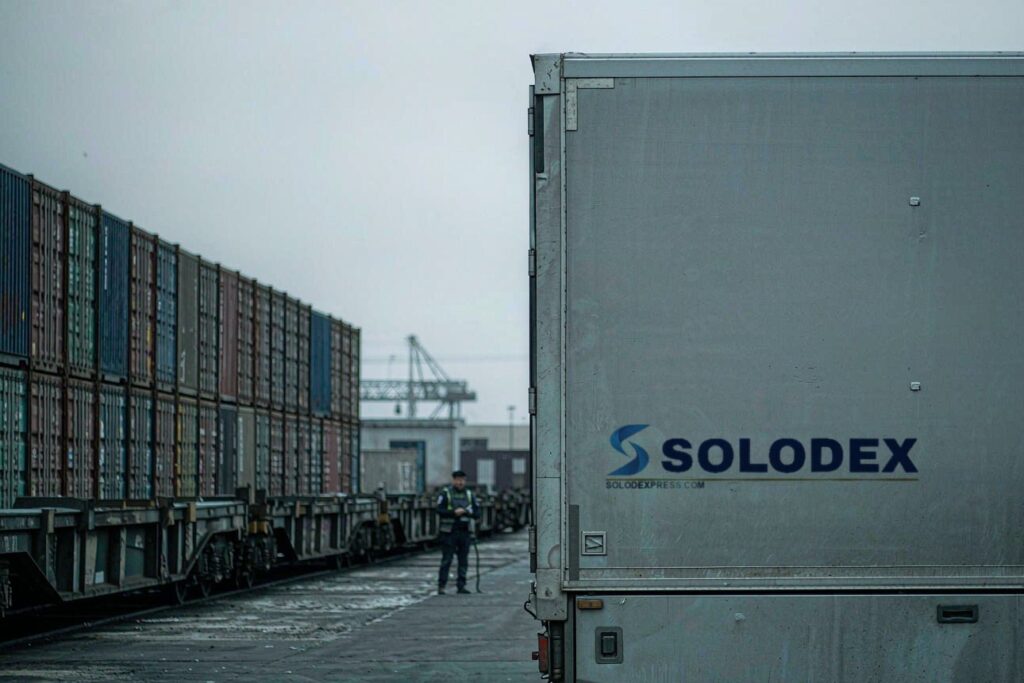
Two quotes arrive for the same forty-foot container, same origin warehouse, same destination city. Rail is 3,800 dollars and twenty-two days. Truck is 6,200 dollars and fourteen days. The difference looks like a straightforward trade of money for time, and the cheaper option looks obvious.
It is obvious only until somebody reads what each quote covers. The rail figure is station to station: it ends when the container is lifted off the wagon at a rail terminal on the edge of the city, and it begins when the container is accepted at a rail terminal near the port. Everything between those terminals and the two warehouses is somebody else’s problem, and it is not in the number.
The truck figure is door to door, driver waiting, customs paperwork in the cab. The two quotes are not two prices for one service. They are prices for two different products, and the comparison that matters is not the one on the page.
Rail sells slots, road sells days
This is the distinction underneath every other difference in this article. A rail service is a scheduled slot on a train that departs whether or not your container is on it. A truck is a vehicle that departs when it is loaded and full.
A slot has a departure day, and the departure day is not negotiable. Miss it by four hours and the cargo waits for the next train, which on a secondary corridor can be a week later. The economic benefit of rail comes from filling a train, so the schedule is built around the train rather than around any individual shipper — which is efficient at the level of the corridor and unforgiving at the level of one container.
A truck has no schedule, which sounds like an advantage until you price it. The vehicle is yours for the day whether it moves or waits, the driver’s hours are regulated, and the return leg has to be paid for by somebody. Road freight into an inland market is expensive largely because the truck comes back empty, and the loaded container carries the cost of the empty one.
So the real question is not which is cheaper per kilometre. It is whether your cargo can be made to fit a rail unit — one container, one departure, no changes — and whether the money you save survives the two ends that the rail quote left out.
What the rail quote leaves out
Four items, and on a short inland leg they can consume the entire saving.
Getting to the terminal. A drayage move from the port or the factory to the rail yard, which is a truck journey of between five and eighty kilometres, priced like a truck journey and often subject to the same chassis and slot shortages as any other drayage. This is where the equipment problem bites hardest, because a rail terminal has a closing time and a truck that arrives late is a container that misses a train.
Waiting for the departure. Your container may sit in the terminal yard for several days before its slot. That is storage, and it is charged, and it is also time your cargo is not moving while your inventory clock is.
Getting out at the far end. A rail terminal is not a warehouse. There is no loading dock at container height, no forklift waiting, and no receiving clerk. The container has to be collected on a chassis, which has to be booked, and then delivered — a second drayage move, in a market where you have no equipment of your own.
The dwell on arrival. Containers accumulate at inland terminals when consignees are slow, and terminals respond by charging for the days beyond free time. Sitting on an inland ramp is a specific and expensive form of waiting, and it appears in nobody’s freight quote.
The gauge, and the two ways across it
Between China and Europe — the corridor that made block trains ordinary — the track changes width. Chinese and European networks run on 1,435 mm; the networks of the former Soviet states, Mongolia and Finland run on 1,520 mm. A container that crosses that line does not roll through. It is either lifted from one wagon to another, or the wagon itself is raised and its bogies swapped.
Lifting is faster per container and needs no special rolling stock: a crane takes the box off one flat wagon and sets it on another. A full train can be transferred in a few hours. The cost is handling — the container is picked up again, its twistlocks are released and re-engaged, and anything that was secured inside has now been through one more cycle of acceleration and shock.
Bogie exchange raises the entire wagon on a transfer stand and rolls one set of wheels out and another in. It takes longer per train and only works for wagons designed for it, but it does something lifting cannot: it never touches the load. The doors stay shut, the seal stays intact, and the cargo has no idea it changed countries.
That last point is the one that matters legally as well as physically. A seal cut for transloading has to be replaced and recorded, and every reseal is a point where a transit chain can lose its continuity. A bogie exchange leaves the seal alone, which is why sensitive or high-value loads often travel on services that use it, and why the choice between the two methods is a documentation question as much as an engineering one.
Reliability is not punctuality
Rail is usually described as more reliable than road, and the claim is true in a narrow sense that misleads people planning inventory.
Rail has low variance and large steps. A train that departs on Tuesday arrives on a predictable day, because nothing on the route can delay it the way a road can. But the distribution is not continuous: if you miss the slot, you do not arrive a day late, you arrive a week late. The average is good and the tail is brutal.
Road has high variance and no steps. A truck leaves when it is loaded and arrives when it arrives, and the variable is the border. A crossing that takes four hours on Tuesday can take three days on Friday, for reasons that range from a changed inspection regime to a strike to a queue that formed because a system went down. But the delay is incremental: a day here, six hours there, and you can usually see it coming on a tracking screen.
For a replenishment plan, the question is not which mode has the better average. It is which mode’s worst case you can survive. A retailer holding three weeks of cover can absorb a seven-day rail step. A retailer holding one week cannot, and will pay for the difference in stockouts regardless of what the freight saved.
The comparison that includes everything
Below is the same move read as a total cost rather than a freight rate. Read the rows as a checklist: any row you cannot fill in is a row where the cheaper quote is hiding something.
| Cost line | Rail, station to station | Truck, door to door |
|---|---|---|
| Line-haul | Lower per container, priced per slot | Higher, priced per vehicle and per day |
| Collection and delivery | Two drayage moves you arrange | Included, one vehicle end to end |
| Terminal handling | Lift on, lift off, plus storage before departure | None beyond loading and unloading at the two docks |
| Gauge change | Lift or bogie exchange, one or more times | None, but a vehicle change at the border is common |
| Border exposure | Fixed at scheduled inspection points | Variable, and the largest source of delay |
| Cargo handling events | Four to six per container | Two |
| Transit time | Longer, with a step-shaped tail | Shorter, with a flat but wide tail |
| Working capital in transit | Higher, by roughly a week of inventory value | Lower |
The last row is the one finance notices and operations usually does not. A week of extra transit is a week of inventory financed, insured and exposed, and on high-value cargo it can exceed the freight difference on its own. Which is why the rail-versus-truck decision cannot be made by the logistics desk alone: it is a working-capital decision wearing a freight cost.
Cargo that should not go by rail
Five exclusions, and the first is the one that surprises people who assume rail is always the sensible choice for heavy goods.
High value, low volume. If a container holds goods worth more than a hundred thousand dollars, the interest on a week of extra transit plus the risk of a missed slot usually costs more than the freight saved. Air freight is a different conversation; rail is simply the wrong trade.
Anything with a temperature or humidity requirement. A rail wagon has no power. A reefer container on a flat wagon needs a genset or a clip-on unit, both of which are available on some corridors, some of the time, from some operators. Assume nothing.
Out-of-gauge cargo. Rail loading gauges are tighter than road in the dimensions that matter, and an oversized machine that fits a low-bed trailer may not fit a flat wagon under a tunnel. This is discovered at the terminal, after the crane has already lifted it.
Dangerous goods. Rail carries them, but not on every service and not with every operator. Acceptance depends on the class, the packing and the corridor, and the answer is obtained per booking rather than from a tariff.
Cargo that has to be opened on the way. Anything requiring inspection, sampling, repacking or splitting mid-route should stay on rubber. A container on a train is difficult to reach, and reaching it usually means lifting it off, which converts a small operational need into a week.
There is also a structural limitation worth stating plainly. Rail works between terminals; road works between addresses. If either end of your move is a factory yard in an industrial estate with no rail siding, the road leg is unavoidable, and the question becomes whether the rail section in the middle is long enough to justify two transshipments. Below roughly 800 kilometres of rail, it rarely is.
Five questions that decide it
Can the cargo be made to fit one slot? One container, one departure, no splitting, no changes. If the answer is no, rail’s economics evaporate and you are buying a complicated truck.
How much of a step can your inventory absorb? Not the average transit time — the gap between a good week and a missed train. Cover that gap in stock or do not use the corridor.
Do you have equipment at both ends? A chassis, a drayage booking and somewhere to unload. An inland terminal is not a warehouse, and the last fifty kilometres are usually the ones nobody planned.
Can the cargo survive being handled four times? Count the lifts. If the count includes a gauge change by crane, add it to the damage risk and to the seal records you will need.
What is a week of your cargo worth? Inventory value times the cost of capital, plus the cost of being out of stock. If that number is larger than the freight difference, the cheaper quote is not cheaper.
And who holds the risk while the file is open? Whichever mode you pick, the cargo spends part of the journey in a legal state that no sales contract covers. That allocation is written by nobody and discovered by everyone, usually late.
Rail and road are usually presented as a price comparison between two ways of covering the same distance. They are not. One sells a scheduled slot between two terminals and leaves the edges to you; the other sells a vehicle that arrives at a door and charges you for the empty way back. Choosing well means pricing the edges, counting the lifts and deciding how large a step your business can step over — and none of that is on either quote.
A rail wagon has no power, so a temperature-controlled box needs a genset or a clip-on unit on that leg; keeping the machine supplied preserves its air record, while the goods continue to respond to their own thermal mass throughout.


