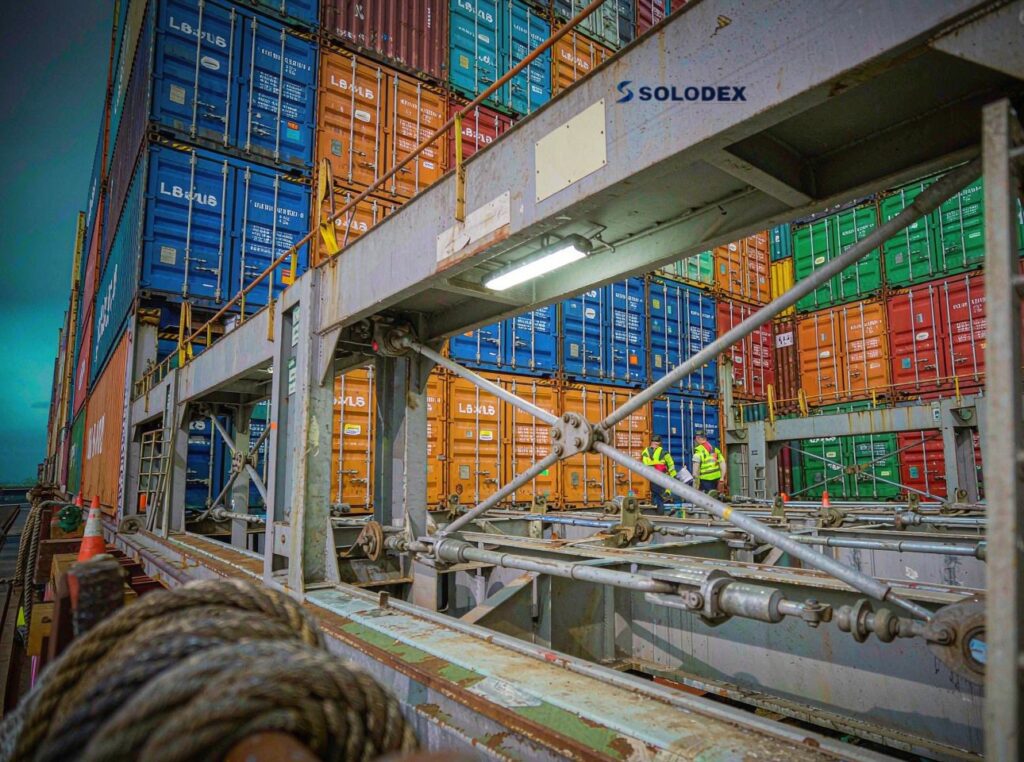
On voyage 041W, the calculation sheet for the stack at bay 14, row 06 had three lines. Transverse racking: 138 kN against an allowable 150 kN. Longitudinal sliding: 74 kN against 96 kN. Vertical lift: 41 kN against 62 kN. The four boxes in that stack weighed 88.6 tonnes together. Nothing on the sheet said whether the top box, SXDU 204871-0, was secured. It was not a question the sheet asked.
That is worth sitting with for a moment. A container on deck is held by twistlocks at its four corners, by rods and turnbuckles running down to a lashing bridge, and by the boxes beneath it. Yet the calculation that says the arrangement is safe is not written about that container. It is written about four containers treated as one column, and it is written three times, once for each direction in which the sea can push. A single box has no force of its own on this sheet. It has a tier, a weight and a position in a column that does.
This page is about that unit of account and about the three sets of numbers behind it. The figures above are illustrative and were chosen so the shape of the calculation is visible; the shape is what carries across vessels, trades and seasons. Only how cargo is carried is in scope here, not rates, claims or anything that happens after delivery.
What exactly is being held?
Stand on a lashing bridge and the eye sees a wall of boxes. The calculation sees a stack: a vertical column occupying one cell on the hatch cover or deck, bounded by four corner castings at each level, tied together by twistlocks, and restrained as a group by whatever rods, chains or bridge fittings the vessel’s approved arrangement provides. The stack is the object. A container is an input to it.
This is not a convention of wording. A box sitting at tier 88 cannot be restrained on its own, because the horizontal force acting on it does not stop at its own corner castings. It passes down through the twistlocks into the box at tier 86, then into tier 84, then into the deck foundation at tier 82. Each level passes on what it receives plus what it generates. If the third box in the column is a light empty, the column is still asked to carry the accumulated load of everything above it, and it is the corner posts of that light box which are checked against the number. Stacking strength is a property of a structure under load, and on a ship that structure is a column of containers, not a carton in a warehouse.
So the first line of the sheet is not “is this box tied down”. It is “what is the total mass of this column, where does its centre of gravity sit, and what acceleration will the ship impose at this bay”. The container number appears only later, as a way of checking that the VGM used in the sum belongs to the box actually planned for that tier. Securing cargo inside a box is a separate problem with its own straps and its own friction; it changes what the cargo does to the box walls, not what one tier does to the tier below.
Where do the three numbers come from?
Every vessel carries a cargo securing manual approved for that hull. One of its quieter tables gives acceleration coefficients by position along the ship. A stack near amidships experiences one set of transverse, longitudinal and vertical accelerations; a stack near the bow, where pitching adds to heave, experiences a larger vertical figure; a stack high on deck sees a larger transverse figure than the same column in the hold. The manual does not care what is in the boxes. It cares where the boxes are.
Multiply the column mass by those coefficients, resolve the result into the three directions, and you get the three demand lines. Compare each with the allowable values for the fittings on that particular hull, and you get three margins. Bay 14, being close to amidships, produced the 138 / 74 / 41 kN set above. Move the identical columns of boxes to bay 62 without changing a single VGM, and the vertical line rises while the transverse line barely moves. The cargo has not been touched. The ship has supplied a different environment, and the ship’s own table says so.
This is the same stowage plan as the one used for stability, read through a different column. A weight multiplied by a vertical arm feeds the whole ship’s GM calculation. Here the same weight is multiplied by a local acceleration coefficient and checked against a local fitting. One table asks whether the vessel will stand up; the other asks whether a particular column will stay together. They share a cell and a VGM and answer different questions, which is why a plan can be comfortable on stability and still have a stack that needs extra rods, or vice versa.
Weather enters only through the ship, not through the goods. A heavier roll angle changes the transverse coefficient used for the whole hull; it does not add a fourth line to the sheet, and it does not ask the shipper for a different packing specification. Schedules respond to weather in ways a shipper never sees; securing responds to the same weather through a table that was written before the voyage began.
How does the force get down to the deck?
Take the four tiers at bay 14 in order. Tier 82 is a 40-foot box of ceramic tiles at 27.8 tonnes. Tier 84 is a 40-foot box of machinery spares at 24.1 tonnes. Tier 86 is a 40-foot box of folded flat-pack furniture at 11.5 tonnes. Tier 88 is another 40-foot box, this one of aluminium extrusions, at 25.2 tonnes. The sum is 88.6 tonnes. The order matters more than the sum: the lightest box is third, so the heaviest box sits on the lightest corner posts in the column.
| Tier | Container | Size | VGM (t) | Mass above (t) | Corner post load checked (kN) | Rods assigned at this level |
|---|---|---|---|---|---|---|
| 82 | SXDU 204318-5 | 40 ft | 27.8 | 60.8 | 184 | Base twistlocks + 4 |
| 84 | SXDU 204522-0 | 40 ft | 24.1 | 36.7 | 148 | 2 |
| 86 | SXDU 204607-3 | 40 ft | 11.5 | 25.2 | 176 | 2 |
| 88 | SXDU 204871-0 | 40 ft | 25.2 | 0.0 | 96 | 2 |
The fifth column is cumulative. The sixth is not a simple fraction of it, because the corner post load depends on how the transverse force is shared between the column’s two sides, on the wind load on the exposed top tier, and on the rated strength of the castings at that level. That is why tier 86, with only 36.7 tonnes above it, checks a higher corner load than tier 84: the light box at 86 is the one that has to transmit the sideways force from the heavy box above it. A planner who reads only the weight column will put the light box high and be wrong.
Two arrangements break the path entirely. A 20-foot box cannot simply be dropped into the middle of a 40-foot column, because the corner castings no longer line up; on ships arranged for it, 20-foot boxes are carried in paired 20-foot cells with their own foundations. And a flat rack or an open-top unit changes where the load can be taken at all. A flat rack has no walls, so the lashing points become the structure, and the rated points in the deck and end frames are the equivalent of the corner posts in this table. In both cases it is the continuity of the column that is being designed, not the attachment of one unit.
Why can one rod not cover three directions?
A lashing rod is a piece of steel at an angle. It resists movement along its own axis; its contribution to any other direction is only the cosine of that angle. A rod angled across the face of a stack contributes strongly to transverse racking and weakly to longitudinal sliding. A rod with a steep vertical component helps against lift and contributes little to racking. Twistlocks resist separation at the corners. Friction between castings resists sliding, but it is not counted as a securing method in a calculation of this kind.
| Direction | What produces it | What resists it |
|---|---|---|
| Transverse racking | Roll and beam seas, largest high on deck | Crossed rods, bridge structure, corner post and twistlock pairs |
| Longitudinal sliding | Pitch and surge, largest forward | Longitudinal components of rods, cell guides, end restraint |
| Vertical lift | Heave and pitch combined, largest near the ends | Twistlocks in tension, vertical rod components, stack weight above |
The consequence is arithmetical and a little counter-intuitive. A margin of 12 kN on the transverse line and a margin of 22 kN on the longitudinal line are not a shared reserve of 34 kN. Tightening one more transverse rod does nothing for a vertical line that is already close to its allowable value. To fix a vertical shortfall you change the column, not the rod count: put a heavier box lower, reduce the number of tiers, or move the stack to a bay with a smaller vertical coefficient. All three are decisions about where cargo goes, which is why they belong in the stowage plan rather than on the deck as an afterthought.
It also explains why the same number of rods can be right and wrong on the same ship. Two stacks with identical masses and identical rod counts, one at bay 14 and one at bay 62, are not equivalent arrangements. The manual has given them different accelerations. A load plan drawn against a description of goods has no bay column; the sheet that decides rod counts does.
Is “secured” a single state?
On a check sheet carried by the crew, the outcome is usually a tick. On the calculation, the outcome is three numbers that must each be below their own allowable value. The tick is a convenient summary of three separate results; it is not a fourth result. Nothing in the physics permits one line to be traded against another, and nothing in the approved manual permits a stack to be accepted because two of the three lines look comfortable.
This is a different distinction from the familiar one between what was planned and what was done. A plan that is not a record is a problem of two documents describing the same act at different times; a packing list is a plan of what should be in a shipment, and a gate record says what actually arrived. Here there is only one calculation, written before departure, and the three lines inside it are genuinely different quantities. A crew member who walks the deck afterwards is checking that the rods listed for each level are present, correctly seated and tensioned. He is not generating a new force number. The check sheet records the presence of hardware; the calculation records three demands and three capacities.
It matters because a change to the ship’s environment can move one line without touching the others. Add ballast and the roll behaviour changes; ballast is already a correction in other shipboard calculations, and here it changes the motion the hull imposes. Change the voyage routing to a season with a different sea state and the coefficients used at the planning stage may be revisited. Neither change alters a carton, a VGM or a seal. They alter the environment that the cargo has been placed into.
What happens to the numbers when a cell changes?
At a middle call, a box can come off the ship and go back onto it in a different cell. The two working lists then carry the same container number against the same voyage and call, while the manifest line stays exactly as it was. Seen from the cargo, nothing moved. Seen from this calculation, something did: the box left one stack and joined another, in a different bay. Both stacks have to be recalculated. The one it left loses 25.2 tonnes from its cumulative column; the one it joins gains it, and the transverse line for that bay is checked again against its own rods.
That is the whole of the connection, and it is worth stating plainly so the two subjects stay separate. The restow page is about reading two lists to establish that no second transport leg exists. This page is about a table of accelerations and three lines of arithmetic. A restow is one of several reasons a stack composition changes between sailings; a revised plan at the first port, a late booking, or a box refused at the gate are others. Each call has its own load and discharge lists, and each revision of a plan can produce a new set of stack calculations without producing a single new commercial document.
The same separation holds for powered boxes. A reefer takes a cell and a numbered socket on a circuit, and its set point, machine reading and cargo temperature are three different objects. Neither fact changes the corner post loads in the column. A powered box is still a mass at a tier, and its cable is not a lashing rod.
Where do the neighbouring pages stop?
Several earlier pages pass close to this one, and it is worth drawing the line precisely. Securing a load inside a container deals with straps, dunnage and the centre of gravity of goods within one box; the half-g figure quoted there is about cargo moving against the box walls, not about columns of boxes on a hull. The stowage moment page deals with the vertical arm and the ship’s stability; it asks whether the vessel stands up. How goods are packed deals with the box walls standing in for the protection a break-bulk piece would otherwise need. Planning a container load deals with axle weights, door-end restraint and the order in which cartons are put in.
None of those pages has a column for bay-position acceleration, and none has three allowable values on one sheet. That is the gap this page fills: the ship sets an environment by position, and the cargo meets it as a column. The distinction is not between paper and reality, not between a plan and a record, and not between two inventories that must both have room. It is between three different directions of force that are checked separately and cannot be netted off against each other.
The boundary also keeps the subject where it belongs. Document mismatches, capacity ownership on an aircraft and how many shippers share a box are questions about what a consignment is and who may move it. A stack calculation answers a narrower question: which column, at which bay, has to absorb how much force in each of three directions.
Two further boundaries are worth keeping in view. A yard stack is ordered by what has to leave next, which is a different ordering problem from a column of boxes on a hull: the yard can rehandle its way to a box, while a ship cannot rehandle a tier in mid-ocean. A berth window spends crane hours in a sequence, and dwell time is assembled afterwards from event rows in four systems; neither record contains an acceleration coefficient. The equipment history of a box begins before the cargo exists, but a stack calculation is interested in that box only from the moment it has a VGM and a tier. A booking window decides when a consignment enters the plan; the lashing sheet decides how the column it lands in is held together.
Which three records prove it?
Three records, held by two offices on the ship and one ashore, are enough to reconstruct any stack calculation. Each alone is ambiguous. Together they fix the input, the environment and the hardware.
The first is the acceleration table in the approved cargo securing manual: a set of coefficients by bay and tier, with the allowable values for the fittings on that hull. The second is the stowage plan’s stack composition: container number, size, VGM, cell and tier for every level of the column. The third is the lashing check sheet: rod and turnbuckle identifiers, the level and corner they are attached to, tension or seating notes, and the time of the check. A planner can take the first two and produce the three lines. The crew can take the third and show that the hardware corresponding to those lines exists.
What no record contains is a number for one box. Ask for the securing calculation of SXDU 204871-0 and the honest answer is a stack at bay 14, row 06, four tiers, 88.6 tonnes, and three lines of 138 / 74 / 41 kN. The container number identifies a tier. It does not identify a force.
That is also why a correction to a shipboard value is never only a paperwork step. A cell can change at a middle call without any change to the manifest line, and each call has its own working lists. A rolled box, by contrast, never reached the load list at all. Classification and out-of-gauge dimensions can move a box to a different part of the ship, which changes the coefficients applied to it; a description of the cartons inside does not.
Three checks before departure
- Ask which bay and which tiers the calculation covers, then read the acceleration coefficients for that bay in the vessel’s manual. A rod count copied from another bay is not a calculation.
- Read all three demand lines against their own allowable values. A comfortable transverse margin says nothing about lift, and a heavy box placed high can fail the vertical line while the other two pass.
- Compare the stack composition in the plan with the check sheet from the deck. If a box has changed cell since the plan was drawn, both the column it left and the column it joined need new numbers.
With those three in hand, the opening sheet reads differently. Nobody decided that the top box was tied down. Somebody placed four boxes in a column at bay 14, took the coefficients that hull publishes for that position, and checked that the column could absorb three different forces. The sea pushes in three directions, and the ship answers with three lines of arithmetic. One stack, three margins, and not a single line that belongs to a container on its own.
A rush to close a booking before the cut-off changes how a stack is built, and the forces involved are set out in lashing forces on one stack.


