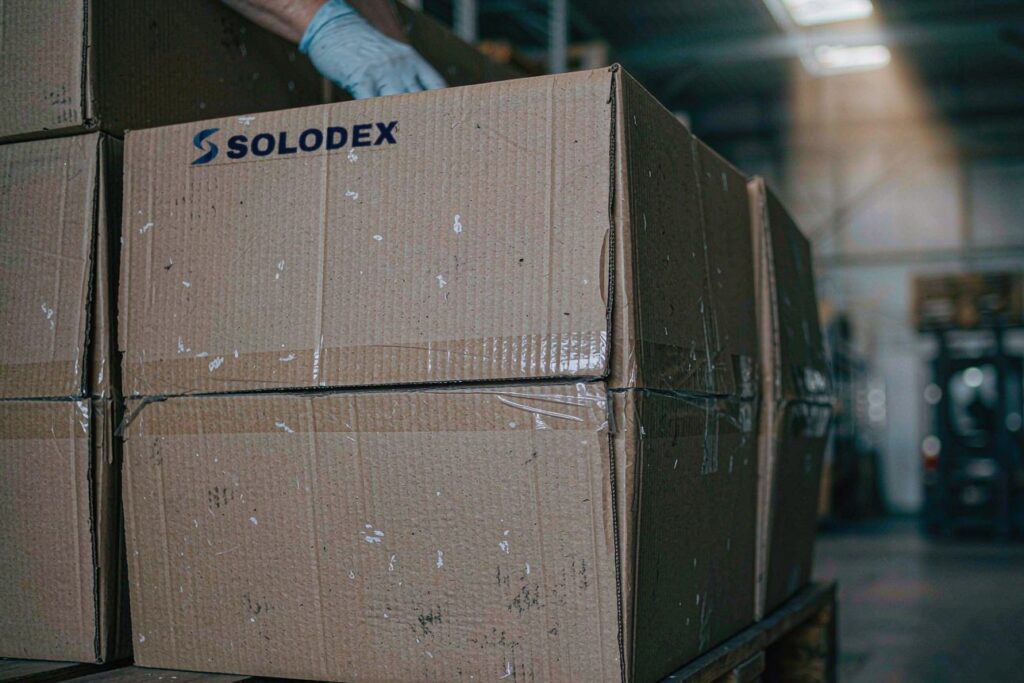
The box that failed on the fourth day
The container arrived on a Tuesday. The top three tiers were perfect. The bottom three had crushed corners, and one carton had folded along its length so that the bottles inside were lying at forty degrees. The warehouse said the boxes had been dropped. The factory said the cartons were five-layer K=K, the same specification they had always used.
Both statements were true, and neither was the answer. The cartons had been stacked eight high, they had sat in a warehouse for forty-seven days before loading, and the last three weeks of that were the wettest of the season. Nothing was dropped. The boxes were asked to carry a load they had never been designed for, for longer than anyone had checked, in air that had taken about half their strength away.
A carton is not a container in the sense a bottle is a container. It is a structure, and like any structure it has a load it can carry and a load it cannot. The difference between the two is arithmetic, and almost nobody does the arithmetic — which is why the same specification can arrive perfect in March and collapsed in July.
Two numbers that are not the same number
Ask a supplier for the strength of a carton and you will usually get one of two figures, and they are not interchangeable.
Edge crush test, or ECT, measures the board: a small strip is stood on edge and crushed, and the result is reported in kilonewtons per metre or pounds per inch. It is a material property, and it is what paper mills and corrugators control.
Box compression test, or BCT, measures the finished box: the whole carton is put under a platen and squeezed until it fails, and the result is reported in newtons or pounds of force. It is what a stack of cartons actually experiences.
The two are related but not by a single multiplier. In the approximations used across the industry, BCT rises with ECT, and also with the perimeter of the box and the thickness of the board — roughly, strength grows with the square root of that combined dimension. Which means the same board, made into a tall narrow box with a small footprint, tests very differently from the same board made into a wide carton with a large perimeter. The board did not change. The structure did.
So when a supplier quotes an ECT figure, you have learned something about the paper and nothing yet about the box. The figure you can stack is the BCT of the carton you are actually buying.
The same board, five different boxes
Between the board and the stack there are five things that remove strength, and every one of them is a normal commercial decision that nobody records as a strength decision.
Hand holes and cut-outs. A hand hole is a hole in the most highly stressed part of the panel. It is also a labour-saving device, so it gets added late, by the buyer, after the box is approved.
Full-panel printing. Ink is not paper. A heavy ink coverage over the whole panel, especially with a varnish, changes how the liner behaves in compression. Light printing costs almost nothing in strength; a full photographic wrap costs several percent.
The proportions. A carton that is long and shallow has a large perimeter and behaves well. A carton that is nearly square, or tall and narrow, carries less for the same board. This is one of the reasons a “same size” substitution — 60×40×40 changed to 50×50×40 — can fail on the stack while passing on the drawing. The same dimensions also decide what you are billed for, since the volumetric rule charges the space a carton takes, not the weight it carries.
The joint. Glued, stitched or taped, and how well. A poorly glued manufacturer’s joint is a hinge, and a hinge is where a stack begins to lean.
Damage before filling. Board that has been stored humid, or scored too deep, starts below its stated value. Nobody tests it again at the filler.
Stacking is a number that changes with the calendar
The load on the bottom carton is easy to state and rarely stated. It is not the weight of one box; it is the weight of everything above it.
A carton with a gross weight of 12 kg, stacked eight high, puts 84 kg on the bottom one — about 824 newtons. That is the static load at the moment of stacking. Then two things happen.
First, the load stays. Corrugated board under sustained compression creeps: it continues to deform, slowly, for as long as the load is there. A box that passes a compression test in thirty seconds may lose a large share of that capacity over sixty days. This is why the industry works with a safety factor rather than a pass mark — commonly somewhere between three and five, and the choice between those numbers is really a question about time and humidity, not about caution.
Second, the stack moves. Pallets get re-stacked at a consolidation warehouse, cartons get stacked on top of a pallet that is already leaning, and the load path moves to a corner that was never designed to take it — which is why the pallet underneath is part of the carton’s strength calculation, not a separate purchase. The failure you see at destination usually started somewhere in the middle of the chain, on a day nobody photographed.
Humidity takes about half
This is the single largest variable and the one most often left out of the calculation.
Paper strength falls as moisture content rises. The relationship is well known in the industry: for every ten points of relative humidity, compression strength drops by something in the region of ten per cent. Run the numbers from a dry, air-conditioned converting plant at 50 per cent relative humidity to a monsoon-season warehouse or a container on a berth at 90 per cent, and the carton in your hand is roughly half the box that was tested.
That is not a small correction to a safety factor. It is the difference between a stack that holds and a stack that folds, and it explains the pattern that puzzles buyers most: the specification was right, the test report was real, and the goods still arrived crushed in one season and fine in another.
It also explains why “we have always used this box” is not evidence. The box is the same. The air is not.
What “five-layer K=K” actually tells you
In China, cartons are usually specified in a shorthand that describes paper grades rather than strength: K, A, B and C are liner and medium grades, and a description like K=K or K=A tells you which grade is on the outside, which is on the inside, and how many walls there are. It is a perfectly good production instruction. It is not a strength value.
Two suppliers can both quote five-layer K=K and deliver boxes whose compression strength differs by thirty per cent, because the grade names describe the paper’s class, not its measured ECT, and because the flute profile, the take-up, the glue and the board’s moisture all differ.
What you want on the purchase order is a number with a test method attached: an ECT value in kN/m, or better, a BCT for the finished box at a stated moisture condition. If a supplier cannot supply either, that is itself the finding — you are buying a description, and the description will be true right up until the stack falls over.
Where the strength goes
The table is the arithmetic in one place. Read the third column as an order of magnitude, not a specification; read the fourth as the thing you can ask for.
| What changes | What it does to the box | Roughly what it costs | How to check it |
|---|---|---|---|
| Hand holes or cut-outs | Removes material from the most stressed panel | 10–20 per cent of compression strength | Ask for BCT with the hole, not without |
| Full-panel printing | Ink and varnish change the liner’s behaviour | 5–15 per cent | Same board, printed and unprinted, tested |
| Box proportions | Small perimeter and tall panels carry less | Can exceed the difference between two board grades | Re-test when dimensions change, not only when board changes |
| Joint quality | A weak glue line becomes a hinge | Shows up as lean before it shows as crush | Pull a box apart; look at the fibre tear |
| Humidity | Paper loses strength as it takes up water | Up to about half, from 50 to 90 per cent RH | Ask for the moisture content at packing, and the route |
| Time under load | Board creeps under sustained compression | 30–50 per cent over weeks to months | Use a safety factor of 3–5, not a pass mark |
The arithmetic you can actually do
Three steps, ten minutes, no laboratory.
Count the layers. Not the layers you plan, the layers that will happen: at the factory, in your consolidated warehouse, in the container, and in the destination warehouse before the pallet is broken. The highest number in that chain is the one to use.
Multiply. Bottom-box load equals the number of boxes above it, times the gross weight of one. Add the pallet above if pallets are stacked — a stacked pallet load is a point load on four feet, not a uniform weight. Then multiply by a safety factor of three for a short, dry journey and five for a long, humid one.
Ask for the BCT at that condition. A supplier who tests at 23 °C and 50 per cent RH has given you a laboratory number. You need the box as it will be after four weeks in a container, which is a different number, and the way to get it is to apply the humidity and creep factors deliberately rather than hope.
In the opening case: eight layers, 12 kg each, a factor of four, gives a required BCT of about 3,300 newtons. The box tested at 4,200 — comfortably enough, on paper, in a dry lab. At 85 per cent relative humidity the same box is worth roughly 2,500, which is not enough, and the bottom tier proves it forty-seven days later.
What the cheaper carton costs
The commercial argument for reducing board is always made per box, and the cost is always paid per shipment.
Assume a carton that saves fifteen cents, on a 5,000-piece order: 750 dollars. Now assume the reduction takes the stack from adequate to marginal and three per cent of the shipment arrives with crushed corners. The claim is not the interesting part — damaged cartons are usually a partial credit. The interesting part is the reshipment, the customer’s receiving report, the photographs, and the four weeks in which somebody has to decide who pays — and whether the damage was visible at delivery or only appeared once the carton was opened, which changes who is even answerable. The claim is a process with its own cost, and it starts long after the fifteen cents was booked as a saving.
Which is why the number to put next to a carton specification is not the unit price. It is the unit price plus the expected loss, and the expected loss is a function of the stack, the season and the route. On a short domestic move in a dry month, a lighter box is a good decision. On a forty-day ocean move through a humid port, it is a decision to self-insure, taken by somebody who did not know they were taking it.
The long pole is the sample
Every number in this article is fixed at the moment the carton is approved. After that, the box is what it is: the board grade, the flute, the dimensions, the print coverage, the hand holes, the glue. The stack height is decided later by a warehouse supervisor who has never seen the specification, and the humidity is decided by the weather.
So the useful work happens at the sample stage, and it is short. Measure the box you actually intend to stack, ask for BCT rather than a grade name, state the moisture condition you expect, and write the number on the purchase order so that the next “small optimisation” has something to be compared against.
The reason this is worth an afternoon is that it is the only point in the chain where the decision is still free. Once the containers are loaded, the arithmetic has already been done — by the stack, in the hold, over forty-seven days, whether or not anybody wrote it down. And the box that arrives crushed is not evidence of bad luck; it is evidence that the load plan, the pallet under it and the air around it were all counted, while the carton itself was not.
A carton is only as strong as the thing it stands on: the pallet under it is a structure with its own limits, and overhang moves the load off the stringers.
A carton that passes the stack calculation can still arrive crushed if the container lets it fall: securing is a separate question from strength, decided at the doors.
Board grade is only half of it. A dense, brittle load fails at the divider before it fails at the box, and the stack above decides which of the two happens first.
Carton strength decides how high a stack can stand in a warehouse; on a ship the same question is asked of a column of containers, and it is asked three times, once for each direction of force.


