Three documents sat on the table when the box was opened at destination. The booking confirmation said minus eighteen degrees C. The carrier’s download said the supply air had averaged minus 19.2 and the return air minus 17.4, with two defrost gaps and a four-hour break in power at the transhipment port. The shipper’s own probe, taped between two cartons in the middle of the third pallet, had logged minus 16.8 for most of the crossing and something warmer for the first day and a half. Every one of the three had been called “the temperature” by somebody in the room.
None of them was wrong, and none of them was a copy of another. They were readings of three different objects, taken by three different parties, at three different places inside or beside the same container. The vessel never combined them into one figure. It had no column in which they could be combined. What travelled was a machine that had been given an instruction, air that the machine kept moving, and cargo that answered to both of them slowly and in its own time.
This matters because the argument that usually follows is about which number is correct. That question has no answer until somebody says what is being measured. A temperature-controlled container is not a thermometer with a door. It is a small environment with an instruction, a sensor, a load, and a clock, and each of those produces its own record. The numbers below are illustrative, chosen to show which object each column belongs to; the structure is what carries across every reefer shipment.
Who wrote down minus eighteen
The minus eighteen did not come from a measurement at all. It was written into a booking instruction by a shipper or a consignee who knew what the goods needed, and it travelled with the booking into the carrier’s systems. It is a target given to a machine, in the same family as the ventilation setting, the humidity target where one is offered, the requirement that the cargo be pre-cooled before loading, and the note about how the cargo should be stowed inside the box. It has an author, a time of issue and a document that carries it. It does not have a sensor.
That is why the instruction is stable while everything else moves. It can be amended, but it does not drift with the weather, and it does not rise during a defrost cycle. Ask where it came from and the answer is a paper trail: the booking window in which it was lodged, the confirmation that repeated it, and the transport document that eventually carried the same carriage terms. If the number on those papers differs from the number in the machine, that is a discrepancy between documents, not a measurement error. The two objects are not comparable until somebody has said which one is being quoted.
There is a second reason to treat the instruction as its own object. It states a condition for the air, not a condition for the goods. A set point of minus eighteen describes what the refrigeration unit is being asked to hold at its own reference point. It says nothing about how cold a carton in the middle of a dense stack is at that moment, and it says nothing about how quickly that carton will get there. Those are questions about the cargo, and the instruction is not where their answers live.
What the sensor is bolted to
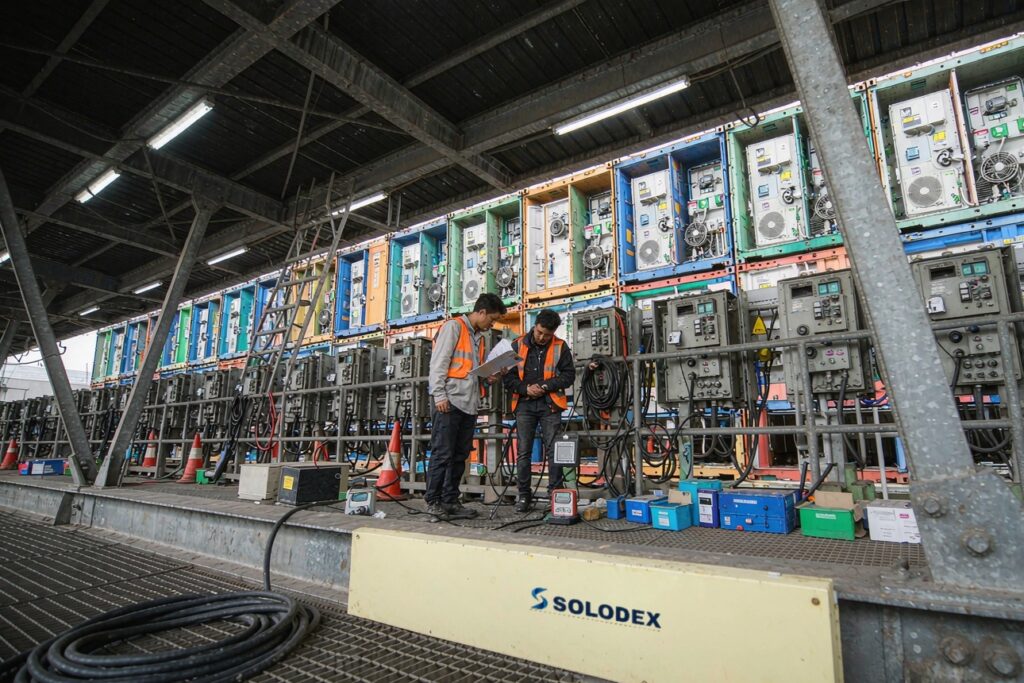
Open the machinery end of a reefer and the thermistor you find is not inside a carton. Supply air sensors sit where the unit delivers cold air into the box; return air sensors sit where air comes back to the unit after passing around the load. The machine logs those two streams, together with defrost cycles, alarms, door or power events where the unit records them, and the state of its own components. It is a competent record of what the machine did to the air moving through it. It is not a record of the goods.
The gap between the two air readings is information, not noise. Return air is warmer than supply air when the load is giving up heat; the difference narrows as the cargo approaches the target. A defrost cycle stops the fans briefly and warms the coil, so a short excursion in a download can be an entirely normal maintenance event. When the unit is unplugged for a yard move or a ship transfer, the logging machinery loses the interval it did not observe, and whatever the cargo did during that interval is simply outside the record. Reefer plug-in and monitoring are billed by the day precisely because somebody has to keep the machine supplied; on the inland leg, a wagon has no power and the box needs a genset or a clip-on unit if that supply is to continue.
So a carrier download is a first-person account by a machine. It is authoritative about the machine. It is silent about anything the machine cannot see, which is most of the inside of a loaded container. Treating it as the temperature of the shipment is a category error, and it is one that a surprisingly large amount of commercial correspondence makes without noticing.
The number inside the carton
The third object is the cargo itself. Frozen prawns, cut flowers, chocolate and soft cheese do not change temperature at the rate air does. A dense pallet has thermal mass: the outside of a carton responds to the air around it hours before the middle of the pallet does, and a product loaded warm keeps a memory of that warmth long after the machine has reached its target. That is why pre-cooling is written into the instruction as a separate line. It is an acknowledgement that the machine can win its own argument with the air while the goods are still losing theirs.
An independent probe or data logger is the only one of the three records that is placed with the goods. Where it is placed decides what it can say. A unit taped between cartons in the middle of a stack reads something close to the slow core of the load; one left near the door reads a much livelier curve; one pressed against a wall can pick up the sun on that side of the box. The sampling interval and the moment the file is downloaded matter too. This is the same lesson as planning a load so air can reach the cargo, with one difference: here the position is being chosen to produce a reading rather than to produce a flow.
None of the three parties owns all three numbers. The shipper owns the instruction and usually the independent probe. The carrier owns the machine and its download. The goods own their own temperature and give it up only to whoever put a sensor next to them. A single word, temperature, is being used for an instruction, an air stream and a physical state of a product.
Three objects, three owners
Put the three side by side and the shape of the problem becomes obvious. The columns below are not three estimates of one quantity. They are three quantities with different authors and different subjects.
| Object | Who produces it | What is actually read |
|---|---|---|
| Set point and carriage instruction | Shipper or consignee, carried into the booking by the carrier | A target for the air, plus ventilation, humidity and pre-cooling requirements; no measurement at all |
| Supply and return air record | The refrigeration unit, downloaded by the carrier | Air at two points in the machine’s own airflow, with defrost, alarm and power-state events |
| Cargo or pulp temperature | An independent logger or probe placed with the goods | The temperature of the product or of the space immediately around it, sampled at a chosen interval |
Two consequences follow. First, no arithmetic turns one column into another: there is no conversion from an instruction to a reading, and no conversion from return air to the middle of a pallet. Second, a disagreement between the columns is expected. It is not a fault to be reconciled. It is the normal output of a system in which a machine acts on air and air acts on goods with a delay.
Why they are allowed to disagree
Air is light, mobile and directly coupled to the unit. Cargo is heavy, often packed in layers, and coupled to the air only through the surface of whatever contains it. When the unit works harder, supply air moves first. When a defrost cycle warms the coil, the air shows it within minutes. When the box stands in the sun on a weather deck, one wall warms before the rest of the space, and packaging designed for deck stowage is dealing with that uneven environment long before any logger at the centre notices. Through all of it the centre of a dense pallet traces a slow, smoothed curve that lags everything the machine reports.
Other effects pull in the same direction. Air that is warm holds more water than cold air, so a temperature swing inside a sealed load changes where moisture ends up, a mechanism explored in what happens when a container makes its own rain. A partly loaded box has different airflow from a tightly stacked one. A door opened for an inspection, a power break during a transfer, or a period spent on a chassis with a clip-on unit each shows up differently in the three columns: the machine logs an event or loses an interval, the air responds quickly, and the goods respond slowly and only if the interruption is long enough.
This is also why the phrase “the temperature was wrong” is so unhelpful aboard a ship. Wrong against the instruction is a document question. Wrong against the download is a machine question. Wrong against a probe is a question about the goods and about where the probe sat. The vessel has its own calculation for where a box may sit, and that calculation changes what the box is exposed to, but it never produces a temperature figure for the cargo.
A voyage in four readings
The three objects do not appear at the same moment. A crossing can be read as four stages, and at each stage a different one of them is the useful record.
| Stage | Instruction | Machine record | Independent record |
|---|---|---|---|
| Before loading | Set point, ventilation, pre-cooling requirement issued and confirmed | Nothing yet; the unit may be pre-tripped at the depot without cargo | Product temperature at the packing house, if anyone measured it |
| Plug-in and gate | Unchanged, now attached to a container number | First supply and return air values; plug-in timestamp; any pre-trip alarms | Logger placed and started, its position noted |
| At sea and at transhipment | Unchanged, or formally amended with a new author and time | Continuous air values, defrost cycles, alarms, power gaps at transfers | Slow cargo curve, including any drift during an unpowered interval |
| Discharge and download | Still the reference the other two are compared with | Carrier file, complete only for the periods the unit observed | Logger file, complete only for where it was placed and how often it sampled |
Read that way, the four rows are not four attempts to measure the same thing. They are a timeline of which object exists at which point. The instruction exists from the booking onward. The machine record exists only while the unit is powered and logging. The independent record exists only from the moment a probe is placed and started. A gap in one column is not a gap in the voyage; it is a gap in what one particular object was able to observe.
What a carrier download does not contain
The download is the most authoritative of the three records about its own subject and the least informative about the others. It does not contain the temperature at the centre of a pallet. It does not contain the difference between a carton against a sunlit wall and a carton in the middle row. It does not contain the product temperature at the moment of stuffing, which is exactly the value a pre-cooling requirement is meant to control. It does not contain who wrote the set point or when it was last amended. And it contains nothing at all about an interval in which the unit had no power, because a machine cannot log an interval it did not experience.
Those absences are not defects. They are the boundaries of the object. The useful discipline is to name the object before quoting the number, in the same way that a port dwell figure has to be read together with the rule that produced it. A download that shows a stable return air line is good evidence that the unit behaved as instructed. It is not evidence about the goods, and it was never produced to be.
The plug is a clock, not a temperature
Power events are worth separating out because they are so often read as temperature events. A plug-in at the terminal, a plug-out before loading, a transfer to a genset on a rail leg, and a reconnection on board each mark a boundary in the machine’s record. They change which intervals can be logged. They do not themselves add a value to any of the three columns, and the cargo continues to behave according to its own thermal mass throughout.
That makes the power history a timing tool. It tells you where to look for a gap in the air record, and it tells you how long the goods were left to their own inertia. It belongs with the other timestamps a container accumulates: the discharge sequence at the berth, the position it held in the yard, the call number of the vessel on this service, and the reasons a transit time moves. None of those is a temperature. All of them decide what a temperature record is able to cover.
What the earlier temperature articles answer
There are already several articles on this site in which temperature appears, and each of them is about a different question from this one. Dry ice is a regulated substance with a per-package limit, so its temperature language belongs to a dangerous goods declaration. Wine needs a carriage instruction and a record that survives the voyage, so its recorder is discussed as evidence kept for a later reader. Moisture trouble is settled by what was recorded at loading, so temperature there is one line in a loading note. A medical device is classified by what its maker claims it does, and a product is judged by its composition rather than its name. Food contact materials are assessed for market entry, and pet products carry their own shelf-life conditions.
What all of those have in common is that temperature is a property of the goods or a piece of evidence about the goods. None of them follows the three records across a voyage and asks which object each one belongs to. That is the narrow piece this article adds, and it is a piece about how cargo is carried, not about what happens after delivery. It also sits beside, rather than on top of, the article about one cargo being measured twice: there the two numbers are two ways of pricing the same consignment, while here the three numbers are three different subjects that were never one consignment’s single temperature.
Three questions before the box is opened
None of this requires access to a carrier’s systems. Three short requests, made before the container is opened, are usually enough to know which object everybody is talking about.
- Ask for the carriage instruction as issued, with its author, time and any amendment. This fixes the set point, ventilation and pre-cooling lines as an instruction rather than a reading.
- Ask for the carrier download’s field list, not only its chart: supply air, return air, defrost events, alarms, and every power-state change with its timestamp. This fixes what the machine actually observed and which intervals it could not observe.
- Ask where the independent logger was placed, what it sampled, how often, and when its file was read. This fixes the one record that was physically with the goods.
With those three answers, the table at the start of this article reads differently. Minus eighteen is a target somebody wrote. Minus 19.2 and minus 17.4 are air at two points in a machine’s own airflow. Minus 16.8, with a warmer first day, is a pallet of goods responding slowly to both. A temperature-controlled box does not carry one temperature from one port to another. It carries an instruction, a machine’s account of the air, and a load that keeps its own time. The vessel has no column that merges them, and no document produced during the crossing needs one.
A set point, a machine reading of the air and the temperature of the goods are three separate objects; before any of those readings can exist on a voyage, the box must first be given a numbered outlet on a circuit.


