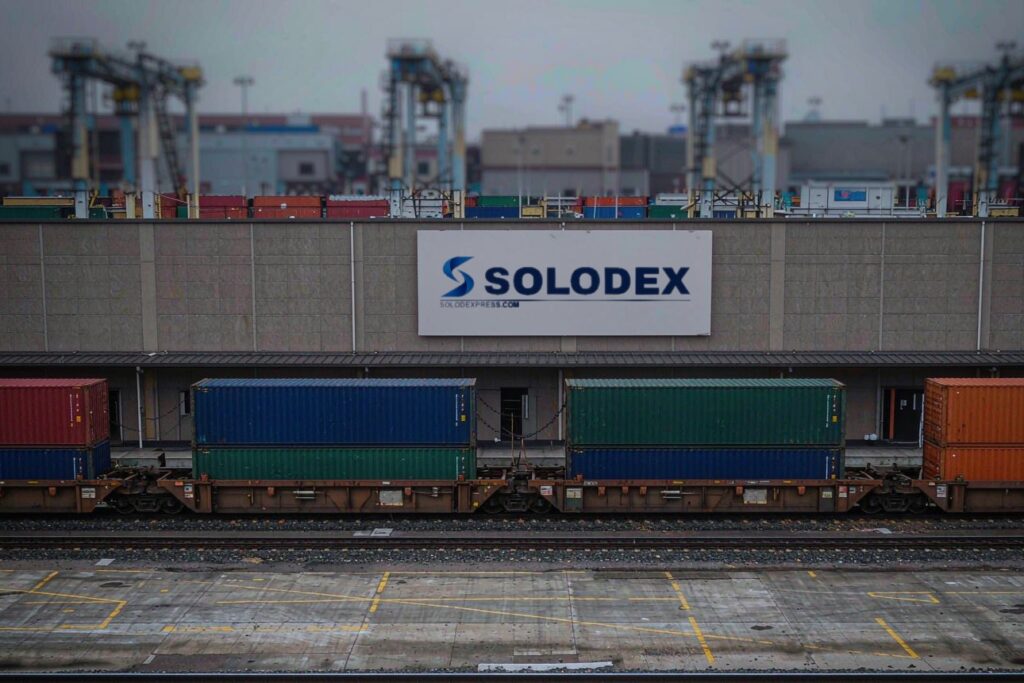
The train takes five days. The container takes fourteen. Both statements are true about the same move, and the gap between them is not a delay in the usual sense — nothing is broken, nothing is stuck, nobody has made a mistake. The box is simply waiting on a timetable that was written before your shipment existed.
An inland rail ramp is the one facility in the whole chain that people consistently misread, because it looks like a yard and behaves like a station. In a yard you can collect your container whenever a truck and an appointment are available. At a ramp you can only collect it, or forward it, on the days the train for your destination is built — and those days are decided by a schedule of blocks and weight that has nothing to do with your delivery date. It is the fourth wait, after the ones catalogued in the six handovers at the port, and it is the only one with a printed timetable.
A ramp is a yard with a timetable
The physical layout is familiar: concrete, stacked boxes, gantry cranes, trucks queueing at a gate. The difference is that a port yard’s constraint is space and labour, while a ramp’s constraint is the next departure. No amount of money buys a slot on a train that has already been made up, and no escalation persuades a railroad to add a car for one container.
That produces a pattern that surprise shippers find maddening. The container arrives at the ramp on Monday. The train for that destination is built on Tuesday evening and departs Wednesday. Everything is on schedule, everyone did their job, and the container has nonetheless been stationary for two days — which is normal, expected, and already priced into the transit time you were quoted. Then the box misses the Wednesday train by four hours because the vessel was late, and the next build is Saturday.
| Port yard | Inland ramp | |
|---|---|---|
| You take the box when | A truck and an appointment exist | The train for that destination departs |
| Constraint | Space, labour, gate slots | The schedule of blocks |
| Escalation works on | Priority, fees, relationships | Almost nothing |
| Bad week looks like | Long appointment queues | Nothing at all, for three days |
The last row is the one that ruins forecasts. A congested port announces itself — the queue is visible, the news covers it, the forwarder calls you. A congested ramp is silent, because the box is sitting in a well-car or on the ground exactly where it is supposed to be, and the only event that has not happened is a train that has not been built yet.
The train does not wait for your box
A freight train is not a bus that fills up and leaves. It is a set of blocks — groups of cars that share a destination and a switching plan — assembled in a fixed order because the whole network’s efficiency depends on blocks arriving intact. Your container belongs to one block, and that block departs when it is complete and the yard has a path for it.
Two consequences follow. First, frequency is a property of the lane, not of the railroad. A main corridor between a West Coast port and Chicago may build a train daily. A secondary lane to a smaller inland terminal may build three times a week, or twice. If your box misses Tuesday’s build on a twice-weekly lane, it waits until Friday, and Friday is a real date you should have known before you booked.
Second, a container can be “ready” and still not move. Being customs cleared, having a release, being grounded in a retrievable position — none of those put it on a train. The only thing that does is the block being built, and the block is built when the railroad decides the train is economic.
This is the single most useful question to ask before committing to an inland move: how many times a week is this lane built, and on which days. It takes one email and it changes the arithmetic of the whole routing decision, because a lane with two builds a week has an expected wait of nearly two days before anything goes wrong.
Double stack is a weight puzzle
Most North American inland container traffic moves two boxes high, in a well car, and that arrangement imposes a physical constraint that has a commercial consequence almost nobody plans for.
The lower position carries more. Heavy boxes go on the bottom, lighter ones on top, and there are limits on both the combined weight and the ratio between the two. A container that is too heavy for the top position is not rejected — it is simply waiting for a partner and a bottom slot. In a week when the ramp is short of well cars, or when the arriving boxes are disproportionately heavy, that wait can be several days, and it is invisible from the shipper’s side because the container is not late, it is unpaired.
The practical implication is that density affects rail transit the way it affects ocean freight, but through a different mechanism. On the water, heavy cargo costs you money because you run out of weight before volume. On the rail leg, heavy cargo can cost you time, because it competes for a limited number of bottom positions. Neither effect is visible in a per-container rate.
Which is why the weight declared on the shipping papers matters more on this leg than anywhere else. A box declared lighter than it is does not travel faster; it gets reweighed, loses its slot, and re-enters the queue at the back.
Three clocks, not one
The inland portion has three separate waits, and they are billed and controlled by three different parties. Treating them as one “transit time” is how people end up with a delivery date that has no relationship to reality.
| Clock | From | Typical length | Who controls it |
|---|---|---|---|
| Port to ramp drayage | Container available at the terminal | 1–3 days | Your drayage provider |
| Ramp dwell before departure | Grounded at the ramp | 0–5 days | The railroad’s build schedule |
| Destination ramp dwell | Train arrives and is grounded | 1–5 days | You, a chassis, and a truck |
The middle clock is the one nobody owns, which makes it the one that gets blamed on everyone. If the box sits at origin ramp for four days, the shipper blames the railroad, the railroad blames the terminal for delivering late, the terminal blames the vessel, and all of them are describing the same four days. The only honest reading is that the box arrived after Monday’s build and before Friday’s, and that window was printed in a schedule nobody read.
The third clock is the one that is genuinely yours, and it is where the inland leg becomes expensive. The train arrives, the container is grounded, and now it needs a chassis and a truck — the same equipment described in the chassis problem, except that inland ramps are further from where equipment pools are dense. A destination ramp with no chassis within forty minutes is a two-day delay that looks like a one-day transit.
Why the box is still there on day six
Five causes account for almost every long ramp dwell, and only one of them is a service failure.
- The lane builds infrequently. Not a failure, a schedule. This is the one to know before booking.
- Customs has not released it. Railroads will not load a container that is not cleared, and a hold discovered at the ramp is a hold discovered two days after it could have been resolved.
- The box is unpaired or overweight. A weight puzzle, as above, and it resolves only when a suitable partner appears.
- The destination ramp is full. Import-heavy corridors accumulate empties and boxes nobody collects, and a full ramp stops accepting, which stops trains, which backs up to the origin ramp.
- Nobody ordered the last truck. The container is available, the customer is waiting, and the move was never booked because each party assumed someone else had.
Items two and five are entirely preventable and account for most of the money. Item four is cyclical and mostly follows the same capacity logic as ocean transit. Item one is a fact of geography that you can plan around but not change. Item three is a loading decision made in a factory eight thousand kilometres away.
The storage tariff nobody reads
Ramps charge storage, and the tariff is a published document with a structure that punishes inattention. The pattern is consistent across operators: a few free days, then a moderate daily rate, then a higher rate, and in some cases a forced move to a secondary storage facility that adds a handling charge on top.
What matters is not the rate but the start event. Free time at a ramp generally runs from the day the container is grounded at that ramp — not from vessel arrival, not from the date on the bill of lading. So a box that spent four days waiting for a train has already consumed most of its free time before the destination ramp has even seen it, and the destination clock starts fresh on arrival. Two ramps, two free periods, two chances to pay.
The practical rule is to treat the destination ramp’s free time as the binding constraint for the whole inland leg. Everything upstream — the drayage, the build schedule, the train — should be planned so that the container does not arrive at the destination ramp before you can take it. Arriving early is not early; it is storage.
The arithmetic, honestly
Here is a 40-foot container from the Los Angeles area to Chicago, priced two ways, with the numbers that actually decide the outcome.
| Line | Rail intermodal | All truck |
|---|---|---|
| Long haul | $2,400 including fuel surcharge | $4,900 |
| Port to ramp drayage | $250 | — |
| Ramp storage, 4 days over free time | $300 | — |
| Destination drayage and chassis | $450 | Included |
| Total | $3,400 | $4,900 |
| Door to door | 10–14 days | 4–5 days |
The rail option saves roughly fifteen hundred dollars and costs a week. That is a good trade for inventory that is not urgent and a bad one for anything with a launch date — and the trade gets worse fast, because every extra day of storage is a hundred dollars against a saving that is fixed. It is also the clearest illustration of a point that holds across the whole chain: the freight rate is a fraction of what a move actually costs once the fixed and the avoidable parts are counted.
The break-even is worth stating plainly. At a three-hundred-dollar storage bill the rail saving is fifteen hundred. At a twelve-day dwell it is zero. So the honest question is not whether rail is cheaper, because it almost always is. It is whether you can keep the two dwell clocks under control, and that is a question about your broker, your drayage provider and your own receiving schedule — not about the railroad.
Which is also why the ocean decision and the inland decision should not be made by the same person on the same day. The ocean leg is priced per container and negotiated annually; the inland leg is priced per container and consumed daily, one storage day at a time. The first is a rate. The second is a behaviour.
What to ask before you commit to the rail leg
- How many builds a week, and on which days? If the answer is fewer than five, add the expected wait to your transit before comparing rates.
- On-dock or off-dock rail? On-dock eliminates a drayage move and a wait; off-dock adds both, and the drayage is billed whether or not the train is ready.
- What is the free time at both ramps, and from which event? Ask for the tariff rather than the summary, because the start event is where the money is.
- Who is clearing customs, and when? A release that arrives at the ramp on day three is a box that missed the Tuesday build — the booking discipline applies to documents as much as to space.
- Who owns the last truck? Name the party, not the process. At a destination ramp this is the question that decides whether day eleven is a delivery or another storage invoice.
None of this makes rail a bad choice. It is the only way most inland freight moves at a sane cost, and the saving in the table above is real. What it makes rail is a choice with a different failure mode: not a late vessel, not a missed appointment, but a container that is perfectly fine, correctly documented and completely stationary, because the train for its destination was built yesterday and the next one is on Friday.
Once you know that, the number you need is not a transit time. It is a calendar — and the calendar was published before you booked, which means the delay was never really a surprise. It was a fact you had not asked about.
A rail ramp is a timetabled yard where free time starts from the box landing; the same pattern begins at the quay, where each landing has its own timestamp and the ship has only one arrival date.
A ramp is a yard with a timetable where even a retrievable position does not put a box on a train; at the sea terminal the same distinction is written as bay, row and tier against a container number.
A train takes five days while the container takes fourteen; both numbers are arithmetic on the same event log, which is why two correct reports can differ and neither system is wrong.
Cartons waiting at an inland ramp for the next collection leg sit on their own dwell clock, as described in inland ramp dwell.


