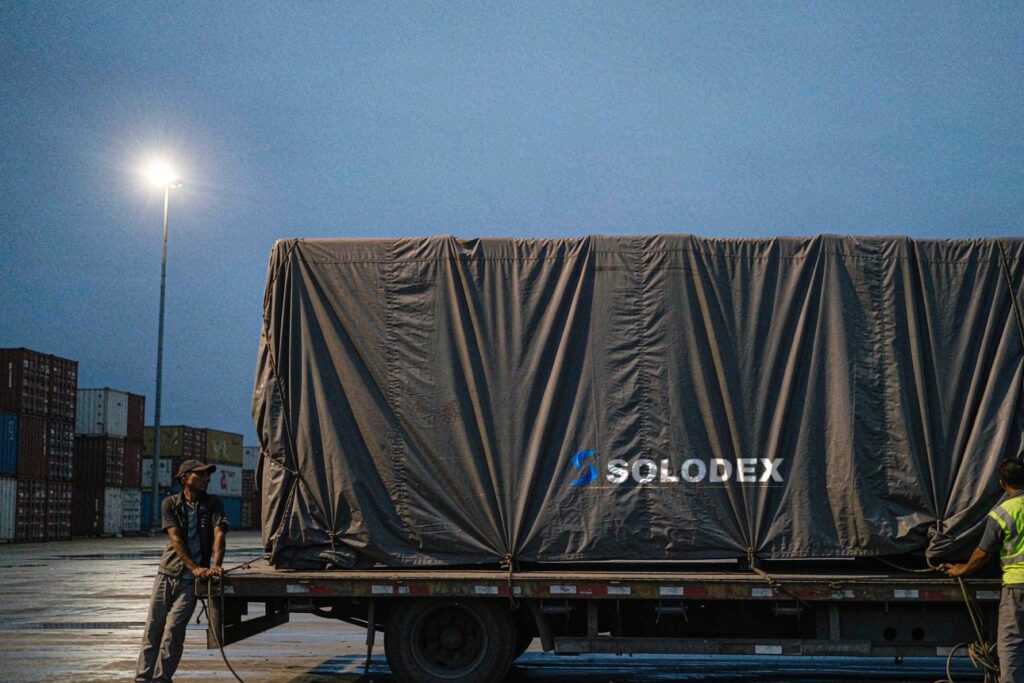
The truck arrived at the gate at seven, and by ten it had made three trips and delivered nothing. The first was to the terminal, where the release had not been issued. The second was to the terminal again, this time with a booking slot that had expired an hour earlier. The third was to the receiver, whose loading dock was occupied by a container that had been sitting there since Monday.
Three movements, one invoice, and a customer who says the forwarder cannot organise a delivery. The forwarder, meanwhile, is looking at a trucking bill with four line items where the quote had one.
All of this follows from a single misunderstanding about what a trucking company sells. It does not sell delivery. It sells a closed loop with four movements in it, and the price of the loop depends on how many of them actually happen.
Four movements, and only one of them is “delivery”
A container that arrives by sea does not get driven to a warehouse and left there. It gets collected from a terminal, driven to an address, unloaded, and then returned — empty — to a depot nominated by the carrier who owns it. That is the product. Delivery is the second of four steps.
| The movement | Who controls whether it happens | What usually goes wrong |
|---|---|---|
| Collection from the terminal | The carrier releases; the terminal issues a slot | No release, expired slot, truck arrives outside the gate window |
| Delivery to the address | The receiver provides a dock and a person | Dock occupied, no forklift, nobody authorised to sign |
| Waiting to be unloaded | The receiver, entirely | Free time expires while the driver sits in a yard |
| Return of the empty | The carrier nominates the depot; the depot accepts or refuses | Depot full or closed for the day, especially at month end |
Read the middle column. Not one of the four is controlled by the trucking company, and three of the four are controlled by parties who are not paying the trucking bill. That is why the loop is fragile, and why a trucking quote is a price for a plan rather than a price for a distance.
Collection needs three things, and they are not interchangeable
The terminal will not open for a truck that arrives with good intentions. It wants a release in the carrier’s system, an appointment in its own system, and a vehicle and driver it can identify.
The release is the delivery order, and it belongs to the carrier’s commercial process — which is why a container can be physically available for a week and still not collectable. The appointment belongs to the terminal, is measured in half-hour windows, and expires. Identity is the easy part, and still manages to fail when the nominated driver changes at six in the morning.
When one of the three is missing, the truck goes back empty and the movement is charged. The trade calls it a dry run, and it is the single most common line on a trucking invoice that a shipper did not expect.
Free time at the door starts when the truck arrives
Every delivery includes a period during which unloading is free — commonly one to two hours — and after that the vehicle is charged by the hour. The arguments are almost never about the rate. They are about when the clock started.
From the carrier’s side, it starts when the truck reaches the address, because the vehicle and the driver are committed from that moment. From the receiver’s side, it starts when unloading begins, because waiting for a dock is not their fault either. Both positions are defensible, which is why the only version that survives is the one written into the booking.
The practical consequence is that a delivery to a site with one dock and a shift change at two o’clock will regularly cost more than a delivery to a site with four docks, for the same distance. Distance explains very little of a trucking invoice.
The empty goes where the carrier says, not where it is convenient
This is the part that surprises people who assume an empty container can be dropped at the nearest yard. It cannot. The equipment belongs to the carrier, the carrier nominates the depot, and the depot decides whether it is accepting returns today.
At month end, or after a blank sailing, or during a surge, depots close to returns. A truck that arrives at a closed depot joins a queue, and a queue of empties is not a fast queue — each one has to be inspected for damage before it is accepted.
This is also where the second clock starts. Detention runs on the equipment from collection to return, and it does not care that the depot was shut. A container that cannot be returned because a yard is full is still a container you are holding.
The chassis is a business of its own
In some markets the trailer under the container is provided by the carrier as part of the move. In North America it is frequently a separate asset with a separate owner, a separate daily rate, and a separate set of rules about where it can be dropped.
The consequence is that a trucking quote in those markets may be quoting the tractor and the driver, with the chassis arriving as a per-day charge from a pool. A container that waits three days for a dock is therefore costing storage, detention and chassis rental at the same time, from three different companies.
It is worth knowing which model applies before comparing rates, because a rate that includes the chassis and one that does not are not the same number, and the difference only shows up on day four.
One truck, one day, two or three moves
The economics that make a dry run expensive are simple and worth stating plainly. A container truck working locally can complete two, sometimes three round trips in a working day. Each one involves a gate in, a gate out, a drive, and a wait.
Which means a wasted movement does not cost a fraction of a day. It costs a third of the day’s revenue, plus the fuel, plus the slot that another job could have used. This is why trucking companies charge for a dry run rather than absorbing it, and why a shipper who treats a booking casually is expensive to serve.
It also explains the phrase that annoys shippers most: “can it wait until tomorrow”. It usually can, because the alternative is a vehicle sitting still at a rate that was calculated on movement.
Who pays for the dry run, and when it comes back
The dry run is the line most often disputed, and the dispute is almost always mis-framed as a question about the trucking company’s competence. It is a question about whose failure caused the movement.
Three causes cover most of them, and each has a different answer. If the carrier had not issued a release that its own terms said was due, the cost is recoverable — not automatically, but arguable, because the obligation and the date are both in writing. If the terminal’s appointment system failed or the gate closed early, it is usually absorbed, because nobody has a contract with the terminal that says otherwise.
The third cause is the interesting one: the receiver was not ready. That is the most common, and it is the one where the shipper discovers that the recovery route runs through a party it does not control. Charging a customer for a truck that arrived at a closed dock is legally sound and commercially expensive, and most forwarders absorb it the first time and price it into the second.
Which is why the free-time and no-show terms belong in the quotation rather than in the argument. A customer who has read “if the dock is unavailable, the movement is charged” behaves differently from one who has not — and the difference is worth more than the clause.
Four buttons, none of them on the truck
When a collection fails, the conversation that follows is usually aimed at the wrong party. The four things that have to be true are each owned by somebody else.
The carrier issues the release and nominates the return depot. The terminal issues the appointment and controls the gate. The receiver provides a dock, a forklift and a signature. The depot accepts or refuses the empty.
The trucking company’s only contribution is to arrive on time with a roadworthy vehicle and a driver who knows the site. That is not a small contribution — but it is the only one they control, and it is the one they are judged on.
What to settle before the truck is booked
Five questions, and every one of them can be answered a week before the vessel arrives.
Is the release going to be issued, and by when? Not “will the documents be ready” — the specific mechanism and its owner.
Does the receiver have a dock, a forklift and an authorised signatory, at the hour we are planning? A receiver who receives between nine and eleven is a different booking from one that receives all day — and if the receiver is a marketplace warehouse, the window is not negotiable at all.
Which depot takes this carrier’s empties, and is it accepting returns this week? This is the question that saves the most money and is asked the least.
Is the chassis included? And if not, who pays for day four.
What is the free time at the door, and when does it start? Written down, not assumed.
None of these is a trucking question. All of them determine the trucking invoice — which is the same pattern as the port charges that appear on a bill nobody itemised, and the same reason a container can be sitting at a terminal with everything apparently in order.
The plan is the product
A trucking company that is asked to “send a truck tomorrow” will send one, and it will cost whatever it costs. A trucking company that is told the release number, the dock, the unloading method and the return depot can price a loop, because a loop is a plan and a plan can be costed.
Which is why the cheapest trucking quotes tend to come from shippers who book late and manage the exceptions themselves — and the most expensive from shippers who book early and expect the carrier to solve the four buttons.
The vehicle is not the constraint. The morning is. Two or three moves fit into a day, and everything that removes one of them — a missing release, an expired slot, an occupied dock, a closed depot — is decided by somebody who will never see the invoice.
The third cause is the one that decides most of these invoices, and it belongs to a party who never agreed to the clause: what a receiver actually has to be able to do before a truck can deliver anything.
Only one of the four container movements is delivery, and the empty goes where the carrier nominates; a tank with 165 litres still in it cannot go to an ordinary empty stack, so its return instruction is really about where the residue is allowed to end up.
Collection and empty return are two separate moves with their own paperwork; a rehandle belongs to neither, because it is work done to the stack rather than to the shipment.
Four movements take an import box from terminal to receiver and back to a nominated depot; at the export end the same loop runs in reverse, starting with an empty release that belongs to the equipment system rather than to a consignment.
Collection and return happen around the box, not around a bill number; that is the same key split that decides whether a manifest correction can be closed with one new version.


