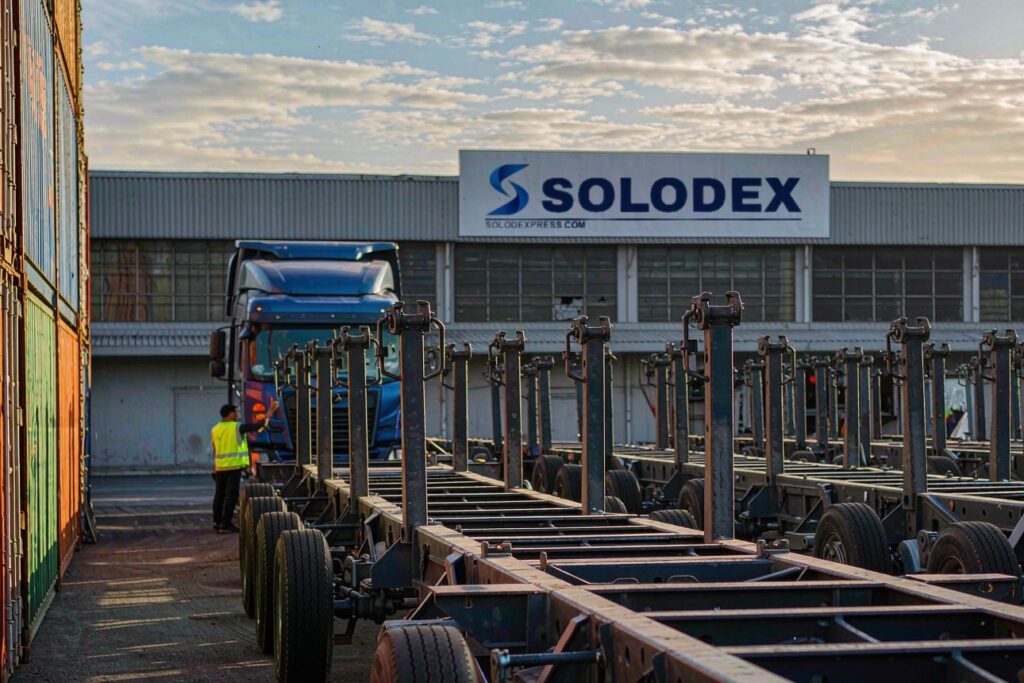
The message from the trucker is four words long and arrives at 7:40 in the morning: no chassis available. There is nothing else in it — no explanation, no estimate, no suggestion. The container has been available since yesterday, the delivery appointment is at one o’clock, and the receiver has a crew booked to unload. In the sequence of the six handovers this is the gate that looks most like a vehicle problem and is least often one.
That message can come from three unrelated failures, and the twelve hours you spend on the wrong one are twelve hours the container sits. The chassis pool is empty, or the terminal has no appointment slot, or there is no driver willing to take a fifty-mile run — and from the outside all three sound identical, because all three end with a truck that does not arrive.
“No chassis” is three different problems
Disentangling them takes one question, asked in the right order. The answers determine completely different actions, and only one of the three can be fixed with money on the same day.
| What is actually missing | How to confirm it in one question | Fixable today | What it costs to wait |
|---|---|---|---|
| Chassis | Ask the pool, not the trucker: is equipment available at this yard, right now | Sometimes — a different pool or an off-dock yard | Chassis per diem plus terminal storage |
| Terminal appointment | Ask the terminal, not the trucker: what is the next slot, and at which gate | Rarely — slots appear when other people cancel | Storage, and a receiver who rebooks |
| Driver | Ask the dispatcher: how many drivers are on the board and what they are refusing | Usually — with a rate, or with a different window | Everything downstream, plus a rescheduled delivery |
The order matters because the trucker only ever sees the last link. A dispatcher with an empty board will report “no chassis”, because that is what the driver was told at the gate, and the real constraint may be that the pool has nothing within a forty-minute drive. Ask the party that owns each constraint, not the party who reports it.
Only America pools its chassis
This is the structural fact that makes the whole problem regional, and it explains why a shipper who has run the same lane in Europe for a decade meets something entirely new on the US side.
In most of the world the chassis is part of the truck. A Chinese or European tractor unit arrives at the terminal with its own skeleton trailer, the container is locked onto it, and the same vehicle leaves. The asset and the driver are the same commercial unit, so a shortage is a shortage of trucks and drivers, and it clears when rates rise enough to attract capacity.
In the United States the two were separated decades ago. Motor carriers supply the tractor; the chassis comes from a shared pool operated by a handful of large equipment providers, and the pool is billed separately, per day, from the moment the equipment is picked up. This is efficient in the normal case — no carrier has to own equipment that sits idle between jobs — and it creates a single point of failure that no amount of trucking capacity can fix. During the import surges of the last several years the constraint on moving containers was frequently not trucks, drivers or terminal hours. It was the number of steel frames in a yard in New Jersey.
The practical consequence for an importer is a completely different diagnostic question. Do not ask whether there are trucks. Ask who owns the equipment, whether it is in this yard, and what the per-diem rate and free days are on the contract that covers your move.
The chassis is eaten by the street
Chassis shortages look like a supply problem and are usually a return problem. The equipment does not disappear; it stops circulating, and it stops circulating in places nobody is measuring.
The mechanism is simple. A chassis is picked up at a yard, carries a container to a receiver, and then waits. It waits while the container is unloaded, and it waits longer if the receiver has no dock space, and longer still if the empty container cannot be returned because the terminal is not accepting empties that week — the pattern described in how congestion cycles, where the first thing a full yard stops accepting is the thing nobody is selling. Every one of those days is billed to somebody, and every one of those days is a chassis that is not available to anybody else. Multiply by a few thousand shipments in the same metropolitan area and the pool is empty in the middle of a busy month without any single party having done anything wrong.
Two numbers make this concrete. Nightly street dwell — equipment sitting at customer locations rather than in a yard — is routinely measured in days rather than hours in tight markets, and a chassis that turns four times a month instead of eight halves the effective size of the fleet without anyone scrapping a single unit. The fleet does not need to shrink for the fleet to become smaller.
Which is why the most effective thing an importer can do in a tight market is not to book earlier. It is to shorten the time the equipment spends at your own dock. Receive on the day of delivery, return the empty the same week, and confirm the return rather than assuming it. Every day removed from your own cycle is a day added to the pool, and in a shortage that is the only lever that actually increases supply.
The drayage invoice, line by line
Short-haul trucking in and around a port is priced as a bundle that hides five separate charges, and importers who budget only the headline rate are consistently short by a third.
| Charge | Typical range | Starts when |
|---|---|---|
| Line haul, port to door | $150–500 for 20–50 miles | Booking, quoted flat |
| Chassis per diem | $20–50 per day | Equipment picked up |
| Terminal or port fee | $30–120 per move | Each gate transaction |
| Waiting time | $60–100 per hour after two free hours | Arrival at the receiver |
| Empty return or re-positioning | $50–200 | When the designated depot is full |
| Pre-pull and yard storage | $100–250 plus daily | When the box is pulled before the appointment |
The line that surprises people is the last one. A pre-pull — taking the container out of the terminal before the receiver is ready, to stop terminal storage — converts a terminal charge into a chassis charge plus yard storage, and it is only cheaper if the receiver is genuinely close to ready. Done reflexively at the start of a busy week, it is how a shipper ends up paying per diem on equipment nobody is using.
Waiting time deserves the same suspicion. Two free hours sounds generous until you remember that a receiver with a single dock and a shift change will exceed it routinely, and the charge is billed to the party who ordered the move. If the receiver’s unloading speed is not in the contract, it is in your invoice. The same principle applies backwards, at the loading end: the load plan decides how long unloading actually takes, because a container packed without thinking about the other end is a container that comes out slowly.
Dual transactions: the one move that pays twice
There is exactly one standard operation that removes a whole truck trip from the chain, and it is worth understanding precisely because it fails more often than it works.
A dual transaction — a street turn, in the trade — combines two moves into one. Instead of running an empty container back to the terminal and then fetching an import box on a second trip, the driver drops the empty at the terminal and picks up the import on the same gate transaction, or delivers an export container using equipment that is already out. One round trip instead of two, one set of gate fees, one set of terminal interactions.
It requires four conditions to be true at once: the same carrier, the same equipment size, the same pool, and a time window in which both boxes are available. Four independent conditions multiply, not add. If each is individually 70% likely, the combination succeeds about a quarter of the time — which is why forwarders who advertise street turns as a standard service are usually describing an attempt, not a guarantee.
Where it works, the saving is real: a meaningful fraction of a drayage invoice per container, and during peak weeks more than that, because the avoided trip is also an avoided appointment slot. Where it fails, it fails late — usually on the day of the move, after the export booking has been confirmed — and the fallback costs more than never having tried.
When owning equipment beats renting it
Some high-volume importers buy their own chassis, and the arithmetic is worth doing properly because the answer flips at a volume most people guess wrongly.
A new 40-foot chassis costs somewhere between nine and fifteen thousand dollars, before insurance, maintenance, registration and a place to park it. Call the all-in annual cost of ownership around two thousand dollars per unit once those are included. Renting the same unit costs twenty to fifty dollars a day, and the relevant question is not the daily rate but how many days per year you would actually need it.
At forty dollars a day, two thousand dollars buys fifty days. So ownership beats renting only if you would otherwise rent for more than about seven weeks a year — and only if your equipment turns often enough to be in use during that time. For an importer running a steady weekly volume into one warehouse, that threshold is reachable and the decision is genuinely close. For everyone else, renting is cheaper, and the reason to own is not cost at all: it is availability in a month when the pool has nothing, which is a service argument dressed as a finance argument — the same confusion that makes small batches look cheap when what they really buy is cash.
The honest version of the case for owning is therefore narrow. Own if you have consistent volume, a place to park, a maintenance arrangement, and a peak season in which equipment availability — not price — is what limits you. Do not own because the per-diem rate looks high in a spreadsheet.
What the terminal appointment actually controls
Terminals moved to appointment systems to smooth gate traffic, and the systems do that well. What they also do is convert a physical queue into a queue for permission, which behaves differently and is much harder to argue with.
When a yard is congested, the number of appointments does not shrink gradually. It drops in steps, because the terminal reduces the release of slots rather than letting trucks queue for hours. A shipper watching from outside sees a day when the truck went in normally followed by a day when nothing is available at all — and concludes that something changed. Something did: the terminal cut the slot release to protect its own throughput, and there is no appeal, because nothing was denied.
Two habits follow. First, book the appointment before you need it, and treat a confirmed slot as the scarce item rather than the container. Second, understand that a missed appointment is not a small thing — some terminals suspend or penalise the carrier account after a small number of no-shows, which removes your access entirely rather than delaying it.
Five things to fix before the peak
- Know your chassis terms in writing. Which pool, what the free days are, what the per diem is, and who is the account holder. This is one page and almost nobody has it.
- Measure your own dwell. From delivery to confirmed empty return, in days. If it is more than two, your warehouse is part of the shortage and it is the only part you control.
- Agree the receiver’s unloading window in the contract. Waiting time billed to you for their dock is a cost you can move by naming it before the season, not after the invoice.
- Ask whether street turns are possible on your lane, and treat the answer as a probability rather than a promise. Have a fallback priced before you need it.
- Book appointments at the same time you book the vessel. Not because the slot will hold, but because the shipper who books early is the one who notices when the slots stop appearing.
The container was never the scarce thing. On a bad week at a busy port the box is sitting exactly where it should be, released and waiting, and the reason it does not move is a steel frame in a yard three miles away, or a slot that was never released, or a driver who did the arithmetic on a fifty-mile run and declined. Four words in a message, three different problems, and the only way to fix the right one is to ask who actually holds it. That question is worth more than any amount of chasing, and it takes one call — to the right party.
A missing chassis and a scarce appointment are equipment constraints; the third reason a confirmed pickup fails is a position in a stack that has to be dug out first.
A street turn saves a truck trip by using equipment that is already out on the street; whether or not a trip is saved, the unit was nominated to a booking and read at a gate before the cargo had a document of its own.
A receiver that collects in stages needs a chassis available for each trip; the equipment shortage that stretches those trips is covered in chassis and drayage shortage.


