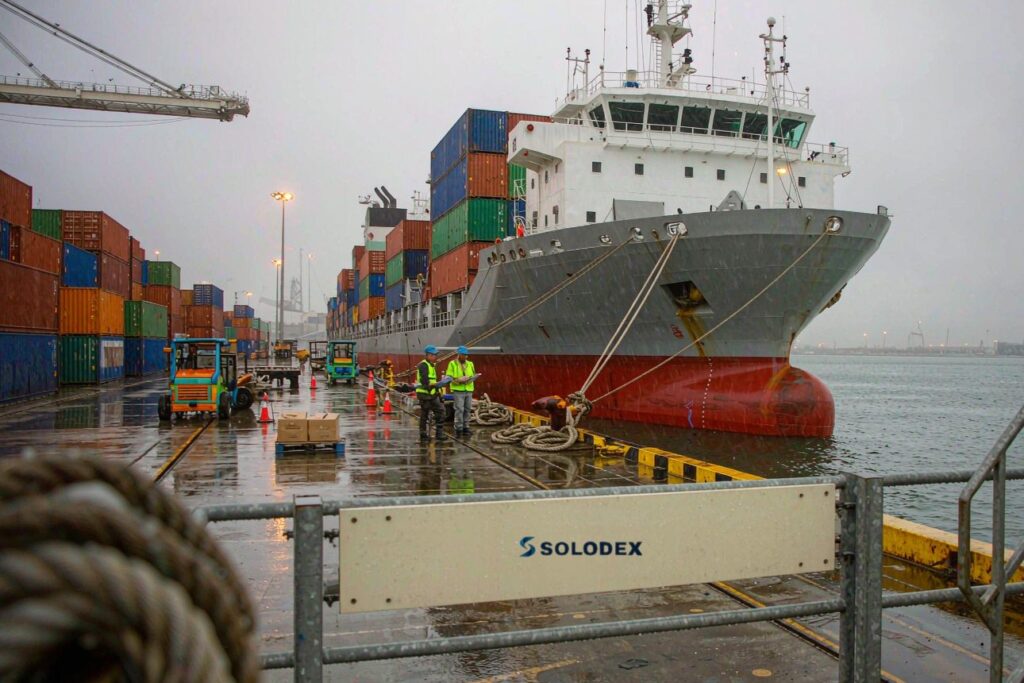
The booking confirmation named one port, one service and one sailing. It did not say which call. The service schedule ran eleven calls, and the port appeared twice: call 3 on the outward leg, worked for discharge, and call 9 on the return leg, worked for loading. Three 40-foot boxes of rolled fabric and aluminium profiles were delivered to the terminal on the 2nd, comfortably inside the receiving period. The vessel working call 3 berthed on the 4th at 06:10 and sailed that evening without them. The three boxes were loaded on the 23rd, when the same named service came back for call 9. Nineteen days in the yard, no rolled booking, no missed cut-off and no document out of place.
Nothing had gone wrong with the ship, either. She was not late, the port was not congested, and no berth window was lost. The boxes were simply attached to a different line of the same schedule. A consignee watching the tracking page saw a vessel arrive at their port on the 4th, then saw their containers sit still for another nineteen days, and had no field anywhere that described the difference between the two visits. Both visits had the same port name. Only one of them had their cargo on it.
A port is a place; a call is an event. The schedule a carrier publishes is not a list of ports, it is a numbered sequence of visits, each with its own estimated times, its own working direction and its own list of container numbers. A shipment does not sail to a port. It sails to one call in one voyage of one service. The bill of lading prints the port name and leaves the call number out, which is why a perfectly ordinary nineteen-day wait can look like a failure that nobody can find in the records.
Eleven lines, and the same name twice
Read a published service schedule from the top and it looks like a route: a port, a date, another port, another date. Read it as the planner reads it and it is a table with three identifying fields. The service code names the product, the voyage number names one particular rotation of that product, and the call number names one stop inside that rotation. Eleven calls on one rotation means eleven rows, each with an estimated time of arrival, an estimated time of departure and a terminal code.
Port names are allowed to repeat in that table. A large vessel on a long rotation may work an intermediate port on the way out and call there again on the way home, because the trade is directional: one leg brings imports in, the other takes exports out. Some services call the same port twice in a few days for purely operational reasons, splitting discharge and load work between two visits to keep the crane hours short. Neither arrangement is unusual, and neither is visible in a field labelled port of discharge.
What changes between two rows with the same port name is everything a shipper actually cares about. The ETA and ETD differ by days. The berth and crane allocation differ. The direction of the work differs. The receiving period, the cut-off and the yard block prepared for the call differ. The container numbers the terminal expects to handle differ completely. To the schedule these are two events. To the paperwork they are one word.
This is also why a service name is not a promise about a single ship. A weekly service with an eleven-week rotation has eleven vessels working it at the same time, one on each week’s departure. Ask whether “the vessel” has arrived and the answer depends on which voyage number you mean. The service is a loop; a call is one numbered place in one numbered turn of that loop.
A call has a direction
The most useful column on a call schedule is the one that says what the stop is for. A terminal works a call in a direction: discharge, load, or both. Call 3 on this rotation was a discharge call. Its crane plan was built around imports coming off, its yard blocks were cleared for grounded inbound boxes, and its gate hours were arranged for collection. Export boxes were not part of that plan, no matter how early they had been delivered or how valid their booking was.
Call 9 was a loading call. Nineteen days later the same service, the same port name and a different voyage number came back with a plan built around exports going on. Now the three boxes were in the load list, in a block prepared for that sailing, inside a receiving period that had been counted backwards from the new ETD. The physical boxes had not moved for most of those nineteen days. Their eligibility to be lifted was created by the direction of a call that had not happened yet.
Put the two visits side by side and the confusion becomes obvious. A driver who delivered on the 2nd saw a ship at the berth two days later and assumed the cargo had missed it. A customer service message said the vessel had called as scheduled, which was true. A warehouse planned labour against the 4th, which was wrong. Every one of those statements used the port name as if it identified an event. It identified a place where two different events happen in one rotation.
Nothing about this requires a special type of cargo. It applies to a full container load, to a consolidated box, and to a transhipment unit waiting for an onward service. It applies at the load port and, in a slightly different form, at a hub where a box is discharged from one call and matched to another. The direction of the call decides whether a particular container number appears in the work list at all.
The booking names a port, not a call
Open a booking confirmation, a bill of lading or a shipping instruction and look for the fields that describe where the goods go. There is a port of loading, a port of discharge, a place of delivery, sometimes a place of receipt. There is usually a vessel name and a voyage number, and often a service code on the carrier’s own documents. There is almost never a call number.
That omission is not an oversight. A bill of lading is a contract about carriage between named places, and the carrier reserves liberty to substitute the vessel and to tranship. The document describes an obligation, not a crane schedule. The call number belongs to operational systems: the service schedule, the berth plan, the terminal’s vessel call record and the load or discharge list attached to that call. It is a working instruction, not a contractual term.
The gap between those two kinds of record is where a tracking page becomes misleading. A public tracker will happily report “vessel arrived” using the port and the ETA, because that is the pair of fields it has. It will not report “arrived at call 3, your booking belongs to call 9”, because the second half of that sentence lives in a booking file and the first half in a terminal system, and nobody publishes the join. Even when a box is on the right call, one vessel arrival still becomes twelve separate discharge timestamps, because stow position decides the order of the lifts. Being attached to the correct call is a separate condition from being early in its work sequence.
Ask a forwarder why a box did not sail and the answer usually comes back in the language of exceptions: rolled, shut out, held, missed cut-off, customs hold. Those are real and well documented. A rolled box is one that was on the load list and came off it, usually because the vessel was overbooked and something more valuable took its place. The three boxes here were never on the call 3 load list. There was no exception to find, because no rule had been broken.
Eight rows that already exist in two files
No new form is needed to see this. Put the schedule row for a call next to the line on the shipment’s own paperwork and the mismatch is visible on paper. Here is what the two records say about the same nineteen days.
| What the service schedule says | What the shipment’s paperwork says |
|---|---|
| Call 3, outward leg, discharge only, ETA 4th 06:10, ETD 4th 21:00 | Port of loading: the same port name. No call number printed. |
| Call 9, return leg, load only, ETA 23rd 04:30, ETD 23rd 22:40 | Intended voyage: a voyage number that resolves to call 9 if anyone checks it. |
| Eleven calls in one rotation under one service code | One service name, treated as if it were one sailing. |
| Two rows carry the same terminal code | One port of loading, one port of discharge, no indication that the port repeats. |
| Call 3 work list: imports to be grounded, export list empty | Booking confirmed, gate-in on the 2nd, VGM and instructions accepted. |
| Call 9 receiving period closes against the 23rd ETD | Delivery on the 2nd is “early” by twenty-one days and “on time” by the wrong deadline. |
| Call 9 load list: the three container numbers appear | Tracking shows the 4th arrival, then no movement until the 23rd. |
| Vessel call record closes with a departure on the 23rd | One sailing date on the bill, with nothing to explain the gap in front of it. |
The sixth row is the one that costs money. A receiving period is not a general window for the port; it belongs to a call. Delivering a box early against a call that will not load it buys nothing except a longer stay in the yard, and the yard charges for that stay are real. The three cut-offs around a booking each have a different owner, and a booking is a claim on space rather than a reservation of a specific lift. Add a second call at the same port and even “which cut-off applies” needs a call number before it can be answered.
Read the eighth row once more. The paperwork is not wrong. A bill of lading names the place where carriage begins and the place where it ends, and it is not trying to describe a rotation. But a plan built from that document alone has no way to say why the goods spent nineteen days at the terminal, and no way to predict it next time.
Nineteen days that no system calls a delay
The awkward thing about this wait is that it produces no status. A delay is normally an event with an owner: a vessel running late, a box rolled, a customs hold, an expired appointment, a machine unavailable. Each of those creates a message somewhere. A box attached to the correct call nine days before that call arrives creates no message at all. It is exactly where it is supposed to be.
That is why the usual diagnostics come back empty. The six clocks that start after discharge each have a document and a handover attached to them, and none of them had started for these boxes. Free time and detention are questions about when a box became available and who was holding it, not about which call it was booked on. A yard slot is a coordinate, and a box can be available without being reachable; these three were both available and reachable for most of the nineteen days. They were simply not on a load list yet.
There is a boundary worth keeping. Congestion is a weeks-long loop in which berth waiting, yard density and truck appointments reinforce one another, and a diversion changes the round trip, so a weekly service needs more vessels than it has and ports start being dropped. Both explain why a schedule stops being reliable. Neither applies here: the schedule held perfectly. A named service can also change its routing and its port rotation, which is a different reason a quoted transit time moves. What this shipment experienced was not a broken loop but the ordinary shape of an intact one.
The commercial consequences are ordinary too, and they are worth naming once. Yard storage accrues against a box that is early for its own call. A warehouse crew booked against the 4th is idle. A delivery promise written as a single date inherits a nineteen-day error that no exception report will flag. A delivery promise is an interval with a stated start event, not a number copied from a schedule, and the start event here is a call number rather than a port name.
Where the other explanations stop
Several nearby articles describe things that look like this and are not. Keeping them separate saves a lot of time when a shipment sits still.
The berth window article is about one call: how a span of crane hours is divided among the boxes on that call, and why one vessel arrival produces twelve discharge times. This one is about which of two calls at the same port a shipment belongs to. The yard article is about where a box stands after it has been grounded, and why a position can block a pickup. This one is about whether the box is in a load list at all. Surcharges and blank sailings change what a sailing costs and whether it runs; they do not change which call a booking was attached to.
Downstream of the load, other clocks take over. The documents that decide who may take delivery can move more slowly than the physical box, and an inland ramp is a yard with a timetable of its own. Those are later problems. The nineteen days here elapsed before the boxes were lifted onto any vessel, at a port that the vessel had already visited once.
Three fields before you quote a sailing date
The check is short and uses records that already exist. First, get the call number rather than the port name. Ask the carrier or forwarder for the service code, the voyage number and the numbered call in the published rotation, together with that call’s ETA and ETD. If the same port appears twice in the rotation, ask which of the two rows carries your booking. This is the field that turns “the ship called on the 4th” into “your call is on the 23rd”.
Second, ask for the direction of the call. A discharge call, a load call and a combined call have different work lists, different receiving periods and different yard blocks. A booking against a load call cannot be served by a discharge call at the same berth, however early the box was delivered. Confirm that your container numbers appear on that call’s list, not merely on a booking confirmation.
Third, match the intended voyage on the bill or booking to the voyage number on the call schedule. Those two fields are the join between a contract and an operation, and they are the only part of the paperwork that resolves a repeated port name. Terminal charges are then a consequence of how long the box stood in the yard, not an explanation of why it stood there. An answer that gives only a port and an ETA has not yet identified an event.
None of this changes how a service is planned or how a terminal works a ship. It changes which line of the schedule gets quoted when somebody asks when the goods will sail. The vessel has a berth window, the container has an availability clock, the truck has an appointment, and the yard has a position written in three numbers. In front of all four there is a numbered list of calls, and a port name that may appear on it twice.
One service, eleven port calls: the schedule sells numbered visits, the paperwork prints only places, and a box can wait nineteen days at the right port for the wrong call.
Eleven calls give the same port name twice and bind a box to one call number; the call fixes which event rows exist, while the number of days in port is chosen by the report footnote rather than printed by the schedule.
Each call in a rotation has its own number and its own work list; at an intermediate call a reefer may also change its socket ID, since the outlet serving a new cell belongs to a different circuit.


