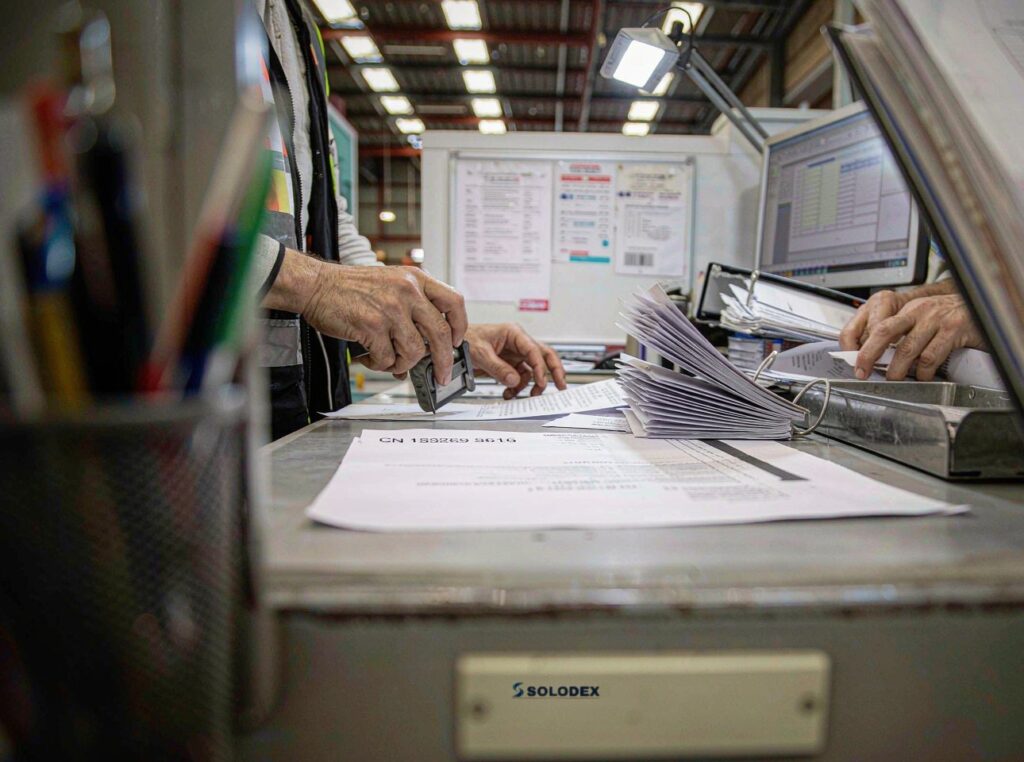
The master bill was clean. The shipping line confirmed release against it, the freight station accepted the container, and the consolidator’s file showed the box as delivered. Then the twelve consignees called, one after another, each asking the same question: my house bill says my goods are here, why can I not collect them? The master bill had done everything it was supposed to do. It had simply done it to the wrong object, as far as they were concerned.
A consolidated container moves through two paperwork layers, and each layer has its own number, its own holder and its own release. The master bill carries the box from the carrier to the freight station. The house bills carry the individual consignments from the station to their receivers. One releases a container; the others release goods. They share a voyage, not a status.
Two Numbers, Two Objects
The first thing to fix is the idea that these are two copies of the same document. They are not. They describe different objects at different points in the journey, and they are issued by different parties.
The master bill is the carrier’s document. It names the consolidator (or its agent) as consignee, covers the whole container, and is what the shipping line uses to decide who may take delivery of the equipment. In most consolidated moves it runs on a single number that appears on the container, the manifest and the arrival notice.
Each house bill is the consolidator’s document. It names the actual consignee, covers that consignee’s cartons, and is what the freight station uses to decide who may collect those cartons. There are as many house bill numbers as there are consignments — twelve in the example above, each with its own holder, its own description and its own release.
The container number is not a substitute for either. It is equipment identification. It tells you which box to look in, not who is entitled to what came out of it. The gap it leaves is exactly the one the container with two packing lists describes from the inventory side.
Two Release Points, Not One Chain
Each layer ends in a release, and the two releases are separate transactions. This is the operational fact the whole article turns on.
Master release happens between the carrier and the party named on the master bill. It is a release of the container: the line has been paid, the document has been surrendered or the telex has been sent, and the station may take possession of the box. Its evidence is a release notice or an endorsed original against the master number.
House release happens between the consolidator (or its destination agent) and each consignee. It is a release of a consignment: that consignee’s documents and charges are settled, and the delivery order is issued against the house number. Its evidence is a delivery order or the station’s collection record for that house bill.
Neither evidence appears on the other layer’s file. A master release tells you nothing about house bill 7, and a delivery order for house bill 7 was not triggered by the master release — it was triggered by a separate request from a separate holder. This is why a screen can show released in green while twelve people stand at a desk being told to wait. They are reading two different release points, and only one of them is green.
The same separation is visible in the paperwork that travels with the cargo: the five readers of one packing list each take a different field from the same sheet, but none of them is reading the other layer’s release record.
Each Number Can Change Hands Separately
The deepest reason the two layers cannot share a release is that each number can be transferred independently. The master bill may be surrendered, endorsed or reissued while the house bills stay exactly where they are; a house bill may be passed to a new consignee while the master bill never moves. There is no operation that transfers both at once, because they are contracts with different parties.
This is why a single status field can never describe the shipment. At any moment the master layer and the house layers can be in different states, held by different people, with different sets of charges settled. The carrier cares only about the holder of its own document. The station cares only about the house bill presented at the counter. Both are right from their own side of the desk.
| Number | Can be transferred by |
|---|---|
| Master bill | Surrender, endorsement or telex instruction to the carrier |
| House bill | Endorsement or reissue by the consolidator to a new consignee |
| Container number | Nothing — it identifies equipment, not a right |
The third row is the one customers most often miss. A container number can be printed on both documents, quoted in every message and painted on the box, and it still confers no right to collect anything. The air waybill with two shippers makes the same point with numbers: the identifier that moves the shipment is not the identifier that releases the goods.
Practically, this means a change of consignee at the last minute is a house-layer event. It does not need the carrier, does not change the master bill and does not move the box. It needs the consolidator to reissue one house bill and the station to update one line on the manifest. Customers who ask whether the shipping line must be informed are asking the master layer a question that belongs to the house layer — an error that costs days precisely because the two layers are independent.
Why the Carrier Will Not Release to You
Customers often discover the two layers by trying to collect directly from the carrier. It does not work, and the reason is contract, not courtesy.
The carrier’s obligation runs to the holder of the master bill. In a consolidated move that holder is the consolidator, not the twelve consignees. A house bill is a contract with the consolidator; it is not a document the shipping line issued and not one the line will honour at the door. The legal consequence — what happens to your claim if the consolidator fails — is set out in the three bill-of-lading release types. This article takes the legal point as settled and asks only what it means for the collection desk: you cannot use the carrier’s release to collect your cartons, and you cannot use your house bill to take the container.
The practical result is a two-step handover. First the carrier releases the box to the freight station against the master bill. Then the station releases each consignment to its receiver against the house bill. The station is the hinge between the two paperwork layers, which is why so many of the arguments in this part of the journey end at that desk.
The Three Places the Numbers Must Match
Two layers only work if the mapping between them is recorded somewhere. In a well-run consolidation that map appears in three places, and a disagreement between any two of them is enough to stop a consignment.
| Place | Number it carries | Who reads it | What breaks if wrong |
|---|---|---|---|
| Arrival notice | Master bill + container | Station receiving clerk | Box delivered to wrong station |
| Deconsolidation manifest | Master ↔ each house bill | Check-out crew | Consignment not locatable in the strip |
| Delivery order | Single house bill | Collection desk | Cartons released to wrong consignee |
The middle row is the hinge within the hinge. The key fields of the manifest are where the master number is resolved into the house numbers; if one house bill is misspelled or absent there, that consignee’s goods exist physically but have no path to a delivery order. The correction is a paperwork repair with a physical consequence, and the rules for document mismatch decide which side has to move.
Note how little of this is visible to the end customer. The consignee sees one house bill, one delivery order and one queue. It has no view of the arrival notice or the manifest, so a mismatch in the middle row looks to them like the station simply losing the goods.
CY, CFS and the Point Where the Two Layers Meet
Where the master release ends and the house release begins depends on the place of delivery named in the contract, and this is where two common arrangements diverge sharply.
Under a CY arrangement the container is released at the terminal yard, still sealed. The master layer ends at the gate. The freight station must first take the box away, strip it and sort it before any house bill can be released at all. The two paperwork layers are separated by a physical operation with its own queue.
Under a CFS arrangement the carrier delivers the box to the freight station, and the station strips it. The two layers meet in the same building, which makes them easy to confuse — a customer at the counter sees one address and assumes one release. There are still two. The differences between these promises, including the waits each creates, are set out in delivery orders and telex release.
Door delivery adds a third step: the station releases the consignment to a local carrier, which releases it to the consignee at the door. That last handover is a delivery promise made against a house bill, never against the master bill that brought the box into the country.
When One Layer Moves and the Other Does Not
The four useful failure patterns all come from the same shape: one paperwork layer advances while the other is stuck.
Master released, house not applied for. The box is at the station, the goods are sorted, and nobody from consignee 9 has presented a house bill. The consignment is physically present and administratively invisible. This is the ordinary case, and it is the one most often misreported as “the goods have not arrived”.
Master released, house blocked on documents. A house bill is held for a missing certificate, a mismatched name or an unpaid charge. The container has done its job; that one consignment cannot move. The station holds it while the other eleven are collected.
Master held, houses ready. The consolidated entry is stopped at the port, so no amount of house-bill preparation helps. Everyone waits on one master-level event. The abandoned-cargo process is the extreme version of a master layer that never completes.
House released to the wrong party. The container was fine, the mapping was fine, and the collection desk released cartons against a house bill presented by someone without authority. The remedy then follows the claim process rather than the release process, which is a much worse place to be.
Air Freight Does It With Eleven Digits
The same two-layer structure exists in air freight, but the identifying numbers make it easier to see. A master air waybill covers the consolidated shipment; a house waybill covers each consignment, and the eleven-digit number on the house waybill is a separate identifier, not a derivative of the master. The two contracts on one pallet show how quickly the two layers separate when the goods change hands.
The operational lesson transfers directly: the number that moves the ULD is not the number that releases the carton. A shipper who quotes the master number at the collection desk has given the one identifier the desk cannot use.
Three Questions That Keep the Layers Straight
None of this needs a customer to learn documentation. Three questions, asked of the right party, prevent nearly every misunderstanding above.
Ask the carrier’s agent for the master status only when you need to know whether the container has arrived and been released to the station. That is the only question the master number can answer. Ask anything else and you will get a true answer to the wrong question.
Ask the consolidator for the house status — has my house bill been included in the deconsolidation manifest, is it checked out, is the delivery order ready. One house bill, one question, one answer that can be acted on.
Quote the right number in every message. A message that says “my shipment” will be answered from whichever layer the reader happens to be looking at. A message that says “master 123, house 456” cannot be misunderstood, and it lets both parties check their own side of the map. Consolidated freight runs on two different economics from a direct move, and this double numbering is part of the price of the sharing.
The Sentence That Ends the Argument
Everything above reduces to one line: the master bill releases the box to the station; each house bill releases one consignment to one receiver. One in, many out, with a separate release at each end. The first release is not the second, and no status screen joins them because no single document does.
M1 showed that the box and the consignments sit on different lists. M2 showed that the strip is an ordered service, not an automatic event. This piece shows the paperwork spine behind both: two numbers, two holders and two release points. The next one asks who pays for the strip that separates them, and why a bill split by piece rarely feels fair.
Related reading: the legal weight of each document is in bill-of-lading release types; the collection instruments are in delivery order and telex release; the inventory side is in one container, two packing lists and five readers of one packing list; the box-versus-consignment split is in the box clears, the consignments do not; who orders the strip is in who opens the box decides the clock; the shared-box logic is in a shared container is not a shared shipment; the air version is in the air waybill with two shippers; and the upstream choice is in consolidation versus direct shipping.
When a sailing closes early, the master bill cannot be issued until the next one, and every house bill waits with it; see one bill in, many bills out.


