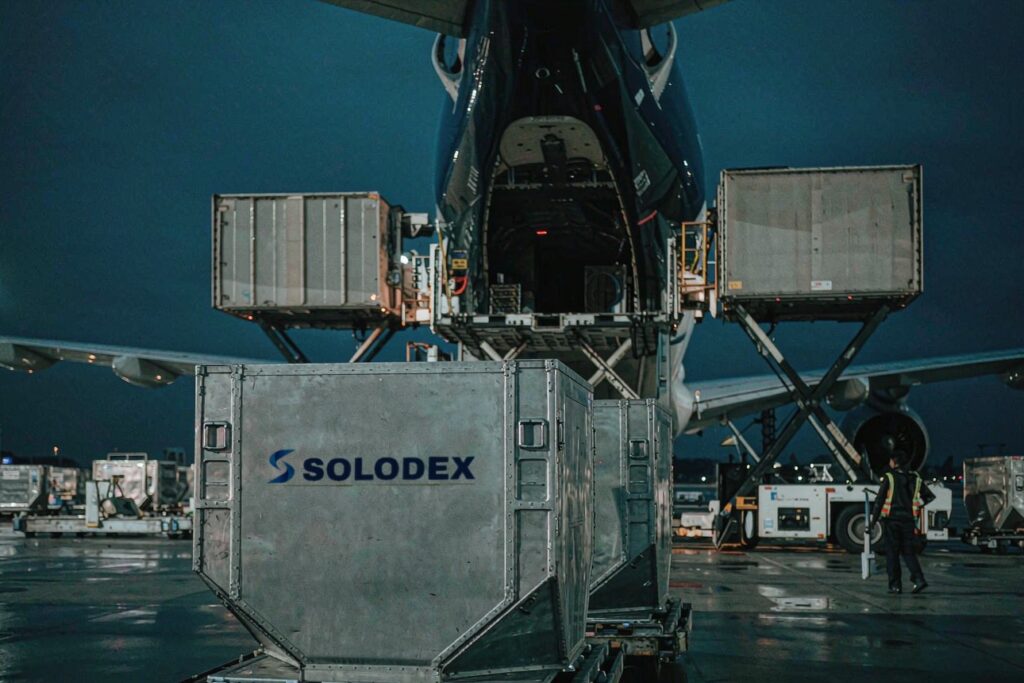
The shipment left on Tuesday. On Wednesday the buyer types the number into the airline’s tracking page and gets nothing — not a delay, not a status, just a message saying the number is not recognised.
Nothing has gone wrong. The number is a house waybill: the document the forwarder issued, numbered from the forwarder’s own sequence, describing one consignment inside a larger one. The airline has never seen it and never will. What the airline has is a master waybill, with a different number, covering a pallet that holds this shipment and eight others.
This is the first thing to understand about air freight, and it explains a surprising amount of what follows: the cargo travels once, but it is described twice, and the two descriptions are contracts with different parties.
Two contracts on one pallet
A consolidated air shipment carries a master air waybill and a house air waybill. The master is issued by the airline, or by an agent drawing on that airline’s stock of documents, and its parties are the airline and whoever tendered the cargo — normally the consolidating forwarder. The house waybill is issued by that forwarder, and its parties are the forwarder and the actual shipper.
So on one pallet there are two shippers and two consignees, and neither pair is the same. On the master, the shipper is the forwarder and the consignee is the forwarder’s agent at destination. On the house, the shipper is the factory and the consignee is the buyer.
Which means the contract that governs the flight is not the contract you hold. Your contract is with the forwarder, on the forwarder’s terms, and the airline’s obligations run to the forwarder. That is not a trick; it is what consolidation is. But it decides who answers when something goes wrong, and most shippers discover the arrangement only at that point.
The eleven digits are not a serial number
An air waybill number is eleven digits in three parts: a three-digit airline prefix, a seven-digit serial, and a check digit. The check digit is the remainder when the seven-digit serial is divided by seven.
A serial of 1234567 divides by seven to 176,366 with a remainder of 5, so the number reads 020-12345675 if the prefix is Lufthansa’s. Because a remainder is always between zero and six, a valid air waybill number can never end in 7, 8 or 9. That single fact catches a large share of numbers that were mistyped, misread from a photograph, or invented.
The prefix is worth understanding too, because it does not mean what people assume. It identifies the carrier that issued the document, not the carrier that flies the goods. On an interline movement the prefix stays with the issuing airline for the whole journey, so a consignment can travel on one carrier under a number that belongs to another. And a neutral waybill — the blank stock a forwarder keeps for carriers it does not hold paper for — carries a prefix too, because the stock is drawn against some airline somewhere.
None of this arithmetic applies to the house waybill. House numbers are the forwarder’s own, any length, sometimes containing letters, often encoding the branch and the year. Running the mod-7 check against one produces a failure that means nothing.
The same cargo, described twice
| Master air waybill | House air waybill | |
|---|---|---|
| Issued by | The airline, or an agent on the airline’s document stock | The consolidating forwarder |
| Contract between | Airline and forwarder | Forwarder and shipper |
| Number format | Eleven digits, mod-7 check digit | The forwarder’s own sequence |
| Consignee named | The forwarder’s agent at destination | The actual buyer |
| Visible to the airline | Yes — this is the only number the carrier knows | No |
| Where a claim starts | With the forwarder, against the carrier | With the shipper, against the forwarder |
Read the last two rows together. The tracking number that returns nothing is not a broken number; it belongs to a system the airline does not participate in. And a claim does not begin where the damage happened, it begins one layer up, with whoever holds the contract that covers that layer.
What the airline is actually liable for
Air carriage liability is set by treaty, as a figure per kilogram of cargo, revised every few years. It is a real obligation and it is almost always smaller than the goods.
A kilogram of electronics can be worth several hundred dollars. The treaty figure is a fraction of that, which is why the useful number on the document is not the weight but the declared value for carriage — an optional field where the shipper states a higher value and pays a supplement for the additional liability.
That field is not the customs value, and the two are routinely confused. Declared value for carriage buys liability from the carrier. Customs value is what duty is assessed on. Paying for one does nothing for the other, and the risk that neither of them covers is the reason cargo insurance exists as a separate product.
The clock is the other half of it. Air claims run on a short window measured in days from delivery, and the window is a condition of the claim rather than a formality — miss it and the liability above becomes theoretical. A buyer who finds the damage in week three has already lost the argument, whatever the treaty says.
The consignee field is not a delivery instruction
On a consolidated master waybill, the consignee is the forwarder’s agent. That looks alarming the first time it is pointed out — the document covering your goods names a company you have never heard of — and it is entirely normal. The agent takes the pallet off the flight, breaks it down, and releases each house consignment to its own receiver.
What releases it is identity and authorisation, not a document. An air waybill is non-negotiable: it is a receipt and a contract, but it is not a document of title, and it cannot be endorsed to somebody else. There is no original to courier, no bank holding three of them, no telex release.
That is why air freight does not get stuck the way sea freight does. A container can sit for a week waiting for an envelope; a pallet cannot, because there is no envelope. The speed of air freight is not only the aircraft. A meaningful part of it is that the document layer has one fewer gate in it.
Where the pallet changes hands
Between the aircraft and the buyer’s door, the cargo is held by four different parties, and each handover is a separate release. The carrier hands the pallet to the terminal operator against the master waybill. The terminal hands it to the forwarder’s agent, or to whoever holds the master, on the agent’s authority. The agent breaks the pallet down and releases each house consignment. Then customs releases it to the importer, and only then does a truck move.
Four releases, four sets of hours, and only one of them is visible on the airline’s tracking page. A shipment can be “arrived” for two days and still be three handovers away from a truck, which is why the event that matters to a buyer is not the landing but the release.
It also explains why an airline trace is such a thin answer. The carrier can tell you where the pallet is within its own custody. It cannot tell you that the agent has not yet been instructed, or that the broker is waiting for a value the invoice does not state. Those are the two most common reasons a consignment sits on the ground while the tracking page says it arrived on time.
When the master waybill has to name the real buyer
Occasionally the consolidation has to be abandoned and the shipment moved on a direct waybill, where the airline’s document names the actual shipper and the actual consignee. Three things push a shipment that way.
The first is a letter of credit that specifies an air waybill consigned to the buyer, or to a bank. A house waybill will not satisfy the document check, because the bank is being asked to rely on a contract to which it is not a party.
The second is a buyer or an insurer who wants the carrier’s liability to run to them directly, rather than through a forwarder’s terms. This matters most on high-value cargo and on anything where a claim is likely.
The third is regulatory: certain dangerous goods, certain destinations and certain government shipments are expected to move on the carrier’s own document.
All three are legitimate, and all three cost money, because a direct waybill means no consolidation rate and no sharing of the pallet. The decision belongs at booking, not after the goods are at the terminal, because by then the pallet has been built around them.
Three things that break on the face of the document
The names do not match across the two documents. The house waybill says one company, the invoice says another, the master says the forwarder. A customs broker matching them by hand will stop, and the same shipment described five ways is the most common reason an air consignment misses its flight even though it arrived in time.
One master, two arrivals. A consignment too large for a single aircraft position can be split across flights under one master waybill, with a split indicator on the document. The pieces arrive on different days, and the receiver who was told “Thursday” gets a third of the goods on Thursday. If the shipment is time-critical, ask whether it will be split before it is booked, not after the first part lands.
“To order” written in the consignee box. This happens when somebody copies the wording from a bill of lading. On an air waybill it means nothing, because the document cannot be negotiated. A broker who sees it will query it, and the query costs a day.
What to check before the goods are collected
Which layer are you buying? Consolidated with a house waybill, or direct on the carrier’s document. The answer changes the rate, the liability and the claim route.
Is the consignee on the house waybill the party that will actually clear and receive? Not the parent company, not the sales office — the importer of record.
Is the chargeable weight on the document the one you were quoted? Air bills on volume as well as mass, and a light carton can bill at eight times its weight.
Is there a declared value for carriage, and does anybody intend to rely on it? If the answer is no, the insurance decision has already been made by default.
Will it be split? One master number is not a promise of one arrival.
You are buying a layer, not a piece of paper
The waybill looks like paperwork and behaves like a set of contracts stacked on one pallet. The airline’s contract covers the pallet. The forwarder’s contract covers your cartons inside it. The insurance contract, if there is one, covers the gap between the two.
Which is why the number that returns nothing from the airline’s tracking page is not a fault to be fixed. It is an accurate description of where your goods sit in the arrangement: known to the forwarder, invisible to the carrier, and moving anyway.
The useful question is never “where is my shipment”. It is “which contract am I asking”. The answer decides who has to reply, and what they can be made to pay.
The waybill also carries the security status of the consignment, and that field decides which aircraft the cargo may board before any of the contract questions even arise.
The waybill records a chargeable weight for a consignment, but the unit the aircraft carries is the built pallet — and its shape is set by the aircraft, not by your cartons.
What the waybill cannot tell you is whether the flight it names had room: space is held in blocks, and the document is issued after that question has already been settled.
The waybill timestamps the flight; it says nothing about the days either side of it. Most of a door-to-door transit happens on the ground, and the document only records the part in the air.
Air freight at least has a document at the level of the whole uplift: a shared sea container has no equivalent container packing list.
Those two names are contracting parties under a master and a house document; a signature line instead names the party speaking to an authority.
An air waybill can name two shippers on one document. A container can hold several shipments behind one seal, and the position each is given decides what the receiver sees first.


