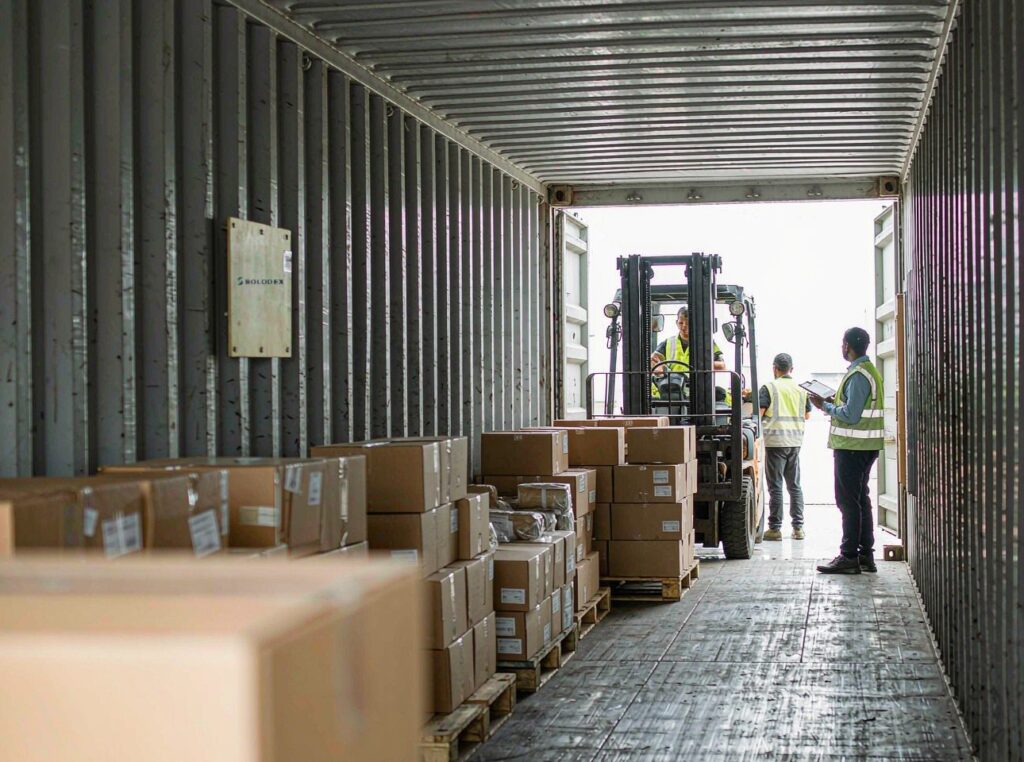
Four exporters deliver cartons to the same consolidation warehouse on the same Thursday. Each is charged by the cubic metre, and each believes the freight line on the invoice is the extent of the arrangement. On Monday the container is loaded. The goods that arrived last go in first and end up against the back wall; the goods that arrived first are loaded last and sit immediately inside the doors. Nobody wrote this down as a decision. Everybody signed for it as a shipment.
That order is the subject of this article. Multiple factories meeting at one point are covered in the multi-factory consolidation guide, and the choice between sharing a container and booking a whole one is argued in the consolidation versus direct comparison. What neither covers is the moment after those decisions: several consignments, one floor, and a loading sequence that silently assigns each shipper a position. The customer here is small — one or two pallets, not a full container — which is exactly why the position matters. A large shipper books the whole box and owns the order. A small shipper inherits it.
One meter, several owners
Consolidation is usually explained as a price. Several shippers share the container cost, each paying for the cubic metres their goods occupy, and everybody saves against a partial or a full-box booking. That explanation is correct about money and silent about everything else. The invoice is divided by volume. The liability is not.
Each consignment keeps its own shipper, its own consignee, its own packing list and its own claim. If one exporter’s goods are damaged, the dispute is between that exporter and the carrier or the consolidator — not among the four companies that shared the space. The container is a shared physical object but not a shared shipment. One container can carry two packing lists and both can be correct, because the document follows the consignment while the box follows none of them.
The practical result is that four shippers can occupy one container while having four entirely different relationships with it. They pay the same unit, but they do not have the same exposure. What separates them is not the rate or the volume. It is where their cartons ended up.
| What is shared | What is not shared | Who decides | Where recorded | Visible to shipper | On the invoice |
|---|---|---|---|---|---|
| Container space and freight | Shipper and consignee | Booking party | Master bill and consignment list | Yes, on the list | Charge per cubic metre |
| The floor and the doors | Packing lists and values | Each exporter | One list per consignment | Only their own | Nothing about contents |
| The voyage and the seal | Claims and liability | Carrier and consolidator | Damage and exception records | Only if claimed | Nothing about risk |
| The unloading event | Position inside the box | Loading crew | Often nothing at all | No | Nothing about order |
The position nobody priced
A container has two structurally different places. Cartons against the doors are the first out and the most exposed to handling at every intermediate stop; cartons at the back travel the longest and sit under whatever is stacked above them. In a full-container load one shipper accepts both positions. In a consolidation the positions are distributed among people who paid the same rate per cubic metre.
The distribution is made in a few hours by a loading crew following a plan. The plan exists because a container has to be stuffed tightly and safely, and because heavy cartons go low while fragile ones go where they will not be crushed. Those are good reasons. The consequence is that one shipper’s fragile goods may travel in the doorway while another shipper’s dense goods sit at the back, and neither was consulted about the trade-off. Container load planning describes the arithmetic of fitting everything in; the question here is who absorbs the parts of that arithmetic that are not equal.
Position also decides what a receiver sees first at the destination. When the doors open, the consignment loaded last comes out first, often before the unloading crew has a clear view of the rest. A short shipment or a damaged carton is noticed in that order, and the first consignment to be checked is not the one most likely to be at fault. The physical sequence becomes an evidentiary sequence.
Loading order is a document whether or not it is written
Most consolidators do produce a loading plan, because without one the container cannot be packed efficiently. The plan lists consignments and quantities and may include a sketch of where each block goes. What it usually does not do is travel with the goods as a record available to each shipper. It is an internal working document, kept at the warehouse and discarded when the container is stuffed.
That is why the same fact can be known and still unavailable. The warehouse knows which consignment went in first. The carrier knows the container number. The exporter knows the cubic metres on the invoice. Nobody among them is holding the one sentence that would answer “whose goods were at the door when we opened it”. Five readers can work from one packing list and still miss a line nobody claimed; here the missing line is the order itself.
Writing the order down costs almost nothing. A photograph of each block before the next one goes in, consignment numbers visible, and a final sheet with four lines — which shipment was loaded first, where it sat, which came out first, and whether anything was rehandled on the way — turns an internal decision into a record. It also reveals something useful immediately: whether the shipper who paid the most for fragile handling was given the position that needed it.
The other end of the sequence
Loading order has a mirror image. At the destination the container is opened once and emptied many times, and the sequence in which consignments leave is rarely the sequence in which they were loaded. A local carrier collects one shipment and drives away; another waits until the next day because its goods are behind the first. The receiver who asks why their cartons were handled twice is asking about a decision made at the origin days earlier.
Deconsolidation is a different operation from consolidation, with different staff, a different warehouse and often a different company. The list that tells the origin crew where each shipment goes does not automatically reach the destination crew, and even when it does, the practical order is governed by truck availability and dock space. The result is that a careful loading plan can be undone in an afternoon by a receiving bay that was never shown it.
This is the point at which the small shipper feels the arrangement most directly. A full-container customer controls both ends. A consolidated shipper controls neither, and the two ends belong to organisations with no reason to optimise for one another. The risk is allocated differently in a shared box: the saving is real, and so is the fact that nobody owns the sequence from first load to last collection.
Where the savings actually go
Shippers choose consolidation for the rate, and the crossing point between a partial load and a full container is a real number. The question worth adding is what the rate does not include. A shared container saves the unused space that a small shipper would otherwise pay for alone. It also introduces a set of decisions — position, order, rehandling, timing at the consolidation point — that a full-container shipper makes for itself.
Those decisions are not costs on the invoice, but they become costs in a claim. If a carton is crushed, the enquiry asks what was stacked above it. If a consignment is short, the receiver asks whether it was accessible near the door or buried behind three other shippers. A damage claim is built from records made at the time; a consolidated load has more moments at which a record should have been made and fewer people responsible for making them.
This is not an argument against sharing a container. It is an argument for recognising what is being shared. The freight is divided by volume; the risk is divided by position. The two divisions rarely match, and nothing in the quote tells the shipper where they will fall.
When the list and the doorway disagree
A discrepancy at the door is usually described as a packing problem. The packing list says twelve cartons, the receiver counts eleven, and the conversation turns to who sealed the container. In a consolidation the more useful question is which consignment was standing at the doorway when the count was taken, and whether anything in front of it had been moved to reach a different shipment. Access is not the same as presence, and a carton behind three other exporters can be present, correct and temporarily invisible.
This is a version of the shortage that closes cleanly on one waybill while three cartons remain uncounted: the system records the event it was designed to record, not the physical count. At container scale the event is the seal and the unloading; the position is not a field. Damage found after delivery has a similar shape — the handover was clean because the record had no place for the condition underneath.
The practical consequence for a small shipper is that a count made at the doorway is a count of what was accessible, not a count of what arrived. If the destination crew is working by truck schedule rather than by consignment, the same container can produce a different number depending on which shipment was collected first. That difference is not a customs problem, a packing problem or a rate problem. It is the position problem appearing as a number.
What a small shipper should ask for
Three questions are enough. First, who decides the loading order and on what basis — weight, fragility, ready date, or simply the order in which the trucks arrived. Second, will the finished arrangement be photographed or sketched before the doors are closed, with each consignment identifiable. Third, at the destination, is unloading by consignment or by whatever comes out first, and who is present when a discrepancy is found.
The answers cost nothing to ask for and are awkward to give after the fact. They also expose how much of the consolidation service is actually included. Reading a freight quote tells a shipper which charges are present; these questions tell them which decisions are being made on their behalf. In a small shipment the second list is usually longer.
The shorter version is this. Each of the four exporters paid for cubic metres and received a position. The invoice records the first. Only the loading plan records the second, and it is rarely kept. When a small shipper joins a shared container, the unit being bought is not just space — it is a place in a sequence that somebody else will decide.
The unit this batch kept changing
Four articles in this series each took one unit apart. A waybill has one status while the cartons are an integer, and the missing box never had a state to lose. A failed call turns a shipment into a stored item with a clock that starts at the deposit scan. Customs holds an importer code while the door holds a name, and the two identities never meet in a record. The carrier measures the outer carton, so the box is the last variable a shipper controls before collection.
This one adds position to the list. Freight charged by the cubic metre packs several consignments into one box; liability stays with each shipment; and the order in which the cartons went in decides who sits at the door and who sits at the back. Small shippers do not buy containers. They buy a unit inside somebody else’s — a status, a clock, a name, a box, and finally a place. Every one of those units was chosen by a system before anyone thought to ask which unit the customer believed they were paying for.


