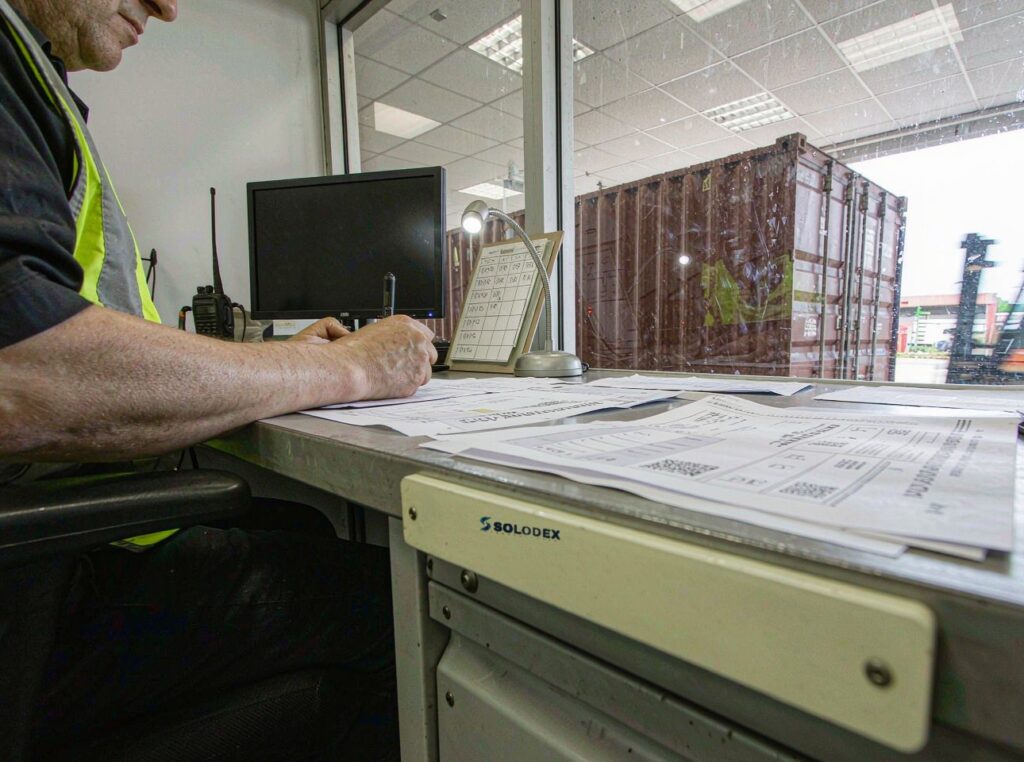
Two containers arrived on the same vessel, were discharged the same afternoon, and cleared customs the same evening. One had its consignments available for collection on Tuesday. The other was still unopened the following Monday. The difference was not the shipping line, the paperwork or the port. It was that somebody had ordered the first box opened, and nobody had ordered the second.
This is the operation that consolidated freight hides best. A container on a dock looks like cargo, but until it is physically stripped it is not yet a set of consignments — it is a sealed box with a manifest inside it. Turning the box into separate, collectable shipments requires a paid instruction and a booked slot. Devanning is an ordered service, not an automatic event. The party who orders it, and when, sets the availability clock for every shipment in the box.
A Box Does Not Open Itself
Container freight is built on an assumption that only holds at the origin: that stuffing a box is a decision somebody makes. At the destination that assumption quietly fails. A container arriving at a freight station is not a work order. No forklift will approach it, no door will be swung open, until an instruction exists and a charge is attached to it.
The instruction has a name in most warehouses — the stripping order, the devanning instruction, the unstuffing job card — and it carries the fields that matter: the container number, who requested the strip, what scope (whole box or selected consignments), when the customer needs the goods available, and who is to be billed. Until that card exists, the container’s status can be arrived, released, even on the dock, and none of its consignments will have an availability timestamp.
This is why the question “when will my goods be ready?” cannot be answered from a tracking screen. The screen shows the box. The answer lies on a job card that may not have been raised yet.
Who Has the Right to Order the Strip
The right to open a consolidated box follows possession and payment, not ownership of the goods inside. In practice four parties can raise the stripping order, and each starts a different clock.
The consignee (or its agent) can request the strip directly, usually by presenting the house bill and settling the destination charges. This is the fastest route when the consignee is in a hurry and knows which consignment it needs. It is also the route that surprises importers who assumed arrival alone would trigger unpacking.
The consolidator or its destination agent orders the strip as part of its standard service, often for the whole container at once, spreading the cost across the house bills. The customer never sees the job card — it simply receives a collection notice when its consignment is checked out. Most LCL customers experience this version and never learn that a decision was made on their behalf.
Customs can order a strip by selecting the container for exam. This is a compulsory devanning, unrelated to the customer’s timetable, and it is the one case where the box opens whether anyone wants it or not. The procedures and costs are set out in the four kinds of customs exam; for this article the relevant point is only that an exam-driven strip creates availability as a side effect, not a service.
The station itself may strip for operational reasons — to free a dock position, to recover a container, to re-stack. This is the least predictable trigger and the one most likely to generate a consignment that is physically available but administratively unfinished.
The Four Triggers on One Job Card
The same physical operation can be triggered for four different reasons, and the reason determines whose clock you are actually watching. Confusing them is how a customer ends up waiting for a strip that happened days ago, or awaiting paperwork for a box nobody has opened.
| Trigger | Who decides | Clock it starts |
|---|---|---|
| Consignee request | Holder of the house bill | Availability for that consignment only |
| Consolidator standard strip | Destination agent | Availability for all consignments, in strip order |
| Customs exam | Authority | Exam clock first; availability only after release |
| Station operational strip | Warehouse | Physical availability; paperwork catches up later |
Read the third column carefully. Only two of the four triggers produce a clean availability timestamp. The exam trigger makes the goods physically accessible but holds them administratively until the examiner releases; the operational trigger does the reverse in some stations, producing paperwork before the goods are actually located. In both cases the customer hears “the box is open” and reasonably — wrongly — assumes collection can begin.
Five Timestamps on One Stripping Order
The decision to strip is a single instruction, but it produces a sequence of timestamps, and each one is a separate answer to “is my shipment ready?”. A well-run station records all five; a poorly run one records the first and the last, which is just enough to make a dispute unavoidable.
Requested. The consignee or agent raises the job card. Nothing physical has happened, but a service has been bought and a duty to schedule it created.
Scheduled. The station allocates a strip slot and a crew. This is the date customers most often mistake for availability; it is only a booking.
Stripped. The container is physically opened and the goods are removed and sorted into their consignment blocks. The box is now empty of that cargo, and its own return clock begins — a separate device lifecycle described in the first move of the empty box.
Checked out. Each block is reconciled against the manifest and the house bill. A discrepancy stops that consignment and no other one; the correction runs through the key fields of a manifest correction. Only now does the consignment exist as a clean, countable unit.
Available. The consignment is declared collectable and the delivery order can be issued. This is the only timestamp that should ever be quoted as “ready”.
| Field | Recorded by | Customer sees it | Means goods are collectable | Can be blocked by |
|---|---|---|---|---|
| Requested | Job card | Rarely | No | Charges unpaid |
| Scheduled | Station diary | Sometimes | No | Crew or dock space |
| Stripped | Strip report | Rarely | No | Exam hold, damaged cargo |
| Checked out | CFS list | On request | Almost | Manifest discrepancy |
| Available | Delivery order desk | Yes | Yes | D/O not presented |
The gap between the third and fifth rows is where most of the waiting lives, and it is almost never visible on a tracking page. The customer who asks “has it been stripped?” is asking a question that can be answered with a yes and still leave them waiting two days.
Early Is Not Always Better
It is tempting to conclude that every box should be stripped the moment it lands. That is not how consolidated freight works, and forcing an early strip can cost more than it saves.
Consignment-level storage at the freight station often starts when the goods are checked out of the strip, not when the container arrived. Strip a box on Monday for a consignee who cannot collect until Friday and you may have started four days of its own storage clock. The asymmetry is the same one the box release article describes: box charges end at the gate, consignment charges start at the strip.
There is also a matching problem. A consolidated box may contain goods whose paperwork will not be complete for days — an inspection, a missing certificate, an importer still being set up. Stripping early turns a clean container-level hold into a messy pile of separated cartons, some of which now need their own storage. The consolidator’s standard strip usually waits until the majority of house bills are ready, precisely to avoid this.
And a strip cannot be partially undone. Once the seal is broken and the blocks are built, the box’s original stow is gone — the position data that makes each shipment locatable in a shared container has been consumed. A re-stow for a late-changing customer is a fresh operation, billed accordingly.
Who Pays Decides Who Goes First
When several consignees want the same container opened, the strip is not scheduled by who asked first. It is scheduled by whose money is attached to the job and whose consignment is easiest to extract. A station with a limited crew will strip the block that clears the box fastest, or the one whose customer is paying the whole stripping invoice, and leave the awkward block for the afternoon.
This is an ordinary commercial fact with an unusual consequence: the order in which consignments become available is a function of billing, not of the manifest. The house bills are equal on paper; the job card makes them unequal in time. A customer who wants its goods first has two levers — settle the consignment-level charges early, and specify the scope of the strip in the instruction rather than accepting a general “strip the box”.
Both levers are visible on the freight bill if you know where to look. The station’s line for devanning appears in the destination charges, and it is often the line that decides the sequence; the broader structure of such charges is unpacked in the seven kinds of money on one page. The same invoice is where a customer discovers that the “all-in” quote did not include devanning at all.
A Customs Strip Is Not Your Strip
The most confusing version of this operation is the one nobody ordered. If the box is selected for exam, customs can require it opened, emptied and repacked — an intensive devanning that has nothing to do with the customer’s collection plan. The mechanics belong to the exam procedures; what matters here is the effect on availability.
An exam strip produces three distinct states that look identical from outside. The box is physically open; the goods have been handled by examiners rather than the original packer; and no consignment is available until the examiner closes the file. A customer who sees the empty cartons and assumes collection can begin will discover the hold at the delivery order desk, not at the door. The six gates after discharge all have clocks, but the exam gate is the one that can reopen a box after it was already declared released.
The practical response is not to resist the exam — selection is not negotiable — but to ask a narrow question: has the exam been closed at the consignment level, or only the box level? A closed exam on the container and an open question on one house bill are the same situation M1 describes, reached from the other direction.
Where the Clock Actually Sits
Four clocks run through this operation and none of them is the vessel’s. The container’s life clock runs until it is stripped and returned; the exam clock runs only if an authority selected the box; the station’s work clock runs from scheduled to stripped; and each consignment’s availability clock runs from checked-out to collected. The freight station is the only place all four meet, which is why the answer to every timing question eventually comes back to the same desk.
That concentration has a cost. A station that is short of crew can hold the work clock open for days without any external status changing, and a customer watching the port will see nothing wrong. The wait charges that follow such a delay attach to different parties depending on which clock was running — the container’s, the station’s or the consignment’s. Knowing which one stopped is most of the argument.
Three Things a Consignee Can Actually Control
None of this requires the customer to run a warehouse. Three instructions, given early, remove most of the uncertainty.
Name the consignment, not just the container. A stripping request that says “box XYZ” joins a queue. One that says “house bill 7, four cartons of samples, required available Wednesday, charges settled” gives the station a job it can price, schedule and confirm.
Settle the destination charges before the slot, not after. Unpaid charges are the most common reason a requested strip never becomes a scheduled one. The customer believes the job is in progress; the station has not raised it.
Ask for the checked-out timestamp, not the strip date. The strip date tells you when the box was opened. The checked-out timestamp tells you when your specific goods became a clean consignment. Only the second one supports a collection promise — and delivery promises that survive contact with a freight station are built on exactly that number, as set out in writing a delivery promise that holds.
The Sentence That Ends the Argument
Everything above compresses into one line: the container arrives; the consignment becomes available only when somebody orders, pays for and checks out the strip. Arrival is a fact about a vessel. Availability is a fact about a job card. They are separated by a decision, and the party who makes that decision owns the clock.
Consolidated freight is priced as one box and delivered as N collections. M1 showed that the box release and the consignment handover sit on different lists; this article shows what physically turns one into the other — a paid instruction, a crew, and five timestamps that almost nobody records for the customer. The next piece in the chain is the paperwork that carries the two levels: the consolidation point where the box was built, and the master and house bills that split it at the other end.
Related reading: the two-list problem is set out in the box clears, the consignments do not; the hourly sequence before this stage is what happens after discharge; the device clock that starts at the strip is the first move of the empty box; exam-driven strips fall under the four kinds of customs exam; the charges are mapped in port and terminal charges and reading a freight quote; liability for the wait is in who pays for the wait; the upstream choice between sharing and not sharing a box is in consolidation versus direct; and the space logic that the strip consumes is in planning a container load.


