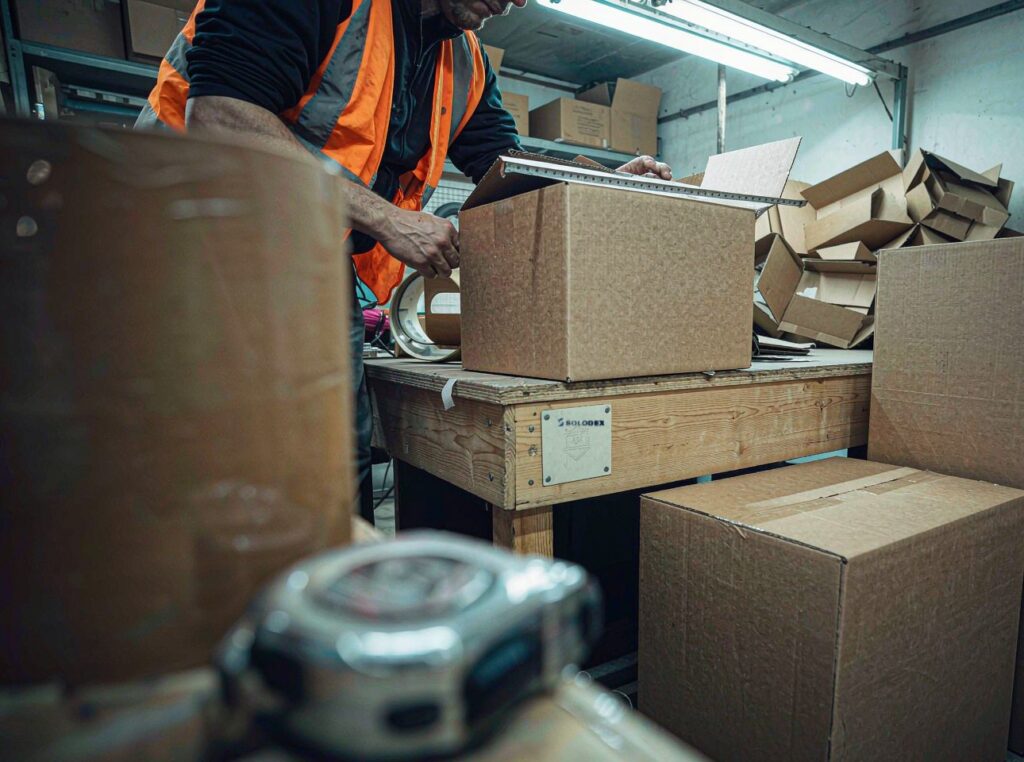
A seller closes three orders on a Friday. Each contains the same four hundred ceramic mugs. The first goes out in the carton the factory keeps for mugs, the second in a slightly taller carton that was on the packing bench, and the third in the carton a customer asked for because it fits under a bed. The goods are identical. The three freight invoices are not. Nobody changed the product, the route, the rate card or the incoterm. The only thing that moved was the rectangle on the outside.
That rectangle is the subject here. The formula that turns length, width and height into a billable number is explained in the volumetric-weight guide, and whether paying someone to open and repack a carton is worth it is argued in the repacking cost analysis. Neither asks the earlier question: why the box chosen on the packing bench is already a line in the invoice before the carrier collects anything. The same logic makes the first kilogram expensive and gives a container a crossing point between cubic metres and cartons; this article stays with the single carton and the decision that closes it.
The invoice is written from the outside in
A quote is built from a small set of inputs: origin, destination, service, declared value and a weight. The weight that matters is rarely the number on the scale. It is the greater of the actual mass and a number derived from the space the parcel occupies, which is why a carton of cushions can bill more than a carton of metal. The carrier does not open the box to check. It measures the rectangle it can see.
This means the outer dimensions are not a description of the shipment. They are an input to it, in the same way the destination postcode is. A factory that packs to whatever carton is nearest is effectively letting the packing bench set the freight charge, and the packing bench is usually optimised for something else — available stock, speed, or how the carton stacks on a pallet. The board grade and stacking strength are chosen in the same room, for the same set of reasons, and the two decisions interact more than either department expects.
The consequence is visible in the quote before anyone disputes it. A shipper negotiates the per-kilo rate for weeks, then approves a carton with four centimetres of unnecessary height, and the extra space quietly raises the number the rate is multiplied by. The rate is the part people argue about. The dimensions are the part that decides what the rate applies to.
| Decision at the factory | What the carrier measures | Field on the invoice | Who decided it | What stays invisible |
|---|---|---|---|---|
| Contents and quantity | Nothing directly | Declared value, commodity code | Product and order | How the goods were arranged |
| Outer carton dimensions | Length × width × height | Dimensional basis of the charge | Packaging specification | Air inside the carton |
| Weight on the scale | Gross mass | Actual-weight basis | Product and packing material | Which basis won |
| Pallet or loose cartons | Handling unit at collection | Handling and lift charges | Outbound workflow | Carton count beneath the wrap |
Why this is not the same as repacking
The distinction matters because the two decisions happen at different times and cost different things. Repacking is a correction: the carton already exists, somebody opens it, and the exercise only pays if the new outer dimensions lower the billable weight by more than the labour and materials cost. Most of that argument is about a break-even point, and it is settled after the first packing decision has already been made.
Choosing a box type is earlier and cheaper. It happens while the carton is still a specification, alongside the grade of board and the stacking requirement, and it costs nothing extra to choose a smaller rectangle if the goods and the protection allow it. There is no opening, no re-labelling, no second scan and no labour charge. The saving is not recovered later; it is never created.
That is why the question is not “should we repack”. It is “why did this product get this box”. In most factories the answer is a historical one: the carton was designed for a different item, or for a pallet pattern that changed, or for a customer who no longer orders. The dimensions survive because nobody revisits them, and every shipment pays for the decision.
The shape does the work, not the mass
Two cartons of identical volume can bill differently. A long, flat box and a compact cube with the same number of cubic centimetres present different problems to a sorter, and the carrier’s measurement rule reflects that. The longest dimension and the girth around the other two enter the calculation, so stretching one side can raise the charge even when the total space stays the same. This is the part of the rule that surprises shippers who only count cubic metres.
Irregular products make it worse. Anything that is not a rectangle is measured as the smallest rectangular box that contains it, which is why a cylindrical shade or a rolled item bills like the cube around it. Air freight builds a contour around the aircraft’s geometry for the same reason: the carrier prices the envelope, not the object. A small change to the way a product is nested inside its carton can move that envelope without touching the product at all.
The practical test is to lay the carton on the bench and ask what is actually occupying the corners. If the answer is air that exists only because the box came in a standard size, the box is a freight decision disguised as packaging. The space is paid for at the same rate as the mugs.
Where the empty space comes from
Empty space in a carton is rarely carelessness. It comes from standard sizes, from a need to protect fragile corners, from a label that must face a particular way, and from the habit of packing to the quantity in the order rather than the volume the goods occupy. Each reason is legitimate on its own. The mistake is assuming the carrier ignores the consequence.
Protection is the hardest trade-off. Reducing the carton too far removes the cushioning that stops breakage, and a damaged shipment costs more than the dimensional saving. A load that arrives depends on how it is supported, and the same carton that bills high may be the only one that survives the stack. The goal is not the smallest possible rectangle. It is the smallest rectangle that still does the job, which is a different sentence and a different design meeting.
Standard sizes are easier to fix. A factory that stocks three cartons instead of eleven can still right-size most orders if the three are chosen from the actual distribution of order volumes rather than from what a supplier happened to have cheap that year. This is a packaging decision with a freight consequence, and like the other inputs in a quote it should be visible before the shipment is booked.
One carton becomes three
The box decision is rarely taken once. An order that fits one carton is often split into two or three, and each new carton brings its own outer dimensions and its own dimensional basis. The goods have not changed and the total volume has barely changed, but the carrier now measures three rectangles instead of one. This is not the repacking argument, which asks whether opening a finished carton saves money; it is the quieter fact that a split multiplies the unit the freight system charges on.
Splitting is usually done for a good reason — a carton over a weight limit, a fragile item that needs its own space, a separate consignee beneath the same order. Each reason is sound. The cost is that the smallest carton in the split often sets the billable weight of the whole consignment, because the measurement rule is applied to each piece and the results are added. A single poorly sized box can dominate an order that was otherwise packed well.
This is the same mechanism that makes three cartons on one waybill close as one status: the freight network records the handling unit, not the intention behind it. Here the handling unit is the carton and the intention is a product decision made months earlier. When an order is split, look at the dimensions of every piece in the split, not only the largest. The small one is where the surprise usually sits.
The one-variable test
There is a simple way to see whether a box choice is costing money. Hold the goods, the destination, the service and the rate constant, and write down two outer dimensions: the carton currently used and the smallest carton that would protect the same contents. Put both through the carrier’s published measurement rule. The difference is the price of the box decision, isolated from every other variable in the quote.
The number is usually small per parcel and large per season. Four centimetres on one carton is a rounding error; four centimetres on nine thousand cartons is a shipment. It is also cumulative across the chain, because the bigger carton may push a pallet over a height limit or reduce the number of cartons that fit, exactly as a container load is decided by dimensions before weight. A box that bills slightly high at parcel level can change the number of pallets at consolidation level.
This is why the test belongs in product packaging rather than in the shipping department. By the time an order reaches the freight desk, the dimensions are printed on the carton and the only remaining lever is the rate. The decisions that actually move the billable weight were taken weeks earlier, in a drawing that nobody thought was a cost document.
Who owns the rectangle
In most organisations nobody owns it. Packaging specifies a carton that protects the product and fits the pallet. The freight desk receives the finished carton and negotiates a rate against it. Purchasing buys the carton because the supplier is approved. Each function has done its job, and the outer dimensions — the one number the carrier will actually multiply — are an inheritance rather than a decision.
The question to ask is not who packs the box. It is who signs off the dimensions knowing they are a freight input. In a small exporter that person may be the same one who books the shipment, which is an advantage: the circle between a drawing on the packing bench and a number on the invoice is short enough to close. In a larger operation the circle is long, and the dimensions persist long after the reason for them has gone.
The cost of a wrong rectangle also lands in a different budget from the one that chose it. Packaging saves a few cents on a cheaper carton; freight pays for the extra cubic centimetres on every shipment for a season. That split is why the components of a shipping cost are worth reading alongside a packaging specification. The two documents describe the same object from opposite ends, and neither tells the whole story on its own.
What the small shipper can still control
A small seller cannot renegotiate the divisor and usually cannot change the service. What remains is the rectangle. Keep a record of outer dimensions per product, not just per order, and review them when the carton supplier changes or when an order pattern changes. Ask the packer to measure the finished carton rather than the blank, because tape, a lid and a reinforced corner all add to the outside that the carrier will measure.
Then treat the dimensions as part of the quote. The checklist of charges that arrive later is mostly about inputs nobody fixed early; the carton is one of the few inputs a shipper can fix without a negotiation. If the same goods can travel in a smaller box, the saved space is real money on every shipment, and it is money that never has to be claimed back — it simply never appears on the invoice.
The six steps that take a parcel from a factory to a carrier are set out in the parcel shipping guide. The step between closing the carton and receiving the quote is where this one sits. The goods did not get heavier. The box got measured, and the box is the unit the freight system actually prices.
The carton sets the chargeable weight, but in a shared container it also gets a position. A shared container is not a shared shipment: freight is divided by volume while the loading order decides who sits at the door.


