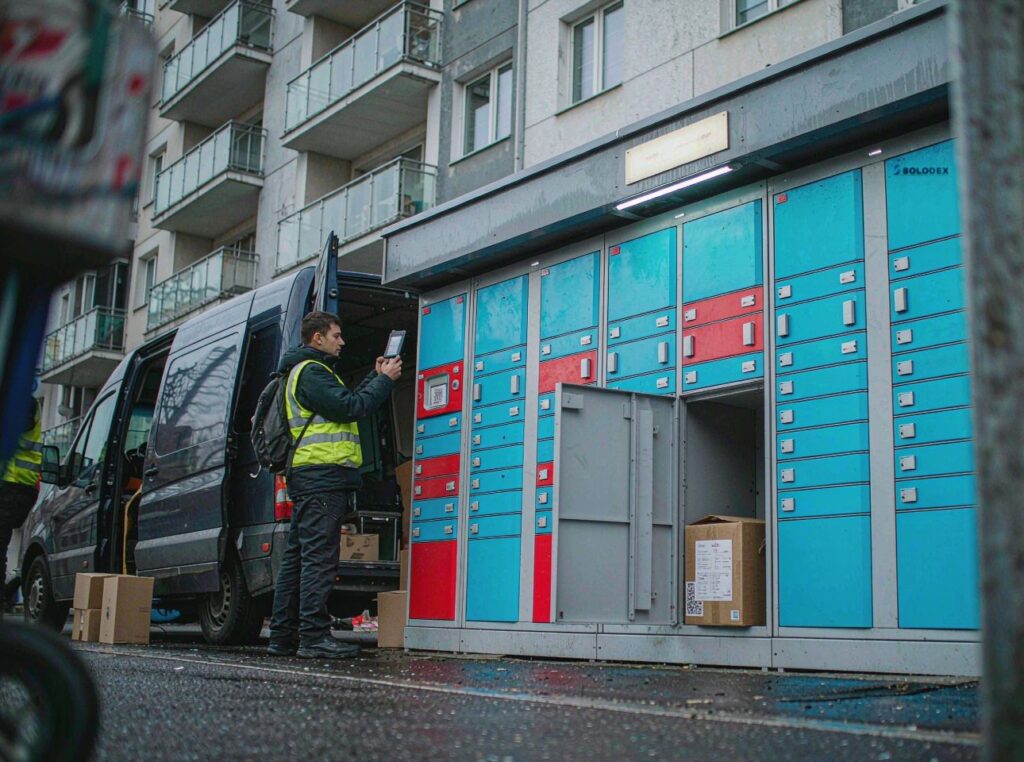
A parcel reaches the destination city on Tuesday. On Wednesday a van stops outside the address, nobody answers, and a card goes through the letterbox. On Thursday the tracking page still says “in transit”. On Friday the sender gets a message saying the parcel was delivered. The parcel is in a locker four hundred metres from the address it was sent to.
Nothing in that sequence is a contradiction. The van did reach the street, the status did stay unchanged, and the locker really did accept the parcel. The three statements describe three different objects. This article is about the moment a small parcel stops being a shipment and becomes a stored item, because that moment decides which clock is running, who pays when it stops, and what evidence survives the change. The steps before the van are covered in the six-step parcel guide; this one starts at the first unsuccessful call.
A failed call is a chargeable event, not a pause
The natural way to read a missed delivery is as a gap in a journey. The van came, the van left, and the parcel is where it was. Carriers do not record it that way. An attempted delivery is an event with its own code, its own van time, its own driver time and its own cost, and it is closed whether or not anybody accepted anything. The van did not fail to deliver. The van completed a delivery attempt.
This distinction explains the first surprise in most small-shipment disputes. The freight quote paid for one carriage to one address. It did not pay for two. The second call is another movement of the same parcel, and in most networks it is charged either as a redelivery or as a fresh local leg. The fee is listed among the charges that appear after a quote, but the reason it appears is not administrative. A vehicle and a driver were booked twice.
The same logic applies when the address was wrong in the first place. An incorrect postcode or an incomplete street is not corrected inside the original movement; it triggers a correction and a new attempt, which is why a parcel whose declared value does not match its contents can fail at the desk before it ever fails at the door. The failure is a new event either way, and new events start new clocks.
The scan that changes the object
Tracking pages are built around a status field with a short list of values. Nothing in that list means “the parcel is now somebody else’s problem”. So when a delivery attempt fails, the network has to put the parcel somewhere, and the scan it uses to do that is not a delivery scan. It is a deposit scan: into a locker, onto a depot shelf, or behind the counter of a collection point. Each of those scans changes the identity of the thing being tracked.
Before the deposit scan, the parcel is in carriage. The carrier owes movement, and the clock that matters is transit time. After the deposit scan, the parcel is in storage. The carrier owes safekeeping, and the clock that matters is the number of free days before storage charges begin. The address on the label has not changed. The receiver has not changed. Only the obligation has.
This is why a tracking page can say “in transit” for a parcel sitting on a shelf. The status field belongs to the carriage record, and the carriage record was closed by an exception. The deposit was written to a different table. Nobody is hiding it; the two tables simply do not share a field, in the same way that one waybill can close while three cartons remain uncounted when the scan was made against a pallet.
| Scan code | What the network did | What the parcel is now | Clock in force | Who is paying |
|---|---|---|---|---|
| Attempted | Van called, no handover | Still in carriage | Transit / attempt | Shipper, in the quote |
| Deposited | Placed in locker, point or shelf | Stored item | Free storage days | Shipper until free days end |
| Collected | Receiver or agent took it | Delivered goods | Stopped at handover | Normally nobody extra |
| Returned | New movement back inland | In carriage again, opposite direction | New local / export leg | Whichever term assigns return |
Free days start at the deposit, not at the failure
The most useful field in a failed-delivery dispute is the timestamp of the deposit scan. It is not the time the van left, and it is not the time the card was posted. It is the moment the parcel came to rest under somebody’s custody, and it is the moment the free-storage allowance begins to count down.
The difference matters because the gap between the two can be a day or more. A van that calls late in the afternoon cannot always return the parcel to the depot and process it the same evening. The deposit is posted the next morning. The allowance runs from the morning, and the receiver who assumes they have three days from the failed call actually have two. By the time they act, the storage charge has already started, and the amount is calculated per day on a parcel they thought was still being delivered.
Ask for that timestamp and the conversation changes. The question “when did it fail” produces an argument about the van. The question “when was it deposited, and what is the free period from that scan” produces a date. Carriers can answer the second question because it is in their system; they often cannot answer the first in a form that helps anyone.
Where the parcel sleeps decides who owes
Storage is not one place. A parcel left with a neighbour, a parcel in a staffed collection point, a parcel in an unattended locker and a parcel on a depot shelf are four different custodial arrangements, and they differ in who is holding the key and when the holding ends.
A locker closes one clock very cleanly. The parcel goes in, a code is issued, and the code is the handover. Once the receiver opens the door, the carrier’s custody ends, and anything that happens afterwards is a different question. A staffed point is less precise: the parcel may sit behind a counter for days, and the point may treat the parcel as collected when the receiver was notified rather than when they arrived. The gap between those two events is where a lot of “it was delivered” arguments live.
A depot shelf is the weakest of the three for a small shipper. There is no code, no counter, no fixed handover moment, and no visual record unless someone asks for one. This is the same custody problem that appears at much larger scale when cargo is held and eventually sold in place: nothing declares an abandonment on the first day, it accumulates through unpaid days and unclaimed space. A small parcel reaches its endpoint faster, but the mechanism is the same.
Route one: someone collects it
Collection is the cleanest ending because it closes both clocks at once. Carriage is complete, storage stops, and a handover record exists. The receiver gets a code or a counter number, and the carrier gets a scan. For small consignments this is usually the cheapest outcome, and it is worth offering before offering a second van.
The condition is that the collection point is genuinely convenient. If it is a van ride away in a city the receiver does not know, the apparent saving disappears: the receiver pays in time, and the parcel pays in additional stored days while they decide. A nearby point with a long opening window beats a distant one with a short window, even when the distant one is nominally free.
What should be left behind is the notification itself. A text saying a parcel is ready is not proof of where it is. A message containing the point name, the address, the code and the date the free period ends is a record. Without the last item, the receiver cannot tell whether acting tomorrow costs anything.
Route two: a second delivery is a new movement
Redelivery is not the original delivery resumed. It has a new appointment, a new vehicle slot and a new proof of delivery, and it is scheduled after the parcel is taken back into the delivery network rather than from the position where the van left it. If the receiver needs a different address, that address is also a new input: the correction has to reach the depot before the second van is loaded, or the same parcel makes the same failed call twice.
The practical consequence is that asking for redelivery without changing anything that caused the failure buys another attempt at the same result. A receiver who was absent at 10:00 and a receiver who is absent at 10:00 on Thursday are the same receiver. A delivery window is a booking, not a promise about a door, and a redelivery booking is no stronger than the first one unless the constraint that failed has been removed.
The exception worth paying attention to is a wrong address on a business shipment. There, the identity of the person who may sign is often the real problem, and receiving is a capability rather than an address: four different people can answer to the same company name, and only one of them controls the bay. On a small parcel the equivalent is simpler — a named person, a reachable phone number and an address that exists in the carrier’s own database — but it has to be fixed before the second scan, not after it.
Route three: going back is not cancelling
When nobody collects and nobody asks for a second attempt, the parcel is returned. The important thing about a return is that it does not undo the outbound movement. The outbound leg happened and was paid for. The return is a second movement in the opposite direction, usually under a new reference, and it crosses the border again at someone’s cost.
That cost is decided by the term under which the parcel was sent. Under a delivered-duty arrangement the seller tends to carry it; under a collect arrangement the receiver may be asked to pay the return carriage before the parcel is released back. Either way, the amount is not the original freight reversed. It is a new local leg, a new handling charge and possibly a new entry, which is why sending goods back can cost more than sending them out for a low-value order.
The reference number matters more than shippers expect. A tracking number that stays the same on the way back is often a carrier convenience, not the same consignment record; a new number is a new shipment with its own status field. If a dispute follows, ask which reference is being discussed. The answer determines which events are even in scope.
The notice is not the handover
Most carrier systems send a message when the first attempt fails. It usually says that a delivery was attempted and that the parcel is available to collect. Read literally, that message is two claims, and only the first one is true in the sense a shipper needs. The attempt happened. The collection has not. The parcel is merely within reach of a collection point, which is a statement about location rather than about ownership.
The gap between the message and the handover is measured in days, and it is chargeable. A receiver who reads the notice on the evening it arrives and collects the next morning may pay nothing. A receiver who is travelling and reads it four days later is inside the chargeable period even though they acted promptly on the information they had. The allowance is calculated from the deposit scan, not from the moment the receiver opened the message, and no notification tool asks whether the recipient was in a position to act.
This is the small-parcel version of a distinction that matters just as much at the other end of the trade: who pays at the destination is decided before the goods move, not when the bill arrives. Here the equivalent question is who absorbs the stored days when the instruction arrives late. If nobody assigned that responsibility in advance, it is argued about afterwards, and the argument is always about the same missing field.
| Event | Clock it starts | Clock it stops |
|---|---|---|
| First attempt scan | Attempt and any redelivery fee | Neither |
| Deposit scan | Free storage allowance | Transit time |
| Receiver notification | Nothing | Nothing |
| Collection or handover scan | Nothing | Storage and custody |
| Return acceptance scan | Return leg and its charges | Storage |
The notification row is deliberately empty. It is the row that shippers assume starts or stops something, and in most networks it does neither. Once that is understood, the three clocks become easy to read side by side, and the question about a late parcel stops being “where is it” and becomes “which clock is still running”. That is the question a consolidator can answer for a small batch the same day it leaves the factory, because the consolidator is the party holding both the deposit time and the receiver’s phone number.
Route four: nobody chooses
There is a fourth ending that appears in no network’s list of options. The free days expire, storage charges accumulate, nobody instructs the carrier, and the parcel is eventually disposed of, sold or destroyed under a local rule the sender has never read. This is the quiet outcome, and it is the one that generates the most later correspondence, because by the time anyone asks, the object no longer exists.
The route is not reached suddenly. It is reached by silence. A notification went to an address that was wrong, or to a phone number that was never given, and each subsequent free period expired without a decision. The same mechanism produces a charge that arrives weeks later in another language when the parcel was sent direct rather than through a local operator, because the local operator at least has a local number and rules the sender can ask about.
The practical defence is a deadline in somebody’s calendar. Whoever owns the relationship with the receiver — seller, consolidator or freight forwarder — should be the party watching the free-period end date, not the carrier and not the shipper in another country. A reminder two days before expiry costs nothing. An unclaimed parcel after thirty days is not a logistical problem any more; it is a written-off order.
What to leave in the file
Four fields settle almost every failed-delivery dispute, and none of them is on the tracking page. The first is the attempt code with its timestamp. The second is the deposit scan: place, time and custodian. The third is the end of the free period calculated from that deposit. The fourth is the termination scan — collection, redelivery handover or return acceptance — with the reference number it was recorded under.
Together they turn a story into a timeline a third party can read. The story version is that the parcel was delivered to the wrong place. The field version says an attempt was made at 09:40, the parcel was deposited in a locker at 16:20, free storage ran until the following Monday, and the locker was opened on Tuesday. One of those accounts can be checked against a carrier record. The other can only be argued.
The same discipline that applies to a damage claim applies here: a claim is built from records made at the time, not from recollections assembled afterwards. For small shipments the records are thinner, and that is precisely why the four fields matter. There is no surveyor, no joint inspection and no port log. There is a van, a shelf, a code and a date. Get those four into the file and a failed delivery becomes an event with a cost, a clock and an ending, rather than a week of messages about a parcel that everyone insists they can see on their screen.
The deposit scan starts a storage clock; the person who must stop it is identified only by the name and number on the waybill, not by anything on the customs entry.


