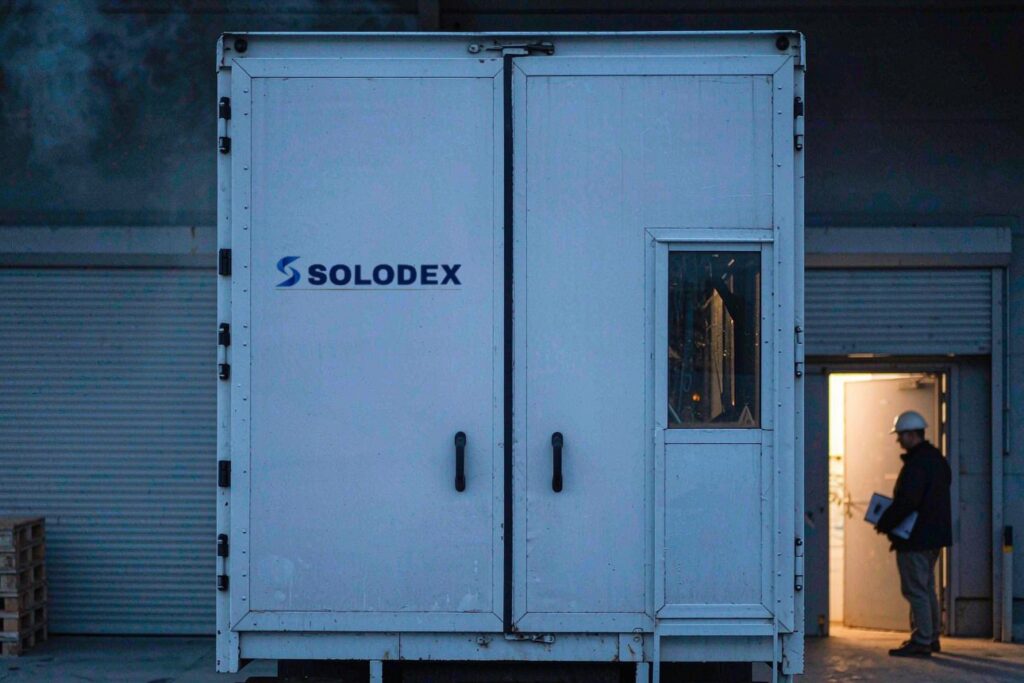
At 16:40 the driver calls. The truck is at the gate, the address is right, and the warehouse will not take the pallets today. The bay is full, the goods-in clerk went home at four, and Friday afternoon is not a receiving window.
The booking was made thirty-four days earlier. In those thirty-four days nobody asked the receiver a single question — not what time they accept, not whether they have a dock, not who signs. The address was confirmed, and everyone treated that as the same thing.
It is not the same thing, and the distance between the two is where the last day of almost every door delivery goes missing.
Four companies answer to the word “receiver”
On a transport document, the consignee is whoever is entitled to take delivery. On an invoice, the receiver is the buyer. For customs, it is the importer of record. On the floor, it is whoever opens the bay door.
Those are routinely four different legal entities. The buyer is a trading company with an office and no warehouse. The importer of record is a local subsidiary set up for tax reasons. The consignee on the bill of lading is the buyer’s bank, or the buyer “or order”. The site that actually unloads is a third-party logistics provider that has never heard of any of them and has a contract with only one.
A refusal is therefore rarely four parties saying no. It is three saying yes — the buyer ordered, the importer holds the licence, the consignee is named — and the fourth saying that it has no space today. From the outside it looks like one company changing its mind. It is four companies, three of which did not know the fourth existed.
Receiving is five capabilities, not an address
Space. A bay to stop in and a position to put the pallet down. Not “a warehouse” — a slot that is free at the hour the vehicle arrives.
Equipment. A dock leveller, a forklift, a tail-lift, and somebody licensed to operate it. A site can have all four and still fail, because the licence holder is on the early shift.
A person. Someone on site with the authority to sign for the goods, and the authority to refuse them. This is a different authorisation from the one that placed the order.
Time. A window that is open, and not the same window as everybody else’s. Receiving hours are shorter than business hours almost everywhere, and they are set by the site, not by the buyer.
A document. An open purchase order, a booking or appointment number, and an entry that has been released. Goods can be physically welcome and administratively unreceivable at the same time.
Every one of those five is checkable weeks before the goods leave, and almost none of them is checked, because the only question in the booking form is the delivery address.
A dock is a schedule, not a door
The word “dock” suggests capacity, and capacity suggests a physical thing that either exists or does not. What a receiver actually sells is minutes: a bay can be occupied by one vehicle at a time, and a site with two bays and a six-hour receiving day has twelve bay-hours to give away.
That is why a warehouse can be empty and still not take your pallet. The bay is free; the slot is not. Somebody booked it three weeks ago for a supplier who delivers every Tuesday, and the calendar has no room for a vehicle that arrives on a Friday afternoon in the last week of the month.
The receiving calendar also has nothing to do with the shipping calendar. It closes for stocktake, for a national holiday, for the two days after a promotion, and for the week the new warehouse management system goes live. None of these events appear on any document the shipper sees.
Three refusals, three different problems
The driver hears one sentence — “we cannot take it” — and reports it as one event. Operationally it is three, and they are not solved by the same people or paid out of the same budget.
| The refusal | What it looks like at the gate | Immediate cost | Whose budget it lands on |
|---|---|---|---|
| Cannot accept | Bay occupied, positions full, system down, stocktake week, nobody on shift | Waiting time, storage, a second delivery attempt, three days of a container nobody can return | The shipper, who then tries to recover it from a buyer who never agreed to a clause |
| Will not accept | Price dispute, quantity outside the purchase order, quality hold, goods sent too early or too late | The goods sit in a carrier’s shed while the commercial argument runs, and the clock does not pause | The shipper first, whoever is right later |
| Must not accept | No import licence, goods not as declared, missing certificate, consignment held by customs | Re-export, destruction or seizure, and a file that may never close | The importer of record on paper; the shipper in practice |
The first is a schedule problem and can be solved with a calendar. The second is a commercial problem and can be solved with a decision. The third is a regulatory problem, and it is the only one where the goods may never become deliverable at all — which is why it deserves a separate paragraph rather than a row in a table.
Note what the last column says. Three different failures, three different causes, and the invoice arrives at the same address in all three cases, because the carrier was instructed by the shipper and the receiver instructed nobody.
“We cannot take it today” is not the same as “we refuse it”
The distinction matters more than it sounds, because the two phrases produce the same report from the driver and completely different futures for the cargo.
A site that cannot take the goods today is still going to take them, and the only question is who pays for the three days in between. A site that refuses the goods has made a statement about the goods — that they are not what was ordered, or not acceptable — and that statement has consequences in the sale contract, in the claim, and in what can be done with the cargo next.
Which is why the follow-up has to be in writing and has to ask a specific question: are you refusing the goods, or are you unable to receive them today. A warehouse clerk saying “not today” is not refusing anything. A buyer saying “we reject this shipment” is doing something else entirely, and the difference is worth several thousand dollars and one legal position. It is also the difference the half-sentence on the delivery note is supposed to record — and the reason that half-sentence gets quoted back, months later, by somebody who was not there.
A refusal changes who is holding the goods
Until the goods are accepted, the carrier’s obligation is to tender them at the place named in the contract. When nobody takes them, that obligation is generally treated as discharged — the carrier has done what it promised — and the cargo moves into storage under the carrier’s terms, at the cargo owner’s expense.
That is the moment the shipment stops being a delivery and becomes a held consignment. It has not been delivered, so under most sale terms it has not been accepted either. It has not been returned, because returning it would require an import into the country it came from. It is sitting in a warehouse that somebody is paying for, insured by somebody who may not know it moved.
This is the first mile of cargo that ends up abandoned. Very little cargo is abandoned at the start. It is refused at the end, and then every subsequent decision costs more than the one before it, so the decisions stop being made.
The second attempt is not the first attempt repeated
A redelivery is a new movement with a new appointment, a new vehicle and a new free-time allowance, and the waiting from the first attempt is not refunded. The vehicle that sat outside for three hours was paid for those three hours.
There is also a queue effect. A refused consignment goes to the back of the receiver’s booking calendar, not the front, which is why the second attempt often lands four or five days later rather than the next morning. If the goods need a different site — a different warehouse, a different city — the whole delivery leg is replanned, and the original instruction is now wrong rather than merely delayed.
The practical consequence is that the cost of a refusal should be estimated before the first booking, not after the first failure. If the second attempt costs half as much again as the first, then the receiving confirmation is worth more than the freight negotiation that preceded it.
The trade term decides who owns the refusal
Under DAP, the seller delivers to the named place and the buyer clears the import. If the buyer’s site will not take the goods, the seller has not delivered, and the storage accrues to the seller while the buyer argues that the place was ready.
Under DDP the seller is also the importer, so a refusal does not merely delay the delivery — it strands goods that the seller has already cleared in its own name, with duty paid and no buyer in possession. That is a materially worse position, and it is one of the reasons DDP is priced higher than the arithmetic suggests: the price includes an option the buyer never exercises knowingly.
Whichever term applies, the refusal is not a force majeure event and not a carrier failure. It is a mismatch between a delivery plan and a receiving capability, and the contract says which of the two parties is holding it.
“We will call before delivery” is not a control
Every forwarder promises the call, and the call happens at the wrong moment. By the time the driver is on the phone, the vehicle is loaded, the bay is booked or not, and the only remaining decision is where to put the goods tonight.
A control is not a call. A control is a written confirmation from the site, four or five lines long, that answers the five capabilities: which site, which day, which window, which bay or booking reference, and which named person will sign — with the name of the person who signs when that one is on leave.
It also has to state what happens if the site cannot take the goods, and who pays for that. Not because the clause will be enforced, but because a receiver who has read it behaves differently from one who has not.
And it has to come from the site, not from the buyer’s purchasing contact. Purchasing has never seen the dock, does not know the receiving hours, and will confirm anything to close a purchase order. This is the same failure as a marketplace warehouse whose window is not negotiable, except that a marketplace at least publishes its rules. Your own receiver’s rules are unpublished, informal, and change when the warehouse manager changes.
Six questions, all of them answerable before production
Which site, and is it the same company as the buyer? If the answer is a third-party warehouse, the buyer is not the receiver and cannot confirm anything.
What are the receiving hours, and which days are closed? Including the week of the stocktake and the days around public holidays.
What equipment is on site? Dock, forklift, tail-lift, crane. A pallet that arrives at a site without a dock is a pallet that goes back.
Who signs, and who signs when that person is away? Two names, not one job title.
Does the site need a booking number, and how far ahead is it issued? If the answer is yes, the delivery date is not the shipper’s to choose.
If the site cannot take the goods, who pays the storage? In writing, in the order, before the goods are made.
None of these is a freight question, and all of them are cheaper to answer than the storage they prevent — the same way free time at the door is decided by a dock the trucking company does not control, and the same way detention runs on equipment nobody at the receiver has ever seen.
The last mile is a permission, not a distance
Selling delivered means selling a promise that somebody will open a door. The distance is the easy part; it is measured, quoted and tracked. The permission is the hard part, because it belongs to a company that has signed nothing with anyone in the chain and owes nothing to the schedule.
Which is why the confirmation belongs at order intake, in the same conversation as the price and the lead time. That is the last moment when a wrong answer can still be fixed cheaply: change the port, change the deconsolidation point, change the consignee, change the week. After the vessel sails, the only thing left to change is the invoice.
The goods were never late. The dock was closed, and nobody had asked what time it opens.
A dock that cannot accept a delivery is a schedule problem, not a distance problem; on the terminal side the equivalent is a released box sitting under two others with a valid appointment already booked.
A receiver who is not ready is one reason a delivery fails; a receiver who is ready but receives two of three cartons is a different failure, and it looks like success on the tracking page.


