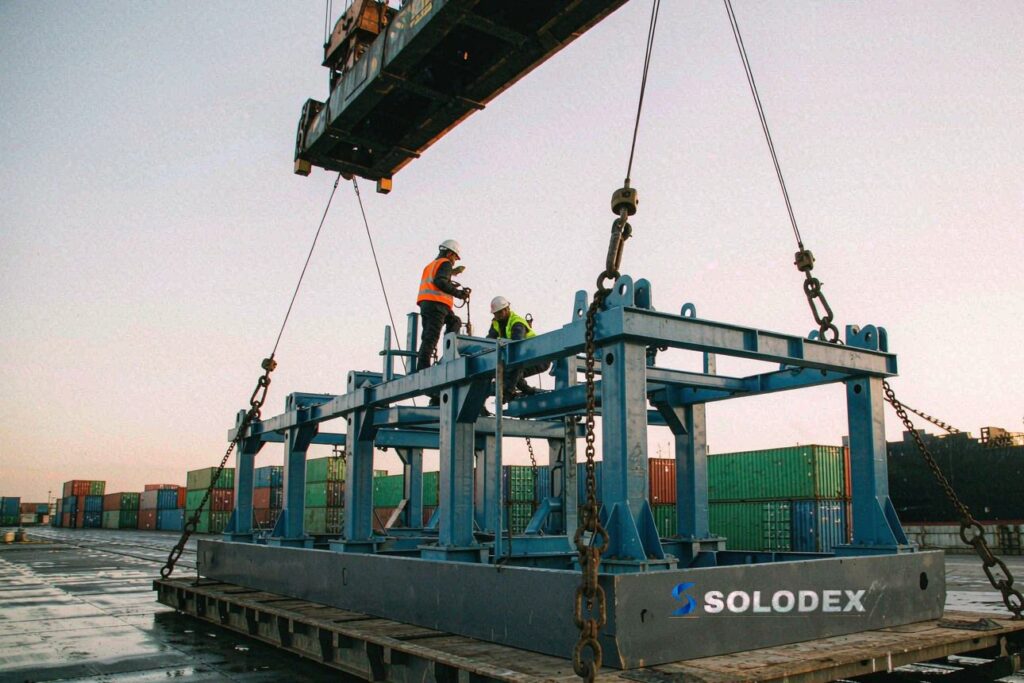
The machine was four point two metres tall. A standard high-cube container has a door opening of about two point five eight. The factory’s answer was immediate and cheerful: take the top off, it bolts on, we do it all the time.
The top did bolt on. It also carried the spindle alignment, and the customer’s acceptance test was a tolerance measured in hundredths of a millimetre. Reassembly at destination meant a service engineer, a laser alignment rig, a new warranty discussion and eleven days. So the shipment did not go in a box at all, and three weeks went into working out what it could go in instead.
That is the shape of oversized cargo. The question is never “which container”. It is “which of the three things that can refuse this shipment will refuse it first”.
A container is a measuring instrument
Most shippers know a container by its nominal length: twenty, forty, forty-five. The number that matters is the opening, and the opening is smaller than the box in every direction except width.
| Type | Inside, roughly | The opening you actually have | What it is for |
|---|---|---|---|
| 20 ft general purpose | 5.90 × 2.35 × 2.39 m | 2.34 wide × 2.28 high | Dense cargo; the weight limit arrives before the volume does |
| 40 ft high cube | 12.03 × 2.35 × 2.69 m | 2.34 wide × 2.58 high | The default for light, bulky goods; eleven centimetres of height buys a great deal |
| 40 ft open top | 12.03 × 2.35 × 2.35 m, no roof | Full width from above, ends about 2.3 m | Cargo loaded by crane from the top, still inside the footprint |
| 40 ft flat rack | 12.06 × 2.44 m deck, no sides, no roof | None — there is nothing to pass through | Cargo that overhangs, or is too tall or too wide for any box |
Figures vary by manufacturer and by age, and a centimetre matters. A machine built to two point six metres will not enter a high cube whose door is two point five eight, and the difference will be discovered at the loading bay with the crane already booked.
The useful habit is to design against the opening rather than the interior. If the product fits through the door, the rest is stowage. If it does not, no amount of planning inside the box will help.
Three ceilings, and the lowest one wins
Oversized cargo is governed by three separate limits that have nothing to do with each other. A shipment has to pass all three, and the binding constraint is whichever is tightest.
The box. Height, width, length, and the weight the floor and the corner posts will take. A flat rack solves the first three and leaves the fourth exactly where it was.
The ship. The crane’s lifting capacity at the radius it is working, the height it can lift to, the deck or hold position that can take the footprint, and the stack weight underneath. A terminal can have a machine capable of lifting the cargo and a berth that cannot accept the vessel’s plan for it.
The road. Height limits, width limits, axle weights, bridges, tunnels, roundabouts, and the police escort that a wide load requires in most jurisdictions. This is the ceiling that surprises people, because the port is where the cargo looks most impressive and the motorway is where it stops.
A machine can be perfectly containerisable and still impossible to deliver, because the last forty kilometres have a four-metre bridge and the truck is four point one.
Open top is about height, not width
An open top container is a normal box with the roof removed. It solves one problem: cargo that is too tall to pass through the door but still fits within the footprint, loaded from above by crane and lashed to the frame.
Two things about it are routinely overestimated. The first is the tarp. The tarpaulin keeps rain out at sea in the way a good coat keeps rain out — mostly, and not for a fortnight of weather. Cargo that must stay dry needs its own protection inside the box.
The second is the horizontal clearance above the cargo. Open top containers carry removable bows across the top to support the tarp, and those bows sit at a fixed height. Cargo that clears the sides but not the bows is cargo that arrives with a tarpaulin resting on it.
A flat rack has no walls, so the lashing is the wall
A flat rack is a steel deck with two end frames. There is no side, no roof and no floor above the deck, which means the cargo is held by nothing except what you attach it with.
The lashing points are in the deck and in the end frames, and they are rated. The common failure is not a weak chain — it is a strong chain attached to a point that was never designed for that direction of load. Cargo that is tall wants restraint against tipping; cargo that is heavy wants restraint against sliding; and the two requirements pull on different fittings.
Which is why a flat rack shipment is normally accompanied by a drawing. Not because the carrier is bureaucratic, but because somebody has to decide where the load path runs, and that decision cannot be made at the quay by two people with a chain tensioner.
The same reasoning applies inside an ordinary container, only less visibly: the load has to be restrained against acceleration, not weight, and a heavy machine on a steel deck is the case where that distinction costs the most.
When the flat rack is also too small
There is a point where no container works, and the shipment leaves the container trade entirely. Break bulk vessels take cargo in the hold or on deck, loaded by ship’s gear or by a floating crane. Roll-on roll-off vessels take cargo that can be driven aboard.
This is a different market with different economics: freight is quoted per cubic metre or per tonne rather than per box, schedules are infrequent, and the cargo is exposed to weather unless it is crated. It is also, for a certain class of machinery, the only option that does not involve dismantling the product.
The decision point is worth knowing in advance, because it changes the packaging specification. A machine that will travel on deck needs a crate and a preservative regime; the same machine in a container needs neither.
VGM is a weighing, not a formality
Every packed container has a verified gross mass, declared before it is loaded, and the declaration is the shipper’s. The figure exists because a container that is heavier than declared changes the stability calculation of the ship, and because stacks collapse when the numbers are wrong.
The tolerance applied at the terminal is small — a few per cent, or a tonne, whichever is greater, depending on the port. Outside it, the box is not loaded. It is weighed again, the paperwork is corrected, and the shipment misses the vessel.
For oversized cargo the arithmetic is harder than for ordinary freight, because the weight is not evenly distributed and the declared figure is an aggregate. A machine that weighs twenty tonnes but sits with sixty per cent of its mass in the rear third of the deck is a different problem from one that is evenly spread, and the container’s own limits are per-unit, not per-shipment.
A point load is not a weight
A container floor is rated for a distributed load, not for a number. The figure quoted — around a tonne per square metre for a standard floor — assumes the mass is spread across the deck. A machine standing on four feet is not spread; it is four points, and each one carries a quarter of the machine through an area the size of a shoe.
This is how a container passes its weight check and still arrives with a floor pushed down between the cross members. Nothing was overloaded in aggregate. The load was simply concentrated where the structure has the least to offer.
The fix is old and cheap: timber bearers, a steel plate, or a pair of runners that spread each foot over a metre of deck. It costs an hour at the loading bay and a few hundred in materials, and it is the difference between a machine that arrives level and one that arrives sitting in a depression.
The same logic applies on a flat rack, where the deck is thinner and the lashing points are the only structure. A heavy item resting directly on the deck concentrates its mass on the plate; a heavy item on bearers transfers it into the frame. One of those survives a fortnight of six-metre swells.
The last fifty kilometres
The leg that fails is usually inland, and it fails for reasons that have nothing to do with shipping.
Height is the first. Most jurisdictions draw the line somewhere near four metres, and a high cube on a standard chassis is already close to it. A flat rack with a machine on top passes that line easily, which is why oversized deliveries are planned around a route survey rather than a map.
Width is the second. A flat rack is about two point four four metres wide; most roads allow two point five five without special permission. Beyond that, the load becomes a wide load: permits, timings, escort vehicles, and in some places a prohibition on moving during rush hour or at night.
Weight is the third, and it is measured per axle rather than in total. A load that is legal overall can still overload the drive axle if the centre of gravity sits too far forward.
All of this has to be settled before the vessel sails, because the alternative is a machine sitting on a quay in a country where nobody has a permit for it. What happens after discharge is a story about paperwork for most cargo; for oversized cargo it is a story about roads.
What dismantling actually costs
The comparison that gets made is a freight rate: open top versus flat rack versus break bulk. The comparison that should be made includes everything that follows from cutting the machine in half.
Dismantling costs a service engineer at origin and another at destination, an alignment or calibration procedure, a test that has to be repeated, a warranty position that has to be renegotiated, and a customer who now owns a machine that was assembled twice. Add the crate for the parts, the extra volume, and the days.
Against that, a flat rack surcharge is usually the cheaper number — which is why the right question at design review is not “can it be dismantled” but “what is the largest single piece we could ship without dismantling, and what would it cost to design for that”.
There is a related economy that shippers often miss: the same machine that just fits a high cube ships at a normal rate, on any vessel, from any terminal, with no permits and no survey. Eleven centimetres of design margin is worth more than a decade of project cargo expertise. The volumetric rule that charges space rather than mass is the mild version of the same lesson; the container door is the severe one.
Three questions before the drawing is frozen
What is the largest dimension, and what is the smallest container opening that could accept it? If the answer is “a high cube door”, everything downstream is ordinary freight.
What is the heaviest single piece, and can it be lifted by the equipment at both ends? Not the machine’s total weight — the weight of the piece that has to be picked up, at the radius the crane will be working.
Can it be split into two pieces that each fit, without a calibration afterwards? This is the question that decides whether a product is a container shipment or a project.
The rest follows. Loading plans and inland mode choices are adjustments; the dimensions are not. A machine that is four point two metres tall has already chosen its route, its vessel, its terminal, its permit regime and its price, and it chose them in a design meeting where nobody was thinking about shipping.
Which is the same conclusion as every other piece in this series, arrived at from the opposite direction. Liquids are classified by two numbers, magnets by a distance, coolants by a net weight. Oversized cargo is classified by a tape measure — and the tape measure was read long before anybody asked whether it would fit.
Oversize pieces are a different problem from merely heavy ones: a load that exceeds the contour or the floor limit is refused at the door regardless of how well it is packed.
The regulatory side has its own ceilings, and they are cheaper to hit first: a used machine may be inadmissible before anybody measures it against a road or a crane.
Length is a handling problem before it is a freight problem: a module crate needs the right equipment at both ends, and the destination’s capability belongs in the quote.
The harder case is the one in this article that does not appear: a unit that fits every envelope and is still refused, because its mass puts it outside the container system altogether.
Height is booking data on a ramp as well as in a container: a modified vehicle can be refused at the ramp after the booking is confirmed.
Choosing how an oversized machine travels is one decision; once it goes as loose pieces, it also has to carry its own identity, because there is no box number.
Choosing how an oversized machine travels is one decision; what counts as one piece is another, and it is settled by the sling rather than by the drawing.
Choosing how oversized cargo travels is one decision; once it goes as loose pieces, each piece has to be weighed and measured for the stowage plan.
Choosing how oversized cargo travels changes the packing specification; a container supplies five kinds of protection that a weather-deck crate has to buy back.
A heavy machine is a question about concentrated load on the floor and the rated gross weight of the box; the same total weight as a liquid becomes a question about the direction of the force instead.
A verified gross mass exists partly because a misdeclared container changes the ship’s stability calculation; that calculation uses the declared weight times the vertical arm of the cell, so the error propagates into a number nobody on the quay can see.


