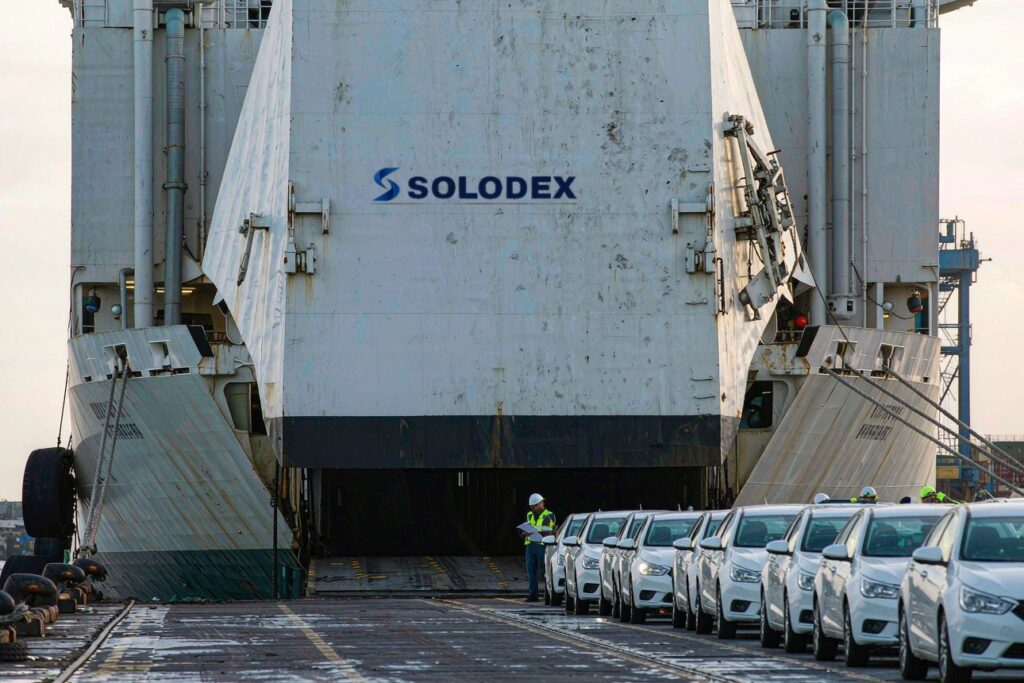
Forty cars arrived without a scratch on them. Paint perfect, interiors wrapped, odometers in single figures. At the port they cleared customs in a day; two weeks later the registration office refused every one of them, and the reason had nothing to do with the voyage.
The certificate of conformity that travelled with them described a type approved for a market where the headlamps dip to the right and the speedometer reads in miles. In the destination, traffic keeps to the other side of the road and the law asks for kilometres. Every car was, in the ordinary sense, undamaged and unused. None of them could be plated, and a car that cannot be plated cannot be sold to anybody who intends to drive it.
This is the last category in the batch, and it is the purest version of the pattern: the goods are legal to make, legal to own, and legal to sell in the country they were built in. What they lack is a permission that only the destination can grant, and no amount of freight expertise substitutes for it.
A car is a registrable object, not a box of goods
Almost everything else on this site is a quantity of something: kilos of ceramic, cubic metres of modules, bales of clothing. The buyer takes delivery and does what they like. A vehicle is different in kind, because the thing being sold is not the object but the right to use it on a public road, and that right is issued by a government that has never seen your factory.
Which means a vehicle shipment has two independent approval questions, and they are routinely confused:
May this object be imported? A customs question, answered by a tariff line, a duty rate and whatever restriction the market applies to vehicles of that age, origin or propulsion.
May this object be registered? A different question, answered by a type approval authority, and it is the one that decides whether the cargo has a buyer.
A shipment can pass the first and fail the second, and that is exactly what happened to the forty cars. The importer had checked the duty rate carefully and had never asked who signs the registration.
Two routes to a plate, and only one of them is fast
Every market that registers vehicles has a concept of type approval: a model is examined once, in detail, and then every unit built to that specification is deemed to conform. The document that travels with the unit is a certificate of conformity, and what it actually says is narrow and important: this individual vehicle was built to a type that has already been approved here.
If the certificate names the destination market, registration is administration. If it names a different market, the unit has no type approval at all, and the only remaining route is individual approval: the vehicle is presented, inspected and tested as a one-off.
That route exists, and it is not a formality. It requires the vehicle to physically meet the destination’s requirements, it takes weeks rather than days, it costs a meaningful fraction of a cheap car’s value, and it can fail – at which point the vehicle is in a country where it cannot be driven, sold as a car, or easily returned. There is a version of this problem in every market, and the details differ enough that the only reliable source is the authority itself.
For parts, the same logic runs through the component rather than the whole: approval follows the vehicle, which is why a bracket that fits forty models is approved for twelve.
What actually differs between two identical cars
The differences are small, physical and individually trivial. Collectively they are the difference between a registrable vehicle and scrap with low mileage.
Which side the wheel is on. This is the one everybody remembers, and it is the least of it – a steering rack and a dashboard move, and the car still drives.
The lamps. Headlamp beam patterns are asymmetric by design: they throw more light to the nearside so they do not blind oncoming traffic. Swap the traffic side and the same lamp now aims at the windscreen of every car it meets. On many units the fix is a new lamp unit, not an adjustment, because the cutoff shape is in the reflector.
The instrument. Miles or kilometres, and in some markets both must be visible at once. A digital cluster can often be reconfigured; an analogue one cannot, and a speedometer reading in the wrong unit fails the inspection that the certificate was supposed to make unnecessary.
The emissions class. A vehicle built to one standard may not meet the next one the market requires, and this is the item that ends the conversation, because it cannot be retrofitted at any sane cost.
The small legal furniture. Child restraint anchorages, a warning triangle, a first aid kit, an immobiliser, a tyre label, a plate for the national language. Each is cheap. Each is checked, and any one of them missing turns a fifteen-minute registration into a rejection.
Used is a second gate on top of the first
A new car faces the approval question. A used car faces the approval question and an age or condition regime, because many markets restrict used vehicles specifically – by age, by emissions class, by whether the unit was first registered locally, or by an outright prohibition that works the same way a banned clothing import does: there is no application to make.
And a used vehicle has an evidence problem that a new one does not. Mileage, accident history and prior registration all live in records held somewhere else, and the importing authority may ask for them in a form the exporter has never produced. The same logic that makes a used machine a different customs category applies here, with the added complication that a car carries its own history in a way a lathe does not: the odometer, the service stamps, the paint depth.
The ship does not carry the car in a box
Very few vehicles travel in containers. The economics of a container are built around cargo that can be packed, stacked and sealed; a car is a self-propelled object with a footprint that wastes most of the box. Two units fit in a forty-foot container with racks, sometimes three, and the operation requires the cars to be loaded through the doors, lashed to a frame, and unloaded with the same care – which is worth doing on a route with no car carrier, and rarely otherwise.
The default is a roll-on roll-off vessel, and the name describes the operation exactly: the car is driven up a ramp by a stevedore and parked in a lane on a deck. The ship’s unit of capacity is the lane metre: one metre of deck length across the lane width. A car occupies a small multiple of that; a truck or a bus is priced by the lane metre and by its height, which is why a high-roof van can cost more than a sedan twice its value.
Three consequences follow, and each of them is a control point that does not exist in container shipping.
The keys travel with the cargo. Somebody has to drive it on and off, which means the keys are handled by people who are not the shipper, and key control is a security procedure rather than an afterthought.
The vehicle waits in a yard. Before and after the voyage it sits in a compound with hundreds of others, moved several times. That is where most damage happens – not at sea, but in a car park, at low speed, by somebody in a hurry. Which makes the condition report made at the ramp the single most valuable document in the file: without a recorded condition at loading, every mark on arrival is arguable.
Height and ground clearance are booking data. Ramps have angles, decks have headroom, and a lifted or modified vehicle can be refused at the ramp after the booking is confirmed. It is the same class of problem as any other unit that exceeds a fixed envelope, arriving later and more expensively.
A vehicle is usually dangerous goods
This surprises people who ship cars for a living until the first time it stops a booking. A vehicle with fuel in it is a vehicle with a flammable liquid, and it is declared as such – UN 3166 for a liquid-fuelled vehicle, UN 3171 for a battery-powered one. A hybrid can be either depending on how the powertrain is described, which is exactly the kind of detail that gets argued about at a gate.
The practical requirements are modest and non-negotiable: a quarter tank or less is the common carrier limit for a liquid-fuelled unit, the battery must be isolated, and an electric vehicle travels at a stated state of charge. None of that is difficult. All of it is verified at the ramp, and a unit that arrives with a full tank is a unit that gets driven back off it.
The battery point has grown teeth. A battery in a vehicle is contained in equipment rather than shipped as cargo, which is a lighter regime than a pallet of cells – but a damaged or recalled battery pack in a used vehicle is a different conversation altogether, and some carriers now ask questions about pack condition that did not exist five years ago. A storage unit built into a frame is the extreme version of the same question: the energy is the cargo, and the paperwork follows the energy.
Four shipments of forty cars
| What is being shipped | Customs answer | Registration answer | Where it usually fails |
|---|---|---|---|
| New units, certificate names the destination | Duty and any restriction by origin | Administration – the type is already approved | Nowhere, if the certificate is genuinely for that market and matches the VIN |
| New units, certificate names another market | Same duty, same documents | Individual approval, weeks and a real failure risk | Nobody asked who signs the registration until the cars were on the water |
| Used units | Age, emissions or an outright prohibition | Approval plus condition evidence | The age rule is discovered at the port, where the only options are store, return or scrap |
| Electric units | Duty, plus battery-specific rules | Same as any other, plus charging and pack condition | State of charge and pack condition are not documented, so the carrier refuses at the ramp |
The second and third rows are the ones that cost money, and both of them fail for the same structural reason: the two approval questions were treated as one. The duty rate was checked because duty is what importers habitually check. The registration was assumed, because the car is a car.
What to establish before the units are built or bought
Which market is the certificate of conformity for? Not which market the model is sold in – which market the certificate names. The two are different documents on the same vehicle.
Does the specification match, item by item? Handedness, lamp pattern, instrument units, emissions class, and the small legal furniture. A written confirmation from the manufacturer’s homologation department, not a dealer’s assurance.
If it does not match, what does individual approval cost and how long does it take? Priced before the order, because it changes the landed cost of every unit.
Is there an age or condition rule, and does it apply to this unit? Written, from the authority, for this VIN range – not from a forwarder’s memory of a similar shipment.
What is the declared dangerous goods entry, and what does the carrier require? Fuel level, battery isolation, state of charge, and the condition of the pack on a used unit.
Who records the condition at the ramp, and where does that record go? Photographs and a signed report at loading, in a form the insurer will accept, before the vehicle disappears into a compound for three weeks.
The object that needs a permission
Every other category in this batch is stopped by a property of the goods: a heading, a barrier, a birthday, a weight. A vehicle is stopped by a property of the destination – its willingness to let this object onto its roads – and that permission is issued after the voyage, by an office that never sees the ship.
Which is why the useful sentence for a vehicle programme is not “we are shipping forty cars”. It is “we are shipping forty registrations, and each one is attached to a VIN”. Once the file is written that way, the certificate, the specification match, the age rule and the approval route all come before the booking, where they are cheap. Written the other way round, they arrive as a rejection letter, three weeks after the cars have been parked in a yard that charges by the day.
Both categories can be legal to import and impossible to use – a cylinder approved in one country may not be fillable in another, which is the same dead end as a car without a plate.
A vehicle is the clearest case of the same problem: installed in a machine and loose in a crate are two different regulatory objects.
Where the cargo is unit rather than carton, the whole idea of a per-piece handling split stops applying; the contrast is in vehicle shipping by RoRo.


