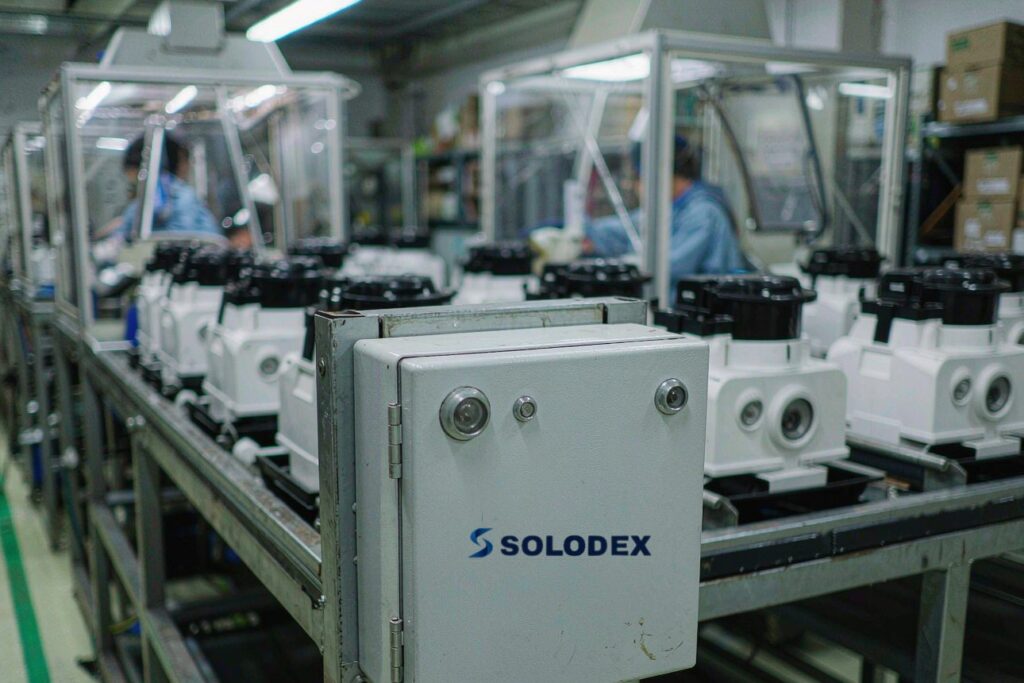
Twelve thousand smoke detectors left on one booking, described as smoke detectors, which they were. Nine thousand of them were optical: a light source, a sensor, a plastic chamber, nothing that any regulator has an opinion about. Three thousand were ionisation, and each of those contained a small sealed source of americium-241.
Nothing on the invoice distinguished the two. Nothing on the outer carton did either, because the cartons were identical and the model numbers differed by two characters. The shipment was, in the ordinary commercial sense, one product. In the regulatory sense it was two, and one of them was class 7.
This is the last and strangest entry in the batch: a consumer object, sold in hardware shops, that is genuinely radioactive – and that travels, in most cases, with no label, no placard and no declaration, because the rules provide a category for exactly this and the category is called an excepted package.
Two technologies under one name
The word detector describes a function, not a mechanism, and the two mechanisms in common use have nothing in common.
Optical, or photoelectric, detectors shine a light into a chamber and watch for it to scatter off smoke. There is no hazardous material in them at all. They are ordinary electronic goods and they travel as such.
Ionisation detectors use a tiny quantity of a radioactive isotope – usually americium-241 – to ionise the air in a chamber and measure the change when smoke enters. The source is small, sealed in a metal or ceramic matrix, and in normal use it is harmless: the alpha particles it emits travel a few centimetres in air and cannot penetrate the detector’s own casing.
Both are sold as smoke detectors. Both look the same from outside. And the difference is not a marketing distinction – it decides whether the consignment is dangerous goods, whether the importer needs a licence to hold it, and what has to happen when the building is refurbished and the detectors come down.
Class 7, and nothing on the box
Radioactive material is class 7, and class 7 has a reputation for being the most paperwork-heavy of the nine. That reputation is deserved for sources, and it is misleading for articles.
The transport rules contain a category for instruments and articles containing small quantities of radioactive material – the excepted package. It exists because the alternative would be absurd: nobody is going to placard a lorry carrying smoke detectors, and nobody needs to, because the activity in a single unit is tiny and the source is sealed inside a device that would have to be destroyed to release it.
So the consignment travels without a class 7 label, without placards, and in most modes without a dangerous goods declaration. What it does carry is a marking that names the UN entry and the consignor – a line of text, not a diamond – and a limit on how much activity may be in any one package.
Which is why a warehouse full of smoke detectors can contain a class 7 shipment and look exactly like a warehouse full of smoke detectors. The exemption is real, and it is why this category is easy to get wrong in both directions: people either panic and refuse the goods, or ship them as though the isotope did not exist.
The activity decides, and the activity is on the data sheet
The threshold for the excepted package is expressed in activity, not in units, and it is compared against the total in the package rather than the total in the container. A single detector might hold tens of kilobecquerels; a carton of two hundred holds the sum; the limit applies to the carton.
Which produces the same arithmetic as the ink cartridge: the unit is comfortably inside the exemption, and the package is where the question is actually asked. Pack more per carton to save space, and a consignment that was excepted becomes one that is not – and the marking, the documentation and the carrier’s acceptance all change with it.
The number itself is on the detector’s data sheet and usually moulded or printed on the body: the isotope and the activity in kilobecquerels. That figure is the whole classification. It is also the figure that nobody puts on a purchase order.
Excepted from transport is not exempt from regulation
Here is where the two doors separate again, and this time the second door is not about the market but about possession.
Transport rules are written for the journey. Radiation regulation is written for the material, and it applies to whoever holds it, stores it, sells it or disposes of it – regardless of how it travelled. In a number of markets, importing or possessing devices containing a radioactive source requires a registration or a licence from the radiation authority, and the requirement attaches to the importer, not to the exporter.
So a consignment can be entirely correct for carriage and still be held at destination because the company receiving it is not authorised to hold radioactive material. This is the same structure as a product category that is closed to import and as a gas quota that belongs to the buyer: the transport question is answered by the shipper, and the permission question is answered by somebody else entirely.
The practical consequence is a question that belongs in the quotation: who is importing this, and are they registered to hold it.
The source does not stop being a source
A detector that comes off a ceiling at the end of a building’s life is a device containing a radioactive source. It is not ordinary electronic waste, and in most markets it cannot simply go into the skip with the ceiling tiles.
What happens instead depends on the jurisdiction: a take-back route through the manufacturer, a licensed collector, or a disposal pathway for low-activity sources. What does not vary is the principle – the obligation attaches to the material, and it survives the end of the product’s useful life. That is the same logic that makes a container of used electronics a waste question, applied to a source rather than to a circuit board.
Which makes the end-of-life route a cost of the sale, in the same way as the take-back on a mercury lamp. A distributor who has not priced it has not priced the product.
What a damaged detector means
The one scenario that turns an administrative category into an incident is physical damage to the source itself.
An intact detector is a sealed article: the casing, the chamber and the source matrix all do their job, and the external dose rate is negligible. A detector crushed flat by a forklift, or a batch returned from a fire scene, is a different proposition – the source may be exposed, the material may be dispersed, and the response is no longer a freight question but a radiation protection one.
Which is why the loading and handling precautions for this category are about not crushing the goods rather than about shielding them, and why a damaged consignment is quarantined on arrival rather than returned. The dangerous goods question was answered at booking; what arrives later is an incident with its own procedure.
Four cartons from the same production line
| What is in the carton | Transport status | Whose permission matters | The usual mistake |
|---|---|---|---|
| Optical detectors | Ordinary cargo; no class 7 at all | Nobody’s, on this ground | Treating the whole product family as radioactive |
| Ionisation detectors, within the activity limit | Class 7 as an excepted package; marking, no label | The importer’s registration to hold a source | Shipping as general cargo and discovering the licence at destination |
| Ionisation detectors, above the package limit | Full class 7 regime – labels, documentation, carrier acceptance | The importer’s registration, plus the carrier’s own approval | Crossing the limit by packing more per carton |
| Removed or damaged units | A source outside a functioning device | The radiation authority, on both sides | Treating a return as ordinary RMA stock |
The first two rows are the same product sold under the same name, and the difference between them is a technology choice made by the buyer. That is worth pausing on: the specification of a smoke detector is usually discussed in terms of sensitivity and price, and almost never in terms of which of the two regulatory universes it lives in.
What to establish before the order is placed
Which technology, per model number? Optical or ionisation, confirmed from the specification rather than from the catalogue name. If the range includes both, the order needs to say which.
What is the isotope and the activity per unit? From the data sheet or the marking, in kilobecquerels – because the package limit is expressed in activity and the unit count does not answer it.
How many units per carton? The decision that turns an excepted package into a regulated one, and it is made at the packing table.
Is the importer registered to hold a radioactive source? A question for the buyer, in writing, before the goods are built – not a question for the forwarder at the port.
What happens to them at end of life? A take-back route and its cost, priced into the sale.
The smallest source in the batch
Every other article in this batch hides its regulated content inside a machine: a gas in a circuit, a pressure in a shell, an acid in a case, a mineral in a lining. This one hides a radioactive isotope inside a plastic disc that sells for the price of a book, and the rules that govern it are the same rules that govern industrial radiography sources – scaled down until they nearly disappear.
Nearly. What remains is a marking nobody reads, a package limit nobody calculates, and a licence that belongs to the buyer. Which is why the useful habit here is the same one as everywhere else on this site: find out what is inside, in what quantity, and who is entitled to hold it. The product name will not tell you. It was chosen to describe a function.