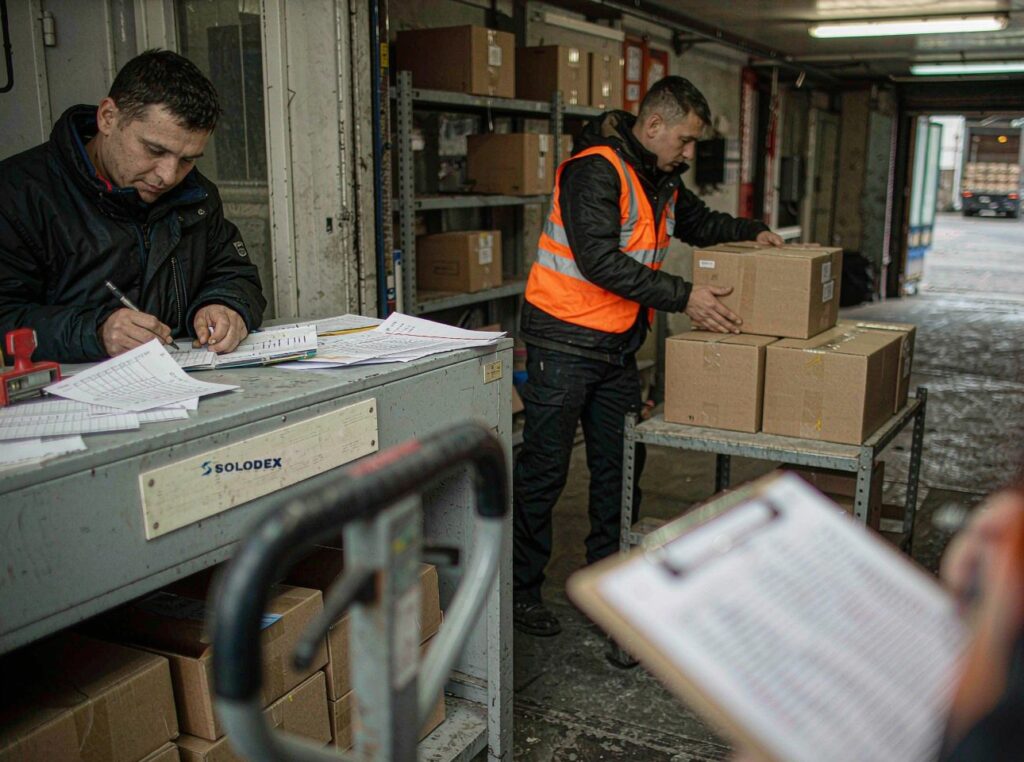
The house bill said twelve cartons. The receiver took four on Tuesday, five on Thursday, and left the last three until the following week. Each trip produced its own scan, its own signature and its own argument about whose truck was late. The shipping file, meanwhile, still showed one shipment and one delivery date. Both were right. The shipment was one consignment; the collections were three separate handovers, and only the third one closed the file.
Most freight writing treats collection as a single event — the truck arrives, the goods leave, the job ends. Consolidated freight at a station rarely works that way. A consignee with limited storage, a partial order, a buyer who wants the fast-moving cartons first, or a truck that can only carry half the load, will collect in stages. Every collection is its own handover with its own evidence, and the balance left on the shelf is the real state of the shipment.
A Consignment Is a Total, Not a Moment
The first correction is to what a house bill actually represents. It states a quantity — twelve cartons, forty cartons, two pallets — and that quantity is a total to be drawn down, not a single block that moves at once. The document does not say when or how many times the receiver will take delivery. It says how much exists to be collected.
The station works the same way. Its record for a consignment is a running balance: what was checked out of the strip, what has been removed, what remains. The delivery-order desk does not ask “has this shipment been collected?” — a question with only one answer — but “how many cartons are still outstanding on this house bill?” The one bill in, many bills out structure sets up the house bill as the unit; this article follows what happens when that unit is drawn down over time.
Seen this way, a partially collected consignment is not a failed delivery. It is a consignment in an ordinary intermediate state, exactly as an order is “partly shipped” rather than “not shipped” in the split-order duty question. The difference is where the splitting happens: that article is about sending goods in separate parcels for customs reasons; this one is about a receiver taking delivery in several physical trips after arrival.
What Each Collection Creates
Every pickup is a complete transaction. It is not a progress note on the first one. Four things are created each time, and all four matter when something goes wrong.
A separate scan. The cartons leaving on this trip are scanned against the house bill at the door. The scan records what left, not what was supposed to leave eventually. It is the evidence the station uses to reduce the balance.
A separate signature. Whoever receives this portion signs for this portion. A driver who took four cartons on Tuesday is not responsible for the five taken on Thursday, and a damage claim has to name the trip it belongs to.
A separate condition record. The state of the cartons at this handover is the state at this handover. Cartons left on the shelf remain the station’s responsibility under its own post-delivery damage rules until the next collection.
A separate charge point. Where the destination tariff charges per delivery-order presentation or has a floor per collection, each trip can carry its own line. The split logic in the stripping bill split by piece governs the handling share; repeated collections can add further desk charges on top.
The practical consequence is that a consignment collected three times has three handover records and one remaining balance. A dispute over any one trip should be argued from that trip’s scan, not from the whole house bill.
The Balance Is the Live Status
The number that describes a partially collected consignment is not the original quantity. It is the remainder. A house bill of twelve with four collected has a live status of eight outstanding — and that eight, not the twelve, is what can still be lost, delayed, damaged or charged storage.
| Collection | Date | Cartons taken | Balance after | Scan evidence |
|---|---|---|---|---|
| First | Tuesday | 4 | 8 outstanding | Four cartons scanned at door, driver signed |
| Second | Thursday | 5 | 3 outstanding | Five cartons scanned at door, driver signed |
| Third | Following week | 3 | 0 outstanding | Three cartons scanned, house bill closed |
Status screens that report a shipment as simply “delivered” or “not delivered” cannot represent this middle state, which is why customers so often receive a confident answer that contradicts what is on the shelf. The accurate answer always names the balance: three cartons outstanding on this house bill, last collected Thursday.
There is an accounting consequence too. Station storage runs on the outstanding balance and its own clock, so a consignee who collects four cartons on Tuesday stops paying storage on those four but keeps paying on the eight that remain. The wait-charge logic in who pays for the wait attaches per unit, not per original shipment; treating a partial collection as a full one is how a small balance becomes a large invoice.
Who Is Allowed to Collect Each Portion
A staged collection multiplies an identity question that a single pickup asks once. Every trip presents the house bill at the desk, and the desk has to decide whether this driver, on this date, may take this portion. The right to collect attaches to the holder of the house bill, not to whoever arrives with a vehicle.
Most consignees solve this by issuing a written collection authority to a regular carrier covering a series of trips, with a named driver or a standing instruction. The station then checks each arrival against that authority and reduces the balance. Without it, every trip becomes a fresh negotiation at the counter and the second collection can be refused even though the first went smoothly.
The check matters more with a remainder than with a full load. A partial balance is a smaller, more portable target — three cartons can be collected by anyone with a plausible story in a way that forty cannot. The delivery order rules on who may collect apply with full force to the last trip, and a station that relaxes them on the small balance is creating the loss it will later have to explain.
A consignee that changes carrier midway has to reissue the authority before the next collection. The remaining cartons do not carry forward the previous driver’s rights, and a signature from the first trip is not evidence for the second.
Why a Receiver Collects in Stages
There are four ordinary reasons, and none of them is a failure of the carrier.
Storage at the receiver. The buyer cannot accept forty pallets at once. It takes what the warehouse can hold and schedules the rest. This is the most common reason and the least visible to the forwarder, who sees only repeated collection requests.
Release against payment. An end buyer pays in tranches, and the consignee releases cartons as each tranche clears. The station is then holding goods whose owner wants them kept but not yet shipped out.
Truck capacity. The collecting vehicle fits half the load. Two trips are cheaper than hiring a larger vehicle for one, and the second trip is a new collection like any other.
Quality hold. Part of the consignment is being inspected or awaiting a document, so the clean cartons are collected while the questionable ones stay. The manifest correction path then runs on the remainder only.
Only the last of these resembles a problem. The first three are planned behaviour, and a rate card that assumes one collection per house bill will misprice all of them.
What a Partial Collection Does Not Do
Three assumptions cause most of the confusion, and all three are wrong.
It does not close the house bill. The consignment remains open until the balance reaches zero. A file marked complete after the first truck leaves will show the remaining cartons as unexpected stock at the next audit.
It does not move risk to the receiver for the goods left behind. Risk transfers at each handover for the cartons actually handed over. The eight still on the shelf remain under the station’s responsibility; a claim for them is not weakened by the fact that four others were collected safely. The claim route is the one in claiming for damaged cargo, tied to the trip where the damage occurred.
It is not a second shipment. The goods were carried once, cleared once and stripped once. A failed first attempt leading to a second delivery is a new movement with its own cost; a planned second collection from the station is not. Confusing the two produces charge disputes that have no basis in the rate card.
Keeping the Record Honest
A staged collection is easy to run badly and easy to run well. The difference is a short set of disciplines at the desk.
One line per trip. The balance sheet should show the date, cartons taken, cartons remaining and the signature for each collection. A single cumulative line makes it impossible to assign a later damage or shortage to a particular handover.
The balance stated in every message. “Four cartons collected Thursday, eight outstanding” is a status anyone can verify. “Partly collected” is not. The promise language in writing a delivery promise that holds works for staging precisely because it names a number and a date.
The last collection closes the file. Only a zero balance should trigger the closed status. Until then the consignment is live, storage continues on the remainder, and the delivery order can still be presented for the outstanding cartons. This is the same discipline the delivery order uses at a single handover, applied to several.
Abandonment is a separate decision. If the balance is never collected, it does not quietly vanish. It follows the abandoned-cargo process, which starts from the outstanding quantity and the last collection date, not from the original house bill total.
The Audit Question the Remainder Answers
Months later, when somebody reconciles the shipment, the question is never “was it delivered”. It is “does the sum of the collection scans equal the house bill quantity”. Three scans of four, five and three cartons answer twelve exactly; a file containing only the first scan answers four and leaves eight unexplained. This is the simplest audit test in the chain and the one most often failed, because the intermediate collections were treated as updates to a single delivery event rather than as separate records.
The same arithmetic settles a shortage claim. If the scans total nine against a house bill of twelve, the missing three did not disappear at the moment of the last collection — they were outstanding throughout and were never handed over. That distinction decides whether the claim belongs to the station or the receiver, and it is why the balance column in the table is more important than the quantity collected.
A good file therefore reads as a ladder: total on the bill, then a line for each trip with its scan and signature, then a zero. Anything less — a single “delivered” mark, a cumulative note without dates, a signature covering the wrong trip — turns a routine staged collection into an open question that no amount of later paperwork can close cleanly. The record discipline is the same one used for manifest corrections, applied to the handover side instead of the declaration side.
The Full Chain, From Dock to Last Carton
Take the whole journey of the twelve-carton consignment in this series. It arrived with one box cleared and twelve consignments not released. Its availability depended on someone ordering the strip. It travelled under one master bill in and a house bill out. Its handling cost was split among the payers by a unit chosen before the cargo existed. And now it leaves in three trips, with the balance on the shelf as the only honest status. At every stage the pattern is the same: the container is one thing, the consignments are many, and the system’s status field describes the wrong object until somebody names the unit they mean.
This is what a shared container actually sells: not a box from China, but a position in somebody else’s paperwork that has to be unpacked, released, paid for and collected one unit at a time. The full path from arrival to final shelf is traced in from dock to shelf; this article ends where that path ends, with the last carton signed out and the balance at zero.
The Sentence That Closes the Series
Everything here reduces to one line: the house bill states a total, each collection is a separate handover, and the outstanding balance — not the original quantity — is the live state of the consignment. A shipment can be collected in stages. A status cannot be reported in stages unless somebody records the remainder.
Across this batch we followed one box through five separations: the box cleared but the consignments did not; the strip had to be ordered; the master bill ended where the house bills continued; one handling bill was divided many ways; and one consignment left in several collections. In each case the container was one event and the goods were N events, and the field that joined them did not exist. That is the whole answer to what happens after the container door opens.
Related reading: the series starts with the box clears, the consignments do not, then who opens the box decides the clock, one bill in, many bills out and the stripping bill split by piece; the release instruments are in delivery order and telex release; the shared-box position is in a shared container is not a shared shipment; the duty-side split is in splitting an order into parcels; a failed first attempt is in delivery failed three days; promise wording is in writing a delivery promise that holds; uncollected balances end in abandoned cargo and sale in place; storage on the remainder is in who pays for the wait; damage at handover is in claiming for damaged cargo and hidden damage after delivery; and the whole path is in from dock to shelf.
When the cutoff moves and goods arrive later, the receiver often collects the delayed consignment in several trips; see one consignment, several collections.