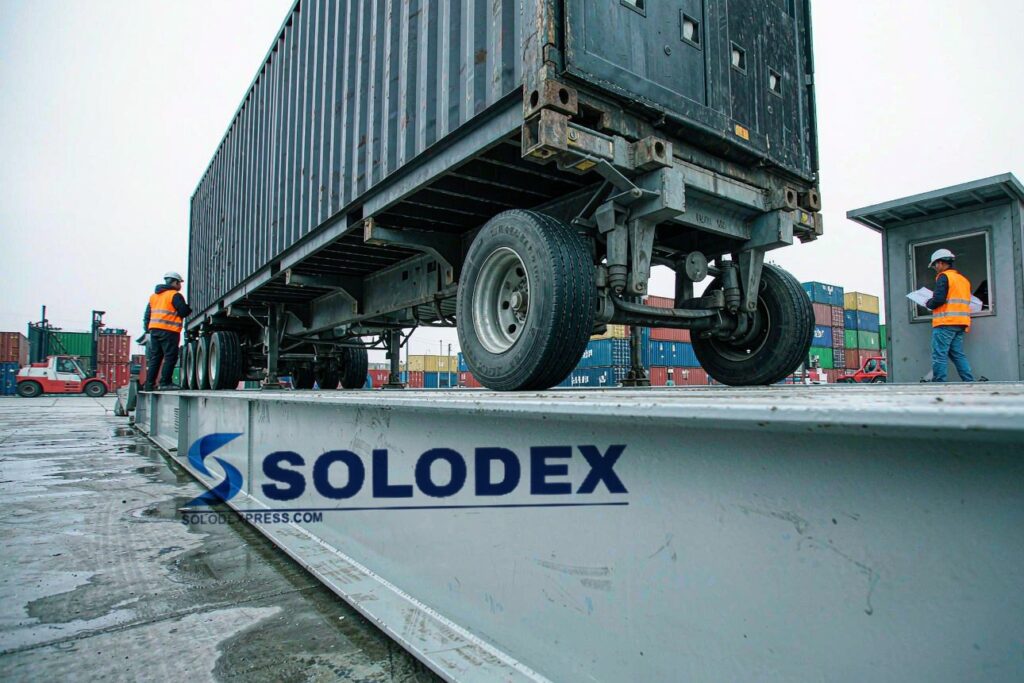
A forty-foot container of 600 by 600 porcelain leaves Shanghai weighing 26.5 tonnes and holding about 1,227 square metres. It is at its legal weight limit and roughly 40 per cent full. The remaining six-tenths — some thirty-six cubic metres of air — were paid for at exactly the same rate as the tiles, and there is no arrangement of the load that changes it.
That is the whole physics of this category in one sentence: tiles are the only product in this series where the weight limit always arrives first. Everything else — the packing, the pallet, the breakage allowance, the duty rate — is arranged around a constraint that cannot be negotiated, only converted.
The conversion nobody puts on the quotation
Tiles are sold by the square metre and shipped by the kilo, and the exchange rate between the two is thickness. Porcelain sits at about 2,400 kilos per cubic metre, so a nine-millimetre tile weighs 21.6 kilos per square metre before packing, crating and pallet. Everything downstream — the freight per square metre, the number of containers in a season, the weight on the chassis — is that one number multiplied out.
| Thickness | Weight per m² | m² per 26.5 t | m² per 20 t | Ocean freight per m² |
|---|---|---|---|---|
| 6 mm | 14.4 kg | 1,840 | 1,389 | $1.96 |
| 9 mm | 21.6 kg | 1,227 | 926 | $2.93 |
| 10 mm | 24.0 kg | 1,104 | 833 | $3.26 |
| 12 mm | 28.8 kg | 920 | 694 | $3.91 |
| 20 mm paver | 48.0 kg | 552 | 417 | $6.52 |
A pallet is where the conversion becomes physical. Frames of 1.2 by 1.2 metres, stacked to about 1.45 high, hold close to 70 square metres of nine-millimetre tile and weigh around 1,500 kilos — a packed density of roughly 720 kilos per cubic metre, which is nearly twice the 427 at which a container stops being volume-bound. Seventeen or eighteen of those fill the box by weight and leave the top third of the cube empty.
Two columns matter more than the rest. The third is what a container holds at the box’s own payload. The fourth is what it holds on a road in the United States, where the gross vehicle limit and the weight of the chassis and tractor leave around twenty tonnes of cargo rather than twenty-six and a half — the arithmetic set out in the container load article. A seller quoting on the payload figure and delivering inland is quoting a container that cannot legally arrive.
The gap between those two columns is 32 per cent. It is also, almost exactly, the gross margin on a mid-market tile — which is why the difference between selling port-to-port and selling delivered is not a service upgrade in this category, it is the whole business.
Weight is the enemy at the port and the friend in the claim
Here is the part that inverts the usual arithmetic. For most goods, the carrier’s liability limit is a fraction of the cargo’s value, so insurance is mandatory and the limitation clause is the thing that ruins your year. Tiles are the opposite.
The limit under the Hague-Visby rules works out at two special drawing rights per kilo, roughly $2.65. A porcelain tile is worth about 35 cents a kilo. So the carrier’s cap is seven or eight times the value of the cargo it covers, and for once the limitation clause is not the obstacle.
The obstacle is evidence, and it is worse here than anywhere else in this series. A pallet of tiles arrives with chipped corners on the bottom course, which is normal, plus three cracked tiles in the middle of a stack, which is not. To recover anything you have to establish how many pieces broke, that they were sound when loaded, and that the damage was not caused by the way the pallet was stacked — and the receiving warehouse will have signed a clean receipt because the pallet looked fine from the outside. That is the same failure described in the damage claim article, and in a cargo where the damage hides inside a stack it is close to fatal.
Practically, that means the claim route is not the control. The packing specification is. And packing is where the industry has quietly agreed to lose money.
Breakage is sold, not suffered
Quotations in this trade frequently carry a breakage allowance — three per cent for first quality, five for economy ranges — and buyers read it as a concession. It is not. It is the supplier pricing a known loss into the unit rate, which is a perfectly rational thing to do and a terrible thing to accept without checking the alternative.
The alternative costs less than most buyers think, because the loss concentrates in two places: the corners of the pallet, and the top course. Corner protectors and an edge board address both, and the delta between a cheap pack and a serious one is about the size of the allowance itself.
| Packing | Added cost per m² | Breakage at destination | Loss per container at $7.50/m² |
|---|---|---|---|
| Carton only, no corners | — | 6% | $552 |
| Carton and corner protectors | $0.12 | 3% | $276 |
| Plus edge boards and top foam | $0.28 | 1.2% | $110 |
The damage is also concentrated in a way that makes it cheap to prevent and expensive to prove. The bottom course of a pallet takes the forklift’s impact and loses its corners; the top course fails when steel strapping is tensioned over a stack that is not square; the middle, where the loss is invisible, cracks from the pallet being set down hard rather than being dropped. That is why a photograph of a sealed pallet is worthless as evidence and a photograph of the stack being built is not.
Read the last two rows together and the decision is almost trivial: 16 cents a square metre buys a 1.8-point improvement, which at $7.50 is 13.5 cents of recovered product — plus the pallet that does not get rejected. The reason it does not happen is that the 16 cents appears on the factory invoice in Guangzhou and the rejection appears in a warehouse in Ohio six weeks later, in a different currency, on a different company’s profit and loss.
There is a second, sharper version of the same trade. Nominal thickness is a commercial promise that is rarely measured at the factory and always measured on site. Shaving eight-tenths of a millimetre off a nominal 10 mm tile cuts 8 per cent of the weight, which is 8 per cent more square metres in the container, which is 8 per cent of margin — and it is invisible until an installer puts a caliper on it, at which point the whole consignment is not the product that was ordered. In a category where the freight is nearly 40 per cent of the goods value, that is the pressure that exists, and it is worth knowing which suppliers price to it.
The specification sheet is the tax document
Ceramic tiles are classified by water absorption, not by appearance. The subheadings separate tiles absorbing half a per cent or less from those between half and ten, and those above ten; the code decides the duty rate, and in several markets it also decides whether the consignment falls inside an anti-dumping measure whose scope is written in exactly those physical terms.
Which makes the technical data sheet the most consequential document in the file. A supplier who writes “water absorption: 0.5%” has described a product in one category; one who writes “0.6%” has described another, with a different rate, and possibly a different trade remedy exposure. The same applies to thickness and to size, because anti-dumping scopes are typically drafted as ranges of dimensions and absorption values rather than as brand names.
Europe has had anti-dumping measures on Chinese ceramic tiles in place since 2011, renewed through successive expiry reviews, with rates that differ sharply between companies that cooperated with the investigation and everyone else. The United States has additional tariffs on Chinese goods under Section 301, and separate anti-dumping and countervailing orders on quartz surface products. Rates move and are worth checking against the current measures for the specific code before any quotation leaves the building — for the same reason that a DDP price is only as good as the assumption behind its duty line.
What does not move is the mechanism: in this category, the physical specification is the tax position. That makes the same discipline described in the supplier documents article apply here with unusual force — the number has to be on paper, from a lab, and it has to match what the factory actually produces in the month of shipment, not what it produced for the sample.
Stone is a different product wearing the same word
Marble, granite and quartz are usually sold alongside tiles and behave nothing like them. Stone runs at 2,700 kilos per cubic metre and more, comes in slabs rather than cartons, ships in A-frame racks or crates, and is limited by weight so severely that a twenty-foot container is often the practical unit rather than a forty. A slab is also a single piece: one break in the wrong place destroys a book-matched set that was cut from one block, and no packing decision recovers it.
The documents diverge too. Stone travels on wooden A-frames and crates, which brings ISPM 15 treatment and visible stamps; engineered quartz is a manufactured product with resin content and its own tariff and trade-remedy history; and anything described as “marble” that is actually a limestone or a dolomite is a classification question before it is a marketing one.
Where the two do meet is the arithmetic. Both are priced by area, shipped by weight, and destroyed by a handling error that leaves no mark on the outside — which is why the instrument logic about invisible damage applies here in a much more expensive form.
What to fix on the order
Five lines, and the first one is the one that decides whether the container can be delivered at all.
- State the destination before the price. Port-to-port loads to the box’s payload; inland loads to the road limit. A 32 per cent difference in units per container belongs in the quotation, not in the discovery.
- Fix the thickness and measure it on arrival. Nominal is a promise; two pallets measured with a caliper at receiving settles whether the rest of the consignment is what was ordered.
- Buy the packing, not the allowance. Sixteen cents a square metre against a 1.8-point breakage improvement is the cheapest line in the file, and it is the only one that also protects the customer relationship.
- Put absorption, thickness and size on the invoice. Those three numbers decide the code, the rate and the trade-remedy scope; “porcelain tile, grey” is a description of a colour.
- Photograph the load, not the pallet. The claim will turn on whether the damage was inside a stack, so the evidence has to show the stack being built, not the pallet arriving.
None of it is difficult. It is just unusual to see a category where the freight is a third of the goods value, the packing is 4 per cent of the freight, and the loss is larger than both if the pallet is packed the way it was packed last time. A container of tiles is a weight problem with a breakage problem attached, and the two are solved by decisions taken weeks before anyone books a sailing.
Dense tiles and stone use up a weight allowance long before they fill a box; on board, the same dense box also changes the three force lines of the entire stack it sits in.


