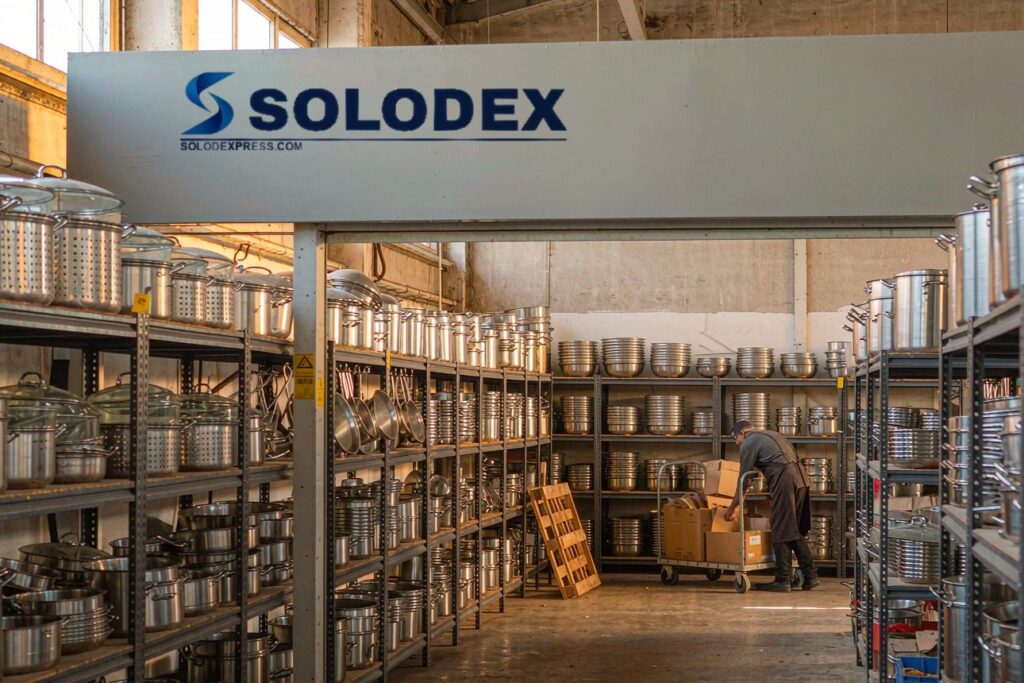
A twelve-piece cookware set is one SKU on the purchase order and one line on the invoice. Written out as materials, it is a coated aluminium pan with a phenolic handle and two steel rivets, a stainless stockpot with a tempered glass lid and a silicone gasket, a steamer insert, a ladle and a slotted turner — fourteen surfaces that will touch food or be handled while food is being handled, spread across five material families, each of which has its own regulation, its own test and its own way of failing.
That gap between one SKU and fourteen surfaces is where this category’s compliance cost lives. It is not that kitchenware is heavily regulated; it is that the regulation is written per material in contact with food, and a product is not a material. A supplier who quotes “food grade stainless steel, LFGB certified” has answered a question about one surface and left thirteen unaddressed.
Compliance is counted in surfaces, not products
The way to price this correctly is to stop thinking about items and start making an inventory. For each product, list every surface that touches food, and separately every surface that touches a hand holding food. Then attach a material to each, and a test to each material. The count is usually two to four times the number of items.
| Surface | Typical material | What is actually tested | How it fails |
|---|---|---|---|
| Interior of a pan | PTFE or ceramic sol-gel on aluminium | Total and specific migration, coating adhesion after abrasion | Coating blistering; PFOA in the supply chain |
| Exterior of the same pan | Polyester powder coat | Migration at temperature; heavy metals in pigment | Cadmium or lead in a coloured pigment |
| Handle | Bakelite, silicone, or stainless | Formaldehyde and phenol release; heat resistance | Handle softens at oven temperature |
| Rivets and fixings | Steel or aluminium | Nickel and chromium release | Pitting, then migration above the national limit |
| Lid and rim | Borosilicate or tempered glass, steel rim | Thermal shock; metal release at the rim | Rim corrosion where the two metals meet |
| Knob and gasket | Bakelite, silicone | Volatile transfer at 200 °C | Odour and taint in the first cooking |
| Ceramic or stoneware pieces | Glazed earthenware | Lead and cadmium leaching | Glaze formulation, not firing |
This is the same logic that makes children’s products expensive to certify — the cost follows the number of distinct materials, not the number of cartons — and it is why a supplier’s certificate for “the pot” usually turns out to cover only the interior coating.
What the inventory costs to clear
Once the surfaces are listed, the bill is easy to estimate, because laboratories price by material and by test rather than by product. For a twelve-piece set that is entirely coated aluminium and stainless with one glass lid, a full file usually lands between $2,800 and $4,500 and takes three to four weeks.
| Test | Applies to | Typical cost | Lead time |
|---|---|---|---|
| Overall and specific migration, per simulant | Coatings, plastics, gaskets, handles | $400–700 per material | 7–10 days |
| PFOA and PFAS screen | Non-stick coating | $200–400 | 5–7 days |
| Heavy metals in pigment | Coloured exterior coats | $150–250 | 5 days |
| Lead and cadmium leaching | Ceramic, stoneware, vitreous enamel | $120–200 per vessel class | 5–7 days |
| Nickel and chromium release | Stainless bodies, rivets, rims | $150–250 | 5 days |
| Thermal shock and oven safety | Glass lids, handles, knobs | $300–500 | 7 days |
Two things about that table are worth noticing. The first is that the tests are cheap individually and the total is dominated by the number of materials, which is why a supplier who consolidates materials — one coating instead of three, one handle compound across the range — halves the file without changing the product much. The second is that none of it is a one-off: a change of coating, glaze or pigment supplier restarts the relevant line, which is the same retest logic that makes appliance certification expensive.
Vitreous enamel is the trap in the middle of that list. It is glass fused onto steel, so it is tested as a ceramic for lead and cadmium even though the product is sold as a metal pot, and factories that think of themselves as metalworkers routinely have no report for it at all.
Stainless steel is not one thing
Most of the cost difference between two quotations for something that looks identical is in the alloy, and the alloy is invisible. The grades that matter are 201, 304 and 316. 304 — sold as 18/8 or 18/10 — carries 18 to 20 per cent chromium and 8 to 10.5 per cent nickel. 201 substitutes manganese for most of the nickel, at 3.5 to 5.5 per cent, and costs roughly a third less. 316 adds molybdenum and is what you specify for salt water and chloride.
The failure mode of 201 is not immediate and it is not subtle once it starts: it pits and rusts in a saline or acidic environment, which is to say in a dishwasher, in a tomato sauce, and on a coastal shelf. A pan that rusts in the third month is a return, a review, and a conversation about who pays for the pallet.
The test most buyers use to check grade is a magnet, and it does not work. Both 201 and 304 are austenitic and effectively non-magnetic when annealed; both become slightly magnetic after deep drawing, so a magnet will stick to the rim of a good pan and not to a cheap one depending on how it was formed. What works is a mill certificate naming the grade and the heat number, plus, if you want to be certain, a spot check with an X-ray fluorescence gun — a service that costs less than the freight on one carton.
The coating is the regulated layer
Non-stick is where the paperwork concentrates, because a coating is an indirect food additive rather than a metal. In the United States that means the relevant sections of 21 CFR 175 and 176; in Europe it means the framework regulation 1935/2004 that sits behind every consignment into the bloc, plus the plastics measure 10/2011 and, in practice, the German BfR recommendations that most laboratories test against — the entry mechanics themselves are in the EU import rules. The specific thing that changed the industry was PFOA, which is restricted as a persistent organic pollutant — so a “PFOA-free” claim on the box is a regulated statement, not marketing, and it needs a declaration from the coating supplier naming the formulation and the batch.
Then there is the sentence on the packaging, which fails more often than the coating does. Melamine tableware is a formaldehyde-based resin with a migration limit for formaldehyde, tested in three successive migrations because the material is intended for repeated use — the third extraction has to comply as well as the first. And melamine is not microwave-safe; the resin degrades above about 70 °C in contact with acidic or fatty food. A bowl that is compliant in the laboratory and labelled “microwave safe” on the box is a non-compliant product, because the instruction creates a use the material was never tested for.
That is the pattern across this whole category: the test report and the packaging copy are two halves of one claim, and the packaging is the half nobody checks before printing twenty thousand boxes.
Glaze is measured by shape, not by recipe
Ceramic and stoneware are governed by leaching limits for lead and cadmium, and the limits are set by the shape of the vessel rather than the glaze — because a flat plate holds a film of food while a mug holds a column of hot acidic liquid against the same surface for minutes at a time.
| Vessel class | Why it is separated | Direction of the limit |
|---|---|---|
| Flatware — plates, platters | Shallow contact, short dwell | Loosest |
| Small hollowware — bowls, small pitchers | Liquid held against the wall | Two steps tighter |
| Large hollowware — tureens, large bowls | Volume, but a lower surface-to-volume ratio | One step tighter than flatware |
| Cups and mugs | Hot acidic liquid, deep vessel, rim contact | Strictest, around 0.5 µg/mL for lead |
Which is why a factory can hold a valid report for its dinner plates and fail on the mugs in the same range, with the same glaze, out of the same kiln. It is also why the sensible test set for a new range is one piece per vessel class rather than one piece per design — the ceramics logic, applied to a bowl.
A set is a volume decision dressed as a product decision
Cookware is dense — a 24-centimetre pan is around 1.1 kilos of aluminium or steel — so it is not weight-bound, but it is not quite volume-bound either. Packed as a nested set in one carton, twelve pieces occupy about 0.048 cubic metres and weigh 9.5 kilos: a density of 198, comfortably volume-bound, about 1,290 sets in a forty-foot container and $2.60 of ocean freight each at $3,400.
Shipped loose, with each piece in its own carton because the customer sells open stock, the same twelve pieces take 0.075 cubic metres and the container holds 826 sets — 36 per cent fewer, and $4.11 of freight each. That difference is the entire margin on a mid-market set, and it is decided by a merchandising question rather than a logistics one: does this range sell as a boxed set, or as individual pieces a shop can reorder?
Nesting and open stock are close to mutually exclusive. A nested set arrives as a single carton that a warehouse cannot break without repacking, so the freight saving is only available to a seller who commits to set-only retail. Sellers who want both usually ship nested to their own warehouse and re-pack there, which trades $1.50 of freight for roughly $2.00 of labour and a second carton.
The other lever is packaging weight, and it is small in a way that makes the arithmetic easy to check. A set that ships in a printed colour box inside a shipper absorbs about 1.2 kilos of the 10.7-kilo gross; a plain shipper with a sticker saves perhaps 0.4 kilos and costs nothing per unit, which at 1,290 sets is 500 kilos of a container’s volume that is now product instead of board.
What to put on the order
Five lines, and the first one is the only one that cannot be fixed later.
- A surface list, not a product list. Every food-contact and hand-contact surface with its material named, sent to the laboratory as a schedule rather than as a photograph.
- Grade and heat number on the mill certificate. 304 or 316 written into the purchase order with the alloy, because “stainless steel” covers a grade that rusts in a dishwasher.
- Coating formulation and a PFOA declaration from the coating maker, not from the pot maker, and matched to the batch that will actually be sprayed.
- One test piece per vessel class, and a report whose date is later than the last glaze or formulation change — the document check in its most literal form.
- The packaging copy reviewed before printing. “Microwave safe”, “oven safe to 220 °C”, “dishwasher safe” are claims about tested use, and each one adds a test if it is not already in the file.
None of this is exotic, and the total bill for a new twelve-piece range is usually a few thousand dollars — against a certification file that a household appliance would consider routine. The difference is that an appliance fails at the border, visibly, once. A cookware set fails at the customer’s third dishwasher cycle, quietly, and then again in the review section, where it costs more.
Packing a set is one problem; holding evidence for it is another. What the report has to cover, and why it is asked for years after entry, is set out in the food contact file.
Cookware is dense, so the scale often wins over the tape measure. Even then, the box that leaves the factory is the unit the quote is built around, and a poor choice still costs on every order.


