The carton arrives square, dry, and unmarked. Inside, the acoustic guitar has a hairline crack running from the bridge to the edge of the top, about nine centimetres long, and the customer photographs it against a white wall so there is no doubt about it. The carrier’s inspection finds no damage to the packaging, which means no damage to the cargo, which means the claim comes back declined — and the seller spends a week convinced that somebody at the warehouse dropped it.
Somebody may have. But a drop leaves a mark on a carton, and this carton has none. What happened is that the guitar spent thirty-one days in a steel box crossing two climate zones, and the spruce top lost four per cent of its moisture content, and wood that shrinks does not shrink evenly.
Instruments are the one category where the journey damages the goods without touching them. Every other article in this series is about weight, volume, duty or documents. This one is about a number nobody puts on a shipping document: relative humidity.
A container is a kiln in the afternoon and a swamp at night
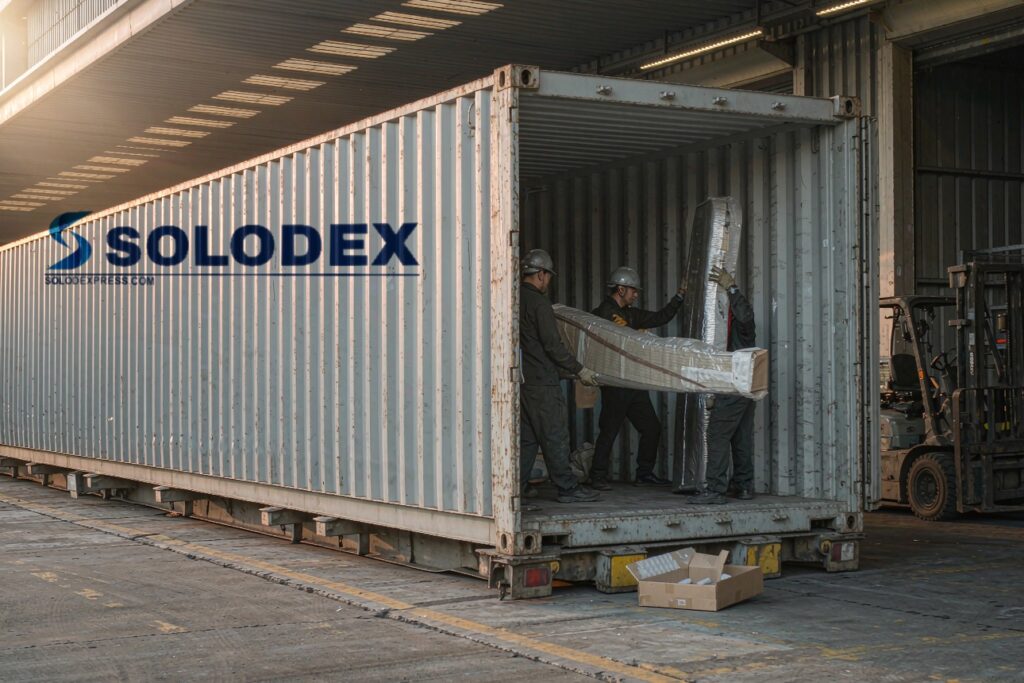
A forty-foot container sitting on deck in the tropics absorbs sun all day. Interior air temperatures of 55 to 60 degrees Celsius are ordinary in the afternoon; the steel roof will be hotter. Overnight the same steel drops to fifteen or twenty, the air inside cools faster than the cargo does, and the moisture that the cargo has been releasing all day condenses on the ceiling and then falls.
The industry calls it container rain, and it is not a metaphor. On a thirty-day voyage a loaded box can cycle through that pattern thirty times, and the relative humidity inside can sit above seventy per cent for weeks at a time — not because anyone put water in it, but because wood, cardboard, foam and glue all carry moisture and release it into the only air available.
Which is why the cargo that suffers most is the cargo that looks dry. A pallet of instrument cases is roughly forty per cent paper and foam by volume, and every kilo of that material is a reservoir. Add a humid loading day in Guangzhou — which is most days in June — and the box starts its voyage already carrying more water than it can hold at the other end.
Wood moves before it breaks
A solid wood instrument is built at equilibrium with the air around it, usually somewhere between 45 and 55 per cent relative humidity. Held near that band, it is stable for decades. Outside it, the wood does what the physics requires.
Below about 35 per cent, the top and back shrink across the grain faster than the braces do. The result is a crack along the grain, or a seam that opens, or frets that suddenly stand proud of the fingerboard because the board under them got shorter. Above 65 per cent for more than a couple of weeks, hide glue creeps, the neck moves forward, the action rises, and in a bad case the case lining grows mould. Neither of these failures leaves a mark on the carton.
There is a third mechanism, and it is the one that produces most of the damage claims. The box does not stay at one humidity; it oscillates, sometimes by thirty points in a week. Wood that is repeatedly wetted and dried fatigues at the joints, and a guitar that would have survived a month at a steady 70 per cent can fail at a month averaging 55 with a range of 30.
This is also why the packing matters more than the padding. Foam protects against impact, and impact is not what usually goes wrong. A moisture barrier protects against the thing that is.
Eighty-five cents a guitar buys the argument
The fix is cheap and almost entirely absent from Chinese export quotations, because it is a consumable rather than a service and nobody’s margin depends on it. It consists of a liner, a desiccant load calculated against the voyage, and a decision about what goes in the box on the day.
| Item | Per 40-foot container | Per guitar, 400 units |
|---|---|---|
| Moisture barrier liner, floor to ceiling | $120 | $0.30 |
| Desiccant, 24 kg of calcium chloride in poles | $190 | $0.48 |
| Humidity indicator cards, one per pallet | $30 | $0.08 |
| Loading discipline: no wet pallets, no damp cardboard | — | — |
| Total | $340 | $0.85 |
Compare that with the first paragraph. A guitar with a cracked top is not a repairable item in commercial terms — it cannot be sold as new, and the repair costs more than the wholesale margin on the sale. At a landed cost of $420, one destroyed instrument pays for the protection on four hundred and ninety of them.
The arithmetic gets more uncomfortable when it is annualised. A seller moving 3,000 instruments a year at a two per cent moisture-claim rate is losing sixty units, or about $25,000, and could have spent $2,550 on liners and desiccant. The reason it does not happen is not cost. It is that the $2,550 appears on an invoice before the loss does.
Freight, for comparison, is almost irrelevant here. A guitar in a hard case and carton is 0.093 cubic metres and eight kilos, so a container holds about 666 of them and the ocean leg costs around $10 — less than two and a half per cent of landed cost. Every instrument in the table below is below the 427 kilos per cubic metre at which a container becomes weight-bound, which is the volumetric weight problem in its mildest form.
| Instrument | Carton or crate | Weight | Per 40-foot | Ocean freight each |
|---|---|---|---|---|
| Acoustic guitar, hard case | 0.093 m³ | 8 kg | 666 | $10 |
| Digital piano, 88 keys | 0.195 m³ | 22 kg | 318 | $21 |
| Drum kit, three cartons | 0.42 m³ | 28 kg | 148 | $46 |
| Upright piano, crate | 1.74 m³ | 260 kg | 35 | $194 |
| Grand piano, 1.8 m, crate | 4.33 m³ | 380 kg | 14 | $486 |
Trade names lie, genus decides
The other half of this category’s difficulty is paperwork, and it hinges on a distinction that catalogues routinely blur. Rosewood is a trade name, not a species. Santos rosewood is Machaerium scleroxylon and has nothing to do with the genus that CITES regulates. Bolivian rosewood is also Machaerium. Indian rosewood, sonokeling, cocobolo and African rosewood are all Dalbergia — and every species in that genus has been on CITES Appendix II since January 2017.
The consequence is that a purchase order reading “rosewood fingerboard” tells a customs broker nothing usable. What the broker needs is the genus, the species if it is known, and the country of harvest, because that is what decides whether a permit is required. Brazilian rosewood, Dalbergia nigra, is Appendix I, and commercial trade in new material is effectively prohibited — a guitar made of it is a museum object or a legal problem, not a product.
Appendix II is workable, but it is not free. A shipment needs an export permit from the management authority in the country of origin, which requires evidence that the wood was legally obtained, which for plantation material means plantation records rather than a supplier’s assurance. Entering the European Union also requires an import permit, which is stricter than the convention itself requires. Lead times run from two weeks to two months, and a container that arrives without the paperwork sits at the border while storage accrues.
There is an exemption that explains why small sellers never see any of this and volume sellers always do. The listing carries an annotation for finished articles containing small quantities of the wood — of the order of ten kilograms per shipment. Three guitars a month travel on that line. A pallet of two hundred does not, and the exact wording is worth confirming with a broker rather than a supplier, because it is the kind of sentence that decides a container.
Two more documents sit behind it. Into the United States, wood products require a Lacey Act declaration naming species and country of harvest, and a mismatch between the declaration and the commercial invoice is a seizure rather than a query. And for ebony, the answer is “it depends”: some Diospyros species are listed and most are not, so a fretboard can be either, and the only way to know is to ask for the species in writing.
A piano is a crate nothing can be stacked on
Grand pianos are the only item in this catalogue that changes the container plan rather than the packing list. A crate for a 1.8 metre instrument is roughly 2.15 by 1.55 by 1.30 metres — 4.33 cubic metres for 380 kilos, a density of 88. It goes in through a door 2.34 metres wide, so it fits, but fourteen of them fill a forty-foot container and there is nothing you can put on top.
That last point is the expensive one. The crate is designed to be lifted from below and cannot carry load, so the space above it — about 1.4 metres of the box’s height — is dead volume. In practice a piano container carries fourteen instruments and roughly four hundred cubic metres of nothing, which is why the ocean freight reads $486 a unit against $10 for a guitar.
Uprights are easier and are usually the better product to start with: 1.74 cubic metres, 260 kilos, thirty-five to a container, and a crate you can put a light pallet on. Anything much longer than two and a half metres starts to interact with the door opening and the loading plan in ways that are better discovered on paper than at the gate.
What the invoice has to say
Instrument descriptions fail in a specific way: they describe the object and not the material. “Acoustic guitar, 41 inch, natural” is a complete commercial description and an incomplete customs description, because the duty rate, the permit requirement and the Lacey declaration all key off what the thing is made of.
A workable line reads like this: acoustic guitar, six string, spruce top, Dalbergia latifolia back and sides, rosewood fingerboard, manufactured in China, country of harvest India. It is longer than most sellers write, and it is shorter than the argument that follows a misdeclaration. The supplier documents that support it — species declaration, plantation or purchase records, and the fumigation or heat treatment certificate for any solid wood packing — are worth collecting before the first order rather than after the first hold.
Packing is a document too. Solid wood crates and pallets need ISPM 15 treatment with a visible stamp; plywood and engineered panels are usually exempt, which is why piano crates are increasingly built from them. A crate built from untreated solid wood will be refused or fumigated at the destination, and fumigation inside a sealed container is not a thing that ends well.
A specification that survives the voyage
Six lines on a purchase order, and none of them is about price.
- Barrier liner and desiccant sized to the voyage, not to the container. Twenty-four kilos for thirty days in the tropics; more if the cargo is paper-heavy.
- No loading on a wet day. Rain on pallets at the factory becomes condensation inside the box three weeks later, and it is invisible at the moment it happens.
- Species in writing, in the invoice, in the packing list. Genus at minimum; species and country of harvest where the wood is Dalbergia or Diospyros.
- Permits before production, not before shipment. Two to eight weeks of lead time does not compress because the vessel is booked.
- ISPM 15 stamp on any solid wood crate, photographed before loading.
- A humidity indicator card per pallet, read and photographed at destination. It is the only evidence that will decide a moisture claim, because it is the only record of what the air did.
None of this is exotic. It is the same discipline a furniture shipper applies and a garment shipper never has to think about — the goods are hygroscopic, so the air is part of the packaging. What makes instruments different is the ratio: the freight is two per cent of the landed cost, and the failure mode destroys the whole unit rather than denting it. When the cheap line on the invoice is the one that decides the loss, the calculation stops being about shipping and starts being about evidence.
An instrument is often packaged for protection first and billed for the space around it afterwards. The rectangle on the outside is what the freight system actually prices, so the case design belongs in the cost discussion.


