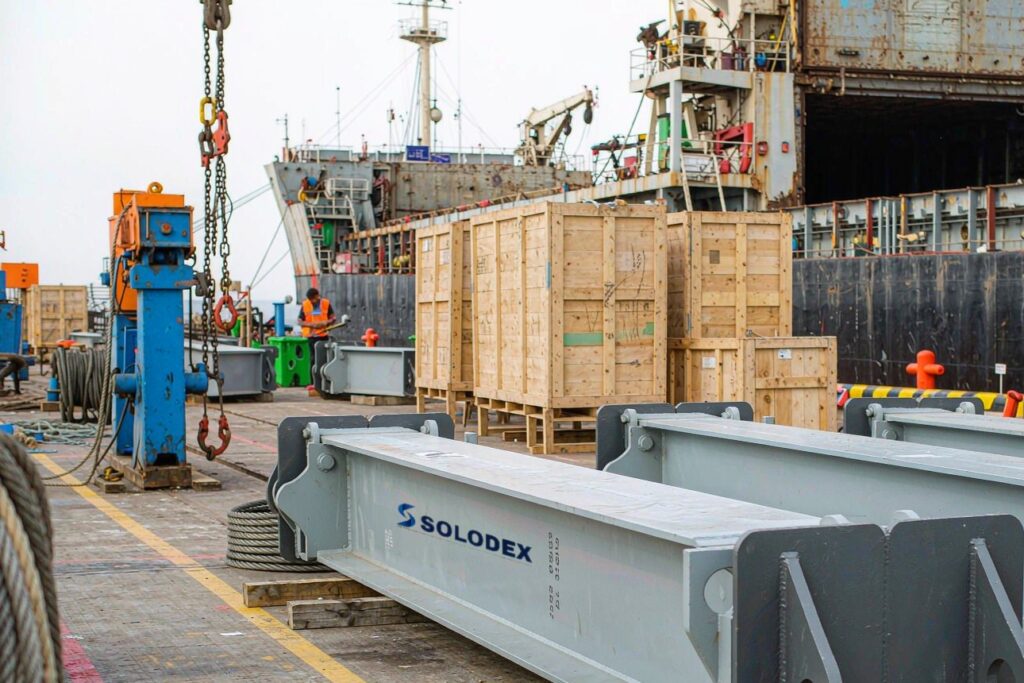
Start with a sentence nobody puts on a booking form: a container number is not a property of the cargo. It belongs to the box. The twelve steel beams inside it do not become MSCU-something; they remain twelve steel beams that happen to be travelling inside a steel box with a name of its own. For most of this site’s articles that distinction does not matter, because the box is always there. It starts to matter on the day the cargo is too long, too tall or too awkward to go into one.
Then the number disappears, and with it a surprisingly large amount of free work. Nothing replaces it wholesale. What replaces it is a line of stencilled letters and a fraction painted on the cargo itself: a shipping mark and a piece number. Those two things are asked to do a job that a box number never had to be asked to do, because a box number was never really about the goods at all.
The Box Number Is Not the Cargo’s Name
A container is a registered piece of transport equipment. Its number is assigned to that physical box, stays with it for years, is unique across carriers, and can be read by a gate camera or a handheld scanner without anybody opening anything. When a shipment is built around a container, every system along the route gets a common key for free. The booking, the terminal appointment, the gate-in record, the manifest, the bill of lading and the delivery order can all point at the same eleven characters.
That key is also an identity by proxy. The cargo does not need to be individually named because the box is named instead. Ask where the shipment is, and the honest answer is a box position in a yard or a slot on a vessel. Ask how many pieces there are, and the honest answer for the carrier is often one box; the count inside is a matter for the shipper’s packing list, not for the hand-over. The container quietly separates two questions that would otherwise have to be answered together: where the unit is, and what is inside it.
That separation is the whole trick. It works so well that it is invisible. It only becomes visible when a piece of cargo is delivered to the quay on its own, on dunnage, with no steel walls around it and no number anyone can scan.
Four Things a Box Number Does for Free
First, it binds unlike things into one hand-over unit. Forty cartons, three pallets and a crate of spares become a single object that can be accepted, lifted, stacked and released. Second, it gives every document a common primary key, so a discrepancy between two papers is easy to spot: the strings either match or they do not. Third, it makes recognition independent of the goods, which means a checker can identify the unit without touching or even seeing the contents. Fourth, it turns the count into a single event at the gate, deferring the messy question of how many individual pieces exist until somebody at the destination opens the doors.
None of those four is a property of the cargo. All four are properties of the container. A shipment that does not use one has to obtain each of them somewhere else, and there is no central registry to obtain them from.
What a Shipping Mark Actually Says
A shipping mark is a stencil on the cargo or its packing. It typically says which shipment a piece belongs to, who it is for, which port it is going to, and which piece of the shipment it is. That is a lot of information for a few lines of paint, but note what kind of information it is: it is local and read by people.
Local means unique only inside this consignment. Two unrelated shipments in the same shed can carry marks that look almost identical to anybody not holding the right sheet of paper. A container number is globally unique; a shipping mark is unique in the way a table number is unique inside one restaurant. Read by people means that recognising the piece is an act somebody has to perform: walk up to it, find the stencil, compare it with a document, and decide. No camera at a gate produces the same event by itself.
There is a third difference that matters more than the first two. A box number belongs to equipment that survives the voyage unchanged. A shipping mark belongs to a surface. Re-pack the piece, turn it, band two pieces together, replace a damaged crate, or reload it onto a different mode halfway through the trip, and the mark has to be re-made or supplemented. Identity here is not attached to the object for good; it is attached to whatever outer layer currently faces outward.
The Piece Number Is the Count
The fraction painted next to the mark is the part that is easy to overlook. A mark alone says this belongs to that shipment. It says nothing about how many there are supposed to be. The piece number supplies that: one of twelve, two of twelve, and so on. Together, the two lines turn a heap of similar objects into an enumerable set with a known size.
That is why a missing piece number is more corrosive than a badly lettered mark. If the stencil is smudged, somebody still knows a mark exists and goes to look closer. If the sequence is absent, the goods are simply a group of beams, and the only thing that can establish how many there should be is a document somewhere else. The count stops being visible on the quay and becomes a claim made on paper.
There is a useful way to state the difference: a container number is read, while a shipping mark has to be found. Systems are built to look for the first. People are left responsible for the second.
Three Moments That Must Recognise the Piece
Consider twelve identical box-section steel beams, each about nine metres long, delivered loose to a break-bulk berth. They are the same section, the same length and the same paint. Nothing about one of them distinguishes it from its neighbour except the stencil. Three times before the voyage is over, somebody has to know which beams belong to this consignment and whether all of them are present.
In the yard, before loading, the twelve have to be staged as one lot rather than mixed with a second consignment of similar sections lying two metres away. At the hook, as each piece is lifted, a tally clerk has to count what actually goes over the ship’s rail and note its condition. At discharge, the receiving party has to separate this lot from everything else that came out of the same hold. For a container shipment, all three moments resolve to the same string of characters on the same steel box. Here they are three different people, at three different times, each reading a line of paint on a piece of cargo.
| Moment | What a boxed shipment reads | What loose cargo reads | Who has to decide |
|---|---|---|---|
| Staging in the yard | One equipment number, one location | Marks on each piece, grouped by eye | Yard checker holding the booking |
| Hand-over at the hook | Gate-in event, seal intact | Piece numbers counted one by one | Tally clerk at the ship’s rail |
| Stowage reference | A slot on a vessel plan | A position in a hold, drawn for this cargo | Planner and chief officer |
| Discharge and split | One box released against one document | Twelve pieces matched against a count | Receiving clerk at destination |
| When something is short | The seal or the box is the question | Which fraction is missing from the sequence | Whoever holds the tally sheet |
The fourth column is the one worth reading downwards. Every row needs a person. There is no equipment-based shortcut in any of them, and no two rows rely on the same person.
Why a Wrong Mark Is Safer Than No Mark
Here is the counter-intuitive part. A misspelt or misapplied mark is usually discovered quickly. It disagrees with the booking, somebody asks a question, and the piece is held until the line is corrected. An absent mark produces no disagreement at all. In a yard full of similar sections, an unmarked beam is just another beam; it is not a mismatch with anything, because there is nothing on it to compare. It becomes a problem only at the moment of counting, when the tally reaches eleven of twelve and the twelfth is standing quietly at the back of the stack.
By then the cheapest correction has passed. Re-stencilling a piece that is already slung, or that has been loaded under other cargo, costs a lift and a delay. The general rule is not about paint quality: an error has to be visible before it can be argued about, and visibility requires a line of text on the object. Nothing in the warehouse can be wrong about a piece that carries no statement at all.
The same logic explains why consistency between documents is not enough here. One shipment can be described five ways and those five descriptions can agree perfectly while the yard still contains an unmarked twelfth beam. Agreement is a property of papers. Recognition is a property of a surface.
Where the Older Articles Stop
The site already has an article about cargo that is bigger than the box. That piece asks whether the cargo can travel at all: door openings, flat racks and open tops, lifting points, deck and road limits, concentrated loads and the cost of dismantling a machine that would otherwise fit. It ends at the point where a workable transport method has been chosen. This article starts after that decision, with a narrower question: once the cargo is going as loose pieces, who can tell which piece it is?
Two other pieces are close but not the same. One of them argues that a row is the smallest legal unit, so merging many SKUs into one line erases their identities. Here the row is still there, correctly written; what is missing is a corresponding line on the object itself. Another argues that no single reader takes the whole sheet. That is a gap in the reading of documents. This is a gap in the labelling of goods, and it would remain even if every reader read every row.
The box-based articles are useful foils. A loading plan is about arranging weight and layers inside a steel floor; a hold plan for loose cargo is drawn around the cargo instead of the other way round. A port tariff lists tallying as one line among many charges, which is easy to misread as clerical overhead. For loose cargo, that line is where the count is manufactured. There is no pre-existing number for it to copy.
What Can Be Checked Before the Hook
The check is not a stencil standard and not a formatting rule; those vary by trade and by port. It is a comparison that can be made on the quay with two documents in hand. Take the number of pieces stated on the bill of lading and the tally sheet, then walk the lot and read the fractions painted on it. Do the sequences run to the same total, and does every piece carry a mark that places it in this consignment rather than the one beside it?
If the answer is yes, the shipment has what a container gives automatically: a way for a stranger at the other end to recognise the unit and know how many there should be. If the answer is no, the goods may still travel perfectly well; cranes do not read paint. But every later question about where a piece went will have to be settled by somebody’s recollection and a piece of paper, rather than by a number that was attached to the cargo from the start.
This is the part that is easy to underestimate during booking. A loose piece is quoted, lifted and stowed as a physical object, yet its identity is carried as text. The text is the only part of it that a document can see.
The Cargo Has to Carry Its Own Name
A container is often described as a box that protects goods. That is the least interesting thing it does. It also gives a shipment a name, a count, a common key for every document, and permission to postpone the question of what is inside until the doors are opened at destination. All of that is supplied by the equipment, once, at no extra thought to the shipper.
Take the box away and none of it is supplied by anything else in quite the same form. The name becomes a stencil that is unique only within one consignment, legible only to a person who comes and looks, and dependent on an outer surface that may be replaced in transit. The count becomes a sequence of fractions that someone has to paint, then recite, then reconcile. The common key becomes a line that three different people read at three different moments, each from their own sheet.
Twelve identical beams can be loaded, shipped and discharged without a single one of them being confused with another, provided the marks hold and the fractions are complete. That is a real system, and it works every day. But it is a system in which the identity lives on the goods rather than around them.
A container is not primarily a container of cargo; it is a free identity handed to the cargo for the length of the trip. Cargo that does not go into one has to bring its own.
A shipping mark says which piece this is; what counts as one piece is decided at the hook, and changes whenever the bundle is rebuilt.
Shipping marks have to live on a painted surface of the goods; the packing specification has to say what that surface is and which weather it survives.
Shipping marks tell the tally clerk which piece this is; the same glance is the only moment when a sentence about its condition can be written at all.
Without a container number, loose cargo carries its identity on its own painted marks; an ISO tank number is an index into the cargoes that used the same shell before this one.
Without a container number, twelve identical beams have to carry a stencilled mark and a piece number themselves; grain cannot be stencilled, and its identity travels as a grade and a certificate instead.
A box number is read by a gate camera because it belongs to registered equipment and not to the cargo; that same number was already being read at an empty gate-out days before any carton went inside the box.
A box number gives every document a common key; the same string names four different kinds of object across four systems, so aligning them is a selection rule rather than a copy.
A container number gives documents and equipment a common key; on the vessel that key names one row of a moment table, with a cell, a vertical arm and a product that no shore document carries.


