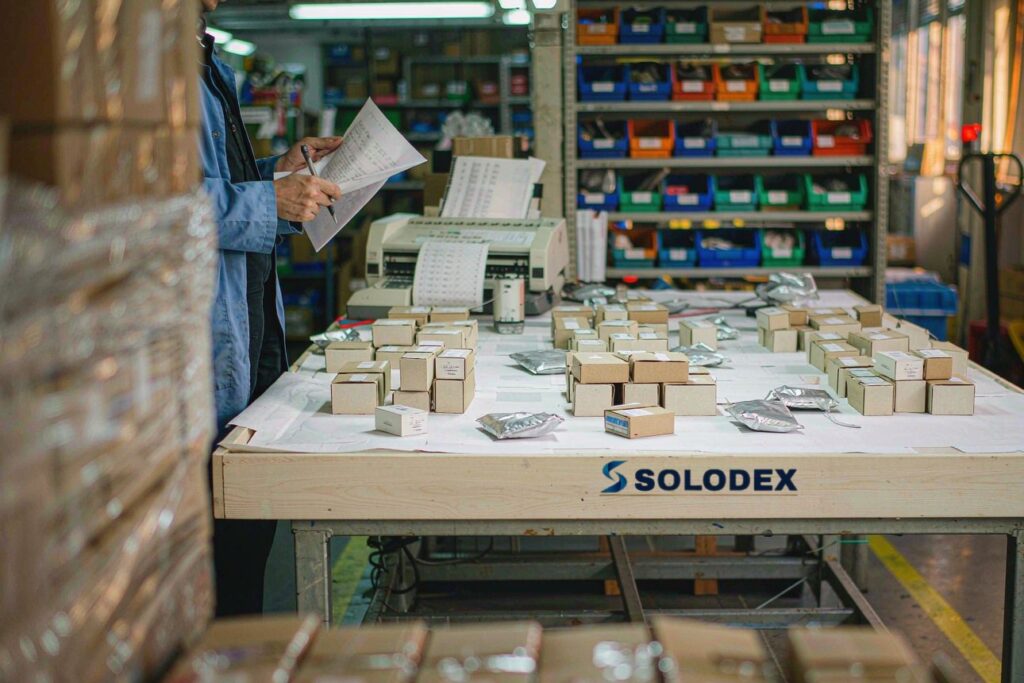
A spare-parts order left the factory with forty SKUs, forty small boxes and forty part numbers. The packing list described three things: machine spare parts, 1 lot; accessories, 1 lot; consumables, 1 lot. Every number on that sheet was correct – the carton count, the gross weight, the total value. The customer had approved it. The pickers had picked it correctly, down to the last foil pouch.
The booking was refused before the pallets reached the port. Not because anyone had lied. Because the paper admitted three objects and the crate contained forty, and the rulebook can only read the paper. Twelve of those objects were individually wrapped alcohol wipes; another was a box of toner. Neither had a line of its own, so neither had a name the carrier could classify.
Three lines for forty things
Merging the rows felt like tidying up. The template held twelve lines per page. The customer had once asked for shorter documents. The forwarding system truncated long descriptions. And the totals reconciled perfectly, which everyone read as proof that the sheet was finished.
What actually happened was not imprecision. It was a one-way operation. Forty rows become three in a few keystrokes; three rows become forty only if somebody walks back into the warehouse and looks at the boxes again. Nothing downstream of that desk has a reason to do it, and most of it has no way to.
Notice the three words that were kept. Machine spare parts, accessories, consumables – all of them answer what is this for. They are the language of a receiving department. None of them answers what is this, which is the only question a classification, a carrier or an inspector is allowed to ask.
And the totals hid it. Addition does not carry identity: three lots and forty part numbers can produce exactly the same carton count, the same gross weight and the same invoice value. Because every number on the sheet reconciled, nobody had a reason to count the rows – which is the one number that would have shown the problem.
A line is the unit the rule can see
Every regulated object needs a row to stand on. The description, the quantity, the weight, the tariff heading, the dangerous goods status, the origin and the licence all hang off that row, and they hang off it together. A carton, a pallet and a container are physical units: they exist for people who lift and stack. A row is a legal unit: it exists for people who decide.
The two numbering systems never match, and nobody expects them to. What is easy to miss is that an object with no row is not “poorly described”. In the documents it does not exist at all – and something that does not exist cannot be declared, cannot be exempted, cannot be inspected and cannot be released.
There is an earlier piece on what customs reads on a packing list and an invoice, and it is about which columns have to be filled. The question here comes before that one: how many rows are there for those columns to be filled in? A perfectly completed sheet with three rows is a perfectly completed description of three things.
Four ways to lose a line
| What was in the warehouse | What the sheet said | What the rule could see | Where the cost landed |
|---|---|---|---|
| Forty spare-part SKUs, including wipes and toner | Three rows, each “1 lot” | Three declarable objects | Booking refused; the list rebuilt line by line at the gate |
| A starter kit of twelve alcohol wipes | No row; folded into “accessories” | Nothing | Undeclared dangerous goods, logged against the shipper |
| One part number split across two cartons | Two rows, two quantities | Two objects | Counted twice at consolidation; explained by hand |
| The same forty SKUs listed one by one | Forty rows | Forty objects | Twenty extra minutes at the printer; every later question answerable |
Read down the last column. The first three rows are all bills for the few minutes saved by fitting the shipment onto one page. The fourth row is the same work done once, before anybody else had to redo it.
Who chose three
No classification decision was made that afternoon. A clerk chose a page layout. The template had twelve rows, the PDF was supposed to be one page, the customer disliked attachments, and the totals balanced. Those are all reasonable reasons, and none of them is about the goods.
That is what makes this category uncomfortable to audit. The decisive act looks like formatting, so it is not reviewed by anybody who understands the goods, and it leaves no trail. When the rejection arrives, the search begins at the carrier’s desk or the customs office, which is three weeks and five systems away from the place where the answer was actually set.
There is a long-standing observation that the same shipment ends up described five times, and that those five descriptions must share one source. True – but that is a problem of values drifting between copies. Here the first copy was born with thirty-seven objects missing, and the other four faithfully inherited the omission. Consistency is not a defence when the source was already thin.
The copy inherits the line
The invoice, the export declaration, the bill of lading, the manifest and the insurance schedule are all generated from, or checked against, that first sheet. Their job is to agree with it. None of them is tasked with asking whether a row ought to be split.
Automated checks are very good at that agreement and indifferent to the other question. A mismatch engine compares values; it does not open a carton and wonder whether “consumables, 1 lot” ought to be eleven rows. A merged line passes every consistency test in the chain, because every copy of it is equally merged.
So the deletion propagates faster than the goods do. The more automated the hand-offs, the quicker three objects become the settled truth about a pallet that contains forty.
What the inspector is holding
At an examination, one person has a sheet of paper in one hand and a carton in front of them. They are not recalculating the invoice total. They are trying to find the row that corresponds to the thing they have just lifted out of the box.
Different readers want different lines. Customs wants the description and the heading; the carrier wants packages, weight and any regulated content; the insurer wants value; the destination authority wants origin. A merged row gives each of them a plausible answer and lets each assume somebody else has looked at the rest. That assumption is the most reliable thing the three-line sheet produces.
When they cannot find the row, the finding is not “there is an extra item”. It is “there is an item that was never described”. That changes who has to do the work. From that moment the shipper has to prove what the object is, why it is in the consignment and which rules apply to it – using a document that was not created, because the item-by-item list was never printed.
The awkward part is that the proof is usually sitting in the warehouse system. Forty part numbers, forty pick confirmations, a scanner log with a time on each line. It simply was never copied onto the only sheet that travelled. There is a related distinction in how a carton of cartridges is judged: thresholds are counted per package, while identity is counted per row. The same physical box belongs to both counts, and only one of them was written down.
When one line is exactly right
None of this means more rows are always better. A pallet of forty identical spanners – same material, same heading, same origin, same destination, no regulated content – is clearer as one row than as forty. Splitting it would add pages and invite the very inconsistencies that cause delays.
The test is not a row count. It is whether everything inside a row can share one answer: one classification, one dangerous goods status, one origin, one licence, one set of documents. If a single question about the row would produce two different answers, the row is too wide.
It is a check that can be done at the bench without a rulebook. Take one row and ask what would happen if each item in it were separately asked its classification, its dangerous goods status and its licence. If the answers come back identical, one row is honest. If they come back different, the row is hiding a decision that somebody will have to make later, in a place with less information and less time.
Which reframes the whole job. The useful question at the packing bench is not “how many items are in this shipment”. It is “can these two things share an answer”. A spanner and a wrench can. A spanner and an alcohol wipe cannot – and the difference has nothing to do with how many boxes are on the pallet.
What to count before the sheet is printed
Count the rows. Count the SKUs. Then count how many different answers the goods would need if somebody asked about each of them in turn.
On this order those numbers were three, forty and seven. No standard template has a field for the third one, which is why nobody noticed it was missing.
The paper is not a record of the cargo. For every system downstream of the packing bench, it is the cargo. Forty things left the warehouse, three arrived at the booking desk, and the only person who ever saw all forty was the picker holding a scanner.
Width is only half the story: a packing list can have forty honest rows and still be a plan written nine days before the container was sealed.
And a row stops at the edge of its own consignment: when two shippers share one container, neither packing list describes the whole box.
Row width is one thing a sheet can lose; so is the identity of the party standing behind those rows.
A row can hold too many identities; it can also keep its own identity and still have no reader at all.
A row is the smallest legal unit on paper; for break bulk cargo that row also has to be stencilled on the piece itself.
A row is the smallest unit the paperwork recognises; on the quay the unit it names can be rebuilt into a pallet without the row changing.
Line items describe the goods and their quantities; no line item records the cell a box occupied on board, which is why a mid-voyage change of cell leaves the commercial description exactly as it was.


