Put a twelve-line packing list on a table and make five copies. Give one to the customs desk, one to the carrier, one to the insurer, one to the bank, and one to the team that checks whether the goods may be sold at destination. Ask each of them to mark only the lines they actually use. When the five copies come back, the marks barely overlap. Two lines have no mark at all.
Nobody has been careless. Each reader did exactly what their job asks, and each of them could defend their marks. What has not happened is a reading of the whole sheet. The document has twelve lines and five partial readings; it has never had one complete one. This is the fifth and last consequence of a piece of paper standing in for a shipment, and it is the one that explains why the first four are so hard to notice.
The Five Copies on the Table
Imagine the sheet itself. Ten product lines, each with a description, a carton count, a net weight and a value. Then line eleven, assembly hardware, one lot, and line twelve, printed leaflets, 480 pieces. The two last lines were added by somebody in the shipping office who thought they were being helpful: the factory had mentioned the little bags of fixings and the instruction sheets, and leaving them off felt worse than writing them down.
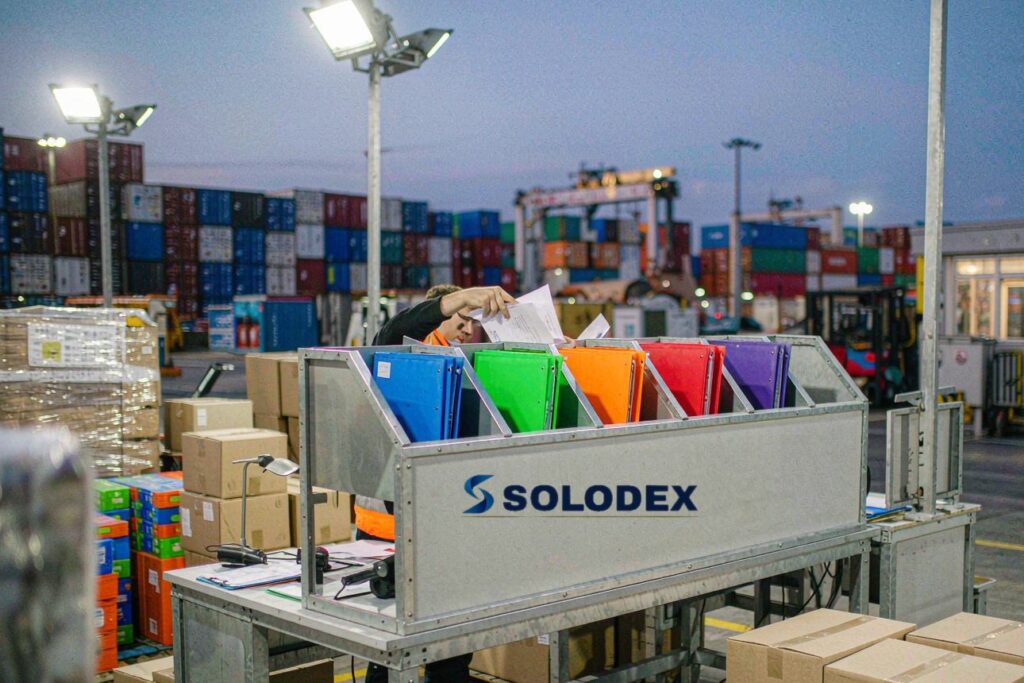
Now the five copies go out. One comes back with a blue circle around the descriptions, the HS-related wording, the quantities and the value columns. One has a green circle around carton counts, gross weight, dimensions and shipping marks. One has an orange circle around the declared value and the nature of the packing. One has a purple circle around the invoice total and the commercial description. One has a red circle around the product names and the material wording. Every one of those marks is a legitimate act of reading. Not one of them is a reading of a document.
A reader takes what answers their own question. The rest of the page is not rejected; it is simply not looked at. That distinction matters more than it sounds. A rejected line can be argued about, corrected or escalated. A line that was never looked at produces no argument at all, because no one has an opinion about it.
Who Actually Reads the Whole Sheet
The working assumption in most shipping offices is that a document is submitted and then examined. In practice it is submitted and then divided. Classification and valuation take the descriptive and money lines. The carrier takes the physical lines. Insurance takes value and packing. A bank or a buyer under documentary terms takes the commercial description and the total. Destination compliance takes the product and material wording. None of these five has a task that says “compare all twelve lines with the whole consignment”.
So the field worth pointing at is not a number or a date. It is a mapping: for each row on the sheet, which reader takes it, and which rows have no reader at all. That mapping is almost never written down, because each party already has a checklist of their own and no party is paid to compare checklists.
An earlier article on what a packing list and a commercial invoice must contain covers the six fields one authority reads and the three mistakes that break that reading. This article is not another field list. It is about the space between five such lists. Adding a seventh field to one reader’s checklist does not give the sheet a reader; it gives one reader more to check.
The Windows and What Each One Takes
Five readers, one page, and a column that is empty in every row:
| Reader | Lines it takes | Question it answers | Lines it never looks at |
|---|---|---|---|
| Customs classification and valuation | Description, quantity, unit price, total, origin | What is this, and on what amount is duty due | Carton-level weights, marks, packing notes |
| Carrier and terminal | Carton count, gross weight, dimensions, marks | Will it fit, how is it stowed, does the scale agree | Unit price, HS wording, origin detail |
| Insurer | Declared value, packing nature, product name | What is covered, and from when | Carton numbers, HS wording, row count |
| Bank or buyer under documentary terms | Invoice total, commercial description, document consistency | Does the paper comply on its face | Net weight detail, origin, packing notes |
| Destination compliance or inspection | Product name, material, quantity | Is a certificate needed, may it be sold | Unit price, marks, carton numbers |
| The shipper | Wrote all twelve lines; saw the whole consignment | None that counts as a reading | None, because writing is not reading |
Read the last column downward and the shape of the problem appears: every reader has a large blind area, and the blind areas are different. Read the last row across and a stranger fact appears: the only party that has seen the goods is the only party whose view of the sheet is not a reading anyone acts on.
Two Lines Nobody Claimed
Back to lines eleven and twelve. They are still there. The ten product lines were not collapsed into a single vague row covering the whole shipment, which is the failure the first article in this batch described when it asked how wide a row is; lines eleven and twelve are separate, countable rows. That piece showed how merging forty SKUs into three rows erases their identities. This one shows something colder: a row can keep its own identity and still have no reader.
The fixings bag does not change the classification of the main product, so the customs desk has no reason to dwell on it. It is inside the declared gross weight, so the carrier’s scale agrees either way. The declared value covers the whole consignment, so the insurer sees no separate amount. The commercial description on the invoice covers the kit, so the bank sees a consistent document. The material question at destination is about the product, not the leaflet. Five rational answers, and not one of them depends on reading line eleven or line twelve.
Which means that if those two lines are wrong, nothing in the ordinary flow will surface it. A leaflet that carries a claim nobody cleared, a fixings bag containing an item with its own rules, a quantity that quietly doubled: all of it can sit in plain sight on a page that five people have read. An error does not need to be hidden. It only needs to land on a row that nobody takes.
Consistency Is a Sum, Not a Check
When all five readers report no problem, the natural conclusion is that the shipment’s paperwork is clean. It is not the same claim. What has been established is the sum of five local judgements, each made against the reader’s own subset of lines. Nobody has compared the twelve lines with the twelve things in the warehouse, and no system can, because the warehouse is not in the system.
This is a different question from the ones the older articles ask. One shipment described five times is about the same goods becoming five different texts, and why a machine cannot see that 250 cartons and 5,000 pieces are the same batch. The rules that compare those texts rest on the assumption that agreement means accuracy, and show both directions in which that assumption fails. How an export declaration works in China is about one form being three instruments at once, with consequences for the tax rebate base. And an electronic invoice is an event in a tax system, not a page sent by email. All four are about what a document is and how its values travel. This article is about who looks at it, and how much of it they look at.
There is a small trap here. Making the five copies agree with each other is genuinely useful, and it is the work most documentation teams spend their day on. But agreement is internal to the paper. Five partial readings that agree are still five partial readings. The missing comparison is with the consignment, and that comparison has no owner.
The One Person Who Saw the Whole Shipment
The shipper wrote all twelve lines. Somebody in that office watched the cartons being closed, or at least spoke to the person who did. If a question arises about what is physically inside one saleable box, this is the only party that can answer without relaying somebody else’s observation. And yet the shipper is not one of the five readers. It does not get to say whether its own description is acceptable; it only gets to be asked about it later.
The name at the bottom of the page, which the fourth article in this batch was about, is the party that must answer when an authority finally asks, and that name is often a trading company that never opened a carton. Put the two findings together and the arrangement looks almost deliberate: the party with knowledge does not examine, and the parties that examine do not have knowledge. The sheet is the only place the two meet, and on the sheet they meet as twelve lines, not as a shipment.
Neither side is failing. An authority cannot inspect every consignment, and a shipper cannot certify its own description. The division is what makes trade at volume possible. It is also what makes a whole sheet structurally unread.
Where the Gap Sits When Something Goes Wrong
Consider what happens when a problem is finally found at the destination. Each reader can produce their copy and show that the lines they took were correct at the time they took them. The carrier’s weight agreed with the scale. The invoice total agreed with the contract. The classification matched the description supplied. The product wording matched the certificate. Five defensible answers, and a discrepancy in a line that appears on none of their worksheets.
The question then becomes who should have caught it, and there is no clean answer, because no role includes “read the entire sheet against the entire consignment”. The third article in this batch described a different missing owner: a shared container has no document at its own level, so the gap belongs to no party. That was a gap in document coverage. This is a gap in reader coverage. Both are produced by competent people doing exactly their own jobs, which is why neither one looks like an error until the day it is expensive.
There is no procedural trick that closes this. A checklist with more columns gives one reader more columns. A sixth copy gives a sixth partial reading. What would be required is a named moment at which somebody compares the whole sheet with the whole consignment, and in most flows that moment does not exist as a paid task. It exists only in the memory of whoever packed the boxes.
Five Questions, One Batch
These five articles have each asked one narrow question about the same sheet:
- How many identities are inside one row? Width.
- At what moment does this sheet become true? Tense.
- Where does this sheet’s boundary stop? Extent.
- Whose voice does this sheet carry? Speaker.
- Who reads it, and how much of it? Reader.
None of the five is a question about how to fill in a form. All five are questions about the same substitution: a physical consignment is replaced by a few lines on paper, and the rules that govern the shipment can only see the lines. A row can be too wide, a date can be in the wrong tense, a document can stop short of the container, a signature can belong to somebody who never saw the goods, and a page can be divided among five readers without ever being read whole. Each of those is a different way for the paper to be an inadequate stand-in, and each is invisible from inside any single job.
Nobody Took the Sheet
The consignment arrived as one thing: cartons, fixings, leaflets, all of it together in a sealed space. Its paper arrived as twelve lines. Five readers took two lines each and went back to work, and every one of them was right about what they took. Two lines stayed on the table with no mark on them.
That is the whole argument of this batch. Paper does not record a shipment; paper stands in for one. Rules cannot see the warehouse, only the few lines on the sheet. And the quietest version of that fact is not that a line is wrong, or late, or too short, or signed by the wrong company. It is that the sheet has no reader at all: it has five.
Five readers take different rows of one sheet; when there is no container, the line a reader needs is painted on the cargo.
Five readers each take the rows that concern them and nobody owns the gaps between them; on a tank booking nobody is assigned to compare the previous cargo with the new product name.
One sheet is read differently by five different parties; a restow is the opposite case, where two separate working lists are read together to establish that one voyage and one call produced both lifts.