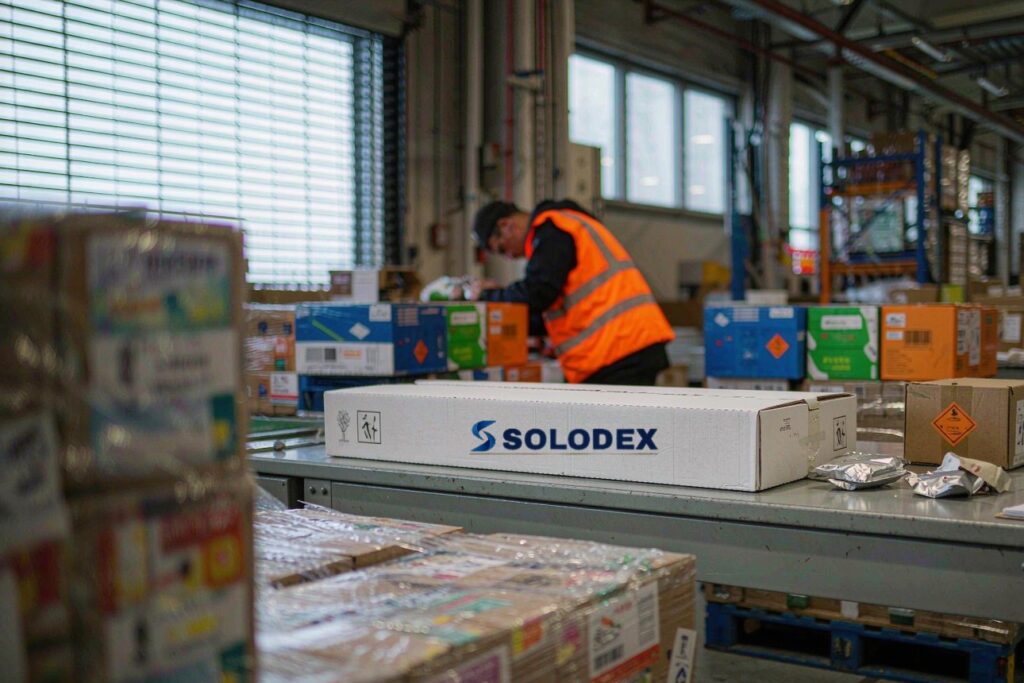
The crate held one analyser, two spare cables, a printed manual, and a small white carton of twelve individually wrapped cleaning wipes. The packing list called the last item “cleaning cloths, qty 12”. It was worth less than the foam it sat in, and it was the reason the booking came back.
Not because the wipes were wet. They felt dry. The foil pouches were sealed, nothing had leaked, and the outer carton was clean enough to have gone straight onto a retail shelf. The objection was that a cloth impregnated with isopropyl alcohol is not a liquid in a box. It is a solid containing a flammable liquid, with its own entry: UN 3175, solids containing flammable liquid, n.o.s., Class 4.1, Packing Group II. A shipment described as laboratory equipment was, in the carrier’s reading, laboratory equipment plus twelve packages of undeclared dangerous goods.
The factory had answered the question it was used to being asked – is there any liquid in the crate? There was not, in the sense that mattered to a packer. But the question was whether the liquid had a carrier, and a piece of nonwoven cloth is a carrier. It holds liquid the way a wick holds oil: distributed through a solid structure, with no surface to pour from and a great deal of surface to burn from.
The cloth is the container
Class 3 is written for liquids. Its test is a closed-cup flash point, and a liquid with a flash point at or below 60 °C belongs there. Class 4.1 is written for flammable solids, self-reactive substances and solid desensitised explosives, and it contains an entry made specifically for the awkward middle case: a solid that has been soaked in a flammable liquid and from which no free liquid remains at the temperatures met in carriage.
That last condition is the whole boundary. If liquid can be poured out of the pack, the goods are a liquid and the wipes are merely what it was spilled onto. If the liquid is held by the substrate, the article offered for transport is a solid, and it is classified as one. Nothing about the chemistry changed between those two sentences. What changed is the physical form of the thing being handed to the carrier.
This is the same discipline that decides an ink cartridge is an article rather than the substance inside it. The rule addresses the object in the crate, not the drum it was filled from. But the wipe is a harder case, because the object looks like packaging. A cartridge has a shell, a shape and a part number. A wipe has none of those, so everyone downstream reads it as a disposable accessory and stops asking.
Two percentages with the same name
Ask a supplier what is in the wipe and the answer arrives as a number: 70% alcohol. That is a perfectly good answer to a different question. It describes the concentration of the solution in the mixing tank, which is what determines whether the product cleans well. It says nothing about how much of that solution one wipe holds.
The field that settles the classification is the liquid load, sometimes written as the impregnation ratio or saturation ratio – grams of liquid per wipe, or that mass as a percentage of the dry substrate weight. It lives on the consumable’s technical data sheet, on the pouch print, or in section 9 of the safety data sheet. It does not live on the commercial invoice, and it does not live on the equipment’s bill of materials, because the wipe is not a component of the analyser. It is a consumable that somebody in production decided to include.
From that one figure, three things follow. It tells you whether the substrate is saturated to the point where free liquid can appear under pressure or heat. Multiplied by the count in the carton and the count of cartons in the crate, it gives the quantity of flammable liquid being offered. And it tells the carrier which of the two entries above the consignment belongs to. A supplier who sends “alcohol 70%” has sent a marketing fact. A supplier who sends “2.4 g per wipe, 12 wipes per carton” has sent a transport fact.
Which is why the smallest item in the shipment generates the longest email thread. The equipment has a manual, a model number and a declaration of conformity. The twelve wipes have a technical data sheet that nobody in the export office has ever requested, held by a subcontractor who does not appear on the purchase order.
The flash point test has nothing to test
A common way to lose an afternoon is to forward the safety data sheet to the forwarder as proof. Section 9 will give a flash point around 12 to 13 °C for a 70% isopropyl solution, and everyone then argues about whether that makes the shipment Class 3. It does not, because the test that produces that number requires a free liquid surface in a cup. There is no cup inside a sealed foil pouch. The number is a property of the solution as it was blended, not of the article as it is packed.
The reverse mistake is more dangerous. Absence of a free liquid surface is not absence of flammable vapour. The headspace in a warm pouch reaches equilibrium with a very large internal area of alcohol-wetted fibre, and fibre is an efficient arrangement for feeding a flame. A solid that burns along a wick is what Class 4.1 is for. So the same sheet of paper can be used to argue for the wrong class, or against any class at all, and both arguments fail for the same reason: the test was run on the wrong object.
The general habit is worth keeping: classification starts from the article as offered for transport, and a data sheet written for a bulk chemical describes a product that is not on this pallet.
Dry to the touch is a tactile claim
Every person who handles one of these kits performs the same inspection. They squeeze the pouch, look at their fingers, and conclude that the goods are dry. Capillary action makes that conclusion feel rigorous. It is a statement about a fingertip at room temperature, made once, on one wipe, in an office.
Three conditions in a real shipment are not represented by that moment. A container on a sunny apron is considerably warmer than an office, and vapour pressure rises with it. A carton at the bottom of a pallet carries the weight of everything above it, and a saturated substrate under sustained compression can give up liquid. And a crate spends part of its journey at an angle its designer never drew, so whatever liquid does appear collects at the seam instead of staying where it was absorbed.
None of this means the wipes will arrive leaking. It means the classification rests on a documented liquid load rather than on a tactile impression, because the moment free liquid is present the premise of UN 3175 has gone and the goods are back in Class 3. “It felt dry” is the most expensive sentence in this category, not because it is false, but because it is satisfying enough to end the enquiry.
A spare part is still a consignment
The starter kit is invisible in the commercial paperwork by design. It is not invoiced as a line item, it sits outside the equipment’s bill of materials, and it is described in contracts as free-of-charge accessories. Production puts one in each crate because customers expect it, and the person who decides that has no reason to think of it as an export declaration.
Carriage rules have no free-of-charge category. An article that is installed inside a machine and doing work there may be treated as part of the machine, depending on the mode and the code. An article sealed in a pouch and placed beside the machine in the same crate is a separate article, and putting it in the same box does not integrate it – the same edge that decides whether a charged component is installed or merely loose. The kit is loose.
“Cleaning cloths, qty 12” makes it worse rather than better. A packing list that names the object without naming what is in it does not read as an abbreviation to a carrier; it reads as a declaration from which a regulated property has been removed. The booking desk is not asking whether the factory was careless. It is asking what the UN number is, and the only place that number can come from is the smallest carton in the crate.
Four things that look like the same wipe
| What is in the crate | The figure that decides it | The entry it belongs to | What happens at acceptance |
|---|---|---|---|
| Twelve foil-packed 70% IPA wipes in an accessory kit | Liquid load per wipe, and the count per carton | UN 3175, Class 4.1, PG II | The UN number is requested; “cloths” is not an acceptable answer |
| Water-based lens wipes with a low alcohol content | Flash point of the formulation as blended, plus liquid load | Often no UN entry at all | Moves as general cargo, but only with a formulation sheet that says why |
| A bulk tub of pre-saturated wipes, loosely filled | Whether liquid collects at the bottom of the tub | Class 3 liquid, not 4.1 | Reclassified at the warehouse; the tub is treated as a receptacle |
| A bottle of cleaner and a stack of dry cloths, packed together | Two articles, two descriptions, two quantities | Class 3 for the bottle; the cloths are ordinary goods | A less ambiguous declaration, and a different product from the outset |
Down the third column, the same visual object lands in three different entries and once in none at all. The first and last rows differ only in whether the liquid was put into the cloth at the factory. That decision was made by a product designer choosing a convenient format, years before anybody booked a container.
The earlier piece on this product family, aerosols, alcohol and the one-litre rule, is about what happens after the form is chosen – limited quantities, excepted quantities and the privileges of retail packaging. This one is about the step before it: why the form has an entry of its own at all.
The claim on the label is a separate product
There is a second door, and it opens on a word rather than a number. A pouch printed “cleaning wipe” is a consumable. The same pouch printed “disinfectant” or “kills 99.9% of germs” makes a biocidal claim, and in many destination markets a product making that claim must be registered before it can be sold, with the registration held by a named local entity.
Nothing about the cloth, the solution or the liquid load changed. What changed is what the seller says the goods do. This is the two-door structure that a banned lamp meets on the market side: the transport door asks which class and which packaging, and the market door asks whether this product may be placed on the shelf at all. A carrier’s acceptance letter answers the first and says nothing about the second.
It also explains an otherwise odd pattern. Equipment makers who ship the same analyser to twenty markets often ship twenty different accessory kits, and the differences are in the print, not the contents. Legal, marketing and logistics are each reading a different line on the same pouch.
Where the answer stops being a label
An undeclared dangerous good is not, at most carriers, a missing piece of paper that can be added at cut-off. It is a refused booking and a record against the shipper, and some channels – passenger aircraft bellies, certain courier networks, postal streams – do not accept the entry in any quantity worth shipping. No amount of careful packing changes that answer. The classification is not a surcharge to be negotiated; it is a yes or no from the network.
That is the shape this batch keeps meeting. These things are not especially dangerous. They are, in the right channel and with the right declaration, entirely ordinary. The trouble is that the wrong description does not make them more dangerous, it makes them inadmissible – and admissibility is not a matter of degree. A crate of laboratory equipment with twelve wipes in it is either declared correctly or does not travel.
Five questions, one field
- What UN number, if any, is printed on the innermost pouch?
- How many grams of liquid does one wipe hold, and what percentage of its dry weight is that?
- Can free liquid appear after heat, compression, or a week stored upside down?
- Does the accessory kit appear on the packing list under its real name?
- Does the label make a disinfecting claim, and who holds that registration in the destination market?
The middle question is the one that settles the classification. The others settle whether anyone will believe it. The whole shipment turns on a number that is printed on the least valuable thing in the crate, in a document nobody thought to ask for, from a supplier nobody knew was involved.
So the useful habit is not memorising UN 3175. It is opening the accessory kit. Whatever else is in a machine’s crate, the thing that decides how it travels is often the sample the factory threw in for free – and in this case, as in the rest of this batch, the answer is not about how dangerous it is. It is about whether it is allowed at all.
That pouch only becomes visible to a carrier if it has a row to stand on: a packing list is read line by line, and a starter kit folded into “accessories” has no name at all.
Impregnated goods can be refused at short notice, so a booking close to a moving cutoff is a poor plan; the classification is in alcohol wipes and impregnated goods.