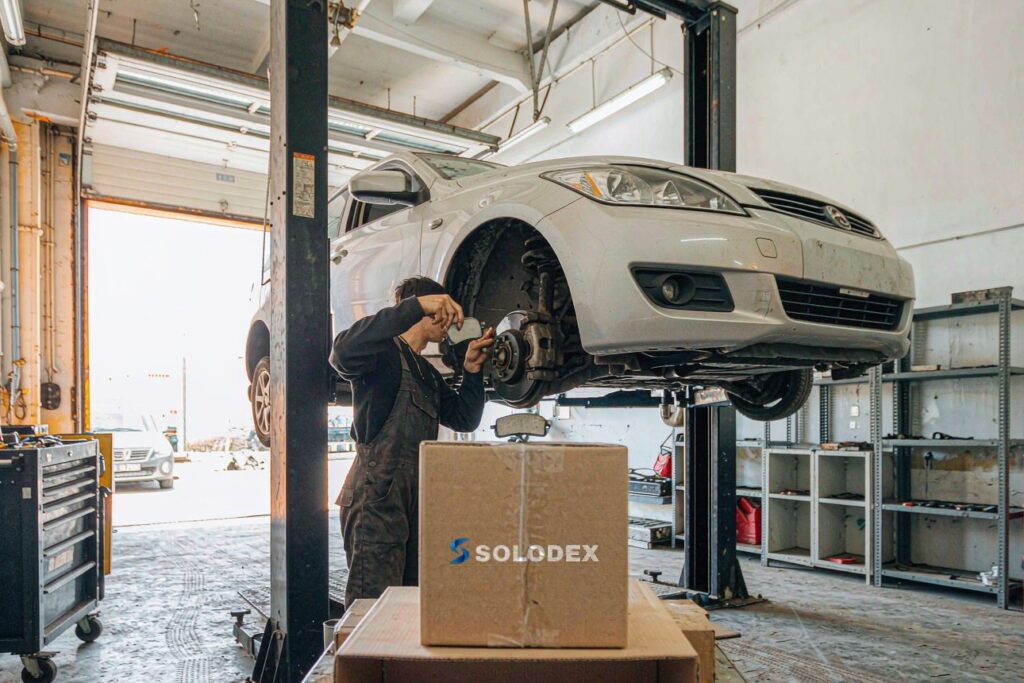
The container held four thousand brake pad sets. The tariff code was right, the duty was paid, and the boxes carried a printed line that said NON-ASBESTOS in three languages. Two years later a market surveillance laboratory bought a set from a shop shelf, put it under a microscope, and found chrysotile in the friction material.
The importer’s defence was the one everybody uses: the supplier certified it. The certificate was genuine, the supplier existed, and the paperwork was complete. None of that changed the finding, because a supplier’s declaration is a statement of belief, and the prohibition is on the goods.
This is the second category in this batch that is closed rather than licensed, and it is harder than the first – not because the hazard is worse, but because the customs document has no field in which to declare it.
The tariff describes a function, not a material
A brake pad enters under a heading that describes what it does: a part of a braking system, mounted on a vehicle. That heading says nothing about what the friction material is made of, and it is not supposed to. Tariffs classify by function and by trade category, not by chemistry.
Which means the thing that is prohibited is invisible to the classification system that the whole shipment is built on. An officer reading the declaration sees brake parts, a value and an origin. The material – the only part of the goods that matters legally – is not on the form, is not in the code, and cannot be inferred from either.
Compare that with the mercury lamps, where the product category itself was named on a list. Here the category is not named at all. The prohibition attaches to a constituent, and the constituent lives in a sentence the supplier wrote on a box.
Asbestos is dangerous goods, and that is the easy part
Worth stating plainly, because it inverts the usual order of difficulty. Asbestos has transport entries and a hazard class; a consignment of raw fibre or of material that is known to contain it is regulated, labelled and declared. So the transport question has a clear answer.
The problem is that the answer is only available to somebody who knows the material. The dangerous goods question starts from the substance, and everyone in this transaction starts from the part: a brake pad, a gasket, a clutch facing, a sheet of insulation board. Fill in the form for a brake pad and the substance never comes up.
Which is why the enforcement in this category happens late. The goods clear, they go into the aftermarket, a set is sold, and the finding arrives from a laboratory three steps downstream – by which time the consignment has been distributed, the remainder is being recalled, and the argument is about who pays for the recall.
There is no application form
The distinction that matters commercially is the one this site keeps coming back to. A restricted good can be imported with permission. A prohibited one cannot, and the prohibition has no procedure attached – no licence, no quota, no exemption to apply for, no official with discretion.
Asbestos in friction materials is in the second group in a growing list of markets, and the practical consequence is blunt: there is no version of this shipment that is lawful except the version without the mineral. Not a lower content, not a sealed enclosure, not a warning label, not a worker-protection plan at the destination. Those are answers to a different question – the safety of people handling it – and the market rule is not about handling.
What follows is that the useful work happens before the order, not at the border. A buyer who specifies “asbestos-free” and receives a certificate has bought a claim. A buyer who specifies the material, the test method and the sampling plan has bought evidence.
What a test can and cannot do
Microscopy on a sample can establish that the sample contains no asbestos fibres. That is a real and useful finding, and it is the only way to challenge a supplier’s assurance. What it cannot do is license the consignment.
Two limits are worth understanding, because both are argued about.
A passing sample is not a passing batch. Friction material is mixed in batches, and a laboratory report on one set describes one set. The evidence that survives a recall is a report tied to a batch, a date and a quantity, plus the records that show which cartons that batch became.
A test is not a permission. Even a clean report does not make an asbestos-containing product importable; it only shows this consignment is not one. In a prohibited category the test is a defence, not a document you present to obtain entry.
One part number, two specifications
There is a version of this problem that catches careful buyers, and it is worth spelling out because it is not about cutting corners.
A friction material is a formulation, and a manufacturer selling into several markets may well produce more than one of them under the same part number: an asbestos-free compound for the markets that prohibit it, and a cheaper compound for the markets that do not. Both are legitimate products, correctly labelled for their destinations, and both carry the same catalogue number.
Which means “we buy from the same factory as brand X” is not evidence of anything. The question is not who made it but which specification was run for this order – and that is a question about a purchase order and a batch record, not about a brand. It is the same structure as the same air conditioner leaving the factory with two different gases depending on which market it was built for: identical product, different contents, and only the label knows.
The practical instruction follows directly. A specification should name the material standard and the market it is intended for, because a part built to a permissive market’s standard is not made compliant by shipping it to a strict one.
The aftermarket is where it hides
Original equipment from a major manufacturer is, in most cases, well controlled: the specification is written, the supply chain is audited, and the material is declared. The risk concentrates in the aftermarket – the unbranded set, the second-tier brand, the parts sold by the container to distributors who repackage them.
Which is also where the price pressure is. Asbestos is an excellent friction material: cheap, heat resistant, and hard-wearing. That is why it was used for most of the twentieth century, and why a supplier under cost pressure has an incentive that runs exactly against the buyer’s interest – and why “NON-ASBESTOS” printed on a box is a claim with a commercial motive behind it.
The same logic applies to used parts. A container of used brake assemblies stripped from vehicles is a container of unknown friction material, and “used” does not make a prohibited substance disappear – it makes the material harder to establish. That is the mirror image of the used-electronics problem: the older the goods, the less the paperwork knows.
Four cartons of the same brake pad
| What is in the carton | Customs view | Market view | The usual mistake |
|---|---|---|---|
| Pads declared asbestos-free, with a supplier certificate | Brake parts; nothing unusual on the entry | Prohibited if the certificate is wrong | Treating a certificate as evidence rather than as a claim |
| Pads with a laboratory report per batch | Same entry | Defensible, and the recall is containable | Testing one set and shipping four thousand |
| Pads that do contain asbestos | Still brake parts – the code does not change | Prohibited; no licence exists | Looking for an exemption procedure that does not exist |
| Used brake assemblies | Used parts, often with their own rules | Unknown material, and the burden is on the importer | Assuming age removes the obligation |
The second column is identical in all four rows, and that is the whole point. The system that decides entry cannot see the difference, so the difference has to be carried by documents the importer created – and if they were not created, the fourth row is where the shipment ends up.
What to establish before the order is placed
What is the friction material, by specification? Not “non-asbestos” as a slogan – the material family, the supplier’s declaration, and the standard it is declared against.
Is there a test, and is it tied to a batch? Method, laboratory, sampling plan, and the link between the report and the cartons in the container.
Is this category prohibited or restricted at destination? If it is prohibited, there is no procedure to start, and the answer belongs in the quotation rather than in the post-mortem.
Who carries the recall if it goes wrong? In most markets the obligation lands on the importer, and the cost is not the value of the goods – it is the cost of getting them back off shelves.
If the goods are used, how will the material be established? Because “stripped from vehicles” is a description of origin, not of composition.
Invisible to the form
Every category in this batch has a place where the truth is written down. For the mercury lamp it was a list of product categories; for the cartridge it was the quantity in the outer package. Here there is no place at all – the prohibition attaches to a constituent that the classification system was never designed to describe.
Which is why the discipline is different in kind. Elsewhere, the job is to read the right document. Here, the job is to create the document, because nothing in the normal flow of a brake pad shipment would ever produce one: not the invoice, not the packing list, not the customs entry, not the bill of lading.
And that is the uncomfortable part. A shipment can be perfectly documented and still be unlawful, because every document in it describes the part, and the rule is about the material. The only defence is a piece of paper that somebody decided to commission before there was a problem – which is the same lesson as every other kind of evidence in this trade.
Where a material is restricted, the working cutoff is earlier than the published one because extra checks must clear first; the rule is in asbestos in brake linings.


