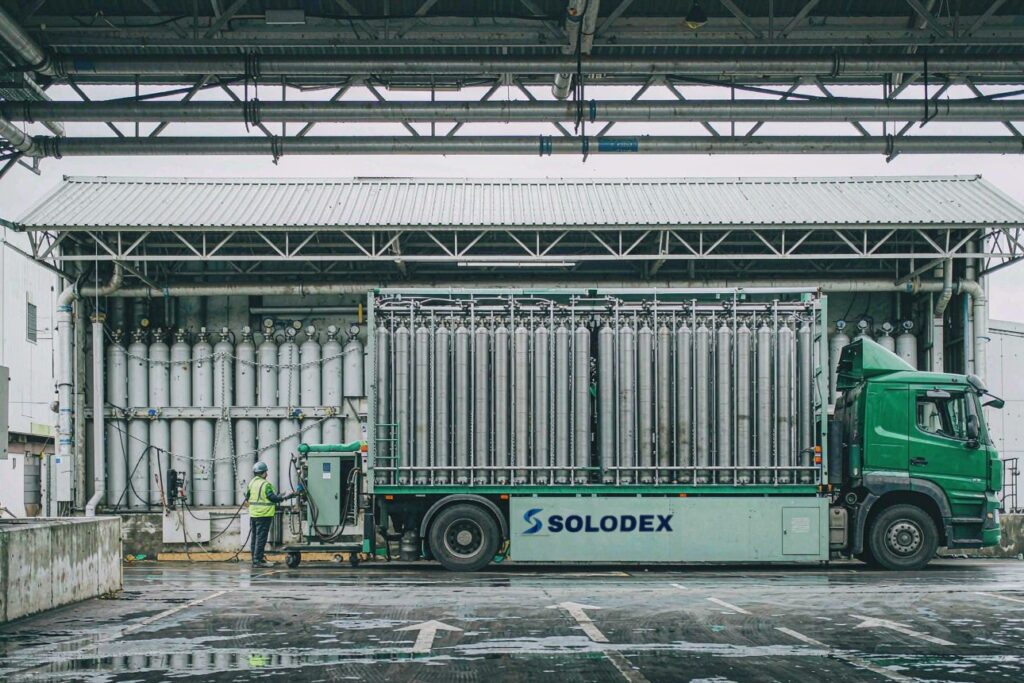
Three hundred fire extinguishers arrived in unopened cartons, still on the factory pallet, each one with its gauge in the green. They cleared customs without difficulty. Two weeks later the site safety officer refused to sign them in, and the reason was six characters stamped into the shoulder of every cylinder: a month and a year, from before the shipment was booked.
The extinguishers were new. The cylinders were not – they had been bought as surplus stock, filled and packed recently, and the date on the shoulder was the last pressure test, which had happened years earlier. Nothing about the goods was defective. They had simply stopped being transportable somewhere between the factory and the site.
This is the difference between this category and the last one. A tyre’s date code is a birth certificate: fixed at the moment of moulding, impossible to alter. A cylinder’s date is an inspection record – which means it can be renewed, and also that it can expire while the goods are in transit.
Two dates, and only one of them is on the invoice
Every pressure receptacle carries its own paperwork, permanently, in steel. Stamped into the shoulder or a collar ring you will find the test pressure, the manufacturing standard, the identifier of the body that tested it, and the date of that test. On a good cylinder the stamp is legible decades later; on a bad one it has been painted over, which is itself an answer.
The invoice, meanwhile, carries a shipping date. Those two numbers have no relationship, and the entire commercial argument in this category comes from people assuming they do. A container of cylinders bought from stock, filled last month and invoiced this week can carry a test date from six years ago – and the transport rules do not care when the goods were sold.
Which is why the first thing a forwarder should ask for is not the MSDS. It is a photograph of the shoulder stamp, close enough to read.
The interval belongs to the receptacle, not the contents
Periodic inspection exists because a steel shell under pressure fatigues, corrodes from the inside out, and can be damaged in ways that are invisible from the outside. The interval is set by the cylinder type and by the regime it is regulated under – commonly five years, sometimes ten, shorter for some composites and for cylinders in hard service.
Two consequences follow, and both of them are arithmetic rather than judgement.
A cylinder that is legal today may not be legal on arrival. A five-year test that expires in March is no use on a voyage that lands in April, because the rule applies at the moment of carriage, not at the moment of booking. This is one of the very few cases in freight where a certificate can expire in the water, and the cost of discovering it is a consignment that cannot be moved onward by road either, since the same rule applies there.
And a cylinder cannot be tested full. A periodic inspection means emptying, opening, inspecting the interior, pressure testing, drying and re-valving. It is a workshop operation with a price per unit, and on cheap extinguishers that price is often a substantial fraction of the value of the goods. So the commercial question is not “can this be renewed” but “is it worth renewing”, which is a different conversation and usually a worse one.
“Empty” is not a class
The most expensive misunderstanding in this trade is the word empty.
An empty cylinder that last contained a flammable or toxic gas is, for transport purposes, still a cylinder of that gas until it has been cleaned and purged to a defined standard and marked accordingly. The hazard did not leave with the contents; a residual film, a vapour space, a valve seat with product behind it – any of those will do.
Which is why the paperwork for empty cylinders is not a blank. It is a declaration that says what was in them, what was done, and what is in them now – and “empty” alone is not an answer, because it describes a quantity rather than a condition.
This matters most in the return direction, which is where most of these shipments actually go: cylinders come back for refilling, and the return leg is treated by the shipper as a logistics formality rather than a dangerous goods shipment. It is not. It is the same shipment, in the other direction, with a worse paper trail and a smaller budget.
The extinguisher is a pressure vessel with a product attached
A fire extinguisher is one of the few consumer objects that is unambiguously dangerous goods: a pressure receptacle, charged, with a valve and a safety pin. The entry that covers it – fire extinguishers containing compressed or liquefied gas – is not a formality, and it comes with conditions about valve protection, orientation and bracing that a pallet of cartons does not.
The physical part is not difficult, but it is specific. Cylinders travel upright and secured, in frames or bundles built for the purpose, with the valve protection in place – because a valve that shears off in a container turns a pressure receptacle into an uncontrolled release in a steel box with the doors closed. Which is the same problem as any other load that has to be restrained rather than stacked, with a worse failure mode.
Then there is the agent inside, which is a second question entirely – and the second question can override the first. Carbon dioxide and dry powder are ordinary. But some extinguishing agents are controlled substances in their own right, restricted or banned for environmental reasons in a growing list of markets – which means the identical red cylinder, with the identical label, can be an ordinary import in one country and a prohibited one in another, on the basis of what is inside rather than what it is.
It is the same structure as the refrigerant in an air conditioner: the article is the shell, and the contents carry their own regime. The difference is that here the shell has a regime too, so a single pallet can be caught twice.
The standard problem: a cylinder is approved somewhere
Pressure receptacles are made to national or regional standards, and the approval is granted by the authority of the country where they will be filled. A cylinder manufactured and approved for one market is not automatically fillable in another, and the gap is not bureaucratic decoration: the wall thickness, the thread on the valve, the test pressure and the marking all differ.
Bundles and manifolds make the point sharper. A pallet of cylinders strapped into a frame is one object for handling and a dozen objects for regulation, and the frame is usually designed for one standard’s dimensions. Swap the cylinders and the frame no longer fits; swap the market and the frame may fit while the cylinders inside it are not fillable there.
In practice this produces a shipment that is legal to import and impossible to use – the same shape as a car that arrives and cannot be registered. The cylinders pass customs, reach the gas company, and are refused at the filling manifold because they do not carry the mark the filler is allowed to fill. Nobody did anything wrong. The goods are simply approved in the wrong country.
Which explains a shipping pattern that puzzles buyers: a large share of new extinguishers move without their charge. The shell travels as a pressure receptacle with a holding charge of air or nitrogen, or with the valve loose, and the agent is put in at the destination by a filler who is licensed to do it. It costs a filling step and a set of local approvals – and it removes both the dangerous goods question and the standard question in one move.
Four pallets of the same red cylinder
| What is on the pallet | How it travels | What decides | The usual mistake |
|---|---|---|---|
| New, charged extinguishers, current test | Dangerous goods, full regime – valve protection, bracing, declaration | The shoulder stamp and the agent inside | Booking as general cargo because the cartons look ordinary |
| Charged extinguishers from surplus stock | Same, if the test is current; not transportable at all if it is not | The date, not the invoice | Assuming a recent purchase means a recent test |
| Empty, uncleaned, for refilling | Still the class of the last contents | The declaration of what was in them | Declaring “empty” as though it were a category |
| Empty, cleaned and purged | Generally not dangerous goods, with the right declaration | The purge record and the marking | Cleaning without documenting it, which is indistinguishable from not cleaning |
The third row is the one that catches professionals, because it looks like a saving. Shipping empties back is cheaper than shipping them full, right up to the point where a terminal asks what the last contents were and nobody can produce a document that answers it.
What to establish before the pallet is wrapped
What does the shoulder stamp say? A photograph, readable, of every cylinder type in the consignment. Not the certificate that came with the purchase – the stamp on the steel.
When does the interval expire, and where will the goods be on that date? Priced against the actual routing, including the inland leg, not against the sailing date.
What was in them, and what is in them now? For anything described as empty, a declaration that answers both.
Is the agent itself restricted at destination? A separate question from the pressure vessel, with a separate authority, and it can end the shipment on its own.
Will the destination’s filler accept this standard? Asked of the filler, not of the supplier. It is the single question that most often turns an import into a warehouse full of unusable steel.
Would shipping them uncharged be cheaper? Including the local filling cost, the local approval and the extra week.
The only date in this series that can be renewed
Everything else on this site is stuck with the date it was made: a tyre, a battery, a pouch of sterile dressings, a bag of seed. The cylinder is the exception, and it is the exception in a way that makes it harder rather than easier – because a date that can be renewed is a date that people assume has been.
Which is why the useful discipline here is not knowledge of the rules. It is a habit: before anything is booked, read the stamp. Six characters on the shoulder decide whether the pallet is cargo or a workshop booking, and they are the six characters that nobody puts on a quotation.
The two categories meet at the same arithmetic: a charged article is judged by capacity multiplied by pressure, not by the gas inside it.
An empty cylinder keeps the transport class of the gas it last held until it is purged and marked; a non-hazardous tank residue raises no class question at all, only a weighed difference that the quantity column calls nil.


