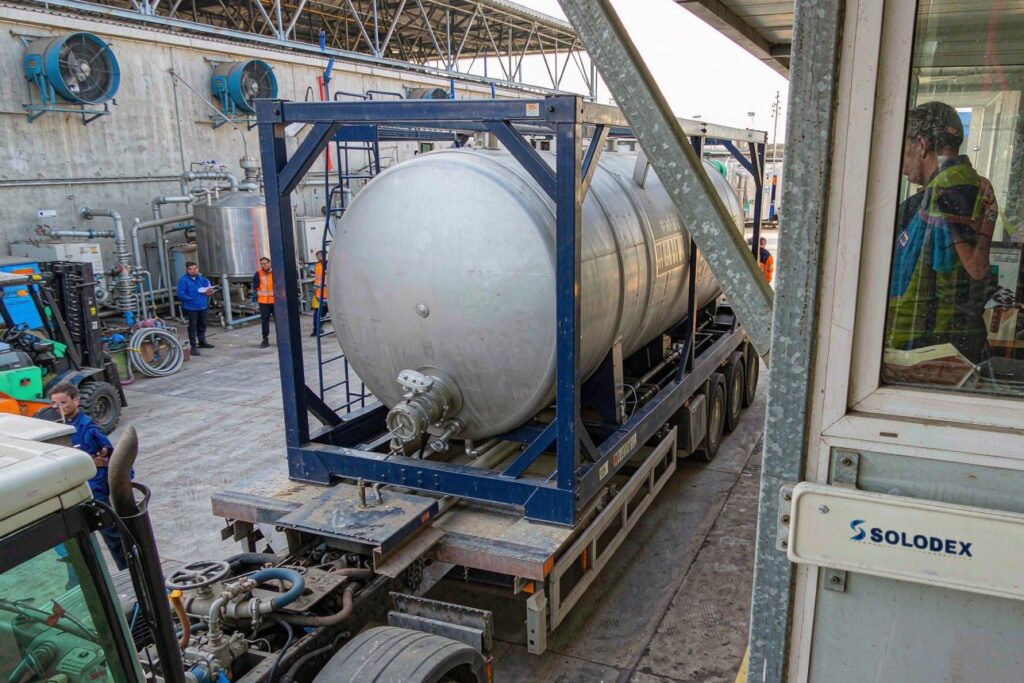
07:10 on 12 March, the outbound weighbridge printed 28,259 kg. 14:40 on 2 April, the receiver’s bridge printed 3,887 kg. 09:15 the next morning, the wash bay gate printed 3,884 kg. 16:20 that afternoon, the same wash bay printed 3,715 kg. Four tickets, one stencilled number: SXTU 730216-8.
The plate on the frame says the tank weighs 3,715 kg empty. Its capacity is 24,000 litres. So the second ticket is 172 kg heavier than the plate, the third is 169 kg heavier, and the fourth is not heavier at all. Between the second and the fourth readings, a truck carried that tank 140 kilometres to a cleaning station. Every document for the trip said it was empty. It was carrying 172 kg of water-based acrylic emulsion.
This is not an argument about whether a tank is clean. It is an argument about what was actually moving. The return leg had a driver, a booking, a gate appointment, a freight charge and a receiving signature, and the thing inside the shell changed weight at the far end of the trip. The quantity column on every sheet for that leg was blank, zero or the word nil. The only place the 172 kg exists in writing is the difference between two numbers on two tickets held by two different companies.
Four weighbridge tickets, one stencilled number
The first reading is the easy one. The tank was loaded with 23,600 litres of a water-based acrylic emulsion at a density of about 1.04 kg per litre, which gives a net weight of 24,544 kg. Add the 3,715 kg plate tare and the gross is 28,259 kg. The bill of lading quoted 24,544 kg net, one tank as the package, and the product name. A weighbridge operator at the shipper’s gate signed the ticket, and a copy went into the transport file. Nothing about that row is unusual.
Twenty-one days later the receiver pumped the tank out through the bottom valve, ran a line-clearance procedure, and had the chassis weighed again on the way off the site. The bridge printed 3,887 kg. The operator wrote “empty” in the remarks field, which was true in the sense he meant: there was no deliverable product left, the pump had drawn what it could draw, and the delivery was complete. What remained was a film on the internal surface, a pool below the valve seat and a quantity held in the discharge piping. At 1.04 kg per litre that 172 kg is about 165 litres, or seven tenths of one per cent of what had been loaded.
The third reading happened at the wash bay gate the following morning: 3,884 kg. Three kilograms had gone somewhere on the road, or the two bridges disagree by three kilograms, or a little had dried on a warm wall. Nobody investigates three kilograms. What matters is that the tank arrived at a facility whose entire business is removing what the word “empty” declined to describe. The gate ticket records the gross weight, the tank number, the time and the name of the driver.
The fourth reading came after the wash, the internal inspection and the drying: 3,715 kg. The tank now matched its own plate. That is the only moment in the whole sequence when empty meant what it says. By then the return movement was over, the residue had been turned into wash water and sludge, and the wash bay had written a receipt for 169 kg received against that tank number.
Four readings, four locations, four signatures and one number that stays fixed throughout: SXTU 730216-8. Nobody is employed to put the four tickets side by side. The shipper keeps the first, the receiver keeps the second, the wash bay keeps the third and fourth, and the carrier keeps the transport order that quotes none of them. The identity of the material travels as a stencilled equipment number, while its quantity travels as a subtraction that nobody has been asked to perform.
Where the word empty is printed
Open the return transport order and read it literally. Equipment: SXTU 730216-8, ISO tank, 20 foot. Status: EMPTY. Packages: 1 unit. Cargo quantity: nil. Description: “empty tank container, last contained water-based acrylic emulsion, uncleaned, residue approx 165 L, non-hazardous”. Freight: one empty tank movement. Destination: the wash bay named by the tank operator, not the depot the carrier would normally nominate.
Those two lines are not a clerical mistake. “Empty” in equipment language means there is no consignment to be delivered, no consignee to take delivery, and no commercial invoice behind the movement. It is a statement about the absence of a transaction, not about the absence of matter. The note underneath it says there is matter. Both are accurate, because they are answering different questions, and the form has one field for the first answer and a remarks box for the second.
The distinction is worth holding onto, because there is a neighbouring case where the same word causes much more trouble. An empty gas cylinder that last held a flammable or toxic gas keeps the classification of that gas until it has been cleaned, purged and marked to a defined standard; there the argument is about a transport class and about what has to be declared on a dangerous goods document. The emulsion in this tank is not a dangerous good and has no UN number following it around. There is no class to inherit. That removes the whole classification argument and leaves a plain physical one: something with mass was on the truck, and the quantity column says nil.
The destination field is where the device of calling it empty starts to cost something. A dry container returned after delivery goes back to a carrier-nominated depot, and that fourth movement is a normal part of the trucking product, controlled by whoever owns the box. A tank with 165 litres of uncured emulsion cannot go to an ordinary empty stack. It has to go to a place licensed and equipped to receive what is inside it. So the return instruction is not really about equipment repositioning at all. It is about where 172 kg is allowed to end up, written in the vocabulary of equipment.
A difference of 172 kilograms
The residue has no invoice, no tariff code, no purchase order, no consignee and no package count. The wash bay is not buying it. The tank operator is not selling it. The carrier is not carrying it as cargo in the ordinary sense. It has a mass, a density, a product name and a disposal route, but no document on which it is the subject of a shipment. The only way to establish that it existed at all is to subtract a number printed on a steel plate from a number printed on a ticket.
That is a very different use of a weighbridge from the one most shippers know. In a break bulk or palletised shipment the bridge produces the gross weight of each piece, and that figure is written into the manifest next to a measurement column; the two columns describe the same object in two units and are never converted into each other. Here the bridge is not describing an object that appears on a manifest. It is producing evidence that an object the manifest denies is present. The subtraction is not a quantity to be shipped. It is a quantity to be accounted for.
It also runs in the opposite direction from the bulk carrier case. A draft survey reads the hull before and after loading, deducts everything the ship itself changed, and prints the remainder as the bill of lading tonnage. There the difference is the quantity, and it is the most important number on the document. Here the difference is deliberately not the quantity. The document prints zero, and the 172 kg survives only in the gap between two weighings that no single party is required to compare.
The packages field cannot help either. A package count is an integer supplied by the container, because a liquid has no discrete objects of its own. On the return order the integer is 1, and it counts a tank, not anything in it. Write 1 IBC, 1 drum or 1 package for the heel and the form becomes false in a new way: it asserts a boundary that does not exist. The film on the wall has no outline. The only honest entries are a unit of equipment and a remark about what is stuck to the inside of it.
Three names for the same liquid
At the receiver’s plant, those 165 litres are still product. They appear as a difference between the quantity loaded and the quantity pumped into the storage tank, and they are handled as a yield variance or a line-loss figure. The plant’s material account has a name for them, and the name belongs to the language of production.
On the public road, the same 165 litres are residue attached to hired equipment. They are not goods in transit in the commercial sense, they are not entered anywhere as a commodity, and the driver’s paperwork describes the unit rather than the contents. If a small amount drips from the valve at a junction, the event will be reported as a leaking container, not as a spill of a consignment. The name has changed without anybody changing the substance.
At the wash bay gate, the same material becomes an input to a treatment process. It is weighed in, assigned to a wash method, mixed with water and recorded as 169 kg received and 1.8 cubic metres of effluent. In this trade, making something stop existing is a documented operation with a witness, a facility and a signature, not a physical event with a truck. The wash bay receipt is that document for this material. It records a service quantity, not a delivery, and it is the only sheet in the file that puts a kilogram figure next to the residue.
Three names, three ledgers, one unchanged stencilled number. No document records the moment the product became residue, and no document records the moment the residue became effluent. What connects them is the equipment number, which is why the tank number on the wash bay receipt matters more than the product description. A transposed digit there does not corrupt a description; it breaks the only chain that says what happened to the 172 kg.
Notice also that the residue has no transport instruction of its own. Nobody books 165 litres of emulsion to a treatment plant. The material travels because a tank is being repositioned, so its destination is chosen by the equipment owner for equipment reasons. If the nominated depot is not the wash bay, the substance would follow the tank to a place with no licence to receive it, and the error would look like a routine empty return. What comes back is still cargo; it is cargo travelling on somebody else’s routing decision.
Five sheets, four blank quantity fields
Put the paperwork for this one movement in a row and read down the quantity column. The result is more instructive than any individual document.
| Sheet | Quantity field | What that figure measures | Description field | Who signs it |
|---|---|---|---|---|
| Outbound bill of lading | 24,544 kg net, 1 tank | The product that was sold | Water-based acrylic emulsion, 23,600 L | Carrier’s agent at load port |
| Discharge weighbridge ticket | 3,887 kg gross, remarks “empty” | The shell plus what is stuck to it | Tank SXTU 730216-8, delivery complete | Receiver’s weighbridge operator |
| Return transport order | 1 unit, cargo quantity nil | One piece of equipment, no contents | Empty tank, last contained emulsion, uncleaned, approx 165 L residue | Tank operator’s dispatcher |
| Terminal empty release and manifest | 1 unit, 0 kg | A gate transaction, not a mass | Empty tank container, non-hazardous | Terminal or depot clerk |
| Wash bay receipt | 169 kg received, 1.8 m3 effluent | The service input, not a delivery | Tank number, residue type, wash method, inspection result | Wash bay supervisor |
| Return freight invoice | 1 empty tank movement | A charged movement | Equipment repositioning, no commodity named | Carrier’s billing department |
Five of the six quantity fields contain a zero, a nil, a unit of equipment or a freight item. Only the first contains a number that describes the emulsion as cargo. Yet the description column carries the same product name from the first sheet all the way to the fifth. The name follows the tank; the quantity does not. That is the shape of the problem, and it is visible without knowing a single regulation.
The wash bay receipt is the one sheet where a mass appears next to the residue, and it appears as a service input rather than a delivered quantity. The sheet is not wrong. It simply belongs to a different transaction, which is why a reviewer looking for a mismatch between the return order and the receipt will find nothing to compare. Zero and 169 kg are not two claims about the same number. They are answers to two different questions, printed on six sheets that were never designed to be read together.
Billed as equipment, carried as contents
The movement is priced as one empty tank repositioning. The rate is computed for a box of a certain length going from A to B on a chassis, with the usual gate and appointment events. There is no commodity, no declared value, no ad valorem component and no quantity to multiply. From the billing system’s point of view, the 172 kg does not exist.
The risk is computed the other way round. If the bottom valve weeps onto a public road, what arrives at the incident is not a box but a liquid with a name, a viscosity, a film-forming behaviour and a clean-up procedure. Somebody has to decide whether the event is a leaking piece of equipment or a release of goods, and that decision determines who is notified, who pays for the response and what the carrier’s liability is measured against. The insurance schedule was written for equipment; the exposure came from the contents.
This is not a pricing article and there is no tariff table to consult here. The point is narrower and more useful: the same movement has two different descriptions in two different systems, and the seam between them is exactly where the residue sits. One system counts a unit, the other has to cope with a substance. Neither of them has a field for “a unit with 165 litres still in it”.
The practical consequence is that the remark on the return order does real work. It is not a courtesy note and it is not a warning label. It is the only line that tells the carrier, the gate clerk and the wash bay that the two descriptions both apply to this movement. Delete it and every remaining sheet is internally consistent and incomplete. Keep it and the person at the receiving gate has a reason to weigh the unit rather than merely scan it.
Nobody is assigned to own the heel
Ask four parties who is responsible for those 172 kg and you will get four reasonable answers, none of which is the whole answer. The receiver has signed for the delivered quantity and closed the delivery; what is left in the shell is not in its warehouse. The tank operator owns the equipment and wants it back in a condition fit for its next booking; it did not order the residue. The carrier has accepted an empty unit under an equipment booking; it did not accept a consignment. The wash bay will take the material, but only once the tank is at its gate and a service order exists.
What is missing is not an owner but an instruction. No party is tasked with deciding, before the truck is ordered, where the residue goes, under which description, and who will sign for it at the other end. The equipment instruction covers the shell. The commercial documents cover the delivered product. The gap between the two is filled by habit: an empty return is booked to the nearest convenient depot, and the tank is dealt with when it gets there.
That habit survives because almost nothing goes wrong. The volumes are small, most products are benign, and the wash bay is often on the same industrial estate as the depot. It stops working the moment the nominated destination cannot lawfully or physically receive what is inside, or the moment the residue has a classification, an odour, a value or a disposal code that somebody cares about. At that point the question is not who owns 165 litres. It is why a routing decision about a steel frame was allowed to decide the destination of a liquid.
The chain of custody is therefore an accident of the equipment number rather than a plan. The tank number is the only identifier that appears on the bill of lading, the discharge ticket, the return order and the wash bay receipt. It is doing the work that a consignment reference would normally do, without ever having been issued as one.
The wash is where empty is made
There is a small reversal hidden in the four tickets. On 2 April, at 14:40, the word “empty” was written for the first time, and the bridge at that moment printed 3,887 kg. On 3 April, at 16:20, the tank finally matched its plate, and nobody wrote “empty” anywhere, because that sheet is a cleaning record. The word was used when it was least true and retired when it became true.
So empty is not a state observed at discharge. It is a result produced at a facility by a process, evidenced by a reading that returns to the tare. Until the fourth ticket exists, the return leg has been carrying a substance, and the only accurate description of the movement is the one in the remarks box: a unit of equipment with a named residue attached.
That fourth ticket is also where the next shipment begins. A tank operator will not release the unit to a new booking until the wash record is in the file, and the next shipper’s question is a different one entirely: whether the name of the cargo that just left, and the way the shell was cleaned, make the tank acceptable for what is about to go in. Here the record is an endpoint; there it is a starting condition. One piece of paper closes a movement and opens an eligibility decision, which is why the tank number on it matters more than the signature.
The other unpackaged liquids take a different route home. A flexitank leaves behind a disposable bladder as well as a borrowed dry box, and the two physical things go to different places with different paperwork. The bladder can be weighed, folded and sent for disposal as an object. A film on the inside of a steel shell cannot be picked up, counted or handed over. It can only be washed out, which is why this particular “empty” has to be manufactured rather than declared.
When the last reading is not the tare
Three variations on the same four tickets show what to look for, and each one needs only the sheets already in the file.
First, suppose the post-wash ticket reads 3,742 kg instead of 3,715 kg. Twenty-seven kilograms of baked-on film or liquid held in a heating coil has survived the wash. The tank is again not at its plate weight, and the return movement that was closed on paper is still open in fact. Compare the wash receipt against the outbound tare, not against the gate ticket. A file that only records the gate weight will never notice.
Second, suppose the wash bay gate reads 3,902 kg, fifteen kilograms heavier than the receiver’s discharge ticket. Either the tank was opened and something was added, or rinse water was left in it, or one of the two bridges is out by fifteen kilograms. All three are ordinary. None of them is visible if the return order says nil and nobody compares two consecutive weighings. The comparison is between the second and third tickets, and it belongs to the dispatcher who booked the move, not to the wash bay.
Third, suppose the wash bay receipt reads SXTU 730216-8 on one line and SXTU 730261-8 on another, a single transposition in a long stencilled code. The 169 kg has been received, the wash has been done and the effluent has been treated, but the record now points at a different tank. The next booking will inherit a cleaning history that belongs to another shell. This is a string comparison between the return order, the gate ticket and the receipt, and it takes a minute.
None of these checks requires a new form. They require somebody to read the quantity fields that were left blank, the tare that is stamped on a frame, and a remark that was typed as an afterthought. The number that decides each case is a subtraction, and a subtraction needs two documents in front of the same person.
What to read before the return is booked
The order of operations is short. Weigh the unit after discharge and put the gross on the ticket, not just the word empty. Subtract the plate tare before the truck is ordered, and write the resulting figure into the remarks field of the return transport order together with the product name and the words uncleaned residue. Then check that the destination on that order is a facility that can actually receive it, and that its tank number matches the discharge ticket. At the far end, read the wash bay receipt for the received mass and the final tare reading, and keep the four tickets together under the same equipment number.
Those three fields are the whole control: the weighbridge difference, the return order’s residue clause, and the wash bay receipt’s tank number and received quantity. They sit on three sheets issued by three parties, and no form asks anybody to reconcile them. Writing 172 kg into a remarks box does not turn the residue into a commercial consignment and does not create a package. It does something simpler and more valuable: it gives the return leg a content statement that can be checked at the gate, so that the movement is no longer described by a word that was true only about the transaction and false about the tank.
The same discipline answers the routing question that nobody owns. Once the residue has a number and a name on the return order, the destination stops being a purely equipment decision. A depot that cannot receive it becomes visible as a mismatch before the truck leaves rather than as an incident after it arrives. The shell is still being repositioned. It is simply no longer reasonable to pretend that nothing is being carried.
This is the last of the cases where a liquid has no boundary of its own. On the way out the boundary was lent by a tank, and the paperwork recorded the loan as one package, a net weight and a product name. On the way back the loan has not been fully returned: a film, a pool and a valve full of the same product are still inside the borrowed wall. They have mass, they have a name, they have a destination chosen for them and a receipt signed at the end. They have no quantity column, which is not the same as having no quantity.
What comes back is still cargo. The boundary was borrowed, and on the return leg the borrowed thing still has something inside it, travelling under a word that describes a transaction rather than a tank.
A partial collection leaves a residue on the shelf just as a returned tank leaves a residue inside; the accounting rule is in empty tank return residue.


