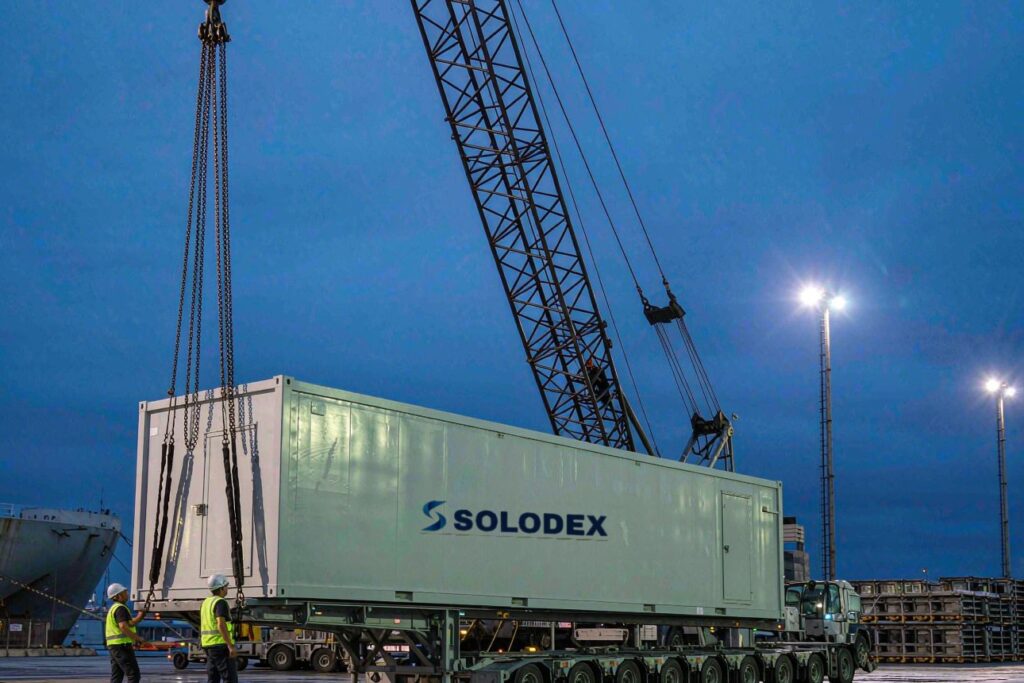
The unit was quoted as a twenty-foot container, and it was one: the same footprint, the same corner castings, the same twistlocks, the same slot on the same ship. Every dimension was inside every envelope. It was refused three times in a week, by three parties, for three different reasons, and not one of them was about size.
It weighed thirty-four tonnes.
This is the opposite problem to the one a genuinely oversize piece of cargo presents. That article is about things that do not fit: too long, too wide, too tall, and the whole chain has to be redrawn around them. This one fits everywhere and still cannot travel, because at thirty-four tonnes it is no longer cargo. It is a container-shaped object that is heavier than a loaded container is allowed to be.
The number nobody puts in the quote
A standard twenty-foot general purpose container has a maximum gross mass of 30,480 kilograms. Subtract its own tare of roughly two and a quarter tonnes and the payload lands near twenty-eight tonnes. That figure is not a shipping line’s policy; it is the rating stamped on the safety approval plate, and it is the number every crane, spreader, chassis, stack and lashing calculation downstream is built on.
A containerised battery storage unit of the kind now being installed at substations and solar farms is commonly between thirty and thirty-eight tonnes, because the cells are the density. It is, in other words, heavier than the maximum gross of the box it appears to be – and that sentence contains the whole problem.
The consequence is subtle and it is where quotations go wrong. The unit is not cargo inside a container. The unit is the cargo transport unit: its frame carries the load, its castings take the spreader, its own plate is the one that matters. Which means it is not being shipped under the container system’s rules at all. It is being shipped as a heavy indivisible object that happens to be container-shaped, and every party in the chain has to agree to treat it that way.
There is a dangerous goods entry written for this object
Lithium batteries have three familiar entries: cells and batteries on their own, batteries packed with equipment, and batteries contained in equipment. None of them describes a shipping container with a megawatt-hour-scale battery built into it, which is why a fourth entry exists – lithium batteries installed in a cargo transport unit, usually quoted as UN 3536.
What makes it unusual is that it has no packing instruction, and cannot have one. A packing instruction tells you what to put the goods in. Here the goods are already in the only packaging they will ever have. The requirements therefore attach to the unit itself: how it is marked and placarded, what state of charge it may be in, what the fire suppression system has to be, and what the shipper has to declare about all of it.
That last point is where a storage unit differs from a shipment of cells. A battery shipment is a quantity of energy in packages. A storage unit is a piece of electrical infrastructure that has been tested, commissioned at the factory, and switched off for the journey. The declaration has to describe the infrastructure, not just the chemistry.
State of charge is a decision, not a specification
A charged battery carries its energy with it, and the energy is the hazard. So the state of charge at which a unit travels is a negotiated number: low enough that a thermal event is less likely and less energetic, high enough that the unit arrives able to be commissioned without a charge cycle the destination may not be able to provide.
Thirty per cent is the figure that appears most often in carrier acceptance criteria for units shipped as batteries, and it is not universal. What is universal is that the number has to be agreed before the unit is switched off, because it is set at the factory, recorded, and then verified – by a reading, in writing, at the point of loading. A unit that arrives with a state of charge nobody can evidence is a unit that a surveyor will treat as undeclared.
The switch is the other half of the misunderstanding. Switching a unit off does not remove the energy, and it does not make the unit non-dangerous. It isolates the output. The cells inside are at whatever charge they were left at, and the fire suppression system is still armed or still pressurised, depending on its design – and in some configurations that system is its own dangerous goods entry, declared separately from the battery.
Four links in the chain that each say no
The refusal is not one decision. It is four, taken by four parties who each own a different limit, and a booking only survives if all four say yes.
| Who | What they are checking | Why thirty-four tonnes fails | What actually resolves it |
|---|---|---|---|
| The shipping line | Stowage position, stack weight, lashing, and its own dangerous goods acceptance policy | The unit cannot go in a normal slot; a stack is designed for boxes of a rated gross mass, and a heavy unit goes low and under deck or not at all | A named stowage position agreed before booking, not a slot number |
| The terminal | Spreader capacity, crane safe working load at radius, and the ground under the wheels | Container spreaders and their frames are rated for container gross mass; a unit over that rating needs a different lifting plan | A lift plan that names the gear and the rated capacity, agreed with the terminal |
| The road | Axle loads, gross train weight, and the permit regime | A thirty-four tonne unit plus a tractor and trailer is well past a normal permitted gross, and past most bridge formulae | An abnormal load permit, a route survey, and often a night movement |
| The destination | Grid connection approval, product certification, and commissioning | Not a transport limit at all – but the unit cannot be energised until the local operator has approved it as a type | Certification in the destination market, obtained before the unit ships |
Read the third column downwards and the pattern is clear: three of these are about the same physical fact and one is about a piece of paper that takes longer than the voyage. The certification in the last row is routinely the critical path, and it is the only one of the four that cannot be accelerated with money.
What a dent costs
For most cargo, damage is a negotiation about percentage. For this cargo it is closer to a binary.
A cell that has been shocked, dropped, or tilted beyond the manufacturer’s limit cannot be inspected back to certainty. You can look at the enclosure, you can photograph the corner casting, you can run a insulation test – and none of it tells you what happened to the separator inside a cell that took a four-tonne impact through the frame. So the manufacturer’s position is generally that a unit which has been dropped, or which shows impact damage to the frame, is not warrantable, whatever the tests say afterwards.
Which is why the insurance on these shipments is not a cargo policy in the ordinary sense. It is a project cargo placement, priced on a load-out survey, a method statement and a lift plan – the documents that say how the unit will be handled before anyone knows whether it will be handled well. Lashing and bracing matter, but they are the small end of it: the bigger exposure is the twenty minutes when the unit is in the air.
Why the quote looks reasonable and the shipment still fails
A rate for a twenty-foot container is a rate for a slot, and slots are priced per box on a service that assumes boxes of a normal weight. The storage unit is quoted that way because it looks that way, and the quote survives right up to the point where somebody reads the gross mass.
Then the surcharges arrive, and they are not surcharges on the freight. They are a different service: heavy lift, a named stowage position, a permit, an escort, a survey, and a terminal that has to schedule a crane differently. Terminal charges for that are not per box, and if the unit misses its slot the daily cost of waiting is measured against the value of a power station component, not a container of goods.
None of this is a reason not to ship. It is a reason to have the conversation in the right order: the weight first, then the stowage, then the gear, then the road, then the certificate – and the freight rate last, because it is the smallest number in the file.
Six questions before the unit leaves the factory
What is the gross mass, on the plate, with the suppression system filled? Not the design mass, not the shipping mass in the brochure. The weighed figure, with everything that will be inside the frame when the crane lifts it.
Which entry is this unit declared under, and what does the carrier’s acceptance policy say about it? The entry may be UN 3536; the carrier may still have its own conditions, and those conditions are the ones that will stop the booking.
What state of charge, and who will read it at loading? Agreed, set, recorded, and verified in writing at the gate.
Which stowage position, and has the line named it? A booking confirmation that does not name a position is a booking that has not been accepted for this unit.
What lifts it, at both ends, and what is the gear rated for? Including the ground the crane stands on and the trailer that takes it away.
Is the destination certification in hand, or in progress? Because that is the one item that decides the date, and the ship’s schedule does not wait for a grid operator.
A container that is not a container
Everything about this object is designed to make it look ordinary: it sits on a chassis, it goes through a gate, it stacks, it has corner castings and a plate. The resemblance is the trap, because the container system is a set of assumptions about mass, and this unit is outside them by design rather than by accident.
Which is why the useful way to describe it is not “a container with batteries in it”. It is a substation that has been built into a frame so that it can be lifted – and the frame is there for the crane, not for the ship. Once that sentence is in the file, the stowage position, the heavy lift quote, the permit and the survey all follow from it. While it is still a container in the paperwork, every one of them arrives as a surprise, in the week the unit is already at the gate.
Both categories are stopped by a permission rather than a rate: a storage unit needs a stowage position, a car needs a plate, and neither is issued by the seller.
Both categories are decided by what is sealed inside the equipment: energy in one case, a flammable gas in the other, and neither is visible from the carton.
A box that exceeds its rated gross mass is refused as equipment; without the box, the cargo reports both weight and measurement to the ship.
A battery container brings its own mass, classification and approval plate; the stack calculation wants only its verified mass and tier, and then checks the column in three directions.