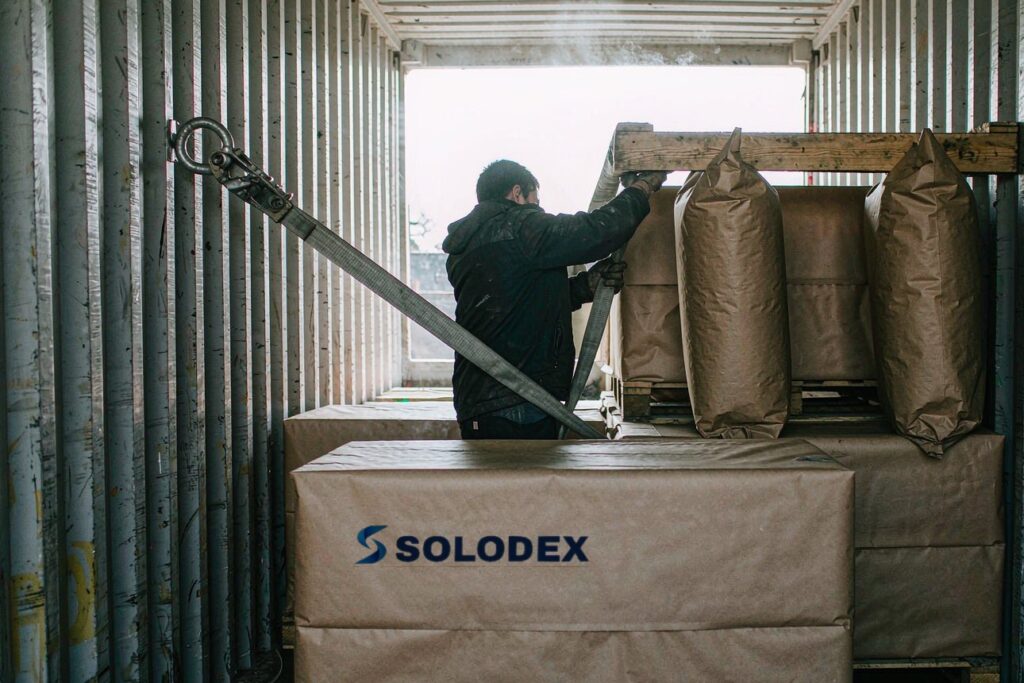
The load that arrived as a pile
The doors opened and the front two rows were on the floor. Everything behind them was exactly as it had been loaded — same stack heights, same spacing, same straps. The forwarder’s first comment was that the cargo was heavy, so it could not have moved on its own.
It can, and the weight has nothing to do with it. A heavy object needs a large force to accelerate it, and the force available is proportional to its mass, so mass cancels. What moves cargo is acceleration, and at sea the acceleration does not care how much the box weighs.
That is the mental switch this article is about. On a loading dock, cargo stays put because nothing is pushing it. On a ship, cargo is being pushed continuously — sideways, lengthways, and up — and the only question is whether something is there to stop it.
Weight is not the force
A ship at sea does three things at once: it rolls, it pitches, and it rises and falls. Each of those produces acceleration at deck level, and the accelerations add. In the design guidance used for securing cargo, the figure that matters is often quoted in the region of half a g laterally — meaning a sideways push equal to half the cargo’s own weight, applied repeatedly, for days.
Half a g sounds violent, and in a storm it is. But the more important point is that it is not a rare event. A vessel rolling ten degrees every twelve seconds produces a continuous sideways acceleration, and a container stacked eight tiers high at the outboard end of a bay experiences it amplified by the ship’s own motion.
So the right question is never “will this move?” It is “what is holding it, and how much can that thing hold before it stops holding?”
Where the force arrives first
Two places in a container do most of the damage.
The door end. Cargo loaded last sits nearest the doors, and it is the only cargo with nothing in front of it. Under longitudinal acceleration — pitching, braking on a chassis, a hard shunting impact at a rail terminal — it moves toward the doors with a clear runway. When the doors open, it falls out. This is why the last two metres of a container deserve more attention than the first ten, and why they usually get less: by then the loader is tired and the container looks full.
The top of a stack. The higher a carton sits, the larger the arc it travels when the ship rolls, and the more energy it carries when it arrives somewhere. A tall stack that is stable standing still becomes a lever under acceleration. This is the argument for keeping the centre of gravity low, and for not filling the last half metre of height with whatever fits.
Three tools, three different failures
Almost every securing method in a container is one of three things, and each fails in its own way.
Dunnage bags. An inflatable paper bag wedged into a gap, pressing against both surfaces. It works by contact area: the force it can resist is the pressure inside multiplied by the area touching the cargo. Its failures are specific. It gets punctured by a carton corner or a staple and deflates slowly, so it is flat by the time anyone looks. It is placed at floor level, where it does nothing about the load tipping. Or it is inflated against a surface that cannot take the pressure — a single layer of cartons bows and the bag walks out of the gap.
Timber bracing. Boards nailed across or against the load. Timber is strong in compression and weak in tension, so it works when it is being pushed into and fails when it is being pulled away. A brace is only as good as its ends: nailed into a container’s plywood lining, it will pull out; cut to bear on the corner posts or the floor cleats, it holds. It also has to be cut to the actual gap — a brace that is 20 millimetres short is a brace that is not there.
Lashing straps. Webbing or steel, tensioned between the cargo and the container’s lashing points. Straps work in tension and are the only one of the three that can stop something lifting. Their efficiency depends almost entirely on the angle: a strap running nearly vertical holds down well but resists sideways movement poorly; a strap at 45 degrees is a compromise; a strap hooked to a point directly above the load does nothing at all against horizontal force. And a strap over a sharp edge will chafe through in a way that is invisible until it happens.
The gap is the enemy
All three tools exist for one purpose: to remove the distance a load can travel before something stops it. Cargo that is touching its neighbour cannot accelerate into it. Cargo with 15 centimetres of air in front of it will use all 15 centimetres.
Which is why “the container was full” is not the same statement as “the cargo was secured”. A container can be full of cartons that are each free to move a hand’s width, and the sum of those hand’s widths is a collapsed stack at the door.
Friction helps and cannot be relied on. Carton against carton is roughly a third of the load’s weight before it slides; timber on a steel floor is similar. Half a g exceeds both, which is precisely why the design guidance exists: in any seaway worth the name, friction alone is not a securing method.
Height, weight and the centre of gravity
Two numbers decide how violent the voyage will be for your cargo, and both are set at the loading plan.
How high the weight sits. A container loaded to the roof with light cartons and a container loaded to half height with dense ones can weigh the same and behave completely differently. The tall one has a high centre of gravity, so the same roll produces a larger moment at the base of the stack, and the outboard corner takes a load it was never designed for.
Where the weight sits along the length. Concentrating mass at one end raises the load on that end of the chassis and on the crane’s spreader, and it changes how the container behaves in a seaway. The practical rule is boring and correct: heavy cargo low and spread, light cargo on top, and the last row treated as the one that has to survive on its own.
Who is responsible for the stow
In a full container load, the shipper loads and the carrier carries. That division matters more than it looks, because the carrier’s obligation to load, stow and discharge properly applies to what the carrier actually handles. When you fill and seal the box yourself and hand over a container that is already closed, you have taken the stow — and the securing — into your own hands.
This is not a technicality to be argued after a loss. It decides what evidence matters. If the cargo was secured by your loading crew, a claim has to show that the securing was adequate for the voyage, which means the loading plan, the materials used and the photographs taken at the door. If it was secured by a third party at a consolidation warehouse, the question becomes who instructed them and against what specification.
Either way, the answer is written down before the doors close or it does not exist. Risk in transit is allocated by the contract; the evidence that the risk was managed is allocated by whoever remembered to photograph the load.
Five ways a secured load still moves
The table is the short version. The middle column is what the person opening the doors will see.
| What was done | What it protects against | How it fails |
|---|---|---|
| Dunnage bags in the gaps | Longitudinal and lateral movement of the stack | Punctured, under-inflated, or placed at floor level where it cannot stop tipping |
| Timber brace across the load | Movement toward the doors | Nailed into lining rather than bearing on posts; cut short; loaded in tension |
| Straps to lashing points | Vertical movement and tipping | Wrong angle, chafed edge, or tensioned over a carton that compresses in transit |
| Friction alone | Nothing, once acceleration exceeds about a third of a g | Silently — it looks like a well-loaded container |
| Nothing at the door end | Nothing | The first two rows arrive on the floor |
Five minutes at the door
The last check is short enough that there is no excuse for skipping it, and it is done with the doors still open and daylight on the load.
Push the top carton of the last row sideways, hard. If the whole stack moves, the securing is decorative. Look at the gap between the load and the doors: if a person can stand in it, so can the cargo. Check that every brace end is bearing on structure and not on lining. Check that every strap runs to a real lashing point at a useful angle, and that nothing sharp is under it. Then photograph the load, the door end and the seal number in one frame, because that photograph is the only record that will exist.
The cartons and pallets were decided weeks earlier. This is the last five minutes in which anything can still be changed, and it is the five minutes most often spent waiting for the seal.
The long pole is the loading plan
Securing is not a thing you add at the end; it is a consequence of how the container was filled. A load plan that leaves a metre at the doors, or that stacks dense cargo to the roof, has already decided that the securing will be difficult. A plan that fills front to back with the heavy goods low and the gaps closed as it goes has decided the opposite, and needs less material to finish the job.
That is why the useful conversation happens before the first pallet goes in, with three questions: what will stop the last row, what will stop the top layer, and what will hold the middle when the ship rolls for six days. If those three answers are “a bag”, “nothing” and “friction”, the load is not secured — it is merely loaded, and the plan said so from the beginning.
A securing method is also a document: the loading plan and the door-end photographs are what answer an allegation of insufficient packing.
Inside a box the lashing is a precaution; on a flat rack it is the only structure there is: no walls, no roof, and lashing points rated for a direction.
Some loads have to stay upright for a reason the lashing cannot fix: a wet battery vents hydrogen and spills acid if it goes on its side.
Bracing answers the sideways acceleration of a ship at sea; a flexitank adds a sideways pressure that is already there while the box stands still in the yard.
Keeping the centre of gravity low inside one container protects the stack from the roll; the vessel repeats that calculation at a larger scale, where the height of the whole box above the keel becomes the second column.


