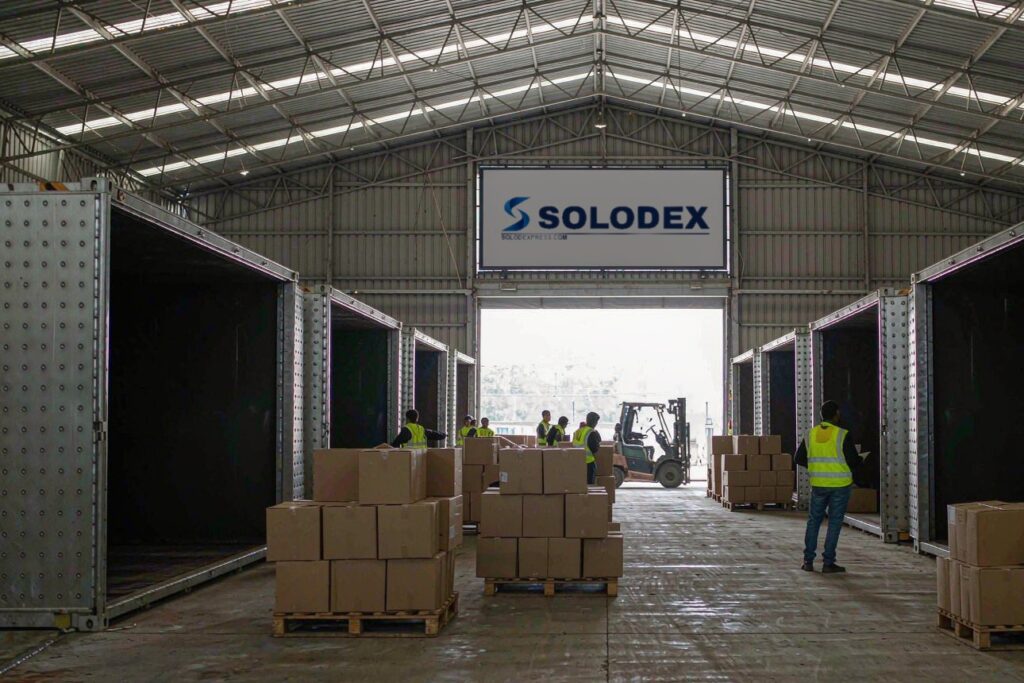
In the tracking portal it is one line of text: exam required. No further detail, no estimate, no explanation. That single line can mean an image taken and filed within a day, or a container emptied onto a warehouse floor and a sample sent to a laboratory for three weeks, or a case file opened against the consignee with the cargo held as evidence.
Four completely different procedures announce themselves with the same four words. The slowest is roughly forty times the fastest, the most expensive can cost more than the freight, and one of them is not a clearance step at all — it ends clearance. Knowing which one you are in is the difference between a phone call and a lawyer, and the notification never tells you.
Four procedures, not four levels
People talk about exams as if they were grades: a light one, a heavier one, a bad one. They are not ranked that way, and the intuition leads to the wrong reaction. Each procedure answers a different question, using a different method, and the answers are not interchangeable.
| Procedure | The question it answers | Method | Typical duration | Who pays |
|---|---|---|---|---|
| Non-intrusive inspection | Does the density profile match the declaration? | X-ray or gamma imaging of the closed box | 1–2 days | Terminal scanning fee, usually small |
| Tailgate | Does what is visible look like what was declared? | Doors opened, first rows inspected | 2–4 days | Importer, via the terminal |
| Full devanning | Is every carton what the entry says? | Container emptied and counted at a CES | 5–10 days | Importer, $300–1,500 plus drayage |
| Laboratory analysis | What is this material, actually? | Sampling and testing against a standard | 2–6 weeks | Importer, plus storage for the whole period |
| Seizure and enforcement | Is this a violation? | Case file, hold, administrative or criminal process | Months | Nobody — the cargo stops being cargo |
Read the last row against the others. The first four are things customs does to a shipment it intends to release. The fifth is customs deciding that the shipment is not a shipment any more, and from that moment the delivery schedule, the free time and the demurrage clock all become irrelevant to the thing you actually care about. That is a very different ending from the one described in the six handovers after discharge, where every problem is still a scheduling problem.
The image is what gets read, not the cargo
Non-intrusive inspection produces a greyscale image of a steel box full of unknown material, and a trained officer reads that image rather than the cargo. The consequences are not obvious from the outside, and they explain a lot of selection patterns that shippers find arbitrary.
Imaging systems colour by density and by effective atomic number, which means two completely different products can produce the same signature and one product can produce a signature that looks wrong for reasons unrelated to its declaration. A pallet of the same carton, stacked square, produces a clean repeating pattern an officer can clear in seconds. The same goods loaded loose, with gaps, with a pallet of something denser in the middle and a void at one end, produce an irregular profile that looks like an anomaly — and the anomaly is what triggers the next stage.
So the first useful rule is not about paperwork at all. Load the container so that its density profile is boring. Uniform stack heights, no unexplained cavity, no heavy item sitting alone at the far end, and the declared weight within a few percent of what the image suggests. A box that scans predictably has a much shorter path through the terminal than a box that scans strangely, even when both are perfectly compliant.
It is also worth knowing what imaging cannot do, because it sets a ceiling on how much a good scan can save you. It cannot read a label, and it cannot separate two materials of similar density packed together. Anything that turns on a document or on chemistry will leave the imaging lane and enter a slower one.
Opening the doors: tailgate and full devanning
Opening the container is a different kind of event. In a tailgate inspection the doors are opened and the officer looks at what is immediately visible — the first row or two, the blocking and bracing, the carton markings. It is fast because it is shallow, and it is defeated by depth, which is exactly why the next step exists.
A full devanning moves the container to a designated examination station, empties it, and reconciles the contents against the entry line by line. This is the procedure that produces the invoices people remember, because the cost is not the examination itself. It is the round trip for the container on a chassis, the handling at both ends, the labour to empty and reload, and the storage that accrues for every day the box is out of the terminal but not yet released.
Two things follow that shippers rarely plan for. First, the free time does not pause. The container is out of the terminal, so terminal storage stops — but detention starts, because the box is now outside on wheels, and the daily rate after free time is usually the most expensive number in the whole chain, as the two separate clocks make clear. Second, repacking is your problem. What comes out has to go back in, and a container that was packed at the factory with a loading plan very rarely goes back together the same way.
Practically: ask whether the examining station is on-dock or off-dock before you agree to anything, and ask who is arranging the drayage. An off-dock station on the wrong side of a port complex can add two days of driving to a procedure that the notice described in one line.
Sampling: when the question is chemical
Some questions cannot be answered by looking. Whether a powder is a food additive or an industrial chemical, whether a textile contains a restricted dye, whether a toy’s plasticiser content is inside the limit, whether a food contact surface releases lead — all of these require a sample and a laboratory. The last of those four is the one that catches kitchen and tableware importers, and the material-by-material testing it implies is priced per surface, not per SKU. And a laboratory does not work to the rhythm of a port.
The structural difference from the first three procedures is that the outcome is not binary in the same way. An image is clear or it is not. A tailgate is clean or it is not. A laboratory produces a number, and that number is compared against a threshold, and the comparison can go three ways: conforming, non-conforming, or requiring a second sample because the first was inconclusive. Only the first of those ends with your cargo moving.
A non-conforming result does not usually mean a resubmission with better paperwork. It means the goods cannot be released into the market as declared, and the options narrow quickly to re-export or destruction — and destruction is a service with a fee, performed under supervision, on a timeline you do not control. Storage for the entire period is billed to you as well. This is the case where the arithmetic of waiting stops being about demurrage at a hundred or two hundred a day and starts being about the whole consignment.
Which is why the sampling category deserves respect out of proportion to its frequency. If the product is food, a supplement, a cosmetic, a chemical, or anything children put in their mouths, assume the possibility of a laboratory question and have the composition data and the test reports in a folder before the container sails, not after it is held.
Seizure is not an exam
The word gets used loosely, and the looseness is expensive. A seizure is not a thorough examination. It is the point at which the goods change legal status: from merchandise awaiting release to evidence or to the subject of an administrative penalty. The customs procedure you were following stops, and a different procedure begins, with different rules, different timelines and different people.
Three practical consequences follow immediately. The carrier is still entitled to its freight and still wants its container back, so the commercial clock keeps running even though the customs clock has stopped. The forwarder’s ability to act is reduced to filing documents, because the decision-maker is no longer the officer at the terminal. And the outcome is not a delay but a liability: assessed duty, penalties, and in serious cases a record that follows the importer of record into every future entry.
The distinction matters because the response is completely different. For the first four procedures the correct response is operational — chase the appointment, arrange the drayage, get the documents in. For the fifth the correct first call is not to the forwarder but to someone who does customs law in that jurisdiction. Treating it as an exam is the single most common way a manageable problem becomes an unmanageable one.
Who pays, and why the free country is the expensive one
Nearly every jurisdiction puts the cost of examination on the importer, but the mechanics differ enough to change behaviour, and one widely held belief about this is backwards.
| United States | European Union | China | |
|---|---|---|---|
| Examination fee charged by customs | No direct fee for the examination | Varies by member state, usually a modest flat fee | No fee; inspection is free of charge |
| Where the cost actually lands | CES handling plus drayage, $300–1,500 | Terminal handling and storage | Terminal storage, devanning labour, re-stuffing |
| Who arranges the move | Importer or broker, to a bonded CES | Customs designates, terminal executes | Terminal, under customs supervision |
| Realistic delay | 3–10 days | 2–7 days, longer for agriculture or food | 2–7 days, longer if sampled |
China does not charge for the inspection itself, and that fact is repeated as if it were good news. It is true and it is misleading. The free inspection still requires the container to sit at a terminal, still requires workers to open and empty it, still requires it to be closed again, and every hour of that is billed by someone who is not customs. The examination is free; the examination event is not.
The mirror image is the United States, where the examination is performed at a centralized station by a private operator who charges for it, and the container has to be trucked there and back. The invoice is explicit and larger, but at least it is an invoice. The Chinese version arrives as a cluster of small charges — storage, handling, a re-stuffing fee nobody quoted — which is harder to forecast and harder to dispute.
Six reasons a box is selected, and which ones you control
Selection feels random because the reasons are not published per shipment. They are not random, though, and they divide cleanly into things you can influence and things you cannot.
| Reason | What it looks like | Controllable |
|---|---|---|
| Random selection | No pattern at all, clean history | No |
| Risk score on the lane | Origin, routing and commodity combination | Partly — routing and consolidation choices |
| Document discrepancy | Value, weight or description disagreeing across the set | Yes, entirely |
| Description too broad | “Parts”, “gifts”, “samples”, “accessories” | Yes, entirely |
| Importer history | Prior findings, unpaid duty, no bond | Yes, over time |
| Intelligence or tip | Specific, and you will never see it | No |
Two of the six are entirely within your control, and they are the two that most often turn a random look into a long one. A description that cannot be classified forces an officer to open the box to find out what it is — the examination is not a punishment for a vague description, it is the only way to proceed. The word “gift” is the worst of the set, and what it triggers is a documentary problem that escalates into a physical one. A value that does not match the weight, or a weight that does not match the bill of lading, is a discrepancy that has to be resolved physically — which is why the invoice and packing list agreeing with each other is cheaper than any broker’s fee.
The importer history line deserves a note of its own, because it is the slowest to build and the fastest to lose. A consignee with years of clean entries and a valid bond is processed with a presumption that is invisible until it is gone. One finding — an undeclared item, a value that was adjusted after the fact, a restricted good that slipped through — resets that presumption for every future shipment, and no broker can restore it for you.
The first 72 hours after the notice
What happens in the first three days sets the cost, and almost none of it is customs work.
- Identify the procedure, in writing. Not “it’s been examined” — which of the five above, where, and who is performing it. The answer determines everything else and it is one question to the right person.
- Find out whether the free time pauses. In most systems it does not, and the answer decides whether you are buying days or buying hours. If the container leaves the terminal for an off-dock station, the expensive clock has already started.
- Book the drayage yourself or confirm who has. The most common avoidable cost in a full devanning is a container that sat an extra two days because nobody owned the truck.
- Send the documents before they are asked for. Commercial invoice, packing list, the classification reasoning, and any certificate that speaks to the specific question. An officer who has the file resolves it in one pass; an officer waiting for a file resolves it in three.
- Photograph the repacking. If the box is emptied, you will need to know how it went back, and the examination station will not keep a record for you.
None of this shortens a laboratory result or argues with a case file. It does something narrower and more useful: it keeps an inspection from becoming an inspection plus a storage bill plus a repacking dispute. The four words in the portal are unavoidable. What happens in the seventy-two hours after them is mostly a matter of who is paying attention.
Different examinations look at different things, from papers to the box itself; a corrected field that is also a shipboard key is the case where the papers and the physical arrangement both have to be right.


