There is a sentence that causes more trouble than any other in this business: “we already have someone in China.” It is usually true, and it usually means something narrower than the person saying it thinks. It means there is someone who can find the factory, agree a price and get the goods made. It does not mean anyone has arranged how the goods will leave.
Sourcing and freight are two professions that meet at a single point, and almost every problem in a first import lives inside that point. This piece is about where the seam is, what has to cross it, and why the handover fails even when both sides are competent.
Two jobs, and the line between them
The confusion is understandable, because both parties describe themselves with words like “supply chain” and both will quote you a delivered price. But the work is different, and the incentives are different.
| Sourcing side | Freight side | |
|---|---|---|
| Core question | Who makes this, and at what price | How does it get there, and what does the border cost |
| Success looks like | Right product, right spec, right factory | Right documents, right routing, no surprises at arrival |
| Paid by | Commission or margin on the goods | Freight, handling, clearance fees |
| Fails when | The factory cannot hold the spec | The paperwork does not match the goods |
| Knows most about | Product, process, factory capability | Carriers, codes, ports, customs practice |
Neither party can substitute for the other, and the reason is knowledge rather than size. A sourcing agent who has spent years in automotive diagnostics knows which factory’s calibration tooling is worth the money. They do not necessarily know that the same product’s battery ships under a different regime than the tool it powers. A forwarder knows the second thing and has never opened a calibration tool.
Five things that have to cross the seam
When an order moves from the sourcing side to the freight side, five facts decide whether the shipment goes smoothly. All five are established long before anyone books anything, and four of them are frequently established by accident.
One: the trade term, and who it binds. FOB, EXW, DDP and the rest are not price labels, they are risk allocations, and the difference between two similar-looking terms can move an entire customs obligation from one party to another. An agent quoting DDP on your behalf has taken on the role of importer in your country, which is a legal position, not a service tier.
Two: what the goods actually are, in the language customs uses. “Drone motor” is a description. The classification behind it is a code, and the code decides duty, inspection and sometimes whether a licence is needed at all. This is where a control question can appear on a product nobody thinks of as sensitive — a magnet inside a motor inside a machine is the standard example.
Three: the numbers on the packing list. Carton count, dimensions, gross and net weight, and how the goods are packed. These are not administrative — they decide the freight rate, the container plan and whether the load actually fits. A sourcing agent who packs to protect the product and a forwarder who needs to know the pallet height are optimising different things.
Four: the inspection record. If someone inspected the goods before shipment, the report exists, and it is the only document that describes the condition at handover. Without it, every later claim starts from a dispute about what left the factory.
Five: who owns the goods in transit. This one is answered by the trade term and by the invoice, and it is the one most often left ambiguous — which matters at exactly the moment a claim has to be filed.
What a specialised sourcing partner actually looks like
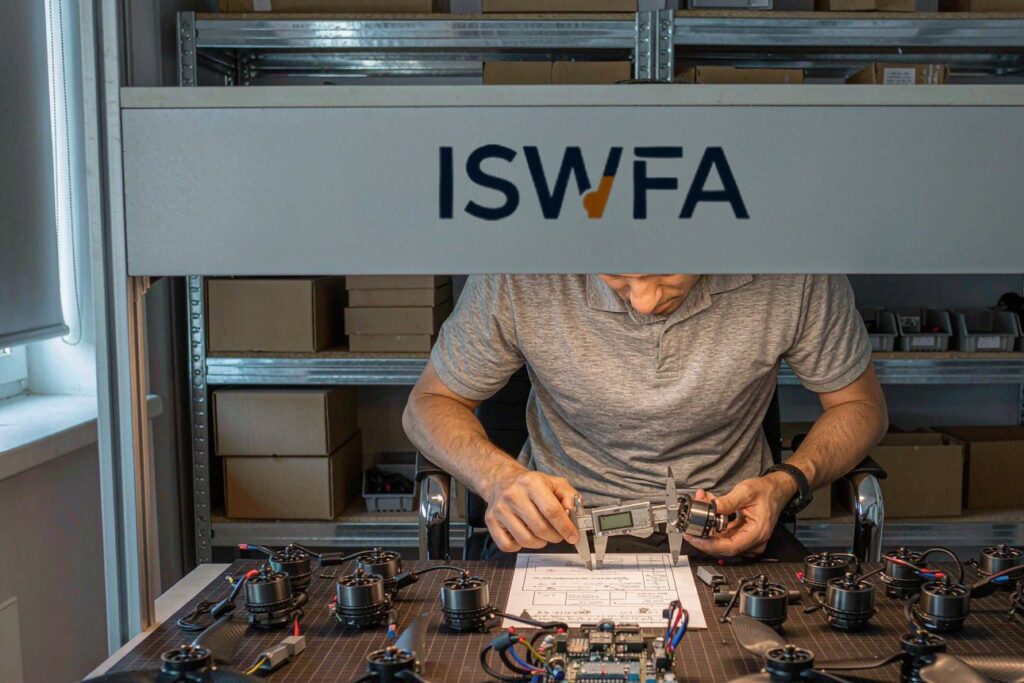
The abstract version of this is easy to write and hard to find. So it is worth describing a concrete example: ISWFA — “I Source With Factory Access” — is a sourcing operation working across three verticals: automotive aftermarket and tuning, drone propulsion and power, and desktop fabrication and CNC.
What makes it a useful illustration is not the product range but the operating shape. It runs as a lean, founder-led operation rather than a trading house with a sales layer, which means the person quoting is the person who has spoken to the factory. Quotes come back inside a day, with specifications verified against the factory’s own documentation before a number is offered rather than after an order is placed. Where a buyer wants it, factory visits, sample evaluation and third-party inspection are coordinated — and the goods then move on the buyer’s choice of forwarder, with tracking.
That last detail is the interesting one, and it is the reason a piece like this belongs on a forwarder’s site. A sourcing partner who hands over the goods and the documents — rather than absorbing the shipment into an opaque delivered price — leaves the buyer in control of the freight decision, and leaves the freight side with something to work with.
Specialisation helps here more than it might appear. A partner who spends every week on drone propulsion knows that a motor’s KV rating or a propeller’s material affects not just the price but the weight declaration, the packaging and occasionally the classification. That is the kind of knowledge that prevents a shipment from being reclassified at the port — and reclassification is where a cheap shipment becomes an expensive examination. The drone side of that account is written up in detail as a logistics case file: four cargo identities in one purchase order.
Where the money goes when the seam is visible
A worked example makes the value of a clean handover concrete. Take a hundred industrial UAV motors, factory price $6,000, packed weight 40kg in 0.3 cubic metres — a small, light, high-value shipment where freight is a minor line and the border is the interesting part.
| Line | Split arrangement | All-in delivered price |
|---|---|---|
| Goods, ex works | $6,000 | Included, unspecified |
| Freight, air or express | $420 | Included |
| Clearance and handling | $180 | Included |
| Duty at 5% on the customs value | $300 | Included |
| Total | $6,900 | $7,450 |
The all-in figure is higher, which is expected — it carries someone else’s risk and margin. The problem is not the price. The problem is that when the second column is the only number you have, you cannot tell which line moved when the bill changes, and you cannot instruct anyone, because nobody in the chain is yours.
With the split visible, three decisions become possible that are invisible in the all-in quote. You can choose air versus sea on a shipment this light, where the freight is a rounding error against the duty. You can decide whether the declared value is defensible, which is what the duty is actually calculated on. And you can tell, at the end, whether the $7,450 was a fair premium or a $550 lesson.
Why the seam fails even when both sides are good
Three patterns account for most of the failures, and none of them involves incompetence.
The document set is completed by different people at different times. The invoice is raised by the sourcing side, the packing list by the factory, the bill of lading by the carrier, and the declaration by a broker who has met none of them. Anyone who has tried to reconcile four documents produced by four parties knows how the mismatch appears — a weight rounded, a description shortened, a consignee spelled two ways.
Nobody owns the specification-to-classification step. The sourcing side knows the technical spec; the freight side knows the tariff. The translation between them is nobody’s job by default, and it is the single highest-value thing a buyer can insist on before an order is confirmed.
The delivered price hides the handover. When one party quotes all-in, the buyer cannot see where sourcing ended and freight began, and therefore cannot see which of the two is responsible when something goes wrong. A quote broken into goods, freight and border charges is not more expensive. It is just legible.
What to insist on, whichever side you hire
- Ask for the classification before the order, not after. A partner who can tell you the code has done the work.
- Ask who signs the export declaration and whether the name matches the company invoicing you. Verifying that takes ten minutes and prevents a class of problem.
- Ask for the packing list as data — cartons, dimensions, weights — not as a PDF that has to be retyped.
- Decide the trade term deliberately. DDP is convenient until it makes somebody else the importer of record in your country.
- Keep one named person across the seam. Not a company, a person, who knows both the factory’s date and the sailing date.
The best arrangement is not one supplier that does everything. It is two specialists who each know exactly what they are handing over, and a buyer who understands that the handover is the part worth managing. Goods arrive late for two reasons: they were not made on time, or the paperwork did not describe them. The first belongs to the factory. The second belongs to the seam — and the seam is where the money is.
The seam has a physical location as well as a documentary one: five suppliers become one shipment at one specific place, and whoever owns that place owns the repack.
The handover from sourcing to freight happens at the packed carton, not at the factory gate. That carton is the last variable a shipper controls before the carrier starts measuring.


