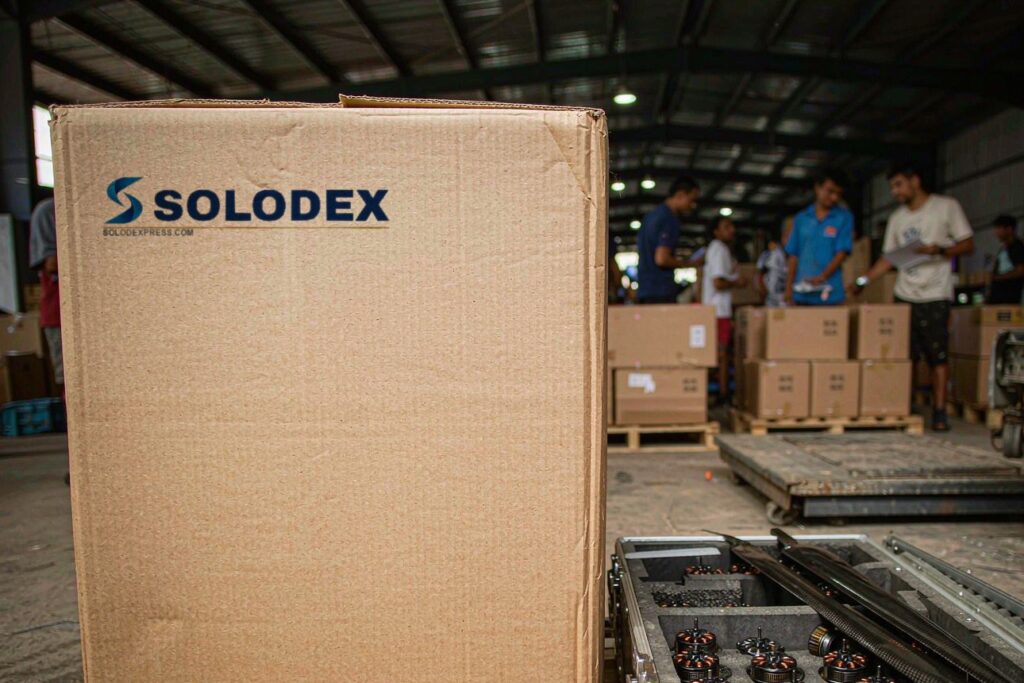
One purchase order, four shipping problems
The order reads like a single line item in a spreadsheet: forty brushless motors, twenty ESCs, thirty pairs of carbon propellers, six battery packs, two flight controller stacks. Total value around eighteen thousand dollars, total weight under ninety kilos. A European drone integrator placed it through ISWFA, a sourcing house that works factory-direct across drone propulsion, automotive diagnostics and desktop fabrication.
From the buyer’s side it is one order from one supplier. From the freight side it is four different kinds of cargo that happen to share a purchase order number.
Motors contain permanent magnets, which makes them magnetized material for air transport. Battery packs are Class 9 dangerous goods with their own state-of-charge rules, their own packaging tests and their own carrier approvals. Carbon propellers are light, fragile, high-value and dimensionally awkward — they cube out before they weigh out. The electronics are static-sensitive, modest in value, and completely unremarkable until someone mixes them into a carton with a magnet and turns the whole carton into a screening problem.
This is what drone parts logistics actually is: not a shipping method, but a set of decisions about which regulatory identity applies to which carton, made before anything is booked. Get it right and the order moves on a normal schedule. Get it wrong and the shipment sits at a hub while three parties exchange emails about a form nobody has.
Why these parts fly at all
Drone propulsion is close to the ideal air-freight cargo. A T-MOTOR class motor weighs a few hundred grams and costs more than a hundred dollars; a carbon VTOL propeller pair can be worth several hundred dollars and weigh less than a bag of coffee. When value density is that high, the freight bill becomes a rounding error against the inventory cost of waiting five weeks on the water.
That is the economic argument, and it usually wins. But it is not the whole decision, because air freight is not one product. It is at least three: express consignments moving through an integrator’s network, general cargo on scheduled freighters, and consolidated shipments built by a forwarder who buys space and fills it. Each has different rules about what it will accept, and the differences matter more for drone parts than for most cargo.
The batteries set the boundary. Lithium cells shipped alone are UN3480; cells packed with equipment are UN3481; and either way the shipment needs a test summary, a state of charge at or below the level the regulations require, and packaging that has passed the relevant drop and stack tests. Many carriers will not take loose cells on passenger aircraft at all, which quietly removes the cheapest and most frequent air options from the table and pushes the shipment onto cargo-only services with their own cutoffs — the same reason a power bank is awkward to post.
So the practical routing question is not “air or sea.” It is “which air product will accept this specific mix, on this lane, this month.” A forwarder who quotes a single air rate for a drone order has either not asked what is in the cartons or is planning to find out at the warehouse. It is also worth knowing that air rates on these lanes are seasonal, so the mode that is affordable in March may not be in November.
The magnet question
Brushless motors are built around permanent magnets, and aviation treats magnetized material as a separate hazard class. The concern is not that a motor will affect an aircraft’s compass from inside a cargo hold; it is that cargo handling equipment, and the aircraft’s own systems during loading, can be affected by a strong enough field at a close enough distance.
What this means in practice is that a shipment of motors may need a gauss reading at a specified distance from the package surface, and shielding — a steel liner, a foil wrap, a specific orientation inside the carton — to bring the field below the threshold the carrier accepts. Two cartons of identical motors can be treated completely differently depending on how they are packed and what the measurement says.
The frustrating part is that this is not a property of the product, it is a property of the packing. A factory that ships motors domestically all year has no reason to own a gauss meter or to know which carriers want a report. The requirement appears at the airport, at the moment of acceptance, which is the worst possible place to discover it — the cargo is already at the terminal, the flight is already booked, and the only remaining options are to repack on the spot or to miss the cutoff.
This is where a sourcing partner and a freight partner have to talk to each other. ISWFA verifies the motor specification before quoting; the freight side has to know, before booking, that the shipment contains magnetized material and whether the factory’s packaging will pass. It is a five-minute question at the quotation stage and a five-day problem at the airport.
Classification splits the order into five lines
Customs does not see “a drone order.” It sees components, each with its own classification, duty rate and documentary requirements. A single purchase order usually becomes several declaration lines, and the split is not arbitrary — it follows what each part actually is.
Motors are electric motors. Speed controllers are, for tariff purposes, power conversion equipment. Propellers are parts of aircraft. Flight controllers sit with the electronics of the airframe. Battery packs are accumulators. Each family carries a different duty rate, and some carry more than duty: drone components can fall within export-control or dual-use screening depending on performance parameters, destination and end use, which is a separate question from customs classification and is asked by a different authority.
For a sourcing operation, the practical consequence is that the invoice has to be built for customs, not for the buyer’s convenience. A single line reading “drone parts, USD 18,400” is not a classification — it is a delay with a value attached. The exporter needs a line per part family, with the quantity, unit value, material and intended function described accurately enough that a customs officer in the destination country can agree with the code without a phone call.
This is also where value density creates a trap. When freight is cheap relative to the goods, there is a temptation to under-describe: simplify the invoice, round the values, describe everything as “spare parts.” That works until a line is selected for inspection, at which point the whole consignment is measured against the description — and the seam between sourcing and freight is exactly where that description was written.
The case file
| Carton content | Shipping identity | What decides the route | What fails first |
|---|---|---|---|
| Brushless motors | Magnetized material (Class 9) when the field exceeds the limit | Gauss reading, shielding, carrier acceptance | Rejected at acceptance; repacking on the dock |
| Battery packs | UN3480 / UN3481, Class 9 | Test summary, state of charge, packaging spec, cargo-only aircraft | Booking refused after the cutoff; no fallback that week |
| Carbon propellers | General cargo, fragile, low density | Volumetric weight, crate design | Charged at volumetric weight; damaged in a soft carton |
| ESCs and flight controllers | General cargo, ESD-sensitive | Anti-static packing, declaration description | Misclassified on the invoice; delay at destination |
| Mixed cartons | Whichever hazard is strongest | Segregation rules | The whole carton inherits the battery’s restrictions |
Read the last row first. The most common mistake in this trade is not a misdeclared motor or a missing test summary; it is a warehouse packing a battery pack into the same carton as propellers to save space. That single decision converts a general cargo carton into a dangerous goods carton, changes the documentation, changes the carrier, and often changes the price by more than the freight itself.
What a working account looks like
The account we run with ISWFA is not complicated, but it is specific, and the specificity is the point. Their orders come from several factories across different provinces, each quoting ex-works, each with its own packing habits. The buyer wants one delivery date and one invoice.
So the flow is built in stages. Goods are collected from each factory and consolidated at a hub where the cartons can be opened, checked against the order and repacked for export. Motors are separated from anything that would complicate screening; batteries are packed to the applicable specification and held to the state-of-charge limit; propellers get rigid protection because a cracked blade is a total loss on a part worth more than its freight. Anti-static bags and moisture barrier packaging are applied where the component calls for it, not as a default. Each consignment leaves with a document set that matches the cartons one for one: commercial invoice split by part family, packing list with net quantities and battery counts, test summaries, gauss report where required, and the dangerous goods declaration when the shipment carries cells.
On the destination side, the same logic continues. A consolidated air shipment lands, clears, and is delivered to the integrator as one delivery; a warranty return travels back the other way as an import, with its own declaration and its own return documentation, and the same battery rules apply in reverse. Returns are where these accounts usually unravel, because nobody designed the return path at the same time as the outbound one.
None of this is exotic. It is the ordinary work of matching a product to the rules that apply to it — done before the booking, by people who know what is inside the carton. What makes it valuable to a sourcing partner is that it removes a category of problem from their day: they can quote a buyer in Europe, promise a delivery window, and not discover at the airport that the motors need a gauss measurement.
What changes when volume grows
The first ten shipments of a drone parts account are handled order by order. The next hundred are a schedule.
Volume changes three things. First, consolidation replaces ad-hoc booking: a weekly air build from the hub, with a cutoff that the factories work to, is cheaper and more predictable than shipping each order when it is ready. Second, the battery flow separates from the general cargo flow, because cells move on cargo aircraft with their own consolidation and their own documentation — mixing them into a general build slows the whole consignment down. Third, the paperwork becomes a system rather than a set of documents, because at a hundred shipments nobody can remember which factory’s invoice format omits the unit value.
The metrics that matter also change. At low volume the question is whether the shipment left on time. At volume it is cost per kilogram against value density, the share of spend going to dangerous goods surcharges, and dwell time at the hub — the hours a carton waits because a document was missing. Those are the numbers that decide whether a fast-growing accessories business stays profitable, and none of them appear on a freight quotation.
There is a version of this business where the logistics is invisible: the buyer orders, the parts arrive, and nobody thinks about how. That version exists, but it is built, not found. It is built by people who know that a motor is a magnet until proven otherwise, that a battery pack defines the aircraft it can fly on, and that a purchase order is five customs lines wearing one number. For a sourcing operation selling factory access and verified specifications, that invisible logistics is part of the product — the same way a verified spec is.
Drone assemblies carry both questions in one carton: the battery has its five documents, and the motors have a magnetic field that air cargo measures and sea freight never asks about.
When those four identities come from four different workshops, the order stops being a pallet and becomes five cartons that have to be assembled into one consignment before any of this can be booked.
Small high-value parts are the ones most often upgraded to air when the buffer runs out; the shipment profile is in drone parts logistics.


