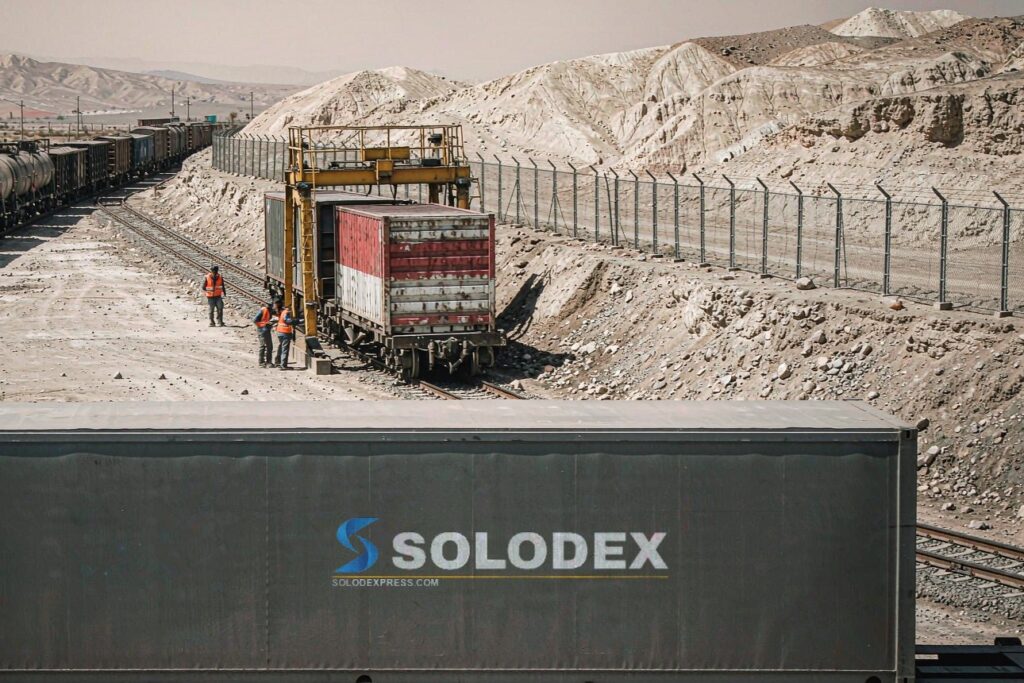
Aktau is a seaport. It sits on the Caspian, it has berths, cranes, a customs office and a container yard, and you can book ocean freight to it. What it does not have is a connection to any ocean. The Caspian is a lake, and the only water route out of it runs through a chain of shallow Russian rivers that no ocean-going container ship transits.
So a buyer in Almaty who books cargo to Aktau has bought a sea leg that ends roughly 3,000 kilometres short of the warehouse, in a country whose customs territory the goods have technically not entered, on a body of water that goes nowhere. The cargo will arrive. It will sit in a yard. And the question of who is allowed to move it, under what document, will be answered by somebody who was not in the conversation when the shipment was booked.
This is not an exotic case. It is the ordinary shape of a shipment to any of the forty-odd countries without a coastline, and the confusion is almost never about freight rates. It is about the fact that a port does three jobs at once, and inland those three jobs come apart.
A port is not a destination
At a coastal destination, three separate things happen at the same dot on the map. The cargo stops moving. It enters a customs territory. And it reaches the place somebody wanted it. The bill of lading names that dot, the Incoterm prices to that dot, and the buyer’s warehouse is close enough that nobody has to think about the difference.
Landlocked countries pull those three apart. The port where the sea leg ends is in a neighbouring country. The customs territory the goods are destined for is a border away, sometimes two. And the physical address is a further road or rail leg beyond that, across ground that belongs to a third administration with its own paperwork.
Inside the European Union the separation is nearly invisible, because transit between member states is a formality and a truck crosses three borders without stopping. That experience misleads people badly when they ship to Uzbekistan, Ethiopia, Nepal, Bolivia or Mongolia, where every one of those borders is a real event with a real queue and a real set of documents. Two countries — Uzbekistan and Liechtenstein — are doubly landlocked, meaning the cargo must cross at least two other states before it sees salt water.
What follows from this is worth stating plainly: on an inland move, the sea leg is the easy part. It is priced competitively, tracked continuously, and governed by a body of law that everyone in the chain has memorised. Everything after discharge is negotiated case by case, and the failures there do not look like transport failures. They look like paperwork failures, because that is what they are.
Four ways inland, and only one of them skips the border
There are four practical routes, and they differ less in cost than in how many administrations get to inspect the cargo on the way.
| Route | A real example | Added time | The constraint that decides it |
|---|---|---|---|
| Neighbour’s port plus transit road or rail | Ethiopia via Djibouti; Nepal via Kolkata; Bolivia via Arica; Mongolia via Tianjin | 5–21 days | The neighbour’s willingness to hold your cargo in bond, and the quality of the corridor |
| Rail from origin, never touching a sea port | China–Europe block trains into Kazakhstan and Uzbekistan; the Laos–China railway to Vientiane | 18–28 days | Gauge changes, and whether your volume fills a block train |
| Air freight | Any inland capital with an international airport | 2–5 days | Cost per kilo, and the fact that the airport is the border |
| Inland waterway or lake | Caspian crossings to Aktau and Turkmenbashi; Danube and Mekong barge routes | 7–20 days | Draft, season and whether any ocean vessel can reach the water at all |
The third row is the one people underrate. Air freight is not merely faster; it collapses the entire problem this article is about. The aircraft lands inside the destination customs territory, so the cargo is cleared where it is needed and there is no transit country, no transit document and no seal to break. For high-value, low-volume goods, paying air rates can be cheaper than paying for the corridor — not because the freight is cheaper, but because the risk and the administration disappear.
Rail sits in the middle. A block train from China to Central Asia runs on Chinese standard gauge to the border, then on 1,520 mm Russian gauge across Kazakhstan, which means the containers are either lifted from one wagon to another or the wagons themselves are raised and their bogies swapped. Both operations take hours, both involve opening and resecuring whatever secures the cargo, and both are the point where a transit chain most often loses its integrity. The rail corridor into Europe has the same physics at Małaszewicze, which is why the schedule on those services is quoted in weeks rather than days.
What keeps cargo un-imported
Here is the legal trick that makes any of this possible. Goods can travel across a country without entering it. They are physically present, subject to that country’s police powers, and at the same time not liable for its duties and not admissible to its market. The status is called transit, and it is created and maintained by three things: a declaration, a guarantee, and a seal.
The declaration names the office where the procedure starts, every office it will pass through, and the office where it ends. In the European common transit system the document is a T1 for non-Union goods; Turkey, Serbia, North Macedonia, the EFTA states and the United Kingdom all participate, which is why a T1 can carry cargo from Rotterdam to Istanbul without the goods ever being imported anywhere in between. On the road side the equivalent is a TIR carnet, which covers a whole journey on one document and requires the vehicle itself to be sealable — a flatbed or an open wagon cannot carry transit goods, because there is nothing to seal.
The guarantee is the money that stands behind the declaration. If the cargo does not arrive at the office of destination, somebody pays the duty that would have been due, and that somebody is the holder of the procedure, not the owner of the goods. This is the single most misunderstood allocation of risk in the whole inland chain, and it is why a forwarder will ask questions about an inland routing that seem out of proportion to the value of the freight.
The seal is the smallest object in the chain and the most important. A seal number converts “this cargo was not opened in the transit country” from an assertion into a verifiable fact. Every time the cargo is transferred — a gauge change, a border yard, a vehicle swap — the old seal is cut and a new one applied, and the new number has to be recorded on the document and communicated forward. A chain of custody with a gap in the seal numbers is a chain that cannot be defended, and the argument that follows is not about freight. It is about whether the goods that arrived are the goods that left.
There is a second, quieter consequence. Anything done to the cargo inside the corridor — repalletising after a damaged unit, adding dunnage, replacing a broken crate — introduces wood that the destination country will inspect. The ISPM 15 mark has to be on the new pallet too, and a yard in a transit country has no reason to care about a stamp that only matters three borders later.
And none of the three elements closes anything by itself. A transit procedure ends when an office at the far end confirms arrival, not when the cargo is handed over — which makes the ninety seconds nobody is paid to spend the most expensive part of the whole arrangement.
Where the money hides between the port and the warehouse
Inland legs are quoted as a rate per container or per tonne, and the rate is the smallest part of the cost. Five items account for the rest, and four of them are invisible in a quotation.
Transloading. A gauge change is not a free service. Lift-on-lift-off at a border terminal is charged per container, and it consumes a day. Bogie exchange is slower and rougher on the cargo. Either way the schedule absorbs it and the cargo gets handled by people who did not pack it.
Border yards. Queues at land borders are not measured in hours but in days, particularly where a single corridor carries a country’s entire import volume. Storage at the border terminal is billed, and it is billed to whoever holds the document.
The guarantee itself. Whether it is a cash deposit, a bank guarantee or a forwarder’s own bond line, capital is tied up for the duration of the transit. On regular volumes that cost is real and it is priced into the rate without being itemised.
Return loads. Freight moves toward inland markets and comes back empty. The empty leg is paid for by the loaded one, which is why a 1,200-kilometre inland haul can cost more than 8,000 kilometres of ocean.
Dimensional limits. A 40-foot high cube on a standard container chassis is about 4.1 metres tall. Several inland corridors outside the European Union have structures at 4.0 metres, and bridge weight limits and axle restrictions that were written for a different generation of trucks. These are discovered at the structure, not in the quotation, and the remedy — transloading into smaller units in the middle of nowhere — is expensive.
Who actually holds the transit procedure
Three roles can sit in three different countries on one shipment. The person who booked the freight may be the buyer. The person who holds the transit procedure is whoever signed the declaration, and carries the guarantee. The importer of record at the far end is the entity legally entitled to clear the goods, which in many inland jurisdictions requires a local tax registration that a foreign buyer simply does not have.
Most commercial terms do not survive contact with this. A CIF sale ends when the cargo is on board at the port of loading — CIF is a shipment contract, not a delivery contract, and the fact that the freight is paid to Aktau means only that the freight is paid to Aktau. The buyer who believes the deal completes at the Caspian port has bought a 3,000-kilometre problem along with the goods.
DAP and DDP are where the confusion becomes expensive. DAP delivers to a named place, so naming an inland warehouse makes the seller responsible for a corridor the seller has probably never operated. DDP goes further and makes the seller the importer, which is often impossible without a local registration, and which is why the difference between DDP and DDU matters more on an inland move than on a coastal one. The practical fix is not a different Incoterm. It is a sentence in the contract naming who holds the transit procedure at each border, in writing, before the cargo moves.
The bill of lading compounds it. Releasing cargo against a telex release or an original bill governs the sea leg, and the transit document governs everything after it. These are two different instruments held by two different parties, and a buyer who has arranged one but not the other will find the cargo stopped at a border for reasons that have nothing to do with the freight being unpaid.
Five things that break at a land border
A seal number that does not match. Either the reseal after a gauge change was not recorded, or the cargo was opened. From the border officer’s point of view these are the same fact, and the burden of distinguishing them falls on the holder of the procedure.
Weight that no longer agrees with the document. Transloading in the rain, repalletising, added dunnage — a declared gross weight that was correct at origin can be wrong at the third border, and a discrepancy on a transit declaration is not a rounding error.
A vehicle that cannot be sealed. Transit goods need a sealable compartment. An open wagon, a flatbed or a container loaded on a bolster requires a vehicle change, which means unloading in a border yard, which means a new seal, a new count and a new argument about damage.
A corridor that closes without notice. Border crossings close for repairs, for holidays, for security, and for reasons that are never published. A route that was specified on the transit document may simply stop accepting traffic, and the document does not amend itself.
The clock. Transit procedures have a time limit for arrival at the office of destination. Exceed it and the guarantee is called, which converts a delay into a duty payment and a compliance record. Nobody in the commercial chain is watching that clock, because it belongs to a customs procedure rather than to a purchase order.
Planning a move that ends inland
Six things, in order, and none of them are about rates.
Put three dots on a map before booking: where the sea leg ends, where the last border is, and where the goods will actually be cleared. If those are not the same dot, the shipment has a corridor, and the corridor needs an owner.
Ask who holds the transit procedure, and get the answer in the contract rather than in an email chain. The holder carries the guarantee, and the guarantee is what pays when something disappears.
Require the seal numbers, all of them, forwarded as they are applied. A chain with recorded reseals is defensible. A chain with a gap is not.
Quote the arrival as a range, not a date. An inland corridor has more variable segments than a sea leg, and a promise built from the best case will be missed in the first month.
Compare the all-in landed cost against splitting the shipment: clearing in a coastal or free-zone hub and feeding the inland market from there is frequently cheaper than dragging containers over three borders, and it converts one hard problem into several easy ones.
And insure the whole route, from door to door, rather than port to port. The segment where the cargo has no customs identity is precisely the segment where the standard marine policy is thinnest.
None of this is difficult, but all of it happens before the cargo moves, and the corridor is the one part of an international shipment where being right late is the same as being wrong. A sea port is a place with a fence, a system and people who answer the phone. An inland leg is a road, and at the end of the road there is another customs office — and in between, the cargo’s legal existence rests on a form and a seal that nobody in the commercial chain is paid to watch.
The strip at the inland depot, not the port, is where the availability clock starts for the final leg; the extra inland handover is covered in shipping to a landlocked country.


