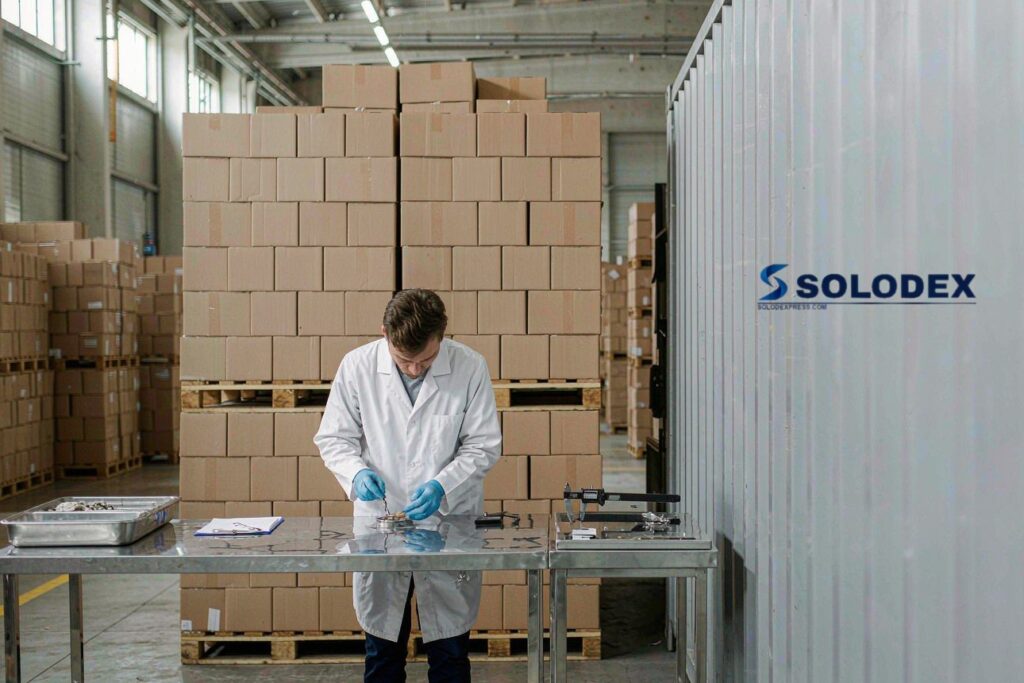
The container is loaded, the truck is at the gate, and the declaration comes back with one line: inspection required, and no inspection record exists. The goods are legal, the paperwork is correct, the buyer is waiting, and the vessel will sail without the box.
That line is not a customs problem in the sense most exporters understand. It is an export inspection problem, and it belongs to a system that is separate from customs, separate from the import controls at the destination, and — for a specific and fairly short list of goods — a hard gate that sits before anything else can happen.
Export inspection is not customs inspection
The two sit in the same declaration, filed by the same broker, in the same system, and this is exactly why they get confused. They answer different questions.
Customs asks whether the goods may leave and whether the declaration is accurate. Export inspection asks whether a specific product meets a specific standard — that a toy’s small parts will not detach, that a ceramic mug will not leach lead, that a consignment of food is fit to be sold. One is a regulatory formality. The other is a product test with a result that can be a refusal.
| Customs declaration | Export inspection | |
|---|---|---|
| Question asked | May this leave, and is the entry true | Does this product meet the standard |
| Applies to | Every export | Goods on the inspection catalogue |
| Outcome | Released or held | Pass, fail, or sample sent to a laboratory |
| Who can fail it | A discrepancy | The product itself |
| Typical delay if it goes wrong | Days | Weeks, and sometimes a rework |
The structural history matters here. Export inspection in China was for decades run by a separate administration — entry-exit inspection and quarantine, known by its initials — with its own officers and its own certificate. That body was merged into customs in 2018, and the two declarations were combined into one submission. The functions did not disappear; they moved inside the same building. Which is why a broker can now file one form and still have a product test come back at you.
The catalogue decides, not the officer
Nothing about the shipment triggers inspection. The product code does. China publishes a catalogue of goods subject to statutory inspection for export, and whether your product is on it is a matter of its classification, not its value, its destination or the officer’s mood.
Each code in the tariff carries inspection categories, shown as letters. The ones that matter for an exporter are the two that create a live obligation: N for export commodity inspection, and Q for exit quarantine of plants and animal products. A code marked N cannot be exported without an inspection record attached to the declaration. It is not a risk of being selected. It is a precondition.
Two practical consequences follow, and both are easy to miss.
First, the same physical product can sit under two codes with different status. A classification that puts an item outside the catalogue can be entirely correct and still be contested, which is why the code on the export declaration is doing more work than most shippers realise. Second, the catalogue has shrunk dramatically — thousands of lines were removed from statutory export inspection over the past decade — so trade knowledge from ten years ago is actively misleading. Plenty of goods that used to need a certificate no longer do, and a handful still do that people assume have been liberalised.
What is on the list, and why those things
The list is short and it is not random. It is, in effect, a list of categories where a bad shipment would embarrass the country rather than merely inconvenience a buyer.
Consumer products with a safety dimension — toys above all, but also products that children use, and certain electrical items. A toy that fails a small-parts test in an importing country becomes a news story about Chinese manufacturing, not about one factory.
Food and things that touch food — processed food, food additives, and food contact materials including ceramics, where lead and cadmium release is the classic failure. The testing regime for tableware exists precisely because a single out-of-limit batch damages an entire category’s reputation.
Cosmetics and toiletries, where the standard is a hygiene and composition question rather than a trade one.
Dangerous goods and their packaging, which is a regime of its own, described below.
Certain agricultural and animal products, where the obligation is quarantine rather than quality — the Q category rather than N.
The pattern is consistent: statutory export inspection covers goods where the consequence of a failure is systemic. It does not cover goods where the consequence is commercial. That is a useful filter when a supplier claims their product “definitely needs inspection” or “definitely doesn’t” — the question is which code, and the catalogue is public.
The chain that has to close before the container moves
For a product on the catalogue, the sequence is fixed and every step has a document.
- Inspection is applied for as part of the declaration, not as a separate errand.
- The consignment is either released on documents or selected for inspection — a risk-based decision, not an automatic one.
- If selected, an officer examines the goods and may draw samples for a laboratory.
- A result is issued — the pass document is what allows the declaration to proceed.
- The certificate follows the goods, in the form the destination requires, for the goods that need one on arrival.
| Step | Typical duration | What usually goes wrong |
|---|---|---|
| Application with the declaration | Same day | Filed after the cargo is ready |
| Document-only release | 1–2 days | Assumed, then not granted |
| Inspection with sampling | 5–12 days | The laboratory queue, not the officer |
| Failure and rework | 2–4 weeks | The re-test is a new application, not a resubmission |
The timing is where planning fails. An inspection with sampling is typically a week to two, and the laboratory is the variable, not the officer. A failure means rework and a fresh application, which is measured in weeks and occasionally in a cancelled order.
Which gives the honest planning rule: for goods on the catalogue, the export date is not set by the vessel, it is set by the certificate. Booking a sailing that leaves four days after the factory finishes is a plan that assumes everything passes on documents. When it does not, the container sits, the exam clock at the destination has not even started, and the delay is entirely upstream of the ocean.
No fee, and still expensive
China stopped charging inspection and quarantine fees in 2017. The statutory inspection itself is now free, which sounds like the end of the cost discussion and is not.
The costs that remain are the ones nobody quotes: the agent who handles the application, the samples that are destroyed in testing, the storage of a container that cannot be loaded, and — the largest item — the production time lost when a batch fails and has to be reworked. A free inspection that takes eleven days and rejects one lot in twenty is more expensive than a paid one that takes two days and rejects nothing, and only the second number ever appears on an invoice.
This is the same pattern as import side examination, where the inspection is also frequently free and the terminal charges are not. In both cases the state has removed its fee and left the cost sitting in the commercial chain, where it is billed by parties who are not the state and who have no reason to itemise it.
The second set of tests nobody budgets for
Here is the distinction that costs the most money, and it is genuinely confusing because both sides call it “testing”.
Statutory export inspection is China checking that goods may leave. Destination compliance is the importing country checking that goods may enter. They use different standards, different laboratories, different acceptance criteria and different paperwork, and passing one tells you almost nothing about the other.
A toy can clear export inspection in China and fail a small-parts test under the American rule, because the two regimes define the cylinder and the force differently. A ceramic glaze can pass the export test and fail a European release limit. The children’s product requirements at the destination are not a formality layered on top of the Chinese certificate; they are a separate obligation with a separate cost, usually several times larger.
The practical consequence for a buyer is that a supplier who says “we have the inspection certificate” has answered a question you did not ask. The question you asked was whether the goods will clear at your border. Those are different documents, and only one of them protects your order.
Dangerous goods packaging is its own regime
One category deserves separate mention because it catches experienced shippers: packaging for dangerous goods.
Exporting dangerous goods requires the packaging itself to be approved, and in China that means two distinct certifications — a performance test on the packaging design, and a use test on the actual packing of the actual goods. Neither is a product test. A perfectly compliant chemical in an unapproved drum is a shipment that cannot be declared, and the drum cannot be approved retroactively on the day of loading.
The failure mode is familiar in shape: the product is right, the classification is right, the packaging is the thing nobody thought about, and it is discovered at the gate. The liquids and cosmetics trade meets this regularly, because a product can be a cosmetic for one purpose and a dangerous good for transport in the same bottle.
What to ask before you book
- Is the code on the statutory catalogue, and what is its inspection category? A supplier who does not know should not be guessing; the catalogue is published and searchable.
- Has this exact product been inspected before, and can I see the record? A history is a much better predictor than an assurance.
- Who applies, and how long did the last one take? The answer tells you whether the export date is realistic or optimistic.
- Which tests does my destination require, separately from the Chinese certificate? This is the number that most budgets miss, and it is usually the larger one.
- If this is a liquid, a powder or a battery, is the packaging approved? Ask for the packaging certificate by number, not for a reassurance.
None of this is a reason to avoid the catalogue. It is a reason to treat it as a schedule item rather than a formality — the one gate in the export chain that is decided by the product instead of by the paperwork, and the only one where the answer “it will be fine” has no evidentiary value at all. Everything else in this batch is a document you can correct. This is the one where the goods themselves have to be right before anyone signs anything.
An export inspection checks goods against a declaration; a placement correction leaves the goods untouched and changes the cell, the stack and the lashing sheet instead.


