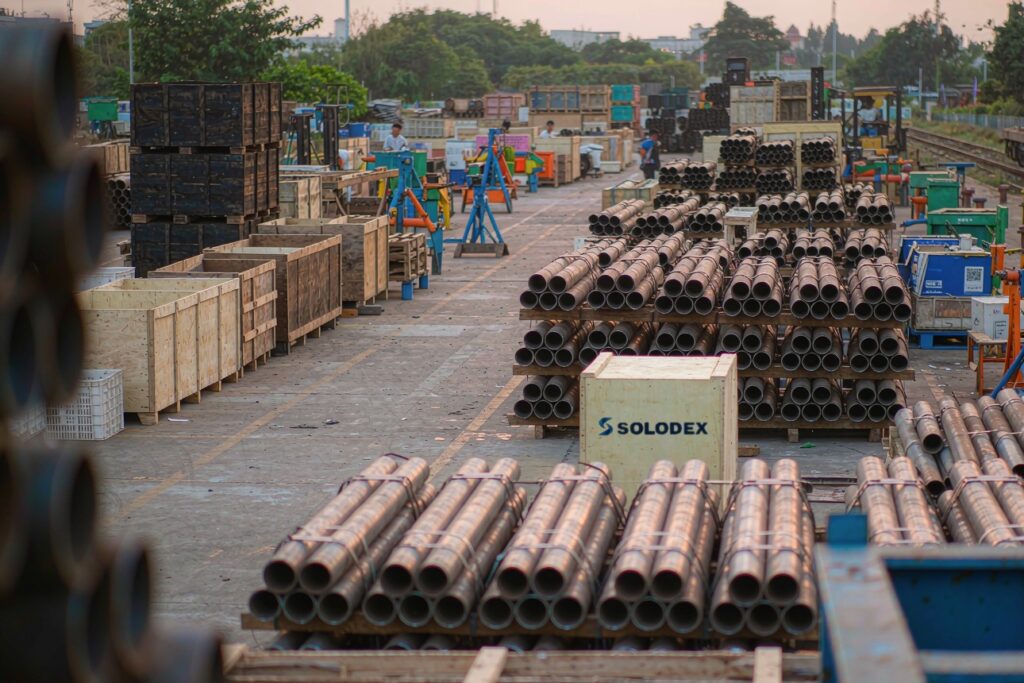
On the quay, the tally clerk counted twenty-four. The factory delivery note said one hundred and forty-four. The mate’s receipt said twenty-four, the bill of lading said twenty-four, and the discharge tally three weeks later said twenty-four. Nothing had gone missing. Six lengths of steel pipe had been strapped into each bundle before the trucks reached the berth, the crane lifted one bundle at a time, and the clerk made one tick per lift. One hundred and forty-four was a count of pipes. Twenty-four was a count of times the hook went over the ship’s rail.
Both numbers are correct, and neither can be derived from the other without knowing what happened to the steel between the factory gate and the quay. That is the part worth pausing on. In a container shipment this gap never surfaces, because the box answers the question before anybody asks it: the carrier accepts one box, and how many things are inside is a matter for a warehouse at destination. Take the box away and the question has to be settled in public, at the rail, by a crane and a person holding a pencil.
This is the second of the decisions a container makes on the cargo’s behalf. The first was identity: without a box number, loose cargo has to carry its own name. This one is the count. Not how much the goods weigh, not how much space they occupy, and not how many the customer ordered, but a much smaller and more awkward question: what exactly is one?
Twenty-Four, Six, One Hundred and Forty-Four
Start with the three numbers, because each of them belongs to somebody different.
One hundred and forty-four belongs to the factory and to the buyer. It is the quantity that was made, invoiced and paid for. It survives every conversion along the route and appears on the packing list as a multiplier: twenty-four bundles of six. It is the only one of the three numbers that describes the goods rather than their movement.
Six belongs to the packer. It is not a commercial figure at all; it is the width of a sling, the reach of a strap, the length of a fork, and occasionally the maximum load a ship’s gear is allowed to take in one lift at that berth. Change the strap and the six changes. Nothing about the pipe changes.
Twenty-four belongs to the ship. It is the number of separate hand-over events that somebody had to witness, record and later account for. It is the number printed on the transport documents, and it is the only number the carrier can be asked to answer for. Ask a carrier where the one hundred and forty-four pipes are and the honest reply is a question back: which twenty-four?
Note that the smallest of the three numbers is the one on the bill of lading. A document that appears to describe a small shipment is describing a small number of operations on a large shipment. That inversion is normal for break bulk cargo, and it is the source of most of the confusion that follows.
A Piece Is What the Hook Lifts Once
For cargo that does not travel in a container, one piece is the largest unit that can be slung, lifted over the rail and landed in a single operation, and that a tally clerk can mark once without opening anything. That is the whole definition. It contains no reference to a carton, a retail unit, an invoice line or a product.
The hook is the first half of the test. A crane does not know what a package is. It knows a load that can be balanced, slung and lowered without shifting. Two pipes strapped together are one load; the same two pipes lying side by side on dunnage are two loads. The steel is identical. The sling arrangement is not, and the sling arrangement is what the crane sees.
The clerk is the second half. A count only works if a person standing at the rail can produce it in one pass, in the order things actually move, without stopping to untie or unpack. If recognising a unit requires opening it, that unit is not the piece at this moment. It may be the piece at the destination warehouse, where somebody has a fork, a knife and all afternoon, but not here.
Both halves point the same way: the piece is a handling event, not a physical object with fixed boundaries. It exists for as long as the arrangement that produced it exists. That is a strange thing to put on a transport document, which is why the container is so useful — it replaces a negotiable unit with a rigid one.
The Box Used to Defer This Question
When a shipment is built around a container, the carrier accepts one item of equipment. The gate-in record, the terminal appointment, the manifest and the bill of lading all point at one box, and the count inside is the shipper’s business. A packing list may say two hundred and fifty cartons, and that figure is perfectly correct, but it is not verified at the ship’s rail. It is verified much later, by whoever opens the doors, in a warehouse, with no crane waiting.
The box therefore does something subtler than protect goods. It separates the number of lifts from the number of things. Once those two are separate, the awkward question of what counts as one can be postponed until there is time and space to answer it quietly, and any disagreement is a warehouse problem rather than a shipping problem.
Remove the box and the deferral disappears with it. There is no later, calmer moment at which the count can be established: the cargo is going over the rail now, one sling at a time, and the number has to be made while it moves. This is why tallying appears on a port tariff as a separate charge rather than as an item of clerical overhead. For loose cargo that line is not a copy of a number somebody already had. It is the moment the number is manufactured.
It also explains why a container bill of lading can say one container said to contain and remain a perfectly useful document. The phrase is a declaration that the carrier has not counted. A break bulk bill of lading cannot be written that way, because the carrier’s own people were standing at the hook holding the pencil.
Five Ways to Change the Number Without Moving the Steel
Take the same one hundred and forty-four lengths of pipe and put them through five ordinary arrangements. Nothing is added, removed, damaged or sold. Only the way the steel is held together changes.
| What was done to the same steel | One lift carries | The clerk ticks | The document says | Whose decision it was |
|---|---|---|---|---|
| 144 loose lengths on dunnage, lifted one by one | One length | One tick per length | 144 pieces | Yard gang and stevedore |
| Six lengths strapped into each bundle at the factory | One bundle of six | One tick per bundle | 24 bundles | Shipper’s packer |
| Four bundles palletised and wrapped at a transhipment port | One pallet of four bundles | One tick per pallet | 6 pallets | Terminal at the intermediate port |
| One machine knocked down into five crates | One crate | One tick per crate | 5 cases | Factory engineering, months earlier |
| The same machine shipped assembled on a skid | One skid | One tick | 1 piece | Whoever chose the transport mode |
Read the last column downwards. Five different parties, at five different moments, can set the number, and not one of them changes how much steel is sitting on the quay. The first and third rows can even occur on the same voyage: twenty-four bundles loaded, six pallets discharged, with no discrepancy in the goods and a very visible discrepancy in the papers.
There is no correct row in that table. Each is correct at the moment and place where the hand-over happened. The mistake is to treat the number as a property of the cargo and carry it unchanged across a change of arrangement.
Does Adding a Strap Remove a Piece?
Bundling adds material, adds labour and removes one hundred and twenty counting events. In a warehouse, strapping is an extra operation; at the rail it is a reduction in the number of things that exist for the carrier. That inversion is worth stating plainly, because the alarms built around shipping are almost all built around a number, and a count of operations can change without any goods changing at all.
Consider the two directions. A bundle is built before loading: the document says twenty-four, the receiving clerk cuts the straps and finds one hundred and forty-four lengths, and both statements are true. A bundle breaks in the hold and its six lengths are discharged as six separate lifts: the discharge tally can read twenty-nine where the loading tally read twenty-four, with more pieces accounted for and exactly the same steel. A short-landed note written from those two numbers would be describing the sling, not the shipment.
The commercial version of the same confusion is more familiar. Repacking is usually sold as a way to change what the freight is billed on — chargeable weight, cube, the density of a parcel. That is a question about money. This is a question about existence: the same operation that makes a parcel cheaper also changes how many pieces the carrier’s clerk will see. A smaller bill and a smaller piece count are different outcomes of the same strap, and only one of them shows up in a quote.
Neither is a reason to avoid strapping. Bundles are what make loose cargo liftable at all. The point is that the number on the document stops being a description of quantity at the moment it becomes a description of an arrangement, and anybody reading it later has to know which.
Can One Machine Be Five Pieces?
Knocked-down equipment pulls the definition in the other direction. The invoice says one machine. The packing list says five crates. The bill of lading says five pieces. Nothing is wrong. One machine is a commercial unit, and it never appears in the piece count because no crane has ever lifted a machine in the abstract — it lifts a crate, a skid or a frame.
The consequence is quietly asymmetric. If one crate is left behind on the quay, the piece count falls from five to four, and the receiver is short a machine, not short a crate. A note that says one case short-landed is accurate about the hook and misleading about the factory order. Conversely, a buyer waiting for one machine may watch five separate units come over the rail, be tallied, be stowed in three different places in the hold and be delivered on two trucks.
This is also where the two questions of this series separate cleanly. Shipping marks and piece numbers answer which piece this is, and how many were supposed to exist. They do not answer what a piece is. A crate can be numbered 3 of 5 and still be rebuilt as a pallet of four at an intermediate port, at which point the sequence on the paint describes an arrangement that no longer exists. Identity survives as text; the unit it was attached to does not.
Assembly drawings, parts lists and crate schedules are the reader’s way back from five pieces to one machine. They are commercial and technical documents, not hand-over records. The carrier has no use for them and no obligation to reconcile them, which is why the reconciliation has to be done by somebody on the receiving side who has both sets of paper.
Who Gets to Decide, and When Does the Decision Expire?
A piece count is not a property of the goods. It is a snapshot of the goods at the moment they were handed over at the loading port. Every re-handle can produce a new one: a bundle broken for a rail leg because the wagon is narrow, crates re-palletised at a transhipment shed, a deck load re-slung for a crane with a lower limit, a pallet split because a hatch opening will not take it whole.
That is why the number on the bill of lading is tied to a loading operation rather than to the cargo in the abstract. Twenty-four bundles describes what went over the rail on a Tuesday. It makes no promise about what will come out of the hold, and it is not a specification the goods have to keep satisfying for three weeks.
The document articles on this site are mostly about disagreement. Five documents can describe one pallet five different ways, and the work is to establish that they are the same shipment. Here the documents can agree perfectly — booking, mate’s receipt, bill of lading and discharge tally all say twenty-four — and the agreement can still go stale, because the arrangement it records was rebuilt halfway through the voyage. Agreement between papers is not durability of the unit.
There is a second version of the same trap on the paper side. A packing list is read line by line, and a row is the smallest unit the paperwork recognises. A row written as 24 bundles, 6 pcs each is a good row: it keeps the multiplier visible instead of flattening everything into one number. But a good row is still a row. It stays unchanged in a filing system while the twenty-four bundles on the quay become six pallets. The paper did not become wrong; the unit it names stopped being the unit being handled.
So the decision about what counts as one has an owner at each stage and no owner for the whole trip. The packer sets it, the stevedore confirms it, a transhipment terminal may quietly replace it, and the receiving clerk meets whatever is left. Nobody along that chain is authorised to change the number on the bill of lading, and everybody along the chain is able to change the thing it counts.
Three Numbers, One Moment
The check is not a standard, a stencil format or a formula; those vary by trade, by port and by the gear available. It is a comparison that can be made with three records in hand, and it is worth making before anybody concludes that cargo is missing.
The piece count on the bill of lading. This is the number the carrier will answer for, and it describes the loading operation. The tally sheet’s count of lifts. This is the number produced at the rail, in sequence, by the person watching the hook. The mate’s receipt, and later the discharge tally. These are the numbers produced at the two ends of the sea leg, and they are the only two that can be compared as physical events.
If the first two disagree, the document was written from a packing list rather than from the rail, and the difference is almost always an arrangement that changed between the warehouse and the berth. If the loading and discharge tallies disagree, the first question is not where did the goods go but was the unit rebuilt: a broken bundle raises the count, a palletised group lowers it, and neither is a loss. A lift is the only one of the three numbers that is physical evidence, because a crane does not fill in a form.
What this comparison cannot tell you is the one hundred and forty-four. That number lives in the packing list and the invoice, and it is recovered by multiplying, not by counting. Expecting the tally sheet to reproduce it is the original mistake in a slightly different costume: it asks a record of hand-over events to behave like a record of goods.
Where the Older Articles Stop
The site already has an article on cargo that will not fit a box. That one asks whether the cargo can travel at all: door openings, flat racks, lifting points, deck and road limits, concentrated loads, and the cost of dismantling a machine whose alignment will not survive the trip. It ends once a workable method has been chosen. This article starts after that decision, with a question that only appears once the cargo is loose on the quay: how many things is it, for the purposes of the hook?
The pieces closest to this one are all about paper. The packing-list articles ask what a row means, who reads it and who signs it. The document-matching articles ask whether five descriptions agree. The tariff article asks who charges for tallying. This one asks what the clerk was actually counting when the pencil moved, and why the same steel can produce three correct numbers in one morning. Tallying as a line on an invoice and tallying as the manufacture of a number are the same activity seen from two different budgets.
None of that is a procedure. There is no stencil standard here, no advice on how to strap a bundle, no claim deadline and no rule about which port requires what form. Some ports count pallets, some count bundles, and some insist on the individual length; the conventions are local and the gear decides as much as the paperwork does. What travels across all of them is the shape of the question, not the answer.
The Count Is Made at the Hook
A container is often described as a steel box that saves handling. The more interesting thing it saves is a decision. It fixes the hand-over unit before the cargo reaches the port, makes the number of lifts equal one, and defers the question of how many things are inside until somebody at destination has time to open the doors and count at a table. The shipper never has to say what counts as one, because the equipment already said it.
Loose cargo gets no such gift. Its unit is whatever can be slung, balanced and ticked once, and that unit is decided by a packer with a strap, confirmed by a stevedore with a sling, recorded by a clerk with a pencil, and liable to be replaced by a terminal with a pallet halfway through the voyage. The count on the document is therefore not a quantity. It is a photograph of an arrangement, taken at the rail, on the day the cargo went over.
The one hundred and forty-four pipes are still one hundred and forty-four pipes at the far end. The twenty-four is not. It belongs to a Tuesday, to a crane, to a bundle that happened to be six lengths wide, and to a person who made a tick each time the load cleared the rail. Ask for the goods and you get the first number. Ask the carrier what it accepted and you get the second, and the space between them is the part that used to be done by the box.
A container decides what counts as once, before anybody has to ask. Cargo that does not go into one has to have that decision made for it again at every hook.
What counts as one piece is settled at the hook; each of those pieces is then measured twice, once in tonnes and once in cubic metres.
A piece is settled at the hook, and a strapped bundle is a different piece from loose lengths; the case around the goods is a transport condition, not a product wrapper.
A piece is settled at the hook, and a bundle can break into loose lengths mid-voyage; the same pencil also writes the remarks column that then has to travel through four sheets.
A piece is what the hook lifts once and a tally clerk can tick once; a flexitank writes “one piece” on the bill of lading for something that is neither lifted nor counted, only pumped.
A break bulk piece is what the hook lifts once, and the tally clerk ticks it as it passes the rail; an IBC package count is a count of cages, and the liquid inside them never passes the hook at all.
Six pipes strapped into one bundle change the piece count because the hook lifts one bundle; a stream of grain offers the hook nothing to lift, and the packages column has no integer to hold.
Break bulk cargo is counted at the hook because each piece is its own unit; containerised cargo is counted again as a column, where a single box has no force of its own.


