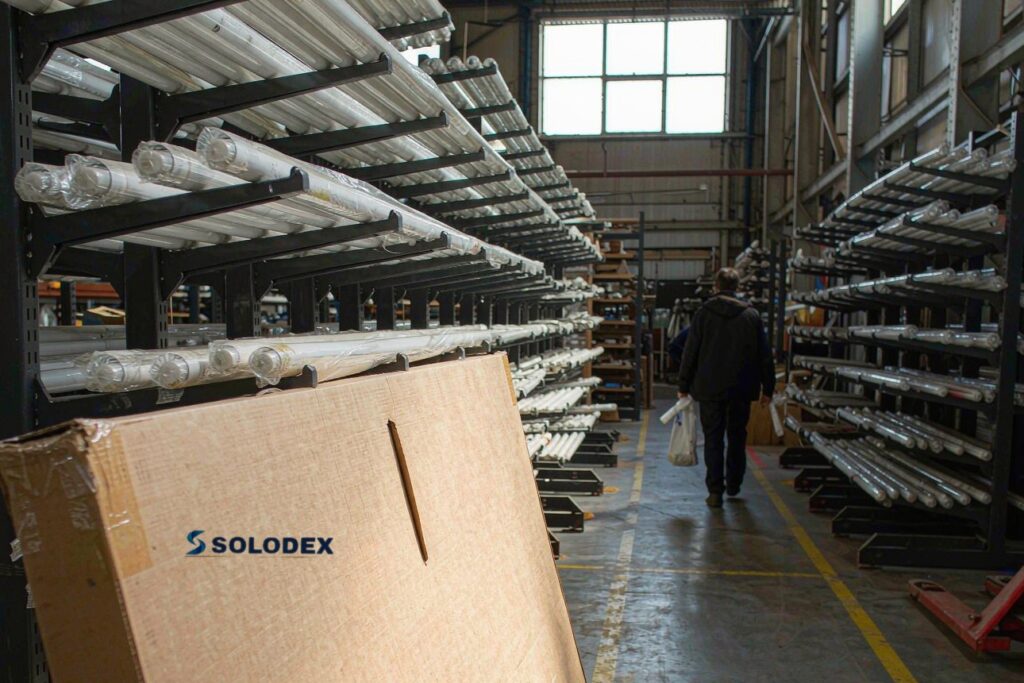
The container held twenty thousand linear fluorescent tubes. The description was accurate, the tariff code was right, the duty was paid, and the consignment cleared customs without a question. Three weeks later it was sealed at the distributor’s warehouse by a different agency, on a different legal basis, and the importer was told that the product could not be placed on the market at all.
Nothing had been smuggled. Nothing had been misdeclared. The tubes were exactly what the invoice said they were, and they were, in the ordinary sense, perfectly safe: sealed glass, a little phosphor, a few milligrams of mercury.
That is the whole subject of this batch in one shipment. The metal inside was not the problem because it was dangerous. It was the problem because it had been banned – not the substance in general, and not above some concentration, but that category of product, by name, in a list.
Two doors, two agencies
Almost everything else on this site is decided at the border, by a customs officer, against a tariff and a set of transport rules. Mercury-added products are decided twice, by two different authorities, and the second decision is the one that ends the business.
The transport door asks whether the goods are dangerous for carriage. Mercury metal has an entry of its own and a hazard class; a finished lamp, with milligrams sealed inside a glass envelope, is usually not regulated as dangerous goods at all. So the transport answer is often a clean no, and it is honestly given.
The market door asks something else entirely: may this product be placed on the market here. That question is governed by an environmental treaty, implemented in national law, and it operates by naming product categories – lamps, switches and relays, thermometers, blood pressure devices, batteries, cosmetics, measuring instruments – with a date after which manufacture, import and export of that category stop.
Which is why the shipment above passed one door and failed the other. The customs officer had no reason to stop it: the classification was right. The environment agency had every reason to: the product was on a list.
The ban is by category, not by concentration
This is the sentence that people argue with, and lose. A supplier will say, truthfully, that the mercury content is tiny – three milligrams, less than a thermometers’ worth, sealed for life. That is a statement about chemistry, and the rule is not about chemistry. It is about a category of product that a country has decided to stop admitting.
Which produces an asymmetry that is genuinely confusing until you see it. A product not on the list may contain mercury and be imported lawfully, because nobody has got around to regulating that category. A product on the list may contain almost none and be refused, because the category is what is prohibited. Precision about milligrams is exactly the wrong kind of precision.
It is the same structure as a ban that has no licence attached to it: not a threshold to be met, not a certificate to be obtained, but a category that is closed. And the practical consequence is identical: no amount of testing, relabelling or reformulating the paperwork changes the answer.
The dates differ by product, and by country
The phase-out is not one event. It is a schedule, with different dates for different categories, and each country implements it on its own timetable – some faster, some with exemptions for spare parts, replacement lamps in existing equipment, or essential uses.
Which means the same product can be lawful in one market and prohibited in another in the same month, and neither supplier nor buyer is necessarily wrong about what they were told. A distributor who imported successfully last year is not evidence about this year, and a catalogue that is legal in one destination says nothing about the next one.
The only reliable answer comes from the destination’s own implementing rules, read for this product category, at the time of the order. That is a specific, boring, checkable question – and it is not the question anybody asks, because everybody is busy asking whether the goods are dangerous.
Inside a machine, the category still applies
The argument that follows is always the same, and it sounds reasonable: the mercury is not a product, it is a component. A switch inside a control panel. A relay inside a socket. The thing being sold is the panel, not the switch.
It does not work the way people hope. The lists name switches and relays as a category, and a switch does not stop being a switch because somebody bolted it into an enclosure. What changes is who is expected to notice: the panel builder buys the switch from a distributor, the distributor buys from a manufacturer, and by the time the assembly is exported nobody in the chain has looked at the component list as a regulatory document.
Which makes the bill of materials the real compliance document in this trade, and makes “we buy the switches locally” a question rather than an answer – because the obligation attaches to placing the product on the market, and assembling it locally from imported parts is one of the ways that happens. It sits alongside the other ways a machine turns out to be a different category than it looked.
“Mercury-free” is a label, not a measurement
A supplier’s specification sheet will usually carry a line that says Hg 0%, or “mercury free”, and it is worth knowing what that line is. It is a declaration by the seller, not a test result, and the two are not the same document – particularly for lamps, where a genuinely mercury-free product (an LED) and a “low mercury” fluorescent tube can both end up described in the same commercial language.
The number that survives scrutiny is the one in milligrams per unit, on the specification, for the exact model being shipped. If a supplier cannot produce it, the shipment has a specification problem before it has a regulatory one.
The mercury does not disappear at the end
There is a second obligation that lands on the importer rather than the exporter, and it arrives years later.
A mercury-containing lamp that is thrown away is not ordinary waste. It is a mercury-bearing waste stream, which most markets regulate separately: separate collection, designated treatment, and in many cases a producer-responsibility obligation that attaches to whoever placed the product on the market. The same company that could not import the tubes is also the company that has to take them back – the same producer-responsibility logic that makes a lead-acid battery somebody’s problem at end of life.
That is the same lifecycle logic that makes used electronics a waste question rather than a goods question, and it is worth flagging at the quotation stage, because the cost of the take-back is a cost of the sale – not a cost of the disposal.
Four cartons of the same fitting
| What is in the carton | Transport answer | Market answer | The usual mistake |
|---|---|---|---|
| Fluorescent tubes containing mercury | Usually not dangerous goods; sealed, small quantity | Often prohibited by category, on a published date | Checking the tariff and the transport rules, and stopping there |
| Mercury switches and relays in equipment | Same – the article is not the substance | Prohibited or restricted by category in many markets | Assuming a component inside a machine escapes the rule |
| Mercury thermometers and gauges | May be regulated if the mercury is free liquid | Among the earliest categories to be closed | Shipping as “instruments” and discovering the category later |
| LED replacements | Ordinary cargo in nearly every case | Ordinarily unrestricted – which is the point of them | Quoting the old product and shipping the new one, or the reverse |
The fourth row is the commercial reading of the whole article. The regulation did not just close a product; it created a replacement market, and the reason the replacement exists is that the old category was closed by name.
What to establish before the order is placed
Is this product category on the destination’s list? Not “does it contain mercury” – is the category named, and has the date passed. That is a question with a yes or no answer, and it belongs in the quotation.
What is the declared mercury content per unit? Not because it changes the answer, but because it will be asked, and because a supplier who cannot state it in milligrams has not read the specification.
Which agency enforces it, and do they inspect at the border or after? In many markets the answer is “after”, which is why the shipment clears and the problem arrives three weeks later at the warehouse.
Who takes the product back at end of life? A producer-responsibility obligation attaches to the importer, and it is priced into the sale or it is a loss.
Is the replacement product actually the replacement? Because the fastest way to lose a customer is to substitute an LED and discover it does not fit the fixture the fluorescents were specified for.
Not dangerous, not allowed
The categories in this batch share a property that the rest of the site does not. Elsewhere, the question is how: how much, how packed, how declared, how old, how heavy. Here the question is whether – and a no is not a negotiation.
A few milligrams of mercury in a sealed tube is one of the least dangerous things in a container. It is also, in a growing list of markets, one of the few things that cannot be sold there at all – and the two facts are not in tension, because they are answers to different questions, asked by different people, at different times.
Which is why the discipline is to ask both, in that order: first whether the goods are dangerous, then whether the product is admitted. The first answer takes ten minutes and a data sheet. The second takes a look at a list, and it is the one that decides whether there is a business.
The next step is harder still: a prohibited material the tariff has no field for, where nothing in the entry asks the question.
The next category is easier to miss because the box says nothing: a class 7 article that travels unlabelled under an activity limit.
And there is the second door again: a disinfecting claim on the same pouch can put the product under a separate registration regime.
Regulated cargo needs its declaration ready before space opens, since a late document cannot exploit a slot that appears at short notice; the rules are in mercury-containing products.